
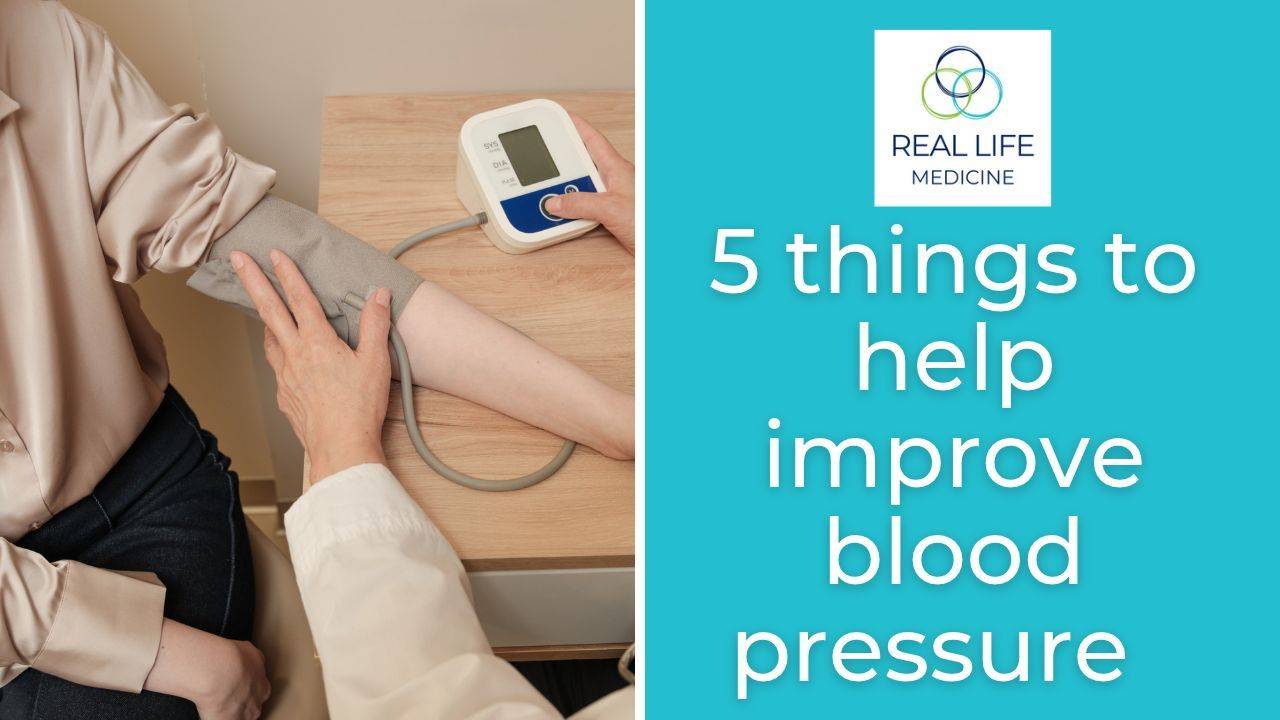
5 ways to lower your blood pressure
Oct 09, 2026High blood pressure is common, often silent, and much more changeable than most of us are told. Here's what's pushing yours up, and five things the research says can help bring it down.
By Dr Lucy Burns and Dr Mary Barson, medical doctors and co-founders of Real Life Medicine. October 2026.
You go to the GP about your sore shoulder. The cuff goes on your arm “while we're at it”. It squeezes, it beeps, and then you hear it: “Hmm, that's a bit high.” Suddenly the shoulder is the least of your worries, and you're walking out with a script and a vague feeling that your body has let you down.
If that's happened to you, you're in very good company. High blood pressure (hypertension) is one of the most common health conditions in Australia, and it gets more common as we get older. In 2022, around 30% of Australian women aged 55 to 64 had high blood pressure when it was measured. By 65 to 74, it was closer to 38%.
Here's the part that surprised us. Three in four adults whose blood pressure measured high in that survey didn't report having hypertension at all. Most of them didn't know.
So this week's Friday 5 is about the number most of us don't think about until someone tells us it's too high. What's behind it, why it matters, and five things that can help bring it down.
The short answer: five things the research says can help bring your blood pressure down.
- Bring your insulin down by eating fewer of the foods that drive it up
- Take an honest look at the alcohol, especially if you're having more than two drinks a day
- Get your sleep checked for sleep apnoea
- Give your stress somewhere to go, starting with slow breathing
- Do a wall sit, three times a week
Why blood pressure matters
Blood pressure is the force of your blood pushing against the walls of your arteries. It's written as two numbers: the top one (systolic) is the pressure when your heart beats, and the bottom one (diastolic) is the pressure between beats.
When that pressure stays high for years, it puts strain on your blood vessels, your heart, your kidneys, and your brain. That's why high blood pressure is a major risk factor for heart attack, stroke, kidney disease, and dementia. It rarely causes symptoms, which is why it's often called the silent killer. Cheerful, we know.
The good news? Your blood pressure can come down. It responds to what you eat, how you sleep, what you drink, and how you move. And a few millimetres of mercury (mmHg, the unit blood pressure is measured in) can make a real difference. In a review of 123 trials, mostly of blood pressure medication, every 10 mmHg drop in systolic blood pressure was linked to around a 20% lower risk of major heart and blood vessel events, and a 27% lower risk of stroke.
Why does blood pressure go up in midlife?
Menopause. If your blood pressure was always lovely and low and has started creeping up in your 50s and 60s, you're not imagining it. Rates of high blood pressure in women climb steeply after menopause. You can see it in the Australian numbers above. Falling oestrogen is thought to play a part, alongside changes in body fat, blood vessels, and sleep.
Insulin resistance. This is the one most people haven't heard about. When your cells stop responding properly to insulin, your body makes more and more of it. High insulin tells your kidneys to hold onto sodium, and holding onto sodium means holding onto fluid, which pushes pressure up. It's one of the reasons high blood pressure so often turns up alongside weight gain around the middle, prediabetes, and fatty liver.
Your sleep. Sleep apnoea, where your airway partly closes while you sleep, is strongly linked to high blood pressure. It also becomes much more common in women after menopause, and it's often missed.
What's in the glass. Alcohol pushes blood pressure up, and it's often more of a factor than people expect. We'll get to that.
Stress. Stress hormones raise your heart rate and narrow your blood vessels. That's helpful when you're running from a tiger. Less helpful when you're running late for school pick-up every day for 20 years.
Your genes. Some of us are dealt a family history of high blood pressure. You can't change your genes, but you can change a lot of what happens around them.
First things first: know your numbers. If you don't know your blood pressure, find out. Your GP or many pharmacies can check it, and a home blood pressure monitor is a good investment if yours has ever been on the high side. One high reading doesn't mean you have hypertension. Your GP will usually want to see several readings over time before making a diagnosis.
What do the numbers mean? Australian guidelines group blood pressure measured at the clinic like this:
- Optimal (ideal): below 120/80
- Normal: 120 to 129 systolic, or 80 to 84 diastolic
- High-normal: 130 to 139 systolic, or 85 to 89 diastolic
- High (hypertension): 140/90 or above, on repeated readings
If your top and bottom numbers fall in different groups, the higher group is the one that counts. Readings taken at home tend to run a little lower than readings at the clinic, so at home the cut-off for high blood pressure is 135/85. Your GP may set a different target for you, depending on your other health conditions.
Five things that can help lower your blood pressure
1. Bring your insulin down
If insulin resistance is part of what's pushing your blood pressure up, lowering your insulin levels can help bring it down. And the most direct way to lower insulin is to eat fewer of the foods that drive it up: sugar, refined carbs, and ultra-processed food.
Way back in 1975, researchers showed that raising insulin levels made the kidneys hold onto noticeably more sodium. More recently, a 48-week trial compared a low carb diet with a low fat diet plus a weight loss medication. Both groups lost a similar amount of weight. But blood pressure fell in the low carb group (by around 6 mmHg systolic on average) and didn't fall in the low fat group. Researchers are still working out exactly how much of the link between excess weight and blood pressure comes down to insulin, but it's a strong piece of the puzzle.
If you do lose weight, that helps too. A review of 25 trials found blood pressure dropped by about 1 mmHg for every kilo lost.
A note on salt. You might be wondering why cutting salt isn't on this list. Not everyone needs to reduce their salt. And when you eat low carb real food and your insulin comes down, your kidneys let go of more sodium, which is why some people eating this way need to add a little salt, especially in the first few weeks. If you have heart failure or kidney disease, or your doctor has told you to limit salt, check with them before you change anything.
An important safety note: if you're already on blood pressure medication and you change the way you eat, your blood pressure can fall, sometimes quite quickly. That's a good thing, but it means your medication may need adjusting. Please don't stop or change your tablets on your own. Talk to your GP, and if you get dizzy or light-headed when you stand up, let them know straight away. For some people, working with their doctor, this is the path to needing less medication over time.
2. Take an honest look at the alcohol
We know. Nobody wants to hear this one on a Friday afternoon.
But the evidence is consistent. A review of 36 trials found that in people who drank more than two standard drinks a day, cutting back lowered blood pressure, and the more people had been drinking, the bigger the drop. For the heaviest drinkers, halving their intake lowered systolic blood pressure by around 5.5 mmHg.
In people who drank two or fewer drinks a day, cutting back didn't make much difference to blood pressure. So this isn't about never having a glass of wine again. It's about noticing whether the “one glass while I cook” has become three, and whether the evening glass has become every evening.
If you'd like some help cutting back, our Reduce Alcohol hypnosis bundle has five recordings designed for different drinking goals, whether that's drinking less or not drinking at all.
3. Get your sleep checked
If your blood pressure is stubborn, it's worth asking whether something is happening to your breathing at night.
In one study of people whose blood pressure stayed high despite taking three or more different medications, 83% had sleep apnoea, and most of them didn't know. Treating sleep apnoea, usually with a CPAP machine or a mouth guard-style device, lowers blood pressure for many people. In a review of 51 trials, both treatments lowered blood pressure by around 2 mmHg on average. That might not sound like much, but the effect was bigger in people who used CPAP for more hours each night, and bigger again in people with more severe sleep apnoea.
Signs worth mentioning to your GP: snoring, being told you stop breathing in your sleep, waking with a headache or a dry mouth, getting up to go to the toilet a lot overnight, or feeling exhausted no matter how long you sleep. In women, it doesn't always look like the classic loud snorer. Our sleep blog has more on this.
4. Learn stress reduction techniques
Stress pushing your blood pressure up for a little while is normal. It's your body getting ready to deal with a problem. The trouble starts when the problem never goes away: the job, the ageing parents, the adult kids who've moved back home, the never-ending list. When stress is constant, your body can spend a lot more of the day in that revved-up state.
We'll be upfront here: the research on stress management and blood pressure is smaller and messier than for some of the other points on this list. But it's promising. A review of 12 trials of an eight-week mindfulness-based stress reduction program in people with raised blood pressure found it lowered systolic blood pressure by around 6.6 mmHg when measured at the clinic, although the effect didn't show up as clearly in blood pressure measured over 24 hours at home. A 2023 review of 15 trials of breathing exercises found an average drop of around 7 mmHg systolic. Many of these trials were small, so treat those numbers as encouraging rather than certain.
Stress management is also low cost, low risk, and tends to help with plenty of other things too, like sleep, mood, and emotional eating.
A simple place to start is slow breathing:
- Sit comfortably and breathe in gently through your nose for a count of four
- Breathe out slowly for a count of six
- Keep going for five to 10 minutes, most days
Other options that count: a short guided meditation or hypnosis recording, a walk outside without your phone, or 10 minutes with a cuppa that nobody else is allowed to interrupt. And sometimes the most effective stress management tool of all is the word “no”.
This isn't about getting rid of stress. Life is stressful, especially for women who've spent decades looking after everyone else. It's about giving your body regular chances to come back down.
5. Do a wall sit
This is the one that surprised us most.
When we think of exercise for blood pressure, most of us think of walking or jogging. They help. But in one of the largest analyses of exercise and blood pressure to date, which pooled 270 trials and almost 16,000 people, isometric exercise came out on top. Isometric exercise means holding a muscle still under tension, like a plank or a wall sit, instead of moving through a range of motion.
On average, isometric training lowered systolic blood pressure by around 8 mmHg and diastolic by around 4 mmHg. That's nearly double the average effect of aerobic exercise like walking. And the wall sit (or wall squat) was the single most effective exercise for lowering systolic blood pressure.
Here's how it works, based on the home-based program used in the research:
- Stand with your back flat against a wall, feet about shoulder-width apart and a little out from the wall
- Slide down until your knees are bent, as if you're sitting on an invisible chair. You don't have to go anywhere near 90 degrees. Higher is easier, and it still counts
- Hold for two minutes, rest for two minutes, and repeat four times
- Do this three times a week, with a rest day in between
By the end of each hold, it'll feel hard, but it shouldn't hurt. Keep breathing the whole way through, because holding your breath pushes your blood pressure up while you're doing it. If your knees complain, stay higher up the wall. And if your blood pressure is very high, or you have a heart condition, check with your GP before you start.
That's about 15 minutes, three times a week. No gym, no lycra, no equipment beyond a wall. You could do it while the kettle boils. Well, a few kettles.
The bottom line
High blood pressure is common, especially after menopause, and it's often silent. But it isn't a life sentence, and it isn't a sign you've failed. It's a number that responds to what you do, and many of the things that help it also help your blood sugar, your sleep, your brain, and your energy.
Start by knowing your numbers. Then pick one thing from this list, give it a few weeks, and see what changes. If you're on medication, keep your GP in the loop, so they can adjust it if your blood pressure starts to come down.
Lowering insulin, eating real food, sleeping well, managing stress, and moving in ways you can stick with are the foundations we build in My Metabolic Action Plan. My MAP also includes our hypnosis recordings, which you can use any time of day as part of your stress management. Strategies, Skills, and Tools, built into real life, one step at a time.
Find out more about My Metabolic Action Plan
Frequently asked questions
What is a normal blood pressure?
Australian guidelines class clinic blood pressure below 120/80 as optimal, 120 to 129 over 80 to 84 as normal, and 130 to 139 over 85 to 89 as high-normal. 140/90 or above on repeated readings is considered high. At home, the cut-off for high blood pressure is 135/85.
Why does blood pressure go up after menopause?
Rates of high blood pressure in women climb after menopause. Falling oestrogen is thought to play a part, alongside changes in body fat, blood vessels and sleep, including sleep apnoea, which becomes more common after menopause.
Can I lower my blood pressure without medication?
For many people, changes like lowering insulin through what you eat, cutting back on alcohol, treating sleep apnoea, managing stress and isometric exercise can help lower blood pressure. If you already take blood pressure medication, don't stop or change it on your own. Talk to your GP, as your dose may need adjusting as your blood pressure comes down.
Do I need to cut salt to lower my blood pressure?
Not everyone needs to reduce salt. When you eat low carb real food and your insulin comes down, your kidneys let go of more sodium, so some people eating this way need to add a little salt. If you have heart failure or kidney disease, or your doctor has told you to limit salt, check with them first.
What exercise is best for lowering blood pressure?
In a large analysis of 270 trials, isometric exercise, where you hold a muscle still under tension, lowered blood pressure the most, and the wall sit was the most effective single exercise for systolic blood pressure. Walking and other exercise help too.
References
- Australian Bureau of Statistics. Hypertension and high measured blood pressure, 2022. Read the data
- Ettehad D, Emdin CA, Kiran A, et al. Blood pressure lowering for prevention of cardiovascular disease and death: a systematic review and meta-analysis. Lancet. 2016;387(10022):957-967. Read the study
- Gabb GM, Mangoni AA, Anderson CS, et al. Guideline for the diagnosis and management of hypertension in adults, 2016. Med J Aust. 2016;205(2):85-89. Read the study
- DeFronzo RA, Cooke CR, Andres R, Faloona GR, Davis PJ. The effect of insulin on renal handling of sodium, potassium, calcium, and phosphate in man. J Clin Invest. 1975;55(4):845-855. Read the study
- Yancy WS, Westman EC, McDuffie JR, et al. A randomized trial of a low-carbohydrate diet vs orlistat plus a low-fat diet for weight loss. Arch Intern Med. 2010;170(2):136-145. Read the study
- Parvanova A, Reseghetti E, Abbate M, et al. Mechanisms and treatment of obesity-related hypertension, part 1: mechanisms. Clin Kidney J. 2023;17(1):sfad282. Read the study
- Neter JE, Stam BE, Kok FJ, Grobbee DE, Geleijnse JM. Influence of weight reduction on blood pressure: a meta-analysis of randomized controlled trials. Hypertension. 2003;42(5):878-884. Read the study
- Roerecke M, Kaczorowski J, Tobe SW, et al. The effect of a reduction in alcohol consumption on blood pressure: a systematic review and meta-analysis. Lancet Public Health. 2017;2(2):e108-e120. Read the study
- Logan AG, Perlikowski SM, Mente A, et al. High prevalence of unrecognized sleep apnoea in drug-resistant hypertension. J Hypertens. 2001;19(12):2271-2277. Read the study
- Bratton DJ, Gaisl T, Wons AM, Kohler M. CPAP vs mandibular advancement devices and blood pressure in patients with obstructive sleep apnea: a systematic review and meta-analysis. JAMA. 2015;314(21):2280-2293. Read the study
- Benning L, Herzig JJ, Mollet MS, et al. Effects of CPAP on blood pressure parameters across different severities of obstructive sleep apnoea: a meta-analysis. J Sleep Res. 2025;34(5):e70072. Read the study
- Lee EKP, Yeung NCY, Xu Z, et al. Effect and acceptability of mindfulness-based stress reduction program on patients with elevated blood pressure or hypertension: a meta-analysis of randomized controlled trials. Hypertension. 2020;76(6):1992-2001. Read the study
- Garg P, Mendiratta A, Banga A, et al. Effect of breathing exercises on blood pressure and heart rate: a systematic review and meta-analysis. Int J Cardiol Cardiovasc Risk Prev. 2023;20:200232. Read the study
- Edwards JJ, Deenmamode AHP, Griffiths M, et al. Exercise training and resting blood pressure: a large-scale pairwise and network meta-analysis of randomised controlled trials. Br J Sports Med. 2023;57(20):1317-1326. Read the study
- Wiles JD, Goldring N, Coleman D. Home-based isometric exercise training induced reductions resting blood pressure. Eur J Appl Physiol. 2017;117(1):83-93. Read the study
This content is for general information only and isn't medical advice. Please talk with your GP before making changes to your health care, including any medication.

Dr Mary Barson and Dr Lucy are the founders of Real Life Medicine. They help women who have been on every diet under the sun optimise their health and achieve weight loss without feeling miserable or deprived.
They do this with their 3-step framework that
- Improves metabolism
- Develops mindset skills
- Provides tools to implement it easily into busy lives
With this comes increased energy, vitality and confidence.
You can avoid chronic disease and stop living life on the sidelines!
You can find out more about My Metabolic Action Plan here
