
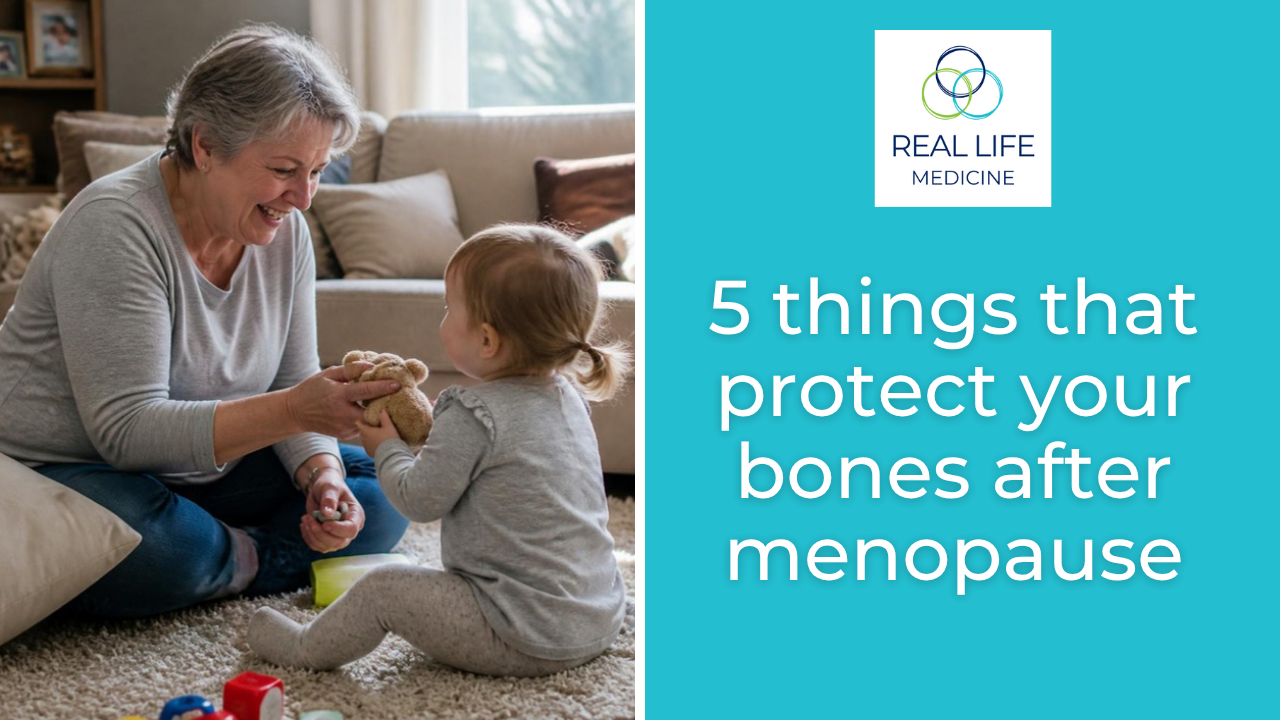
5 things that protect your bones after menopause
Oct 16, 2026Bone loss speeds up around menopause, but your skeleton is still living tissue and it still responds to what you do. Here are five things that help protect it, so you can keep getting down on the floor with the grandkids (and back up again).
By Dr Lucy Burns and Dr Mary Barson, medical doctors and co-founders of Real Life Medicine. October 2026.
The grandkids have built a cubby house out of the couch cushions, and you've been invited in. Getting down there is one thing. Getting back up is a negotiation between you, the coffee table, and your left knee.
Most of us think about our muscles and our joints at moments like this. Very few of us think about our bones. They tend to stay out of sight and out of mind until a bone density scan comes back with a word like "osteopenia", or until a minor trip ends in a cast.
But bones matter a lot after menopause. An Australian study that followed more than 1,300 women in Dubbo, NSW, found that a woman aged 60 has around a 44% chance of breaking a bone from a minor fall or bump at some point in the rest of her life. For women with osteoporosis, that rose to 65%.
That's the sobering bit. Here's the hopeful bit: bone isn't chalk. It's living tissue that's constantly being broken down and rebuilt, and it responds to what you eat, how you move, and what you drink. We've written before about why you're not too old to change your health, and bones are a great example.
So this week's Friday 5 is all about your skeleton. Why it changes after menopause, and five things that help protect it.
The short answer: five things that help protect your bones after menopause.
- Eat enough protein, from real food like eggs, Greek yoghurt, cheese, meat and fish
- Lift heavy-ish things, and add some impact, ideally twice a week
- Check your vitamin D, but avoid mega-doses
- Take an honest look at the alcohol, especially above two drinks a day
- Make falls less likely, with balance training and a few changes at home
What happens to your bones at menopause?
Oestrogen helps keep the balance between bone being broken down and bone being rebuilt. When oestrogen falls, breakdown starts to outpace rebuilding, and bone density drops.
The large US SWAN study tracked women's bones through menopause and found that bone loss sped up from about a year before the final period to about two years after it. Over the 10 years around menopause, women lost about 10% of the bone density in their lower spine and about 9% at the hip, with most of that loss happening in those few fast years.
If you're a few years past menopause, the fastest phase of loss is likely behind you. Bone loss slows down after that, although it doesn't stop. And what you do from here still counts.
Know your bones. If you've broken a bone from a minor fall since turning 50, have a parent who broke a hip, have taken steroid tablets for a long time, or have an early menopause in your history, talk to your GP about your fracture risk and whether a bone density scan (a DXA scan) makes sense for you. Medicare covers this scan for some people, depending on age and risk factors. If your bones are already thin, there are effective medicines for osteoporosis, and your GP can talk you through whether any of them suit you. Everything below works alongside medication, not instead of it.
Five things that protect your bones after menopause
1. Eat enough protein
You may have heard that protein is bad for your bones, that it makes your body leach calcium. That idea has been around for decades, and the research in older adults points the other way.
A review of studies in adults aged 65 and over found a trend towards higher bone density at the hip in people who ate more protein, and an 11% lower risk of hip fracture in those with higher intakes.
Then there's an Australian trial we love. Researchers from the University of Melbourne worked with 60 aged care homes and more than 7,000 residents (average age 86). Half the homes added extra milk, yoghurt, and cheese to the menu, which gave residents about 12 g more protein and about 560 mg more calcium a day. Over two years, the homes with the extra dairy had 33% fewer fractures, 46% fewer hip fractures, and 11% fewer falls. The drop in hip fractures showed up within five months.
These were people in their 80s living in aged care, so it's not a perfect match for a 60-year-old who's still walking the dog every morning. But it's a strong signal that protein and calcium from real food matter for bones, even late in life.
How much protein? An international expert group recommends that older adults aim for around 1.0 to 1.2 g of protein per kilo of body weight per day. For a 75 kg woman, that's roughly 75 to 90 g a day. Most of us fall short, especially at breakfast.
Low carb real food makes this easier than you might think:
- Eggs, Greek yoghurt, and cheese
- Tinned salmon or sardines with the bones in (a protein and calcium double act)
- Meat, chicken, and fish
- Tofu and tempeh
Aim for a palm-sized serve of protein at each meal. Our high protein breakfasts are a good place to start. Protein also helps you build and keep muscle, which matters for points 2 and 5. If you have kidney disease, check with your doctor before increasing your protein.
2. Lift heavy-ish things, and add some impact
Bones get stronger when they're asked to do a bit more than they're used to. That's why the type of exercise matters.
The LIFTMOR trial, run on the Gold Coast, took 101 postmenopausal women (average age 65) with low bone density, some with osteoporosis. Half did a supervised program of high-intensity resistance and impact training, twice a week for 30 minutes, for eight months. The other half did a gentle home program.
The women doing the harder training improved the bone density in their lower spine by 2.9%, while the gentle group lost 1.2%. Bone density at the hip held steady in the training group and fell in the gentle group. The training group also got stronger, did better on balance and mobility tests, and gained a couple of millimetres of height, while the gentle group lost a little. Over eight months of training, there was one minor back spasm and no fractures.
Bone density is one thing. Broken bones are what we're trying to prevent. A 2022 review of 20 exercise trials in adults aged 45 and over found that exercise reduced low-trauma fractures by about a third. And here's the interesting part: programs that were mostly supervised reduced fractures about twice as much as programs people did on their own.
So if you can, get some help. An exercise physiologist or physiotherapist can build a program that's safe for your bones and progress it as you get stronger. This matters most if you have osteoporosis or have had a fracture, because some movements (like heavy forward bending and twisting) may need adjusting.
If you're starting at home, a few bone-friendly options:
- Sit-to-stands from a chair, slowly, then without using your hands
- Step-ups onto the bottom stair
- Heel drops: rise up onto your toes, then let your heels drop to the floor with a gentle thud
- Carrying the shopping bags (one in each hand, like a farmer)
- Wall push-ups, building towards push-ups on the kitchen bench
Twice a week is a great target. You don't need a gym membership, a matching set of activewear, or to grunt (although nobody's stopping you). We've also shared five exercises to prevent muscle loss and improve balance if you'd like more ideas.
3. Check your vitamin D, but don't overdo it
Vitamin D helps your body absorb calcium from food. Living in Australia, you'd think we'd all have plenty. Not quite. In the Australian Health Survey, around 21% of women had vitamin D deficiency (a level below 50 nmol/L). It was more common in southern states, in winter and spring, and in people who spend most of their time indoors.
Now for the twist. Vitamin D supplements aren't the bone insurance policy many of us were told they were.
- In the large US VITAL trial, more than 25,000 midlife and older adults took vitamin D or a placebo for about five years. In people who weren't selected for low vitamin D or thin bones, the supplement made no difference to fractures.
- A Cochrane review of 53 trials found that vitamin D on its own didn't prevent fractures. Vitamin D combined with calcium led to a small reduction in hip fractures, mostly in people living in aged care.
- And more isn't better. In a Melbourne trial, more than 2,000 women aged 70 and over were given a single, very high dose of vitamin D once a year. They ended up with more falls and more fractures than the women given a placebo, not fewer.
So the sensible middle ground is this. If you're at higher risk of low vitamin D (you spend most of your time indoors, cover up in the sun, live down south, have darker skin, or carry extra weight), ask your GP whether a blood test makes sense. If you're low, top it up as your GP advises. If you're not low, a supplement is unlikely to do much for your bones. Avoid the mega-doses. And some sensible sun exposure helps too. Our blog on how much sun we need has more.
4. Take an honest look at the alcohol
We know. Two weeks running.
But bones are another reason it matters. Researchers pooled data from three large studies of nearly 17,000 people from Canada, Australia, and the Netherlands. Up to two drinks a day wasn't linked to a meaningful increase in fracture risk. Above two drinks a day, though, the risk of an osteoporotic fracture was 38% higher, and the risk of a hip fracture was 68% higher. That extra risk was on top of anything explained by bone density.
And alcohol has a sneaky second way of breaking bones. Nobody's balance has ever been improved by the third glass of wine. Add a dark hallway and a 2 am trip to the loo, and you can see how it happens.
Again, this isn't about never enjoying a drink. It's about noticing whether the evening glass has crept up to two or three. If you'd like some help cutting back, our Reduce Alcohol hypnosis bundle has five recordings designed for different drinking goals, whether that's drinking less or not drinking at all.
5. Make falls less likely
A broken bone usually needs two things: a bone that's weaker than it used to be, and a fall. Points 1 to 4 help with the bone. This one is about the fall.
At least a third of people over 65 have a fall each year. The good news is that falls are one of the most preventable problems in later life. A Cochrane review of 108 trials, led by Australian researchers, found that exercise reduced the rate of falls by 23%. Programs focused on balance and everyday movements reduced falls by 24%, and programs that combined balance work with strength training reduced them by about a third (34%). Tai chi helped too.
A few ways to build this into your week:
- Stand on one leg while the kettle boils (hold the bench for balance if you like)
- Walk heel to toe along the hallway, like you're on a tightrope
- Practise getting down onto the floor and back up again. Yes, this is the grandkids' cubby house skill. It's one of the most useful things you can train
- Try a tai chi or balance class
And then look around your home:
- Put a night light between the bedroom and the bathroom
- Tape down or remove loose rugs
- Wear shoes or slippers with a firm grip, not floppy ones
- Get your eyes checked every year or two
- Ask your GP or pharmacist for a medication review, especially if you take sleeping tablets or anything that makes you dizzy when you stand up
The bottom line
Bone loss speeds up around menopause, but it isn't a slide you're powerless to stop. Your bones are still listening. Protein from real food, strength and impact training, the right amount of vitamin D, less alcohol, and fewer falls all stack up in your favour. Many of these things help your muscles, your balance, your blood sugar, and your brain at the same time.
Pick one to start with. Maybe it's eggs or Greek yoghurt at breakfast. Maybe it's sit-to-stands during the ad breaks. Maybe it's that night light. Then build from there.
Eating real food with enough protein, moving in ways that build strength, cutting back on alcohol, and building habits you can stick with are the foundations we work on in My Metabolic Action Plan. My MAP also includes our hypnosis recordings, which you can use any time of day. Strategies, Skills, and Tools, built into real life, one step at a time.
Find out more about My Metabolic Action Plan
Frequently asked questions
Why do women lose bone after menopause?
Oestrogen helps keep bone breakdown and bone rebuilding in balance. When it falls at menopause, breakdown outpaces rebuilding. Bone loss is fastest from about a year before the final period to about two years after, then slows down but doesn't stop.
Does protein harm your bones?
In older adults, the research points the other way. Higher protein intakes have been linked to better hip bone density and a lower risk of hip fracture, and an Australian aged care trial that added dairy foods rich in protein and calcium reduced fractures and falls.
What exercise is best for bones after menopause?
Bones respond to load that's a bit more than they're used to, so resistance training and impact exercise help most. In the LIFTMOR trial, supervised high-intensity resistance and impact training improved spine bone density in postmenopausal women with low bone density. If you have osteoporosis, get advice from an exercise physiologist or physiotherapist.
Is it worth taking vitamin D for my bones?
If your vitamin D is low, topping it up as your GP advises makes sense. In people who aren't low, large trials found vitamin D supplements didn't reduce fractures, and a very high once-a-year dose increased falls and fractures. Avoid mega-doses.
How can I prevent falls as I get older?
Exercise that includes balance and everyday movements reduces falls, and combining it with strength training appears to work even better. Tai chi helps too. At home, night lights, removing loose rugs, good footwear, regular eye checks and a medication review all help.
References
- Nguyen ND, Ahlborg HG, Center JR, Eisman JA, Nguyen TV. Residual lifetime risk of fractures in women and men. J Bone Miner Res. 2007;22(6):781-788. Read the study
- Greendale GA, Sowers M, Han W, et al. Bone mineral density loss in relation to the final menstrual period in a multiethnic cohort: results from the Study of Women's Health Across the Nation (SWAN). J Bone Miner Res. 2012;27(1):111-118. Read the study
- Groenendijk I, den Boeft L, van Loon LJC, de Groot LCPGM. High versus low dietary protein intake and bone health in older adults: a systematic review and meta-analysis. Comput Struct Biotechnol J. 2019;17:1101-1112. Read the study
- Iuliano S, Poon S, Robbins J, et al. Effect of dietary sources of calcium and protein on hip fractures and falls in older adults in residential care: cluster randomised controlled trial. BMJ. 2021;375:n2364. Read the study
- Bauer J, Biolo G, Cederholm T, et al. Evidence-based recommendations for optimal dietary protein intake in older people: a position paper from the PROT-AGE Study Group. J Am Med Dir Assoc. 2013;14(8):542-559. Read the study
- Watson SL, Weeks BK, Weis LJ, et al. High-intensity resistance and impact training improves bone mineral density and physical function in postmenopausal women with osteopenia and osteoporosis: the LIFTMOR randomized controlled trial. J Bone Miner Res. 2018;33(2):211-220. Read the study
- Hoffmann I, Shojaa M, Kohl M, et al. Exercise reduces the number of overall and major osteoporotic fractures in adults. Does supervision make a difference? Systematic review and meta-analysis. J Bone Miner Res. 2022;37(11):2132-2148. Read the study
- Malacova E, Cheang PR, Dunlop E, et al. Prevalence and predictors of vitamin D deficiency in a nationally representative sample of adults participating in the 2011-2013 Australian Health Survey. Br J Nutr. 2019;121(8):894-904. Read the study
- LeBoff MS, Chou SH, Ratliff KA, et al. Supplemental vitamin D and incident fractures in midlife and older adults. N Engl J Med. 2022;387(4):299-309. Read the study
- Avenell A, Mak JCS, O'Connell D. Vitamin D and vitamin D analogues for preventing fractures in post-menopausal women and older men. Cochrane Database Syst Rev. 2014;(4):CD000227. Read the study
- Sanders KM, Stuart AL, Williamson EJ, et al. Annual high-dose oral vitamin D and falls and fractures in older women: a randomized controlled trial. JAMA. 2010;303(18):1815-1822. Read the study
- Kanis JA, Johansson H, Johnell O, et al. Alcohol intake as a risk factor for fracture. Osteoporos Int. 2005;16(7):737-742. Read the study
- Sherrington C, Fairhall NJ, Wallbank GK, et al. Exercise for preventing falls in older people living in the community. Cochrane Database Syst Rev. 2019;1(1):CD012424. Read the study
This content is for general information only and isn't medical advice. Please talk with your GP before making changes to your health care, including any medication or supplements.
Dr Mary Barson and Dr Lucy are the founders of Real Life Medicine. They help women who have been on every diet under the sun optimise their health and achieve weight loss without feeling miserable or deprived.
They do this with their 3-step framework that
- Improves metabolism
- Develops mindset skills
- Provides tools to implement it easily into busy lives
With this comes increased energy, vitality and confidence.
You can avoid chronic disease and stop living life on the sidelines!
You can find out more about My Metabolic Action Plan here
