
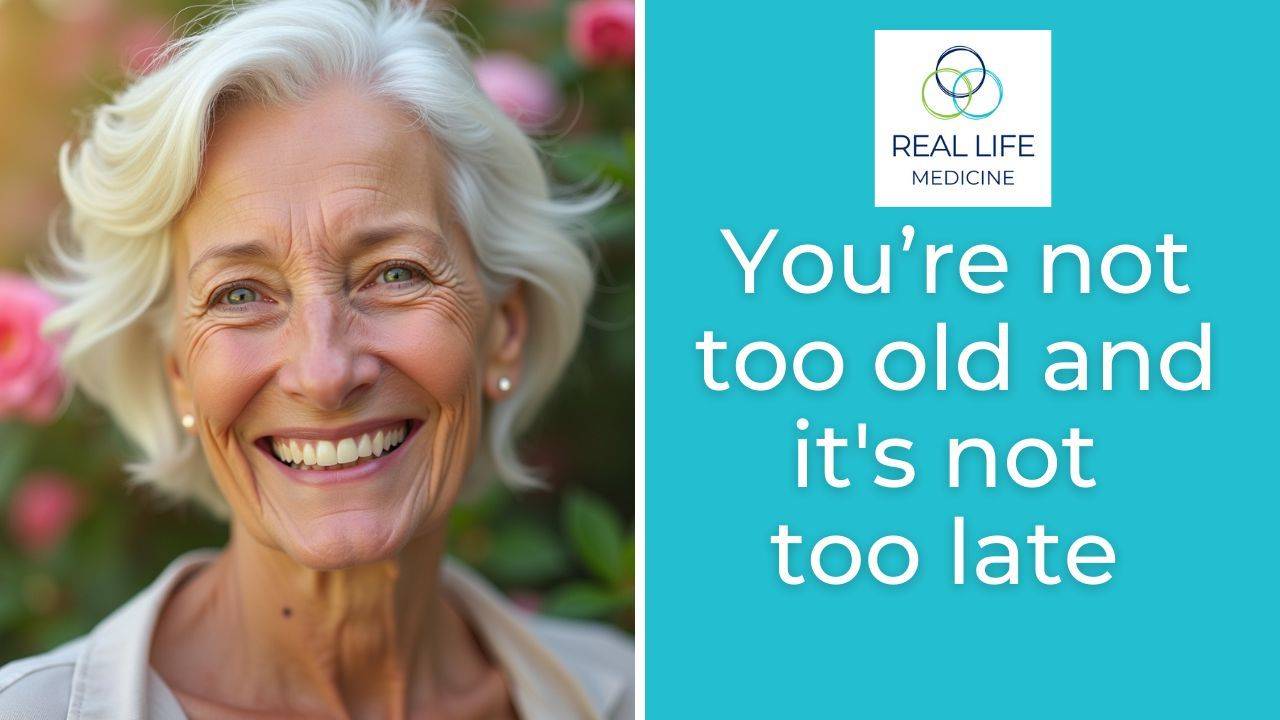
You're not too old. It's not too late.
Aug 07, 2026Five studies that prove your body and brain are still capable of change, no matter your age.
"I've left it too late." We hear a version of this most weeks. Sometimes it's about weight. Sometimes it's muscle, or bones, or memory. The details change, but the belief underneath is always the same: that there was a window for taking care of your health, and somewhere around 40, 50 or 60, it closed.
It's an understandable thing to believe. Nobody handed you evidence to the contrary. What you got instead was a culture that treats ageing as a one-way slide, and a diet industry that markets almost exclusively to younger bodies. So this week, instead of telling you it's not too late, we're going to show you that you're not too old and it's definately not too late.
The story you've probably been told
Muscle declines with age. Bones thin after menopause. The brain slows down. Metabolism stalls. Each of those things is, to some extent, true as an average trend. But the way they get used is where the story goes wrong: as evidence that decline is fixed, and that starting now, whatever "now" is for you, is pointless.
The research tells a different story. Not one where age is irrelevant, but one where your body keeps responding to what you do, well beyond the age most of us assume it stops listening.
What the research actually says
1. Muscle can still be rebuilt even at 90. In a well-known study published in JAMA in 1990, ten frail nursing home residents, average age 90, took part in eight weeks of high-intensity resistance training. Their strength increased by an average of 174%. Thigh muscle size increased too, and their walking speed improved by almost half. These were not fit, active nonagenarians. They were frail residents in institutional care, and their muscles still responded to the right stimulus.
Now, we don't want you tp ai til you're 90 but this study proves that you have not left it too late to improve your muscle mass
2. Bone density can improve after menopause.
The LIFTMOR trial followed postmenopausal Australian women, average age 65, with low bone density, some with osteoporosis. After eight months of twice-weekly, high-intensity resistance and impact training, bone density improved at the spine and hip, alongside better strength and physical function. No one had a spinal fracture as a result of the training. Bone is living tissue. Under the right load, it can still build.
Even if you're not taking HRT, you can still build bone and prevent osteoporosis
3. Brain health can respond to lifestyle change, even once decline has already started to worry you. The FINGER study, a large Finnish trial, followed over 1,200 older adults who were already at increased risk of dementia. A two-year programme combining nutrition guidance, exercise, cognitive training and management of vascular risk factors led to better cognitive performance than general health advice alone. These were people who had reason to be worried about their brain health, not a young, low-risk group. Their brains still responded.
There are so many factors that help improve brain health ( think of the 6Ss); it's not too late to prevent dementia or slow its progress.
4. Becoming active in midlife lowers your risk of early death, even if you've never exercised seriously before. A major analysis tracking over 315,000 people across their adult lives found that becoming physically active in mid to later life, after years of inactivity, was associated with a 32% to 35% lower risk of death from any cause. That's a similar reduction to people who had stayed active since adolescence. You do not need a decades-long head start for movement to count.
It's not too late to start walking, dancing or even pickleball!
5. Type 2 diabetes remission is still possible, whenever you start. In an eight-year general practice study, UK GP Dr David Unwin followed 186 patients with type 2 diabetes who chose a lower-carbohydrate approach. Those who started within a year of diagnosis achieved drug-free remission 77% of the time. Remission rates were lower the longer someone had lived with diabetes, but even among patients who'd had it for more than 15 years, about one in five still achieved it. Earlier is better. Later is not hopeless.
So what does this mean for you?
None of these studies promise that change is effortless, or that every result will look the same for every woman. What they do show, consistently, is that the body you have right now, whatever your age, is still capable of responding. Not despite your age. Regardless of it.
This is exactly why we built My Metabolic Action Plan the way we did: Strategies, Skills and Tools, delivered one step at a time, so you're building real foundations rather than starting from scratch on a Monday and burning out by Wednesday. You have not missed your window. There isn't one.
Check out My Metabolic Action Plan here

Dr Mary Barson and Dr Lucy are the founders of Real Life Medicine. They help women who have been on every diet under the sun, optimise their health and achieve long-lasting weight loss without feeling miserable or deprived.
They do this with their 3-step framework that
- Improves metabolism
- Develops mindset skills
- Provides tools to implement it easily into busy lives
With this comes increased energy, vitality and confidence.
You can avoid chronic disease and stop living life on the sidelines!
You can find out more about My Metabolic Action Plan here
