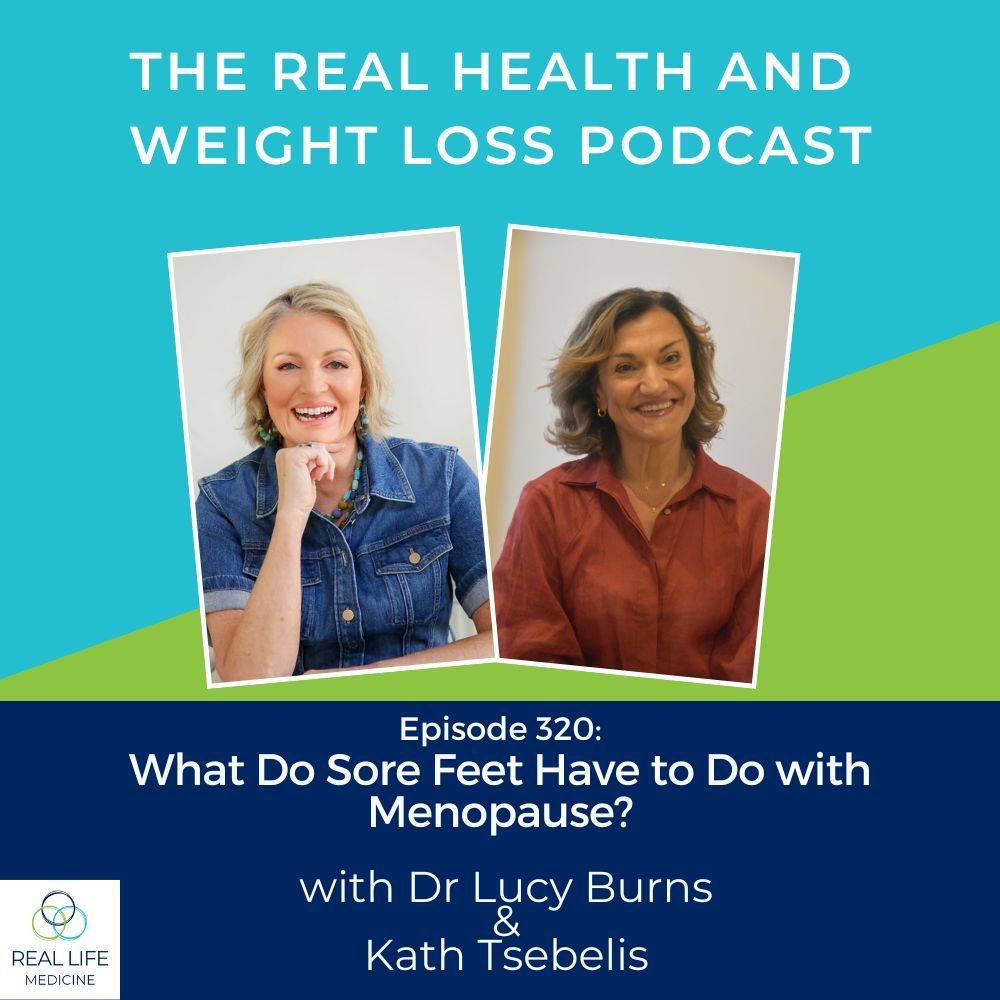

WHAT DO SORE FEET HAVE TO DO WITH MENOPAUSE?
One of Australia's Most Popular Podcasts with Hundreds of 5 Star Reviews

Grab your FREE Ebook copy now!
Have you struggled to lose weight and keep it off?
Start your journey to boost metabolism and transform your body into a fat-burning powerhouse.
Episode 320:
Show Notes
Dr Lucy Burns hosts physiotherapist Kath Tsebelis, director of Physio Moves and a Pilates studio owner, who specialises in women's midlife health after noticing a pattern in her long-term clients.
The discovery
After 21 years in practice, Kath began seeing unexplained shoulder and hip issues in her midlife female clients from around age 45-50 that didn't match typical injury patterns (no falls, no obvious cause). Extensive continuing education in orthopaedics and nutrition didn't fully explain it. During lockdown, while researching her own perimenopause symptoms, she connected hormone decline with the musculoskeletal problems she was seeing, a link that hormone specialists knew but musculoskeletal clinicians hadn't joined up.
Key conditions linked to menopause
- Greater trochanteric pain syndrome (previously misdiagnosed as "hip bursitis", though under 10% of cases are true bursitis)
- Frozen shoulder
- Plantar fasciitis
- Tendinopathies generally, as declining oestrogen reduces receptor activity in tendons, making them less resilient and prone to "fraying"
Tendon healing that once took 9-12 months can take up to double that time (nearly two years) during perimenopause and menopause.
Treatment approach
- Isometric loading is key for tendinopathy, e.g. pushing hands against a desk at about 50% effort for 30 seconds, three to four rounds, later progressing to light weighted range-of-movement work
- Tendons should be loaded, not rested, but within a tolerable, controlled range
- Movement should be modified rather than stopped entirely, e.g. limiting shoulder range while keeping mobility elsewhere, using loops instead of straps in Pilates for tendon issues, and even planks/hand-knee positions can be tolerated with a "frozen" shoulder because they load a different range
- HRT should be discussed with a doctor as part of the overall approach, since oestrogen affects tendon and bone health
Bone health and habit-stacking
Kath emphasised that walking (1.5x bodyweight load) and even running (2.5x) are insufficient for bone density, women need to reach roughly 4.2 times bodyweight loading. She recommends small, easily embedded "exercise snacks" tied to daily habits:
- "Squat till it's hot": squats while the shower warms up
- Jumping or gentler "heel slams" while the kettle boils (modified for those with pelvic floor issues, osteoporosis, or injuries)
- "Balance brushing": single-leg balance while brushing teeth, progressing to eyes closed
She also stressed pairing exercise with adequate protein, calcium and vitamin D, and that progress should start small (even two squats) and build progressively, since "hormetic stress" (small, adaptive stress) is beneficial, while overload risks injury like stress fractures.
Where to find Kath
Instagram: Kath Tsebelis Physio
Get free workbook on the musculoskeletal syndrome of menopause: kathtsebelis.com
Work With Real Life Medicine
For a step-by-step approach to improving metabolic health in perimenopause, menopause and beyond, check out My Metabolic Action Plan. This doctor-led comprehensive programme gives you
Strategies to improve metabolism
Skills to develop mindset
Tools so you will implement!
Episode 320:
Transcript
Dr Mary Barson (00:05) Hello lovely friend, I am Dr Mary Barson.
Dr Lucy Burns (00:09) And I'm Dr Lucy Burns.
Both (00:11) We are doctors, weight management and metabolic health experts. We are the creators of My Metabolic Action Plan, your two-step map to real health and weight loss, which is in fact the name of this podcast. Join MyMap now at rlmedicine.com.
Dr Lucy Burns (00:29) Good morning, my beautiful friend. It is Dr Lucy here. I'm without Dr Mary today, but I have a fabulous guest. You know, from time to time we have guests on the show, and it's always a pleasure because they bring a whole fresh perspective. Really, that's what the health journey is all about - injecting fresh ideas and keeping things moving. So I have the pleasure of chatting today with Kath Tsebelis. Kath's a physio, and not only is she a physio, she's like an uber physio, if you can have one of those. She's worked in the cardiothoracic department at The Alfred in her former life. She's the director of Physio Moves, she's got a Pilates studio, and like many of us entering the whole midlife phase, she's now a women's midlife expert as well. She's qualified in hormone health, nutrition, yoga and Pilates, and she integrates all of this into her practice to help women navigating the perimenopause and menopause space. She's also got this incredible masterclass. I love it because it's called Vibrant Femmes, and we were just having a joke about the sisters and the sons. So if you're of an ilk where you understand the Vibrant Femmes joke, then you'll be absolutely loving today's little chat that we're having. Kath, welcome to the Real Health and Weight Loss Podcast.
Kath Tsebelis (01:48) Thank you. Thanks, Dr Lucy.
Dr Lucy Burns (01:51) Right, so you're a physio based in Melbourne, and you've had your own, well not even little - you actually had quite a significant event - but you've sort of pivoted into the menopause space, as many of us have, because it impacted us personally. So I'd love for you to share what happened to you.
Kath Tsebelis (02:11) I've had a practice for 21 years, and I'm really fortunate, probably like yourself, where you have the same patients and clients that follow you around. I've been fortunate enough to have the same females in particular - they've been coming for 21 years. I guess when you get to know someone for one or two hours a week in Pilates, they become more than just your random client that comes in with an occasional shoulder issue. Over the course of the years, I started my practice when I was 35. So yes, I'm 56 now, and sometimes that does feel like it's in dog years. So what's that if you do the maths?
Dr Lucy Burns (02:48) Close to 400, I think.
Kath Tsebelis(02:52) Oh, okay. Well, go with yours. We'll divide, not multiply. Great. That was sort of my age group - midlife women starting Pilates in their mid-30s. Then, about five years ago, or between ten and five years ago working backwards, they started to develop different kinds of issues, like these random shoulder issues and random hip issues. Of course, I'd wear my standard physio clinician hat and say, "Well, did you lift something with the shoulder? Did you pull on something? Did the dog yank your arm? Did you hurt yourself somehow? Did you fall onto it?" Same with the hip. "Did you stand weirdly? Did you wear high heels? Did you do extra stairs?" Nothing was really adding up with the standard assessment questions. So where do you go with treatment? You kind of perform the same treatment, but you haven't really got the same objective measures, per se. I thought, I must be missing something. What am I missing? Why are these women coming up with this? Some of them would just say, "I've got random aches and pains. Everything hurts. I don't know why it hurts. I haven't done anything different." That's why I'd trained in nutrition. I'd done two big nutrition courses. One was integrated nutrition, where it sort of takes in everything, and then I did one specifically for chronic pain, which was a lot of biochemistry. Oh my goodness - my head's too old for this! Cellular physiology… Then I wondered, Was it a metabolic thing? Was it magnesium? Was it calcium? So we'd go down that path as well because I thought, I'm missing something. Probably about five years ago, during lockdown - which was quite a significant event in Victoria - it gave me a lot of time to research this because I thought, Maybe I need to do much more continuing education than I have been. So I signed up for all the shoulder courses, nationally and internationally, with experts in their field. Hip courses, feet courses with podiatrists, biomechanic experts, and all those sorts of things. I guess the good news was that I realised I wasn't missing anything. Well, that's good... but what was it? At the same time, I was going through perimenopause, and I thought, What's going on with my body? Let me research this. The hormone experts were saying you can get musculoskeletal events, and I went, Oh my gosh - that's the missing link. The musculoskeletal people weren't putting it together. I thought, I think this is it. Of course, I then went down that rabbit hole and really joined the dots. Hormone changes, fluctuations, and eventually decline really explained these pathologies that I was seeing that weren't making sense in any other way. So that was it in a nutshell.
Dr Lucy Burns (05:56) Yeah. Yeah, brilliant. And look, I feel exactly the same. I remember seeing women in general practice, and lots of women with, you know, buttock pain and glute tendinopathy. I'm getting ultrasounds, and yes, they've got, you know, inflammation in the gluteus medius tendons and whatnot. And I'm sending them off to all sorts of people. And it never occurred to me, as it wouldn't have occurred to many people back then, because we weren't talking about hormones. But when I first heard it, I'm still thinking, What? You're telling me that plantar fasciitis, which, you know, if you've ever had it, it's a really painful condition in your foot, has got anything to do with menopause? How can this be so? So yeah, I'd love to know what you discovered and how it's changed your practice.
Kath Tsebelis (06:27) Yeah. So then working, going, Well, I don't think it's just going to be a steroid injection. And really, we used to say, Well, it's hip bursitis, where, in fact, less than 10% of cases are actually bursitis. It's what we call now greater trochanteric pain syndrome. Quite a mouthful. But it's that tendinopathy, and that's that lateral hip pain that you really can specifically put your finger on. You can't lie on it, or if you lie on the other side, the leg dropping over makes things worse. So it's really quite problematic because you can't lie on that side, and lying on the other side gives you just as much pain as well. So it's working out how to offload the tendon. We know we can't really change, as a clinician - or as my kind of clinician - I can't really change what's happening at the tendon. But I can certainly try and offload the tendon. So looking at ways we can offload the tendon and create more strength in the muscle that's attached to that tendon. And getting women to understand that it's not anything they're doing wrong. It's not because they're crossing their legs or hanging on one hip, which really they shouldn't be doing anyway. But that's not the cause of it. Really getting women to understand that you've got these really densely innervated muscles - well, densely rich with receptors, hormone receptors - and particularly oestrogen. As it declines, it will create the fraying of that tendon. The tendon's not as resilient anymore. And the musculature, because of course they're getting tired, they're not exercising as much, they're having poor sleep, so they're not going to go out and pump, you know, 50 squats first thing in the morning and reach for a kale smoothie. They want to sleep in. They're tired, they're grumpy, they're in pain, they don't know what to do because everything hurts. So how are they going to go to a gym? How are they going to go to Pilates or exercise when everything hurts? And anything they do makes it worse. And of course, we're of that paradigm where, if it hurts, you've got to rest it. But tendons don't like that. Tendons need to be loaded. But they need to be loaded in a particular way, which, when I did physio, you know, a million years ago, they went, Oh no, don't do isometrics because that increases your blood pressure and your head's going to pop off. Well, no. We actually know now that we need isometric loading. And it does hurt, but you've got to work just within those levels and work out what's too much and what's not enough. So it's really creating a paradigm shift of, You're not doing anything wrong. It is a hormone issue. And of course, we discuss that if you're an appropriate candidate for HRT, please speak to your doctor because it can make a difference. Appropriate strength training, positions to avoid, positions to go for, and just really understanding that there's nothing they're doing wrong, and this will probably come on and off. And the one thing we talk about in my practice all the time is, Gosh, my tennis elbow's gone on that side. Now it's just started randomly on the other side, and then that gets better. Where we would say once upon a time, Give your tendons between nine and 12 months to heal, you have to almost double that when we're talking about perimenopause and menopause. So it's almost a two-year event, which is devastating when you've got this arm that you can't hold your phone with or do anything with, and you're saying, Give it up to two years. And, you know, the icing and the steroid injections may or may not help. It's really, you know, we've really just got to load it, and it's got to be done specifically in a certain way.
Dr Lucy Burns (09:43) When you mentioned isometric loading, what does that mean?
Kath Tsebelis (09:47) So it could even mean something like, you know, a lot of tennis elbow. So you would pretend that's your desk, where I just give something really simple and doable, where you just put the hand under there and you push up. I'm pushing up against this hand, but of course I've got the firm, unyielding and ungiving surface of the table, and you're just generating force. So there's no distinct movement in any particular direction. Isometric means equal force. So, you know, you might even use your hand there if you don't have a desk. But women that have a desk job, I just go, Stick your hands underneath and just push up against the desk, generate some tension, sort of, you know, 50% of what you can tolerate, and do three or four rounds of that for 30 seconds. Oh yeah, yeah, great. And if you're awful at the timing, you just think, Oh my gosh, this can't be doing me any good, but you're just strengthening that tendon because they like to be strengthened in that fashion. And then you start working through range with, like, a one-kilo weight or a drink bottle or something like that.
Dr Lucy Burns (10:39) Yeah, so really small, controlled movements.
Kath Tsebelis (10:42) Absolutely. They don't feel like they do much, but I guess at this time of your life, when you really don't feel like doing much anyway, it's kind of manageable.
Dr Lucy Burns (10:51) Absolutely. We love talking about the power of small steps and small actions because, you know, everybody thinks they need to do some major overhaul of their life, but it's actually the small things that can make a big difference.
Kath Tsebelis (11:05) Of course, absolutely. And it's never too late to start strength training. You know, I get women to start with, you know, 20 squats, and that's it. Squat till it's hot, I say, while the shower's warming up. So stand there waiting while it's warming up, and you could pump out 20 squats. And squats are the most functional exercise you can do. We want to be getting on and off toilet seats and chairs and couches, you know, for all our days, so it's easy to do that.
Dr Lucy Burns (11:28) Yeah, absolutely. And I think we can talk a little bit about, you know, the exercise snacks. I had the pleasure of watching you perform on stage at the Healthy Hormones Conference not that long ago, where you had the whole room up and moving in between speakers, which was fabulous. But I just want to go back to the ITBs a bit more. So thinking about what women might be told, because again, you know, if they go to you, fantastic, but they might be going to their, I don't know, old man physio in the back blocks somewhere who doesn't know about menopause, who's telling them that they've got, you know, a frozen shoulder. Then they're sort of thinking, Oh God, so they get schlepped off to the orthopaedic surgeon who wants to do a hydrodilatation or whatever it might be. What sort of things would you tell your ladies to do?
Kath Tsebelis (12:20) It's a real balance of how irritable is that situation. Can we get a little bit of movement in there? I've got women that can't lift overhead, but gosh, they can certainly lift to that range there. They can get from zero to 90 degrees, let's say. They can lift to here. So maybe it's nothing above shoulder level, but let's keep that shoulder moving and do what we can down here. So it's not about stopping; it's about changing things around. And, you know, they can still do Pilates. For example, the ones that have got tendonitis can't hold the straps, but we then put the loops around the arms so you can do that versus pulling with your strap. And same with the shoulder - we can, you know, loop things. I've got things where we loop - they look like braces, like TheraBands, the long elastic ones. You stand on them with your feet, and then you can just do shrugs. And a shrug is really helpful in restoring that upward movement of the arm. So until that arm slowly comes around, we can do little things to facilitate the movements that lead into it. So they can do shrugs, they can do forward, they can do back, which helps with shoulder pathology. And they can even do things for frozen shoulders. I mean, this sounds really strange. And I did say to someone this morning, who's looking at having a whole shoulder replacement, mind you, so that's a big deal. It's extraordinary that you can actually do a plank, even on your hands and knees, right? And that doesn't really hurt shoulders. And because it's in that range that's under this range here, they can actually weight bear, which is crazy. And I said to her, It's strange, isn't it, that you've got a really sore shoulder, you can't brush your hair, but you can actually hold your own body weight in a plank? Which is great, because then we know we've got bone density through the wrist as well. And I'm very big on doing jumps every day for women as well. Yeah, so just doing little movements. It doesn't mean a frozen shoulder means that your life has to freeze on that side. It's about working within your range of movement, pushing it to the edges a little bit, you know, and then working out, Was that too much? Did it hurt at the time? For sure. But then did it set you backwards? No, it didn't. So we can work to at least that level and maybe edge it up a little bit every week.
Dr Lucy Burns (14:29) Yeah, yeah, perfect. Now, do you have any tricks? Because I know that, you know, in the past, if I've been given exercises or something to do from the physio, I go, Yeah, yeah. And then I forget to do them, or don't do them, or never do them. And I just kind of go back and I go, I didn't do them. I have to sort of fess up. What strategies do you have for women to perhaps remind them, or for them to think about doing the exercises between sessions?
Kath Tsebelis (14:56) Yeah, so we're all very busy. Absolutely. And I do like to do habits, so exercise snacks, like you said earlier, and habit stacking is really good. So I've got a few things. Like I said earlier, Squat till it's hot.
Dr Lucy Burns (15:13) So can you just explain that one again?
Kath Tsebelis (15:16) You're standing, you're waiting for your shower to warm up. You're standing outside your shower, and instead of just standing around or scrolling or thinking about something, you just squat. You could probably get 20 squats in while your shower is warming up. So there you go - 20 squats done in the day, at least. And it's really nice to have regular cues. For example, you might go, Oh, I have two cups of tea in the day. Well, while that kettle's boiling, let's get you to jump. If you've got a pelvic floor that can't withstand jumping, or you've got osteoporosis, or you can't jump, we can start with a lower level. I do a lot of this stuff on social media, so, you know, there's levels for everybody. You can do what's called a heel slam, where you literally just lift your heels up and down. I had someone this morning with a stress fracture. He was jumping on his right leg, but his left foot is still recovering from a stress fracture. So we had him doing just very gentle heel slams on the left so we can stimulate that bone. Because we know now that walking is not enough. Walking is one and a half times your body weight. Even running is not enough. That's two and a half times your body weight. We need to get to 4.2 times. So what's really extraordinary - and devastating - for these women that have been runners and gym-goers all their life, and then they get a DEXA scan because I kind of nag at them, and they come back and they're devastated, you know, because they've got low bone density. So, you know, your kettle boiling might be your jump cue. And you just say to yourself, Right, well, that's just what I'm going to do. I'm only going to do it once in the day if I have one cup of tea. I'm going to squat while it's hot, you know, while the shower's warming up. While you're brushing your teeth, you do your single-leg balance. I call it balance brushing. So you're standing on one leg, you can hold the basin with your other hand, and you can do your balance brushing with your eyes open, and then progress to eyes closed. And there's your five minutes where you've done your squats, you've done your strength training, you've done your balance training so you don't fall over in the first place, and if you don't fall over, you don't break your bones. And you've done a bit of bone density work as well.
Dr Lucy Burns (17:13) Yeah, perfect. Yeah, I think that's so important. And as you said, tying it all up with, you know, the nutrition bow of making sure you're getting enough protein and enough calcium in your diet is really the key for all of this.
Kath Tsebelis (17:25) Of course. Yeah. Vitamin D, calcium. Absolutely.
Dr Lucy Burns (17:28) Yeah. Yeah, absolutely. I love it. So, Kath, what I'm hearing from you then is that, you know, the "-itises" - and that would be things like plantar fasciitis, the glute tendon "-itises", frozen shoulders, all of those things that people seem to have put down to maybe getting older - are often menopause or transition symptoms related to oestrogen fluctuations. So it's important, if women can, to talk to their doctors or find somebody who can help them discuss whether HRT is appropriate for them, that they get onto that. And it's good for bones, just plugging that in there too. And then if they've got an injury or an "-itis", that you don't just sort of do nothing waiting for that to heal - that you do something, but it's done with small, controlled movements under the supervision of a physio. And then if you've got no specific injuries, we're still needing to move the muscles, move the bones, bash the bones, as Belinda says, to create that little bit of, I guess, stress. There's a little - it's interesting, isn't it? - there's a little bit of stress that's good.
Kath Tsebelis (18:41) Adaptive stress, it's called.
Dr Lucy Burns (18:43) Yeah. Hormesis is our fancy word for it. Hormetic stress is good, but too much is bad. That's how you end up with the stress fracture, like your bloke that you were saying did. Absolutely. Yeah. Yeah. Perfect. Good. All right. So if people want to follow you, because you do have an active social media presence, and you're very enthusiastic - and not just enthusiastic, you're actually out there doing it. You're demonstrating some of the things that you're recommending. So people can actually clap eyes on you and go, Oh, that's what she's talking about. Good. Where do they follow you?
Kath Tsebelis (19:14) So it's Kath Tsebelis Physio, my Instagram page. And I do give info on my website as well, which is just kathtsebelis.com. There's a workbook on there for the musculoskeletal syndrome of menopause, which explains all these things. I give lots of information out, and little YouTube clips and things like that on, you know, plantar fasciopathy. I mean, I've had a fractured spine. I've had two fractured wrists - twice. I've had hip replacements and eight hip surgeries. So I do practise what I preach, and I really give as minimal as possible because I know how busy we all are. So yeah, happy to provide any information that will help and spread the word.
Dr Lucy Burns (19:51) Oh, beautiful. And lovely listeners, if you're driving, we'll have all of Kath's contact details in the show notes for the podcast. So you can just click on there and have a look. But Kath Tsebelis is spelled K-A-T-H T-S-E-B-E-L-I-S. So Tsebelis with a sort of silent T, I suppose, isn't it really? It's kind of a silent T, yeah, yeah.
Kath Tsebelis (20:15) So you're never going to get your tongue around it.
Dr Lucy Burns (20:18) Yeah, yeah, yeah. So that sounds great. And as I said, super enthusiastic. But what I love, Kath, is that you're right. You're walking the walk here - like literally walking the walk. You've had various musculoskeletal issues yourself and been able to work through those, recover, and keep yourself strong, fit and healthy. I love it.
Kath Tsebelis (20:38) It's a constant process for all of us, Lucy. I think it's really important to know that we're all in this together.
Dr Lucy Burns (20:40) Indeed, indeed. And for those of you who are thinking, Oh my God, 20 squats - I can't do that, just start with two. Honestly, everybody starts somewhere. For some people who do lots of physical activity, 20 squats is like a blink of an eye. But for other people, you start with two and then do three. It's all or something.
Kath Tsebelis (21:03) Yeah, progressive overload. You know, a little bit more than you did last week.
Dr Lucy Burns (21:07) Yeah, yeah, yeah, yeah. There's no competition here. There's no winner. You're just competing with yourself. Yeah. Perfect. I love it. Kath, thanks so much for being on the podcast. It has been wonderful. I think the more we talk about menopause, the more we recognise that there are lots of symptoms out there that, you know, health professionals - whether you're a doctor, a physio, anybody - and let alone a layperson, had no idea were related to our declining hormones.
Kath Tsebelis (21:32) Absolutely. Thank you for having me. It's been great.
Dr Lucy Burns (21:35) Oh, you're welcome. All right, my lovely friend, I will talk to you all next week, probably with Dr Mary. I'm not sure. We'll see how we go. Otherwise, it'll be one of us, or both of us, or us and a guest. We'll see you all next week. Have a fabulous week ahead.
Dr Lucy Burns (21:51) The information shared on the Real Health and Weight Loss Podcast, including show notes and links, provides general information only. It is not a substitute, nor is it intended to provide individualised medical advice, diagnosis or treatment, nor can it be construed as such. Please consult your doctor for any medical concerns.