STUCK IN A NEGATIVE SPIRAL? START HERE
One of Australia's Most Popular Podcasts with Hundreds of 5 Star Reviews

Grab your FREE Ebook copy now!
Have you struggled to lose weight and keep it off?
Start your journey to boost metabolism and transform your body into a fat-burning powerhouse.
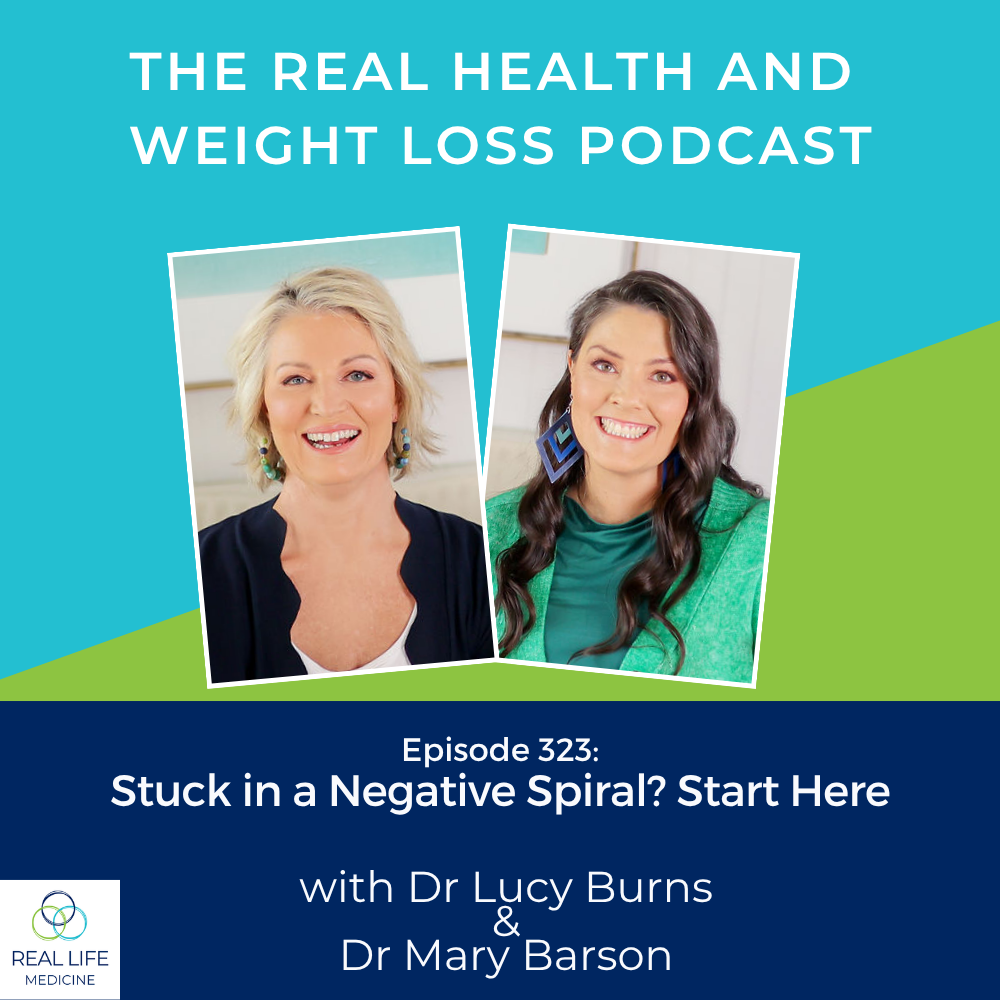
Episode 323:
Show Notes
This episode features Dr Mary Barton and Dr Lucy Burns discussing ageing, menopause, and the mindset shifts needed to thrive in the postmenopausal years, which can span 30 to 40 years of life.
Key Points
- Life in thirds: Dividing life into under-30, 30-to-60, and over-60 highlights that the menopause transition (lasting up to 10 years) sits in the middle third but is relatively short compared with the 40-odd years that can follow it.
- Metabolic shift after menopause: Pre-menopause, oestrogen is protective, and men outnumber pre-menopausal women for metabolic syndrome. After menopause (average age around 51), that flips, with more women than men developing metabolic syndrome, driven by increased visceral fat, insulin resistance, and cardiovascular risk.
- Stress and visceral fat: Managing stress is highlighted as a top lever for metabolic health post-menopause, since cortisol and HPA-axis activation drive the accumulation of pro-inflammatory visceral fat, which in turn worsens insulin resistance.
- Neuroplasticity and mindset: The brain's ability to rewire thought patterns means it's never too late to change habitual stress reactions; small daily moments of calm and more helpful thought patterns can meaningfully support metabolic health.
- HRT/MHT is not for everyone: Some women use hormone therapy, but many can't or choose not to, especially older women who missed the window when better formulations became available. For them, doubling down on lifestyle factors is the practical path forward.
- Society and ageing: The hosts discuss how Western society glorifies youth and stigmatises ageing (including how "senile" shifted from a neutral medical term to a slur), contrasting this with cultures that revere elders.
- Appearance and self-worth: They explore the tension between rejecting appearance-based self-worth and still taking pride in grooming, suggesting personal care can be a marker of self-respect rather than vanity, so long as it doesn't tip into obsession.
- Leaning into wisdom: Both doctors encourage listeners to embrace the "glory years" of postmenopausal life through curiosity, lifelong learning, and prioritising the six S's, sustenance, sleep, and stress management, alongside being a bit more selfish with self-care after decades of prioritising others.
- Next episode: The podcast is starting a new series on mindset, described as the key skill that helps people actually follow through on the health behaviours they know they should be doing.
Work With Real Life Medicine
For a step-by-step approach to improving metabolic health in perimenopause, menopause and beyond, check out My Metabolic Action Plan. This doctor-led comprehensive programme gives you
Strategies to improve metabolism
Skills to develop mindset
Tools so you will implement!
Episode 323:
Transcript
Dr Mary Barson (00:05) Hello lovely friend, I am Dr Mary Barson.
Dr Lucy Burns (00:09) And I'm Dr Lucy Burns.
Both (00:11) We are doctors, weight management and metabolic health experts. We are the creators of My Metabolic Action Plan, your two-step map to real health and weight loss, which is in fact the name of this podcast. Join MyMap now at rlmedicine.com.
Dr Mary Barson (00:29) Hello, lovely friend, and welcome to this episode of the Real Health and Weight Loss Podcast. I am Dr Mary, joined by my lovely colleague, Dr Lucy. How are you, fabulous Lucy?
Dr Lucy Burns (00:42) Oh, I'm great, Mares. I'm really, really great. I'm looking forward to this mindset series. You know, I've done a bit on socials lately talking about mindset because mindset affects everybody, including us. Nobody is immune from some little mindset tricks that your brain can do.
Dr Mary Barson (01:00) Yes, and learning how to drive your brain can be extremely helpful. And one way that we can all learn to drive our brain better is to understand an extraordinary bundle of nerves at the base of our brain that acts as this filter for all our sensory data called the reticular activating system, or the RAS. Tell us a bit more about the RAS, Lucy.
Dr Lucy Burns (01:22) Yeah, I love the RAS. The way I like to think about it is that it is very much like the social media algorithms. In social media algorithms, they're completely designed to show you what it thinks you're interested in. So if you watch a video on, you know, puppies, you will then get more videos on puppies because the algorithm goes, oh, they're interested in that, goody. We'll show them that. You know, if you're watching cake decorating videos, I may have watched a few of those, God knows why. Suddenly, I see every cake decorating creator ever. So our brain does exactly the same because, can you imagine, the poor old brain has to filter so much information every day.
Dr Mary Barson (02:08) Millions of bits of data every second. Honestly, that is what our brain is, you know, onslaught with every second.
Dr Lucy Burns (02:14) Absolutely. Yes. Every, every colour, every light, every movement, every sound, every smell, every thought, everything. It's filtering all of that all of the time. And it would be completely overwhelmed if it had to give attention to all of those. So it's come up with a system where it goes, oh, okay, well, I can't give the same amount of attention to every piece of data that comes into my brain. So I will just focus on the important things. Slightly full of system because, a bit like the algorithm, what it's thought recently or seen recently, what it gave attention to, what was deemed important is then, you know, this self fulfilling prophecy, so to speak, because all of a sudden brain goes, oh, well, that's important. I'll keep looking out for those. So if your brain has suddenly come up with the idea that you're hopeless or useless, for example, in a slightly negative way, but if it's decided, you know, that you're, you've started telling yourself you're useless, it will find information for that because it goes, oh, right. Oh, okay. Well, she thinks that's important. And so all of a sudden, it's magnifying every single mistake. It might be ruminating about the past mistakes that you've made. It's found all of this evidence to confirm this thought that you're useless.
Dr Mary Barson (03:38) Yes. I think probably many of us have experienced that. You spiral down, you know, you're starting to feel completely overwhelmed about a deadline at work. And then you're suddenly realising how you never managed to put your socks away and the house is untidy and, you know, you're not a perfect parent and my car is messy. And all of these things are just adding to the fact that you're no good, you're hopeless, you can't do things, you're overwhelmed. However, it is possible to use your reticular activating system for good, rather than just letting it run its own course for evil.
Dr Lucy Burns (04:17) Yeah, yeah, totally. You can train your system. This, I mean, you can train your whole brain. This is the thing we need to be intentional about it, because the reticular part of the reticular activating system's role was geared up for survival. So it was always looking for threats and danger. And it's very good friends with the amygdala. But, you know, we know that we can pay attention to certain things and essentially train our RAS to help us. And so the power of positive thinking, and it's not just Pollyanna, oh, well, we'll just pretend there's nothing going wrong, because that's, that's not useful. But looking intentionally for positive things throughout your day, throughout your life, has a really powerful effect on this reticular activating system.
Dr Mary Barson (05:10) And being intentional about it can make such a big difference. It's also one of our favourite tools that we've talked about before, a mindset tool of visualisation, where we play mental images in our mind or practice performing habits that are helpful for us in our mind. And this is a beautiful habit that can help not solely trick your reticular activating system, but prompt your reticular activating system to recognise this behaviour as a familiar and important task, and to help ingrain that as a habit. And you can use, it doesn't have to be physical repetition of a task, it can be visualisation of a task that also makes it easier for us.
Dr Lucy Burns (05:54) Absolutely. It is a super powerful part of our brain. It's helpful for emotions. So, you know, you might have a moment of joy in your life or a moment of happiness or contentment, or, you know, an emotion that we associate as being positive or helpful. You can savour that if you like. So you practice rehearsing that, you might go over it, you might remember, you know, nostalgia, all of those. And all of a sudden, your brain looks at that as being, oh, gosh, that's important. She likes it when she's happy. Let's find her more happiness. Just as you can practice being angry and cranky, and it will go, oh, she's looking for angry and cranky. Let's find all the things that make her angry and cranky. And so you may find, you may be out there thinking, yeah, there are periods in my life where it's like everything annoys me. And that's because your brain has prioritised those as being important. There will be things that have happened in your day that haven't made you angry or cranky, but it's not noticing those. It's noticing the angry and the crank.
Dr Mary Barson (07:05) And yeah, that's it. The reticular activating system is one of those reasons why we can spiral downwards, but it's also one of the reasons why we can spiral upwards. And that's a much happier place to be.
Dr Lucy Burns (07:21) Absolutely. I think it was Henry Ford. I may be wrong, but you know, there was somebody, some old dude who said, you know, whether you think you can or whether you think you can't, you're right. Now, again, we don't need to be ridiculous. Obviously we can't fly. I was very disappointed when I realised when I was about nine that I was never growing, grow wings. I think one of my kids was very disappointed when she realised at the age of 12, she wasn't getting a nail and she wasn't going to Hogwarts. So yes, there is realistic expectations, but the concept of self-limiting beliefs, which is this little voice inside you that says you can't do it, or it's not worth it, or it's too late, or what's the point? That sows a little seed that is then grown by the reticular activating system because it finds evidence for that belief and confirms it for you. So if you're in a space like that, if your brain is going, what's the point? It's not working. I can't do it. You know, why bother? If you become aware that that's happening, you can change that. And by changing the belief or the thought process underneath, your reticular activating system will help you to find evidence to the contrary. But you do need to be intentional initially because it's always just going to show you what it thinks is important.
Dr Mary Barson (08:52) Yes. And so many of the mindset tools that we talk about, Lucy, really do harness this power of the reticular activating system. And one of them is like setting your goals to be really specific, like this is helpful, like sort of vague goals. Oh, I just want to do better. It's going to result in kind of vague filtering, which isn't going to help you. But like specific goals, like I am going to eat more protein with my meals. And that results in more kind of specific filtering. And it becomes something that's very specifically doable. And then you do it. You provide that, that evidence to yourself that you do it. And that helps improve your self-efficacy. And you start to realise that you can. And then you're going to realise that you can. And it's going to be easier to do it. And then you start filtering and looking for all of the evidence in all the ways that you do win and all the things that you are good at. And with that self-efficacy, that belief in ourself, change becomes much easier and much more sustainable. And you can have that spiraling upwards.
Dr Lucy Burns (10:04) Yes, absolutely. The reticular activating system really is responsible for momentum, either way, momentum in a helpful direction or momentum in an unhelpful direction. And initially, it can be sneaky either way. So you can start building some habits that are helpful, or you can start building habits that are unhelpful. And your brain is, it's basically kind of categorising them. It goes, all right, okay, good. She likes this. We'll keep doing this. And it's not until you, again, keep developing awareness and intention and being really mindful of what you're doing, of your behaviours or your actions, that you can then start to have a look and go, hang on, what's going on here? Particularly if these are actions that are unhelpful, you can start to go, all right, that's not so, why am I doing that? And unless you stop, sometimes you just keep repeating them on autopilot until you find yourself in a place where you, I don't know, can't fit into your clothes or you've developed diabetes. You think, how did I get here? Whereas when we're intentional and we develop, we're going, right, I'm going to be, because again, I'm rambling a bit here, but our society currently is set up to really not be health promoting. Unfortunately. Yeah. And this has happened in the last, you know, a hundred years since we invented the car and the internet and the telephone and... Electric light bulb. Yep. And now AI, you know, everything is designed for us to do as little as possible. So we have to be really proactive in doing, being different to what the environment just sort of kind of corrals you into. You know, if we think about it like a river, you're just taken down the unhealthy pathway if you are passive, but if you are active and intentional and you actively and intentionally look for things that are going to be helpful. And an example, a great example, I've got a friend who is obsessed with incidental exercise and it's great. He loves it because, you know, again, we are, most of us sitting around not doing much in the way of exercise, unless we go to the gym. Every single task he sees as his opportunity to do incidental exercise.
Dr Mary Barson (12:26) That's a brilliant one.
Dr Lucy Burns (12:27) Put the recycling out. I know, recycling in the bin. Oh, incidental exercise. I'll do that. Hang out the washing. Oh, I'll do that. Incidental exercise. Everything. It's like, he's loving it. So it's like, right. It's a really positive way to look at things that you could otherwise be going, oh my God, I can't believe I've got to get up and go out to the bin again or whatever it might be.
Dr Mary Barson (12:48) Yes. I mean, I love it. So that we all have this system in our brain that it takes what we focus on and creates a filter for it. And that it will seek out information that validates our beliefs and it filters our world through the parameters that we give it. And our beliefs shape those parameters. And this is wonderful because we can, we can change our thoughts and our beliefs. And then we can just sort of do this little bit like that, let our brain then take over on autopilot and it can help us reinforce those beliefs without us needing to constantly apply cognitive effort, and it can help make those things easier.
Dr Lucy Burns (13:30) Yeah. And I think just like your social media algorithm, if you're finding that you're, you know, so a little trick I do with my algorithm, if it's suddenly starting to show me things that make me outraged or cross or mean or cruel or not in keeping with my values, all of that stuff, then that's when I go and I do, I purposely watch videos of puppies. It's like, oh goody, I'm going to get more puppies videos that'll make me happy. But you know, even from a personal point of view, as we spoke about, mindset is sneaky and subtle, and you don't always realise that you've entered a negative mindset. And this happened to me recently where there was a little voice popping into my mind that was saying, what's the point? And it was doing this because, you know, the neuromuscular disease that I have, muscular dystrophy, is getting worse. No surprises. It's a progressive disease. It is going to get worse. However, the theory of that and the practical implications don't always marry up. And as somebody who's experiencing a physical decline, my brain started going to me, you know what, Lucy, what's the point? You're doing all this work, you know, eating well, and you're getting worse. Now you can't walk. So, you know, what's the point of all this? You might as well just eat the lollies. You might as well just have the cocktails because, you know, you've got to live. And so it really started sending me down this little path that I was sort of going, yeah, I was going along with it. It was sort of a bit like, yeah, yeah, I'm going along with that. But what was happening, or what happened, was that I got to the point where I sort of went, what's happening here? I am now doing behaviours that are not in keeping with my health, with health promoting. So yes, you know, I tell people to, you know, do resistance training or go for a walk after eating maybe a carbohydrate loaded meal or whatever it is. And in my head, I'm going, oh, well, I can't do that because literally I can't walk. So what's the point of doing anything? So it became this little lens that was like, well, I'm either doing it or, you know, it was a bit of all or nothing thinking that it sort of just crept back in. It was my old default thinking, and then it snuck back in to, yeah, what's the point? And so then this resulted, interestingly, interestingly, I don't know if that's the right word, in what's the point of brushing my hair? What's the point of putting on makeup? What's the point of buying nice clothes? And so I was starting to schlep around in tracksuits. And again, there's nothing wrong with schlepping around in a tracksuit every now and then, but, you know, it had become, actually, I even did a talk, like I did a keynote presentation without any makeup on, which again is not, it's not bad, but it was a reflection of a standard in personal grooming that I normally wouldn't do. And so I thought, okay, what's going on here? And, you know, what's the point? Became, well, actually the point is that when I look after myself, when I take some pride in my appearance, when I start eating well, when I don't drink copious amounts of wine, when I go to bed on time, I actually feel better in myself. And so we want to be doing that. We want to feel better about ourselves because what was happening was that I started not liking the way I was looking, not liking the thing I was seeing in the mirror, the thing, the image I was seeing in the mirror. And so that voice of what's the point became louder and louder to the point where I started believing it. What's the point? Might as well just eat the lollies. And again, that's not an unreasonable thought, except that what am I going to do? Am I just going to lie on my couch for the next 30 years eating lollies all day? It's not going to be much of a, like, it's not going to be much of a life really. So I drew a line in the sand the other day and thought, no, I'm not doing this anymore. I'm going back to, I'm recommitting. So it was like a little, my own personal recommitment ceremony. And James Clear talks about this idea of external accountability. So when you make a decision, you are more likely to follow through if other people know about it. So yeah, I just told our initially Momentum community and then everybody who follows us on Instagram and now all of you who are listening to this podcast that, yeah, I had a slip, what I would probably call a major slip for me in particular, probably the biggest slip I've had in the last eight years. And I, you know, I didn't want to tell anyone about it. It seemed mortifying. Imagine being a doctor who's helping people with their weight management, who's not actually following our own advice. It's, you know, shameful. So I just kind of hoped it would stop, and it has now, but I'm also telling people about it because it's normal.
Dr Mary Barson (18:47) Yes. Yes. And beautiful, Lucy. Thank you so much for sharing that story. It is so beautiful and so helpful. And how now can you help keep that momentum going? Do you think what, what would help you and your, as, like, spiral upwards?
Dr Lucy Burns (19:07) Absolutely, spiralling upwards. So for me, it was helpful. And we talked a bit about this last week in, you know, the concept of personal grooming. So it is helpful for me to take some pride in my appearance, to spend a little bit of time, you know, brushing my hair, putting on a bit of makeup and wearing clothes that feel nice. That sends a pretty powerful message to my brain that I'm important and that I matter. Again, I'm not going to extremes and, you know, doing things that I perhaps normally wouldn't do or aren't in line with my values. I'm just recommitting to some personal grooming. That has helped. The thing then my brain is starting to say instead of the, what's the point, it's looking, going, well, the point is you feel better. So I keep saying to myself when it, if it pops in with, well, what's the point, you might as well eat the lollies. No, the point is I feel better when I look after myself. I feel better when I sleep. I feel better when I don't drink wine every night. So the sentence that is in my brain that is helping my RAS is the, I feel better. What do I need to do to feel better? You know, what can I do to make my life easier to feel better? Not, you know, what can I do to give up?
Dr Mary Barson (20:29) Yes. And now your RAS is looking for those opportunities to feel better.
Dr Lucy Burns (20:34) Yeah. Yeah. And it's so interesting because I'm sure lots of you out there will know that when you're feeling a bit rubbish about yourself, you also numb, you know, this is where we numb ourselves with behaviours that aren't helpful. And it might be things like doom scrolling, playing games on your phone, binge watching Netflix for hours. And yeah, I started doing a fair bit of that. Just, I don't know what I was doing. Just, I'm playing games. So they're not helpful. Like they're just a waste of time, really. But I would tell myself that I'm relaxing. Oh, this is relaxing. This, I deserve this because I've worked really hard. And the other sneaky thing that was happening was that I was also doing things that I knew I was good at. And in particular, that's working in the clinic. So I was seeing a lot more people, a lot of patients, and that's, you know, there's certainly nothing wrong with that. But that then meant I didn't have time to do some of the things that are helpful, like, you know, going for a swim. I've stopped swimming. Now, my challenge for the next week or so is to create space in my timetable, my timetable of life, to go swimming, to be intentional about that. And I know the same for you, Miss, around your strength training. It's been similar.
Dr Mary Barson (21:55) Yeah, it is carving out that space and then not letting other things squish it away. Yeah, I aim for three times a week. But yeah, look, last week, last Sunday was supposed to be my third one. And I did just let it get squished away by, oh, I'll just clean the house and I'll just do this for my kids and I'll just go and help my mum with that. And yeah, you know, I just didn't go. And yeah, yes, let that happen.
Dr Lucy Burns (22:26) The noble procrastination is very, but it is really also, again, that what that tells us, what that's telling your brain is that, you know, you're not important enough to do that. And so we have to keep reminding ourselves that we are important, that we do matter. And that when we look after ourselves with intention, we feel better. And when we feel better, we're nicer to be around. We're, you know, more fun. We feel better in ourselves. Our relationships are better, like everything. Life is better when we look after ourselves.
Dr Mary Barson (23:03) And that's really what we want, isn't it? It's all about having a better life and making the most of, our one precious wild ride, which is our lives.
Dr Lucy Burns (23:14) Indeed, indeed. And it's interesting. So next week, we are talking about the concept of consistency, because I think that's tricky. It is tricky. Consistency versus perfectionism. We all know what perfectionism, maybe we know, maybe we don't, who knows.
But we're going to chat about that next week, because at the end of the day, we want to be consistent. But what does that actually mean?
Dr Mary Barson (23:38) Hmm. And if it's not perfectionism, what is it?
Dr Lucy Burns (23:41) Exactly. All right, lovely friends, have a fabulous week. Think about your reticular activating system. What you focus on is what your brain thinks is important. So it's going to focus either way. So you might as well make it work for you, not against you.
Dr Mary Barson (23:59) Bye bye now.
Dr Lucy Burns (24:00) Bye now.
Dr Lucy Burns (24:03) The information shared on the Real Health and Weight Loss Podcast, including show notes and links, provides general information only. It is not a substitute, nor is it intended to provide individualised medical advice, diagnosis or treatment, nor can it be construed as such. Please consult your doctor for any medical concerns.