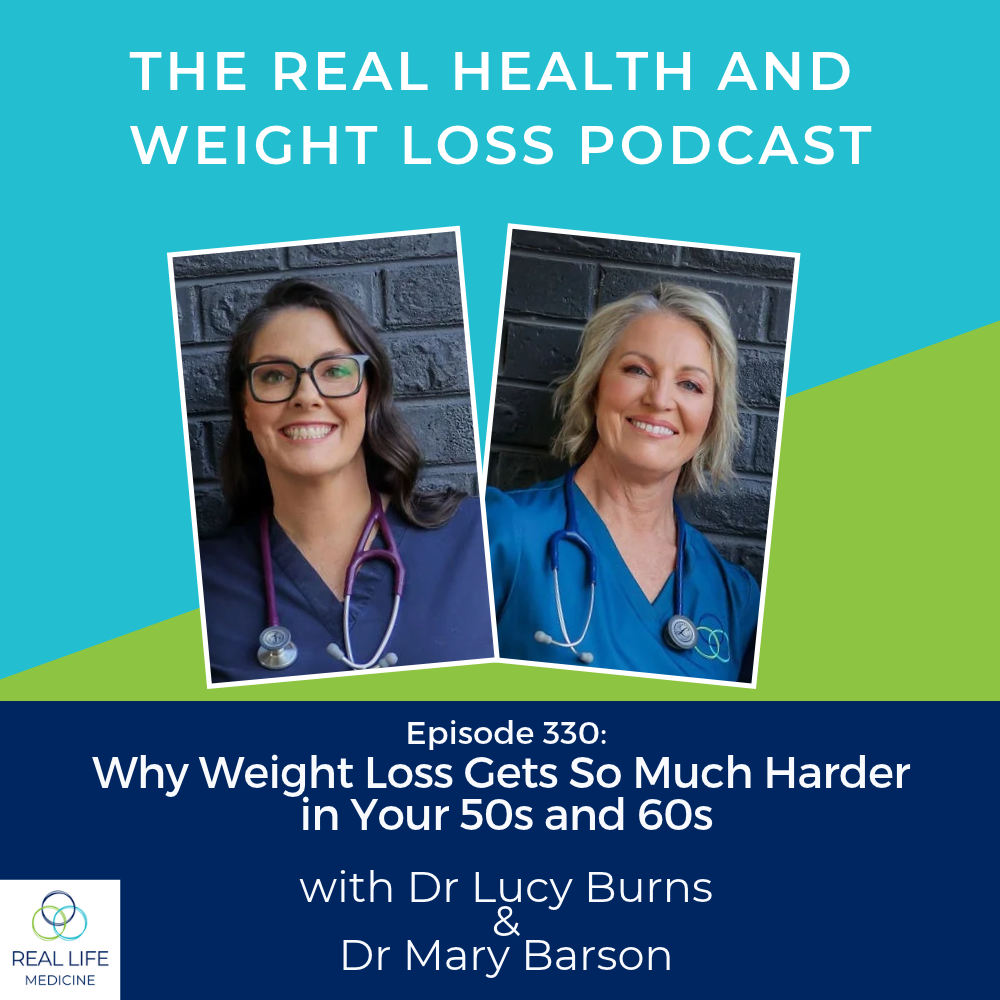
WHY WEIGHT LOSS GETS SO MUCH HARDER
IN YOUR 50S AND 60S
One of Australia's Most Popular Podcasts with Hundreds of 5 Star Reviews

Grab your FREE Ebook copy now!
Have you struggled to lose weight and keep it off?
Start your journey to boost metabolism and transform your body into a fat-burning powerhouse.
Episode 330:
Show Notes
Episode Summary
Ageing and menopause bring real physiological changes, but they do not mean your metabolism is broken or that declining health is inevitable. In this episode, Dr Lucy Burns and Dr Mary Barson explore why body composition and metabolic health can shift after menopause, particularly around the abdomen, and share practical foundations to help women work with their changing bodies rather than fight against them.
The conversation challenges anti-ageing messaging and the idea that an “old woman” is something negative. Instead, Dr Lucy and Dr Mary encourage women to embrace ageing as a meaningful new life stage, becoming wise, wonderful and well-supported as they move through midlife and beyond.
Key Points
- Ageing is inevitable, but poorer metabolic health is not. While we cannot stop getting older, we can take proactive steps to support our health, strength, energy and independence.
- Your metabolism is not broken. Many women notice that the strategies that once worked for weight management no longer have the same effect after perimenopause or menopause. This does not mean you have failed. The physiology and “rule book” have changed.
- Weight gain around the middle is common after menopause. It is important to distinguish between subcutaneous fat, the fat just beneath the skin, and visceral fat, which accumulates around the abdominal organs.
- Not all abdominal fat has the same health implications. Some body fat is normal and protective. However, greater visceral fat is associated with poorer metabolic health and becomes more common after menopause.
- Hormonal changes influence body-fat distribution. Falling ovarian oestrogen, reduced insulin sensitivity and higher cortisol levels can combine to make abdominal weight gain and visceral fat deposition more likely.
- This is not simply a matter of eating too much or lacking willpower. Hormones, sleep, stress, muscle mass, activity levels and food quality all influence metabolic health.
- Hormone replacement therapy can be useful for some women, but it is not a replacement for lifestyle foundations. Whether or not HRT is appropriate for you, consistent lifestyle habits remain central to metabolic health.
The Six S’s for Metabolic Health
Dr Lucy and Dr Mary return to the six key foundations of a healthy “metabolic mansion”.
- Sustenance: Prioritise protein at meals and reduce highly processed, refined carbohydrate foods that can increase hunger and cravings. A lower-carbohydrate, protein-rich real-food approach can support satiety, glucose regulation and reduction in visceral fat.
- Sleep: Good-quality sleep is fundamental, not optional. Poor sleep can increase cortisol, cravings, hunger and the likelihood of weight regain. Aim for six to eight hours of quality sleep most nights where possible.
- Stress management: Chronic stress can drive poor sleep, cravings, emotional eating, alcohol use and reduced movement. Small moments of calm throughout the day can interrupt the stress cycle. You do not need a desert-island escape to make a difference.
- Strength and movement: Strength training helps preserve and build muscle, supports metabolic health and protects bone density. Aim to challenge your muscles two to three times per week by lifting, pushing or pulling until the muscles feel fatigued.
- Movement snacks: Regular incidental movement matters. Break up long periods of sitting by getting up, walking, stretching or moving for even 30 seconds to five minutes at a time. This supports non-exercise activity thermogenesis, also known as NEAT.
- Sunlight and social connection: Morning sunlight helps support circadian rhythms, sleep and metabolic health. Meaningful social connection also matters, as loneliness is linked with poorer health outcomes and inflammation.
Practical Takeaways
- Train for menopause before you reach it. Optimising metabolic health during pre-menopause and perimenopause can help create a stronger foundation for post-menopause.
- Focus on what you can control, rather than fighting the reality of ageing.
- Make protein a priority at every meal.
- Build strength, protect muscle and support bone health now, not later.
- Move regularly throughout the day, not only during formal exercise.
- Protect your sleep as a core health habit.
- Create brief, repeatable stress-management practices that fit into real life.
- Get outside in the morning when you can, keep meal timing and bedtime relatively regular, and invest in supportive relationships.
- Remember that health and aesthetics are not the same thing. A changing body shape does not automatically mean poor health, and chasing a certain appearance is not the same as caring for your long-term wellbeing.
The goal is not to resist ageing. It is to enter your later decades with as much strength, metabolic health, mobility, connection and confidence as possible.
Work With Real Life Medicine
For a step-by-step approach to improving metabolic health in perimenopause, menopause and beyond, check out My Metabolic Action Plan. This doctor-led comprehensive programme gives you
Strategies to improve metabolism
Skills to develop mindset
Tools so you will implement!
Episode 330:
Transcript
Dr Mary Barson (00:05) Hello lovely friend, I am Dr Mary Barson.
Dr Lucy Burns (00:09) And I'm Dr Lucy Burns.
Both (00:11) We are doctors, weight management and metabolic health experts. We are the creators of My Metabolic Action Plan, your two-step map to real health and weight loss, which is in fact the name of this podcast. Join MyMap now at rlmedicine.com.
Dr Lucy Burns (00:30) Hello lovely friend, Dr Lucy here on, well, actually, it's a bit of a dreary old day outside as we're recording this. I don't know, by the time it drops, it may well be, we may be basking in sunlight. Either way, it is what it is. Which is sort of a stupid saying, but anyway. Dr Mary, how are you today, my friend?
Dr Mary Barson (00:48) Yeah, good, good. I actually like the saying, it is what it is. We had a bit of a whirlwind of stress this morning as I had to get my daughter out in a hurry. She overslept, was late for choir and was lamenting the fact very loudly that there wasn't enough time to get ready. And I was like, well, it just is, it just is. And sometimes it is, just is. And it's a useful skill to deal with what is.
Dr Lucy Burns (01:13) Correct, correct. Yes, what is inside your control, what is outside your control.
Dr Mary Barson (01:19) Exactly, which as ever is a good segue to what we're talking about today because there are some things with regards to our health and metabolism that are beyond our control, such as ageing, getting older. We cannot control that, that'll just happen.
Dr Lucy Burns (01:38) Absolutely, and in fact, the only, there's two options. My pop used to always say to me, two options, you're either getting older or you're dead. So you know, which one do you want to choose? So you get to choose that. Well no, you don't get to necessarily, but. The options available. They're the options available. So in some ways I think, right, well we're getting older, that's inevitable, why don't we embrace that and make it as good as possible, rather than this, all of this rhetoric around anti ageing. It's just a marketing ploy and makes us fear ageing. You know, there are cultures where ageing is revered. Yes, bring that on. I want to be in those cultures.
Dr Mary Barson (02:20) Yeah, that's right. Just bring it back to my daughter again. Yesterday she was just brushing my hair and just, you know, plaiting it for me. We were just having a bit of fun and she goes, I love your silver hair, mama. It's just like, it's just like the most perfect highlights. And I was like, damn straight it is. I just love that, you know. She just said that with her heart, you know. Yeah.
Dr Lucy Burns (03:41) Yeah, yeah, absolutely. And there's some things that, you know, again, our society can change around ageing and the way we speak about getting older. You know, marketing is going to be there. The marketing people are always going to be there selling their potions and supplements and you know, anti-ageing longevity, all of that sort of stuff. Oh, yes. You know, it is what it is.
Dr Mary Barson (03:05) Correct. It is what it is. Yeah.
Dr Lucy Burns (03:07) But we can push back on some of it and particularly around the using old woman as a slur. Like it's so interesting when people would go, stop being such an old woman.
Dr Mary Barson (03:19) So yes, yes, I felt that.
Dr Lucy Burns (03:22) I know. Whereas I'm thinking really stop being such a wise, wonderful, wise woman. That's right. Yeah. Stupid old woman.
Dr Mary Barson (03:32) Yeah.No, no, shut that down.
Dr Lucy Burns (03:35) Yeah. So yes, we want wise women. Wow. A wise old woman.
Dr Mary Barson (03:40) That's it. Yes. And I have been thinking about this a lot as I am transitioning into my midlife of, you know, and I'm definitely in midlife. Like this is not something that happened yesterday, but I am transitioning into being an elder and it is, it is a different stage of life and I am leaning into embracing it with open arms, silver hair and all. And because it is inevitable and I don't want to rage against it. That's just not what I want to do with my time and energy. And it's good. I'm going to be a wow, Lucy. I'm totally borrowing that.
Dr Lucy Burns (04:20) Yeah. Yeah. A wise old woman, a wonderful old woman. Yeah. We're all going to be wows. We're going to be wily old women. HOTIs. That's it. HOTIs and wows living our glory years.
Dr Mary Barson (04:29) Love it so much. And I think that it is also important to talk about that things do change as we get older. Our physiology changes. We have important changes to our metabolism that we need to know about so that we can work with them rather than just sort of riling against them. Like we try to, might want to rile against the wrinkles. We don't want to have to rile against the changes that happen as we age and happen post menopause. Cause that's just there. And if we can work with them, then we can reach our health goals and live the life that we want with just better ease and enjoy those glory years being as healthy as we possibly can be. I hear it a lot from women that it's just like, I'm doing what I've always done. I haven't changed anything. In fact, I'm probably eating less than I was before. I'm exercising more than I was before. And yet I am still, it just, my body doesn't respond the way it used to. I'm still gaining weight. What is wrong with me? Everything has changed. And I think that if this is something that has happened to you, like if you have been struggling with your health, your weight, your metabolism, metabolic health, post menopause, you're not broken. Your metabolism isn't broken. It's just that things have changed. The rule book has changed and you need new rules really. Cause the old rules aren't going to be working for you.
Dr Lucy Burns (05:59) Yes, absolutely. And I think the mix, the mix up that happens, which is understandable, we all have it, is the difference between health and aesthetics, which is quite hard to say, health and aesthetics when it comes particularly to weight management. So it is pretty normal for most women to gain some weight around their middle post menopause. Now, that may or may not be a problem. And that's, I guess, what we're going to talk about today. Because there's, when people talk about belly fat, and that's sort of the way people call it, menobelly, belly fat, they're obviously talking about, you know, their waist getting bigger or their fat around the middle or their pouch or pooch or whatever sort of words people like to use. And when we're talking about weight around the middle, there's sort of two types. So we've got subcutaneous fat, which we have everywhere, or which is just the fat that is under your skin. So it's between your skin and your muscles. And all women have that. And sometimes women will get more of that post menopause. And that in itself is not dangerous or unhealthy. It's just, it's why you don't have a six pack basically. And women in general are not meant to have six packs. We are meant to have a bit more body fat than that. But then there's also the extra fat that can come around your organs or in your viscera. And there's this kind of blob of stuff in our abdominal cavity called the omentum, which is sort of like an apron that envelopes all of the organs and has some fat in it. And you can get fat in that as well. And none of that is actually ideal. We don't want to, I mean, we need a little bit. Again, it's normal to have some abdominal fat. That fat's protective and stops your organs bashing into each other. And if you bump into the kitchen bench, your liver has got a bit of protection, all that stuff. But unfortunately, there are some changes that do happen for many women in that visceral department.
Dr Mary Barson (08:16) And especially as we transition post menopause, things do change with the decreasing in availability of ovarian oestrogen. We get more of that abdominal visceral fat deposition. It's far more likely. And it's, we can go from more of a pear shape or an hourglass shape to a bit more apple shaped. And this isn't necessarily about the calories, how much you're eating. It's about the hormones that drive these processes. And the key hormones that we like to talk about, they're not the only ones, but they are, I think, among the most important in this conversation is the oestrogen, insulin, and cortisol. And they all interact with each other that can kind of all sort of gang up on us, if you like, to create this situation where we've got increasing propensity to gain weight, but particularly increasing propensity to gain that visceral fat as insulin sensitivity reduces, become more resistant to insulin as we age. Often we've got increasing cortisol, which happens for multiple reasons, not least of which is the busy rushing women's syndrome, as we have just got so many things that we need to manage in this sort of phase of our lives and insulin. And so all of them, sorry, I said that twice, but I said insulin twice because it's really important. They all work together. This is not to say that this is inevitable, that we just have to spiral downwards into this poorer and poorer and poorer metabolic health. There are levers that we can push and pull to make a big change. And the most important levers are around muscle and moving our muscles around food, around managing our stress, all of the successes that we talk about and getting some sunlight, having some social connection, doing all the things that are going to help rebalance these hormones in a helpful way. And sleep. Did I forget sleep? My goodness. Possibly a bit sleep deprived at the moment, as I am in two directions by my older child and my younger child, sleep is incredibly important.
Dr Lucy Burns (10:26) Yes, absolutely. And so it's interesting. I know people, there are some women out there who can't take HRT or don't want to take HRT or missed out taking HRT because they were told that it's dangerous. And obviously we've changed our minds a bit since then. But again, for those women, it's not the be all and end all. It's not that HRT is the magic potion. It can be helpful for some people, but the magic potion is actually doing the foundations, the six S's. That's the magic. When you can do those, again, we've used many analogies as we love to. We've got the metabolic house mansion. We've got the lifestyle Christmas tree, which is the foundations or the branches of the tree are what's important. And then the baubles on top can be helpful. But I guess it's really more what we're wanting to do today is explain to women why this is happening. It's not your fault. You haven't just suddenly turned into some lazy sloth who's mainlining donuts every day. You can actually change nothing and this weight will come on. I like this phrase VAT, visceral adipose tissue, the VAT. Your VAT will increase. So we probably need to take some proactive steps is really what we're saying here. And I think those steps can be two phases. So it could be pre menopause or perimenopause. You need to prepare for post menopause. So this is like you, Miss. I'm training, training for menopause. Yeah. So you want to have your metabolic health as optimised as possible because it, unfortunately, will get a little bit worse post menopause. And then, yeah, if you can take HRT or you want to take HRT or it's useful for you to take HRT, that can be helpful. But then, again, doubling down on these six S's is really what is going to move the needle. And I know it's not going to sell, you know, a whole lot of supplements. It's not going to make anyone zillions of dollars because really what we're proposing here is, you know, boring lifestyle advice that doesn't get clicks on Instagram. It doesn't sell anything, but is really where the needle moves.
Dr Mary Barson (13:07) It is. This is the foundation of your metabolic health mansion and or your Christmas tree that needs to be put up before you can hang tinsel anywhere. That's right. I am in that pre menopausal kind of area. So I am training for menopause and I really do just try and envision my future, me being as prepared as I possibly can be for this transition, which is, you know, galloping up on me in the next five to 10 years. It's happening and it will happen because it is inevitable. And that's okay. It's all right. I'm happy to embrace it and work with it, but I just need to do it well. And I think we should, let's go through the levers. I know we talk about this a lot, but I really do think it's important that your lever one is your food. It's your sustenance. And I reckon the most important thing is the protein just to really meaningfully prioritise your protein at every meal. If you do that, you're already getting some wins on the board.
Dr Lucy Burns (14:09) Yes. And it's tricky. Do I think proteins are most important or reducing carbs is the most important?
Dr Mary Barson (14:13) They're both important.
Dr Lucy Burns (14:14) They are.
Dr Mary Barson (14:15) They kind of go lockstep together.
Dr Lucy Burns (14:16) They do. Because I also know that when you eat more carbs, you're hungrier. So, you know, it's like carbs forget carbs. The more you eat, the hungrier you are. And so that's tricky. Whereas protein is very satiating. So I think the two combined, that low carb, high protein is like magic. So yeah, those are super, super helpful. And they're helpful for, again, we've just talked about this a couple of weeks ago, the study that showed that a very low carbohydrate diet is incredibly helpful for visceral fat in the liver and glucose control and all of the things. So yay. So that's the S. First S is your sustenance. Second S, and again, these are in no particular order, just whichever order we remember them in. But your second S, I would go sleep.
Dr Mary Barson (15:06) I do love sleep, even though I forgot about it before. Because sleep, it underpins everything else. Well, everything underpins everything. All of these are also interconnected. But with poor sleep, you're going to have increased cortisol, which is going to increase your cravings, which is going to make it harder to get your sustenance right. It's also going to increase your visceral fat supposition, and it's going to make everything harder. And we did talk about earlier on, we talked about a study that showed one of the main reasons why people fail to use that unhelpful term, low carb diets, why people regain weight after losing weight on a low carbohydrate plan is because of poor sleep. If you're able to get six to eight quality hours of sleep, that's what the science shows, every night, at least most nights, you are far, far, far less likely to get that weight regain, which just shows you that sleep is not a little sort of additional extra, wouldn't it be nice if I had time? It is fundamentally important.
Dr Lucy Burns (16:15) Yes. And I think busy women steal from their sleep to do things in the day. And I remember somebody saying to me, I wish I had a few more hours in the day. And I remember thinking, I wish I had a few more at night, because I don't need any more in the day, I'm already doing stuff, but I would like another extra hour of sleep. So yeah, sleep is definitely, definitely in there. And it's tricky because stress is one of the S's. And it's also really important to be able to manage stress. Because when we don't manage our stress, we don't sleep well. And we will often, you know, use unhelpful tactics to sort of mitigate that stress like eating and drinking alcohol and chocolate, for example. So people will wind down then when they're stressed, they will really, they're numbing their emotions with food and alcohol. And so then that all contributes. Yeah. And look, we've done lots of podcasts on stress management. And it's a foundation that we teach, particularly in momentum, we kept coming back to that. Because when women are stressed, they are less likely to implement the things that are helpful.
Dr Mary Barson (17:31) Yep. It creates poor sleep, it creates hunger and cravings, those poorer food choices, those less movement, which could all create yet more stress. And so you can be a vicious, not visceral, vicious circle that you could get stuck into. But brief, short, small interventions, it's all that's required. To borrow your phrase, Lucy, you don't need to run away to a desert island. There are small little actionable steps you can take to have little pauses, little moments of calm, that can just physiologically interrupt that cycle and the physiology of stress, which can be enough to shift the dial in a really helpful direction. And that becomes even more important as we age.
Dr Lucy Burns (18:14) Yes. Which then comes on to the strength and movement. Now, so, you know, one of the trickiest things, I think, as women age, and it is, and again, we won't, we'll just talk briefly about this, but muscle and bones. There are lots of women my age and older, who spent years dieting and calorie restricting and avoiding dairy, and who are now 60 with osteoporosis. And it is really difficult because, you know, osteoporosis, and in fact, osteopenia, even, are such a large cause of morbidity. And what that means is that you are more likely to fracture a bone, if you have osteoporotic or osteopenia with a small impact. And that is then a leading cause of death, particularly as we do get a bit older into the seventies and eighties. If you break your hip, then the mortality rate from a fractured hip is huge. Like it's massive. So again, training for this, we want to be able to optimise our bone health and our muscle health. And we want to optimise our muscle health for so many reasons, apart from the fact that it is a metabolic organ. It means that if we were to have a little stumble, say you catch your toe on the edge of a rug and you've got good muscles, then you are able to correct that. Whereas if you have poor muscle mass, then you're more likely to fall.
Dr Mary Barson (19:47) Yeah. Walking speed is a very high predictor of mortality. The slower your walking speed, you know, the more likely people are to die. So strength training is vital. And that, to get the metabolic adaptation to get your muscles bigger, you have to push them to the point where they are tired, to they feel fatigued, you know, two, ideally three times a week. And it doesn't have to be super complicated, but you do want to do something, lift something, push something, pull something to the point where your muscles get tired and you feel like you can't push, pull, lift that particular thing anymore. Then you stop and have a rest. And then, you know, two or three days later, you do it again. And that is how you preserve and build your muscle mass, which is really non-negotiable for good health. As we age, we talk about the S being strength and movement because I think strength is so important for all the reasons we talked about. We have to preserve our muscle and our bone, but also movement snacks make a big difference. Movement snacks could be your strength training, but moving throughout the day really is helpful as well. A lot of us are moving a lot less, probably moving a lot less than we think. But, and often I think moving a lot less than we used to as we age, we often have a desk job. We often drive. We spend more time sitting. We exercise less just because we're busy. We might have more aches and pains. There might be a whole lot of reasons why we move less. So even if you still exercise and you still do your strength training two or three times a week, you might be sitting a bit more. And if we can break up that sitting, even with just five minutes of movement, even 30 seconds, just getting up regularly rather than having prolonged periods of sitting can help activate our metabolism. And we can get more of what's called this non exercise activity thermogenesis or NEAT, which I like. So breaking up your day with little movement snacks is also extremely helpful.
Dr Lucy Burns (21:46) Absolutely. And I think it's a really useful concept to think about, you know, and again, energy balance, this is not calories in, calories out, because we already know that there's much more complexity than that. But let's just call it the amount of fuel your body will use for the day. And the majority of that is, is just our basal metabolic rate, which is the amount of energy for our body just to run itself, to, you know, make liver enzymes, to grow hair, to pump our heart, to make digestive enzymes, to make the bowel move, all of that stuff that happens without you telling your body to do it. That is the bulk of where our energy requirements are met. Then we have thermogenesis, which is just, again, a fancy name for a sort of heat making, which we get from food. So some food requires more energy to digest it than other food. So things like whole proteins definitely require a lot of energy, more than protein powders, and way more than soft drinks, for example, which are really easy for your body to digest. They hardly require any energy. So we get some, then we get some from, as you said, non exercise activity. NEAT. And that's the, yeah, the stepping around, the getting up. And it's really interesting because there's some studies on that and people's just genetic inclination to move their body. Some people are jigglers and they move all the time. You know, those people that never seem to sit still, they don't, they do find it tricky to sit still. And there are other people who really sit very still where you wonder, are you awake? Their body just naturally conserves a lot of energy. And there's some thought that there's some genetic links to that. But again, we have set up our environment, humans, we're so clever that we're stupid. We've set up our environment to make sure that we do the least amount of energy possible by creating remote controls for everything, apps, apps for everything, apps to turn on the light, apps to turn on, you know, remote control, vacuum cleaners. Like, honestly, it's like we don't have to do anything, except then we go, oh my God, I'm not moving at all. And so you have to go to the gym, which is your exercise activated thermogenesis, your EAT. So the amount of energy that you burn is a combination of all of these. And we certainly know that for the older woman, her metabolic rate is probably lower. The amount of active exercise she's doing is probably lower and probably the non activity thermogenesis is lower, non exercise, sorry, activity. So there we go.
Dr Mary Barson (24:39) And we've got two more S's just to round it out, which are important, but ones that we don't necessarily talk to about that often, sunlight and social connection. So in the next couple of minutes, we could, we could round that off. I think it'd be helpful. Sunlight in the morning helps realign our circadian rhythms, which is our master control switch. And it helps create our chronobiology, which is really important for maximising our metabolic health. And just getting a bit of sunlight in the morning is really helpful. Keeping your meal timing. So you're not eating late at night is really helpful and keeping your bedtimes as regular as you can. Other ways in which you can powerfully improve your circadian rhythms and improve your chronobiology. So sunlight and circadian rhythms are just so important and kind of easy. Like most of this stuff is not that hard. And finally, social connection.
Dr Lucy Burns (25:40) Social connection, which, look, doesn't have a direct metabolic effect other than that we know that loneliness is one of the parameters for poor health. People that are lonely are far more likely to have poor health, far more likely to have inflammation, far more likely to die early. So if we've got good quality social connections, that is awesome. And I think we should do a podcast episode on this next week, around night shift. Because I do know that a lot of women in particular have night shifts as a problem because they've been nurses or they're shift workers for disability support. Or even like you, they've got children that still need them to be up at night or whatever it is, they're collecting teenagers. So there are things like that, that are outside your control, but then what are some of the things that we can do to mitigate that as much as possible, knowing that it's not going to be perfect. So we'll do a podcast on that in the next couple of weeks.
Dr Mary Barson (26:44) Sounds like a great plan.
Dr Lucy Burns (26:45) Good.
Dr Mary Barson (26:46) All right, lovelies. Bye, everybody. Wish you great metabolic health.
Dr Lucy Burns (26:47) Indeed, your metabolic mansion requires the six S's to be successful.
Dr Mary Barson (26:47) Bye now.
Dr Lucy Burns (26:48) Bye now.
Dr Lucy Burns (27:00) The information shared on the Real Health and Weight Loss Podcast, including show notes and links, provides general information only. It is not a substitute, nor is it intended to provide individualised medical advice, diagnosis or treatment, nor can it be construed as such. Please consult your doctor for any medical concerns.