
I EAT PRETTY WELL… SO WHY AM I STILL GAINING WEIGHT?
One of Australia's Most Popular Podcasts with Hundreds of 5 Star Reviews

Grab your FREE Ebook copy now!
Have you struggled to lose weight and keep it off?
Start your journey to boost metabolism and transform your body into a fat-burning powerhouse.
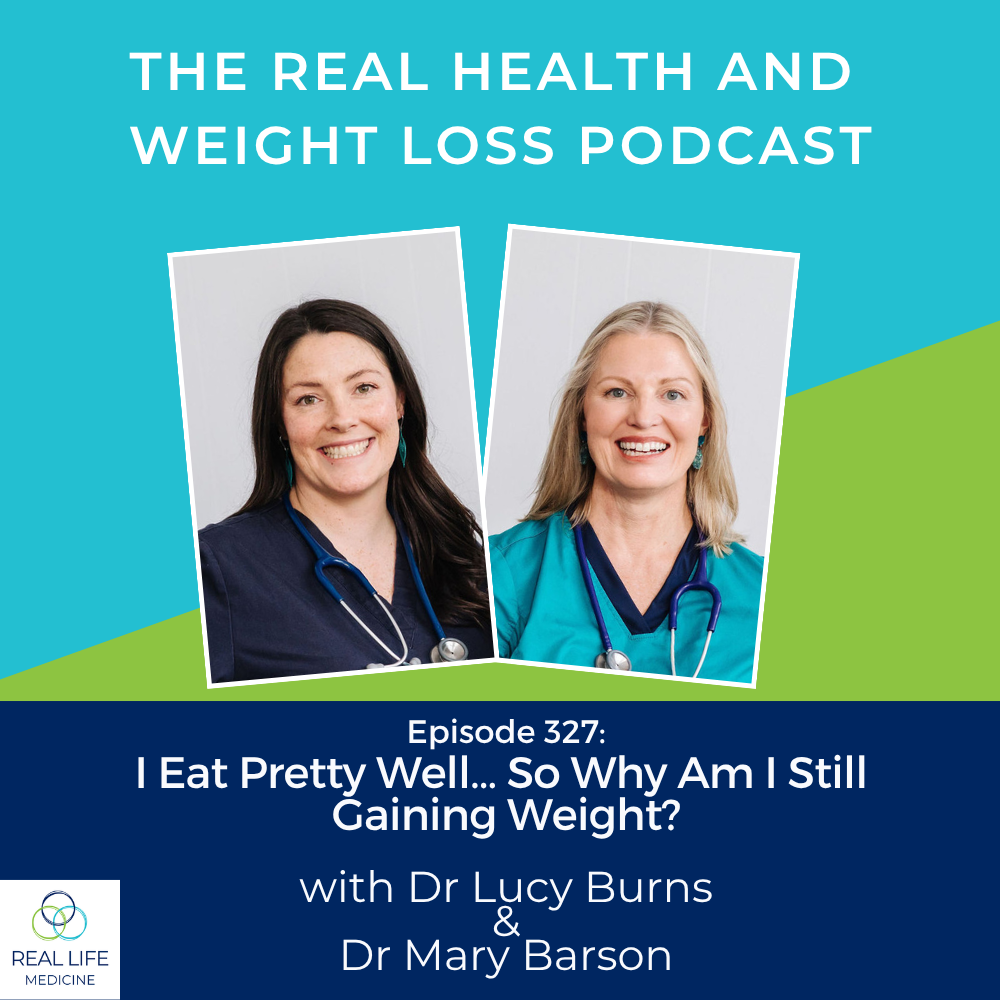
Episode 327:
Show Notes
This episode explores why you can be trying to “eat healthy” yet still experience weight gain, insulin resistance, fatigue or poor metabolic health, particularly through perimenopause and after menopause. Dr Lucy and Dr Mary explain that “healthy” is not a one-size-fits-all label: food quality, protein, satiety, meal timing, sleep, alcohol, muscle and individual metabolic response all matter.
Episode summary
Many women feel frustrated because they are doing the things they have been taught are healthy: eating porridge, yoghurt and berries, salads and avocado toast, avoiding takeaway, exercising when they can, and limiting alcohol. Yet their weight, blood glucose, fatty liver disease, prediabetes or energy levels may not improve.
The doctors argue that this does not mean someone has failed or stopped caring for their health. Rather, their physiology may have changed, especially with ageing, sleep disruption, stress and the menopause transition. The aim is not to label foods as good or bad, but to choose meals and routines that are more satisfying and metabolically supportive for the individual.
Key points
- Healthy-looking foods are not always metabolically optimal. Foods such as oats, avocado toast, yoghurt with berries and salads can be nutritious, but may not provide enough protein or satiety for someone struggling with hunger, weight gain or insulin resistance.
- Prioritise protein, especially at the first meal. A higher-protein breakfast, such as eggs, vegetables and Greek yoghurt, may be more filling than porridge with banana and honey. The doctors suggest aiming for at least 25 g of protein at the first meal, with 30 g discussed in research involving people with type 2 diabetes.
- Satiety changes what happens later in the day. Meals that keep you full can support more stable blood glucose and reduce the likelihood of grazing, snacking or using food to manage emotions when you are actually hungry.
- The same food can affect people differently. An apple, oats or another whole food is not inherently “good” or “bad”. Response can vary between people, and even within the same person depending on sleep, time of day, prior food intake and metabolic health.
- Food form and eating speed matter. Quick oats are more processed and smaller in particle size than whole oats, so they may be digested more rapidly. Eating more slowly may also support satiety and blood-glucose regulation.
- Skipping breakfast is not automatically a problem. Morning fasting can work for some people. However, if it leads to intense hunger, afternoon cravings, overeating or evening snacking, it may be worth trialling a substantial protein-rich breakfast instead.
- Meal timing matters. Metabolic hormones follow circadian rhythms, and many people are more insulin resistant in the evening. The same meal may therefore create a different response in the morning versus at night.
- Morning outdoor light supports circadian rhythms. Spending time outside in daylight, even while having a cup of tea in a coat, can help align the body clock. You do not need to sunbathe.
- Menopause changes the metabolic rule book. Falling oestrogen, rising insulin resistance, poorer sleep, stress and changing cortisol patterns can make previous strategies less effective. This is not a personal failure. It is a cue to adapt your approach.
- Calories matter, but are not the whole story. Calories measure energy, not nutritional quality, fullness, hormonal effects or the way a food influences later food choices. Alcohol is highlighted as a common source of energy that can be overlooked.
- Walking is excellent, but strength training is vital too. Walking supports health, but it may not be sufficient to preserve muscle as we age. Muscle is metabolically active, so regular resistance or strength training is an important addition. This can start simply with bodyweight movements or lifting manageable heavy objects.
- A walk after meals can be particularly useful. If timing is flexible, walking after a meal, ideally within about 30 minutes, may help support post-meal blood glucose. Even brief movement such as stair climbing can be a helpful part of the wider picture.
- Make habits easier rather than waiting for motivation. Dr Lucy describes returning to the pool by lowering the bar: simply getting in the water, pairing the activity with an audiobook, and scheduling time for it. Small, practical actions can create an upward spiral of better choices.
Practical experiment for the week
- Trial a protein-rich first meal that contains at least 25 g of protein.
- Notice whether you feel fuller, snack less and have fewer afternoon or evening cravings.
- Add a short walk after one meal when practical.
- Choose one simple form of strength training, such as squats, wall push-ups, resistance bands or carrying groceries.
- Identify the barriers that make the habit hard, then make the first step smaller, easier and more enjoyable.
Key takeaway
Rather than trying to eat less or pursue generic “healthy eating” rules, focus on working with your current physiology. Choose satiating, protein-rich meals, reduce unnecessary snacking, support your body clock, build muscle and make healthy actions realistically easy to repeat.
Work With Real Life Medicine
For a step-by-step approach to improving metabolic health in perimenopause, menopause and beyond, check out My Metabolic Action Plan. This doctor-led comprehensive programme gives you
Strategies to improve metabolism
Skills to develop mindset
Tools so you will implement!
Episode 327:
Transcript
Dr Mary Barson (00:05) Hello lovely friend, I am Dr Mary Barson.
Dr Lucy Burns (00:09) And I'm Dr Lucy Burns.
Both (00:11) We are doctors, weight management and metabolic health experts. We are the creators of My Metabolic Action Plan, your two-step map to real health and weight loss, which is in fact the name of this podcast. Join MyMap now at rlmedicine.com.
Dr Lucy Burns (00:30) Good morning, lovely friend. How are you today? I'm here with the gorgeous Dr Mary. Hello, Miss. How are you today?
Dr Mary Barson (00:37) Good, I'm good. I had a very big sleep last night, which I needed after three nights of sleep deprivation, being on call at Lawn Hospital whilst the Grand Fondo bike race was on and the town was flooded with lots of people riding around on their bikes, falling off and hurting themselves and coming to Lawn Hospital.
Dr Lucy Burns (01:01) Hmm, oh, that sounds dramatic.
Dr Mary Barson (01:05) Yeah, but I'm well rested now. How are you?
Dr Lucy Burns (01:06) Yeah, good, good, good. I am feeling very inspired. As you know, I've been talking in the past about my recent sort of, I guess, self-abandonment might be a good word, where I had sort of abandoned some of my health goals and I'd sort of got into a negative spiral mindset, and I've been spiralling upwards, starting initially with food and reducing alcohol, and recently I have gone back to the pool. So I'm very happy with myself. Yay! Yeah, you know, I was a bit nervous because I just sort of thought, oh God, I haven't been for so long. What if I can't do it? What if there's, I don't know, what ifs, like all of these imagined barriers? And so my steps were to make the first attempt really low pressure. So the idea was that I would just hop in the water, basically, and paddle around, like nothing too dramatic. And so I made it more fun, again thinking about some James Clear principles, you know, make it more attractive. So I have waterproof headphones. So I took an audiobook that I'm totally in love with, and I'm obsessed with audiobooks at the moment. And so I was excited to go and listen to that whilst I was paddling around in this pool. And by paddling, I sort of mean, you know, doing some deep water running and whatever. Yeah, and it was actually easy. I had built up this enormous kind of story in my head that it was all going to be hard and dramatic and take forever. And anyway, so once I proved to myself that I could do it, then I had to make sure I corralled time away because it does take time, and it doesn't just happen if you don't be intentional about it. So, corralled some time away, and now I'm sort of in the three-times-a-week routine. So I usually go Tuesdays, although not today because we are podcasting, but what I will do on the podcasting Tuesdays, I'll go Wednesday. I go Thursday, and then I go one of the weekend days. So, a bit of flexibility around the weekend. But that's kind of my commitment to myself.
Dr Mary Barson (03:12) I love that, that's good. And so you can continue to spiral upwards as those... Yeah, good choices can beget good choices, can beget good choices, as you can. Yeah, but don't only have to spiral downwards. I love that.
Dr Lucy Burns (03:28) No, absolutely. And so that leads us into today's episode, where we are talking about people who perhaps think they're making good choices. So maybe they're thinking that they're eating well, or maybe, you know, so they eat well, but they're gaining weight, or they eat well, but they're still metabolically unwell, i.e. they've still got diabetes or still got prediabetes, or they've still got fatty liver disease, despite the concept of eating well. So we thought we would talk a bit about that.
Dr Mary Barson (04:01) I think it's something that I hear a lot and have heard a lot in clinic. It's the woman who comes in and says, I just don't get it. You know, I ate my yoghurt and berries and porridge for breakfast. I have my salads for lunch. I don't get takeaway. I don't drink much alcohol. I do exercise where I can, and yet I'm still gaining weight. You know, I'm still 10, 15, 20 kilos heavier than I was five years ago. Like, what is going on? How can I fix this? And I think it's a really kind of a common scenario, especially as women transition through perimenopause into that postmenopause part of our lives. Things do change, and the old rules don't necessarily work anymore. And it's not to say that people have abandoned their health. They're still trying to make good choices, but still not getting where they want to be.
Dr Lucy Burns (04:54) Absolutely. And so I think there's two issues here. One is defining what healthy food actually is. And that's hard because the concept has been completely corrupted by the processed food industry, who have an entire aisle dedicated to health food, which is not the food around the outside of the supermarkets. It's an internal aisle. And I would say that 95% of that stuff that's in that aisle is not health food or healthy food. And then the second thing is, I guess, around timing and quantity and grazing and sort of, I guess, some of those sort of food habits that can sneak in.
Dr Mary Barson (05:41) And also, I put in a third one there, which is that food can be healthy, in those inverted commas, healthy, but it doesn't necessarily mean that it's metabolically optimal for you. And we are all different. There are going to be the women out there who eat their porridge and their salad and only exercise when they can. And they're not gaining weight. They're not having problems with their metabolic health, but there are going to be other women who do. And so I think looking at foods that are best for you, and if you've got issues with your metabolic health and/or weight gain, really want to look at the most satiating foods that you can and looking at foods that are going to really support your metabolism. So the avocado toast, you know, I'm not saying that that is necessarily an unhealthy food, but probably, definitely, a high protein breakfast is going to serve you better. Same with the berries and yoghurt. Could you use, like, a higher protein yoghurt, and can you find the foods that are healthy as well as metabolically optimum?
Dr Lucy Burns (06:51) Yeah, absolutely. And sometimes it's not a matter of taking away things. It might be a matter of adding things as well to your meal that will improve its satiety index, if you like. So satiety is the way in which food fills you up. And when we have a meal that fills us up, two things happen. We are more likely to have stable blood sugars. So that's actually good physiologically. But we're also less likely to then snack between meals or reach for something because we're a tiny bit hungry or even reach for something because we're managing emotions. It is much easier to resist, is too strong a word, but it is much easier not to choose food to manage your emotions if you're not actually hungry.
Dr Mary Barson (07:47) Yes, makes it much easier.
Dr Lucy Burns (07:48) Yeah, we can all override hunger for sure. Absolutely. Not every time we eat are we actually hungry. We all know that. But if you're conscious about what you're trying to do, everything is more difficult if you have physiological hunger driving your decisions.
Dr Mary Barson (08:04) Absolutely. I had that last night. As I mentioned, I was tired. I had a big weekend. We had a big week last week. We did our masterclass. It was wonderful. It was amazing, but it was draining. And yesterday I had work and I had to take the kids to the doctors. And on the way home, I was hungry, tired, irritable. I was like, hangry tired. I was like, oh, I was just in a bit of a state by the time we got home. I don't have much sugary food in the house, but there is a tin of sweetened condensed milk because I'm going to make slices for Max's. I don't know. My son's like some cake stall thing. Anyway, whatever. I'm conforming and I'm doing that. And it was weird. I wanted the sweetened condensed milk. That's something that my tired brain was like, in tired, hungry brain, was in that sugar craving mode. Whereas if I had had enough food beforehand and wasn't hungry, that wouldn't have been an issue.
Dr Lucy Burns (09:06) Yeah, absolutely. Absolutely. The brain does offer all sorts of things. Depending on whether you're physiologically hungry or not, and what determines physiological hunger. Well, hormones. Your metabolic hormones determine that. So, you know, ghrelin, leptin, ghrelin and leptin do hunger and satiety, along with GLP-1, which does satiety, GIP, peptide YY, cholecystokinin. All of those come together to help moderate or manage normal hunger. And they can be dysregulated with metabolic, you know, poor metabolic health, but also dysregulated in things like tiredness. They suddenly, you know, we know that. So, okay, so back to healthy. Healthy doesn't necessarily mean good for you as an individual. And two people can eat the same food and have completely different physiological responses. And that same food might be something like an apple. So, again, an apple is neither good nor bad. It's food. It's whole food. It's real food. So, you know, we're happy with that. It's got, you know, skin on it. Usually, it's got fibre. It's got some fructose in it, probably some glucose. It's got some vitamins in it. It's got, you know, lots of things. But in two people, and in fact, I'd even say in one person, it can have a different response each, you know, depending on the day, the time of day, when you last ate. Like, there's a whole host of things that determine your physiological response to an individual piece of food. So it's really more about the idea that you can choose, you know, foods that are helpful to you most of the time.
Dr Mary Barson (10:58) Yes. And I think that a really logical place to start with that is breakfast. So I do think that our society, for many people, has a healthy breakfast problem. And I would just invite all of our lovely listeners to ask themselves the question, what did you have for breakfast this morning? And it could be helpful to run through some examples, like a breakfast like porridge, banana and honey. Pretty normal, pretty common breakfast out there, does have a bit of a health halo versus another type of breakfast, something like eggs and spinach, maybe with some Greek yoghurt. And I would say that they're going to have very different metabolic effects for different people. I wouldn't say that the porridge is bad as such, just that it is low in protein. It's high in carbohydrates and it's going to be quite metabolically unhelpful for many people versus the higher protein eggs, veggies, Greek yoghurt that is going to be far more satiating. It's going to spike blood sugar less, is going to result in less of an insulin rise. And it's going to help keep people full and keep people's metabolism fuelled for longer. And that if you are in that category of needing more support for your metabolic health, then the higher protein option is going to be better for you. And we really like people to try and aim for at least 25 grams of protein in that first meal.
Dr Lucy Burns (12:33) Absolutely. And, you know, I mean, I can see why people are confused because let's go back to the oats. Definitely everyone thinks oats are healthy. Even within the oats category, you've got the quick oats. The quick oats are basically oats that have been chopped down to almost like a powder so that they can be prepared quickly in the morning. The effect on your physiology from powdered oats compared to whole oats is completely different. Suddenly, those oats are absorbed very quickly into the bloodstream and really act more like a simple sugar than the complex carbohydrate that everyone thinks they are. So, and again, that's, we call that's all part of this incretin effect. Incretin hormones are the little GIP, GLP-1 hormones. And they do, they help regulate satiety and blood sugar. And thinking about the particle size of your food, the speed through which you eat, again, there's evidence around people that eat quickly, and I'm one of those. It's something to eat slowly for me, it's something I have to be really intentional about. And I must say I find it hard, whereas my hubby is quite a slow eater, like I always finish first. But we do know that slowing down your eating is helpful for blood sugar regulation, for satiety. So there's a whole host of things that do impact what is good for your body, if you like.
Dr Mary Barson (14:05) Absolutely. I thought eating fast was a doctor thing. I've always blamed my eating fast on my medical training, how you had negative five, negative five seconds to eat most of your meals as a resident. But your hobby is a doctor. So, yeah, maybe I can't blame that on my habit of fast eating.
Dr Lucy Burns (14:22) No, I don't know what what it is. But yeah, I am. I'm a wolfer or a bolter. Yeah, I am too. And I don't know why. And yeah, to purposely, I have to be very, very conscious about not doing that if that's what I want to do. So, you know, coming back to what should you do? And again, a lot of people out there will be saying, oh, I don't eat breakfast, I fast. And again, morning fasting is fine. I know there's people out there going, oh, you shouldn't fast in the morning. You can fast in the morning if, and there's a caveat, if that doesn't result in late night snacking. So if you find that you're then hungry throughout the day or that you're hungry at four o'clock or that you're not managing your eating for any other reason, then I would be going right. Maybe it's time to revisit the breakfast concept because there is research that suggests and this research was done on people with type two diabetes. So we have to be mindful not to apply it to the entire population. But for people with type two diabetes, if they had a high protein breakfast and it was actually 30 grams, which I know a lot of people find difficult, then they automatically, without trying, reduced the amount of food that they ate throughout the day by 500 calories. So I kind of think, well, that's kind of good, isn't it? Like you don't even have to try it. Subconscious, subconscious. If we can do more healthy things at a subconscious level, then huzzah.
Dr Mary Barson (15:58) And I think it's important now to perhaps expand a bit more about the timing of our eating, because this has important metabolic consequences and implications for people, especially people who are struggling with insulin resistance, weight gain, poor metabolic health. And that the chronobiology of our food is really important. And Lucy, would you like to expand on that? Because you've already sort of touched on why we don't want to be eating late at night.
Dr Lucy Burns (16:27) Yeah, absolutely. So we, you know, hormones, most of our hormones have a circadian rhythm. And what that means is they are different. We have different levels in our bloodstream at different times. And this is particularly relevant for metabolic hormones and even our stress hormones and our sleep hormones, which are all, they're all friends. So we know that most people are more insulin resistant in the evening than they are in the morning. Or another way to write it is they're more insulin sensitive in the morning. We know that in general, people have higher cortisol levels in the morning. That's normal. Lower cortisol levels at night. That is also normal. And when we have high cortisol levels in the evening, that can interfere with sleep. So what we're wanting to be doing is thinking, and all of this is determined, sorry to go back a step, all of this is determined by the sunlight. So it's not the sunshine. You don't have to get sun rays into your eyeballs. You need sunlight, so more outside light. Again, people get confused thinking when we're talking about morning sunlight that they have to be literally outside, like you do have to be outside, but you don't.
Dr Mary Barson (17:40) Sunbathing. Yeah, yeah.
Dr Lucy Burns (17:41) Literally having sun rays tinging on you. You don't.
Dr Mary Barson (17:44) You don't have to be lying on your bikini in the lawn. You can just be sitting outside in your coat, drinking a cup of tea. It's your eyeballs that need the light to optimise your circadian rhythms, not your entire skin.
Dr Lucy Burns (17:56) Indeed, indeed. So if we eat the same food that we eat in the morning, again, you can have exactly the same meal in the morning and have exactly the same meal in the evening. And for some people, it will have a completely different physiological response. So, again, it's that sort of thing of, well, it's not about eating less, it's just about eating differently, maybe, you know, different food, different timing.
Dr Mary Barson (18:28) That's it. And it often does need to be different because our metabolism changes as we age. And especially as we go through that menopause transition, we are more likely to develop insulin resistance just as we just are as we go through these changes. Insulin resistance will increase as estrogen goes down. We're also really busy and sleep deprived and all of these things and cortisol is going up. So things are changing. And so if your body isn't responding the way it's used to, there's a really good reason for this. It's not like you've just suddenly stopped obeying the laws of physics. It's just that the physiological rule book has changed and you can still work with it. But do you need to pick those foods that are more satiating and pick the time of day that you're eating, get that sunlight into your eyeballs and learn to work with your metabolism rather than just pushing through and hoping that everything will be the same as it was when you were 20 or 30, because it probably won't be.
Dr Lucy Burns (19:29) No. And it's really tricky because, you know, women our age, or my age in particular, I'm in my late 50s, have had calorie counting drummed into them. And calories, again, just to kind of re-emphasise, calories just measure. They're a unit of energy. They're a measurement for the unit of energy. So they are a way to calculate the energy of the food that we're eating. They don't tell us anything about the quality of the food or the effect of the food on these metabolic hormones or the satiety of the food. They tell us nothing about that. They literally just tell you the amount of energy this food will produce. So it's not that they're not at all relevant. They are. We see women who are low carb, eating low carb, their insulin levels are low, but they may be still consuming too much energy. And so the sneaky thing is there are sneaky things that do this. So alcohol would be easily, easily a really common energy thing that people have that they sort of don't really count because it doesn't feel like food. In fact, it makes you feel a bit hungrier. Yes, absolutely. And in fact, it will even reduce glucose. So if you wear a CGM, it will reduce your glucose level. It can cause a hypoglycemia effect based on its effect in the liver. And so you can kind of almost think, wow, God, why do my blood sugars go down? But it still is considered energy. And the analogy I love to use for alcohol is that imagining, you know, you've heard about the woodshed concept. So your woodshed's open. You've got insulin levels are low. You can go in and burn your stored body fat, yay. However, when you drink alcohol, basically you've just popped a log in front of that shed and your body will burn that first before it gets into its stored fuel. And if you're having more logs than you're using throughout the day, then it won't be dipping into your stored fuel at all. In fact, it'll be adding the alcohol into the shed.
Dr Mary Barson (21:39) I reckon, leading on from what you've said about calories, that it's not like they're unimportant. It's just that the way that the calorie message has been drummed into us hasn't been helpful. I think another way in which that shows up is around exercise and the idea that exercise is just about burning calories. You know, I walk every day, you know, I take the dog for a walk every day that I'm doing 11,000 steps every day. You know, why? Why am I still gaining weight? And walking is great. I am not going to say that you shouldn't walk every day. I actually genuinely really do think that you should. However, walking isn't necessarily enough to stimulate muscle preservation as we age. And that is key. So muscle can often be the missing piece and muscle is our most metabolically active organ. It naturally declines as we age. We need to be taking active steps to stimulate our muscles so that our body is triggered into maintaining it. So that's just a fancy way of strength training, strength training. And it doesn't have to be, you know, incredibly elaborate. It doesn't have to mean that you need to go out and hang with the gym bros. It just means you need to lift heavy things a bit and that heavy thing can be your body weight in any way that works for you to ideally three times a week in order to preserve that muscle mass. Don't stop walking. Not saying walking is bad. Don't stop doing all of those things, riding your bike. They're all great. But muscle is often a vital missing piece.
Dr Lucy Burns (23:19) Oh, absolutely. And I think people get worried because they're, you know, lifting heavies everywhere on the Internet and they all think they have to go and start, you know, dead lifting things. You don't start with that. Like anything, a bit like me going to the pool, I didn't start getting back to the pool by going, right, I need to swim 40 laps because that wasn't going to happen. I started gentle, easy, made it as fun as possible, removed the barriers. Whether those barriers are real or perceived, you have to break down the barriers so that you can go then and do the thing that is going to be helpful to you. The other interesting thing is that even walking again, as you mentioned, walking is brilliant. There are times that you can do that might optimise that walking. So again, not everybody has the luxury of choosing when they when they're going to go for a walk. But we do know that if you were to walk after your meal, then that is probably going to be more helpful to you than walking before your meal, which is going to be more helpful to you than not walking at all. Yeah, that's right. The best form of walking is do it whenever it suits you. But if you get a choice, then doing it after meals is really helpful, particularly within that first 30 minutes. There was another study released recently about even the idea of walking upstairs one minute. Now, again, this was for people with type 2 diabetes. And so it doesn't necessarily apply to the whole world. But I think it's probably a useful concept anyway. And that was it. One minute of walking upstairs after a meal reduced blood glucose. Now, one minute of walking upstairs is not going to negate a litre of soft drink. That could be sensible, but it may just be another little piece of the puzzle to optimise your metabolic health, particularly for those people whose metabolic health is already compromised.
Dr Mary Barson (25:18) Love that. So how about if we could leave our lovely listeners with a bit of a practical experiment, like just something they could experiment with for over the next week. What would be some of the most powerful interventions to try?
Dr Lucy Burns (25:34) I mean, we've actually, again, for those of you listening out there who don't have our e-book, our e-book does have a whole host of this because I think we call it the golden guidelines. But the golden guidelines would look at, I think the one golden guideline that people forget about that is so useful is snacking to minimise snacking. We haven't even really talked about that yet. But what that does is it gives your body a chance between meals to digest that meal for the insulin rise. It occurs with all meals and is normal to then go down to base, back to baseline. So it's not always elevated, gives your body a chance to dip into its fat stores. And so avoiding snacking. But the key to avoiding snacking is to choose satiating meals in the first place. So I think the high protein breakfast, if we can start with that, I mean, that's actually week one of my metabolic action plan. We start with that because of the flow on effect.
Dr Mary Barson (26:44) Yeah, I think that is such a great place to start, eat that protein rich breakfast and experiment, see how you go. I'd also say, yeah, add in some strength training, which is also part of my metabolic action plan. You're probably not going to see major changes with that in a week, but you will start to see major changes with eating a high protein breakfast that will actually, you know, that day things will change and shift for the better. But yeah, adding in adding in that strength training as well and just experimenting and just showing yourself that you can do it. I reckon this is all doable stuff. We are not talking about impossible goals here. This is stuff that the average busy, overwhelmed, overworked, caring for parents, caring for kids, doing all the housework and still going to work woman can do and also like kind of needs to do.
Dr Lucy Burns (27:38) Yeah, yeah, absolutely. And I think we talked about this actually in Momentum one week, which is that stop waiting for motivation, stop waiting for it to be fun. Just accept that maybe it's not always fun. And it's just a job that you have to do a bit like emptying the dishwasher. We don't wait for the motivation to empty the dishwasher. We don't think, oh, my God, I'm just waiting for it to become a bit more fun. You just do it. And same with this. Sometimes you just got to crack on and it's done. Yeah. So, yeah, there you go. So think when you're doing it, think what are the barriers? What do I need to do to make it as easy as possible? And I'm just going to do it because honestly, if Dr. Lucy can get in the pool with all of her various potential impediments, then I can go and do a few squats.
Dr Mary Barson (28:27) Absolutely.
Dr Lucy Burns (28:28) Good. All right, friends, talk to you next week. Bye now.
Dr Mary Barson (28:30) Bye.
Dr Lucy Burns (28:33) The information shared on the Real Health and Weight Loss Podcast, including show notes and links, provides general information only. It is not a substitute, nor is it intended to provide individualised medical advice, diagnosis or treatment, nor can it be construed as such. Please consult your doctor for any medical concerns.