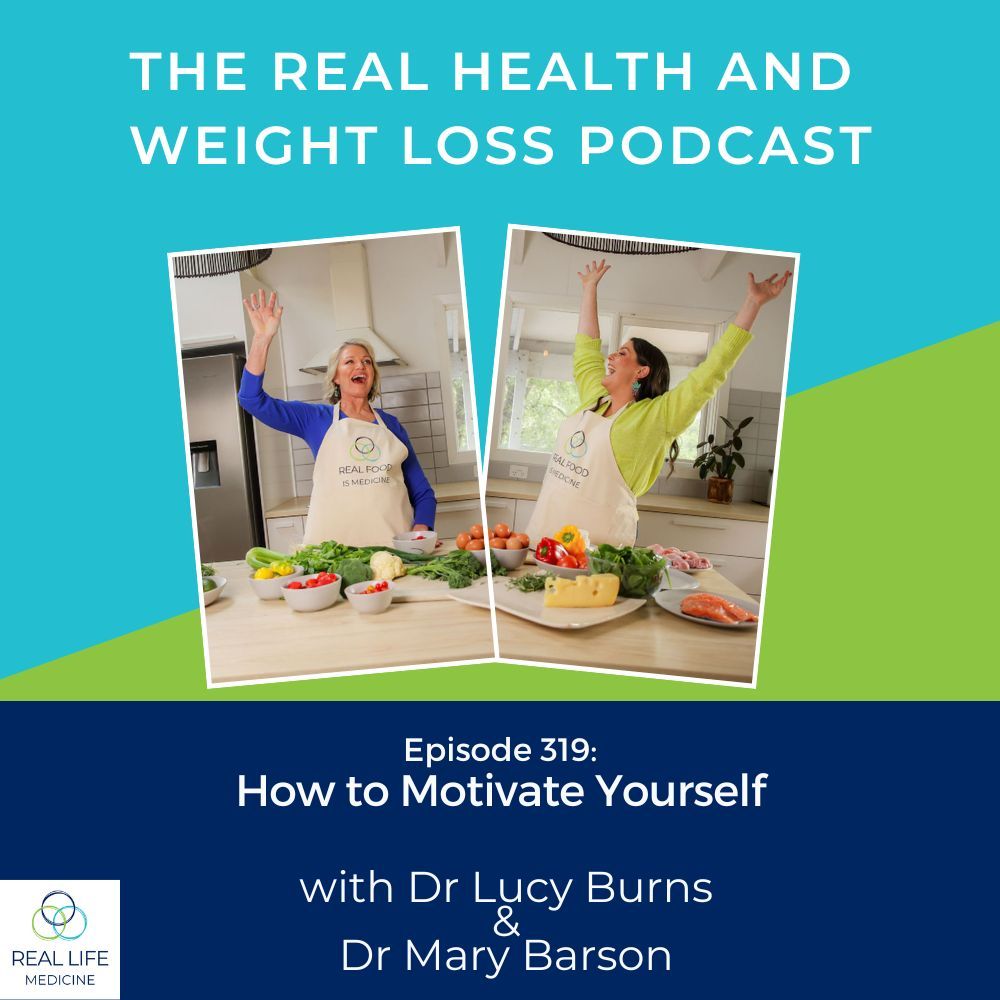

HOW TO MOTIVATE YOURSELF
One of Australia's Most Popular Podcasts with Hundreds of 5 Star Reviews

Grab your FREE Ebook copy now!
Have you struggled to lose weight and keep it off?
Start your journey to boost metabolism and transform your body into a fat-burning powerhouse.
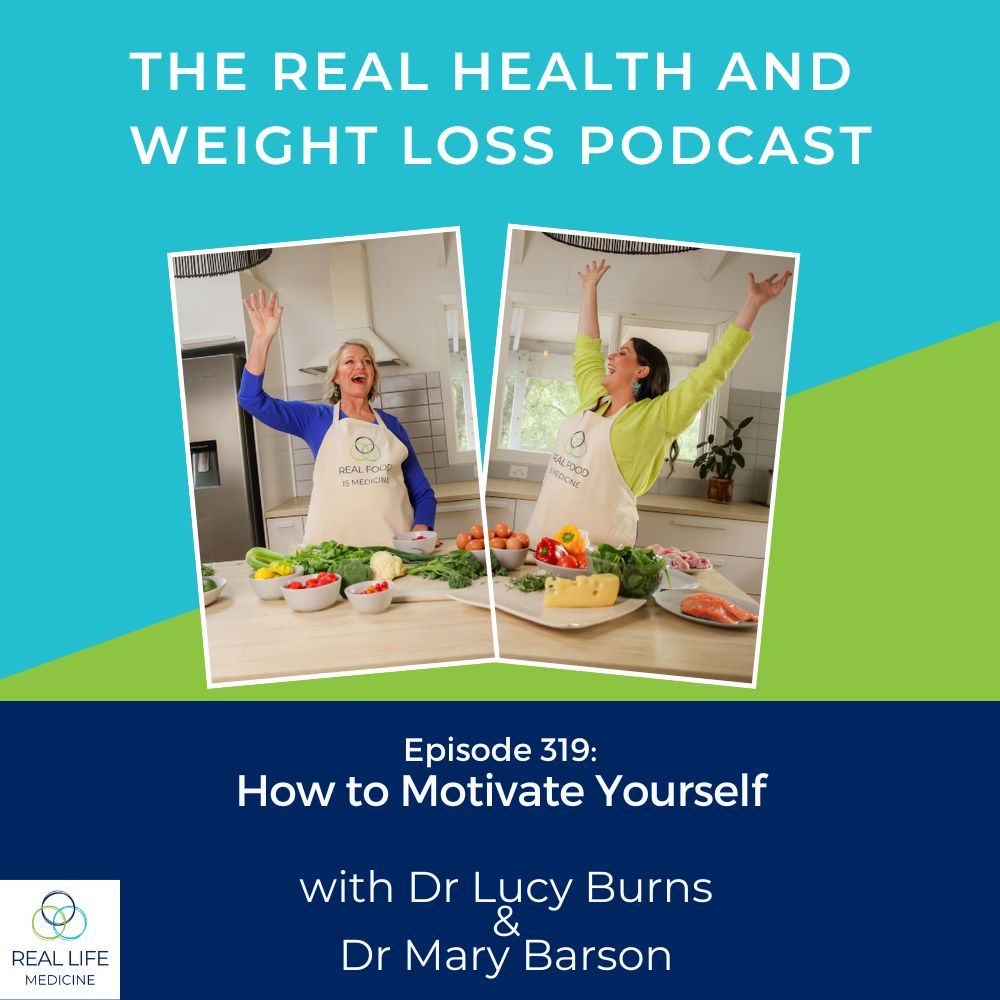
Episode 319:
Show Notes
Dr Mary Barson and Dr Lucy Burns discuss a simple mindset tool for making healthy habits easier: shifting attention from the effort a task requires to the benefit it delivers.
Key points
- The core idea: Dr Mary shares how she struggled to motivate herself to walk her dog on cold Victorian mornings until she stopped focusing on the discomfort (cold, rain, effort) and instead focused on the relief and benefit she'd feel afterwards. This small mental shift made the habit far easier to follow through on.
- Why our brains resist: Our brains naturally exaggerate effort and minimise reward due to recency bias, prioritising short-term comfort and safety over long-term goals. This is a survival mechanism, not a personal failing.
- The reticular activating system (RAS): Dr Lucy explains that the RAS filters the huge volume of information we encounter, showing us more of whatever we tell it is important, much like a social media algorithm. Focus on hardship and your brain shows you more hardship; focus on benefit and it shows you more benefit. This is also how habits form.
- Reframing the question: Instead of asking "do I feel like doing this?" (which often yields a no), ask "what benefit am I buying with this investment?" Examples given:
- Exercise becomes an investment in health, mental wellbeing and the dog's welfare, not just "having to go for a walk".
- Going to bed becomes "giving tomorrow's me a gift of an extra hour's sleep" or heading to your "rejuvenation palace", rather than a punitive bedtime.
- Noble procrastination: A pattern where the brain avoids a task not by claiming it is too hard, but by prioritising other people's needs or responsibilities as a more "justifiable" excuse. Dr Mary relates this to being in the sandwich generation, caring for both children and elderly parents, and notes the importance of recognising self care as ultimately benefiting those who depend on her.
- Thought model basics: Thoughts drive feelings, which drive actions and outcomes. Since not all thoughts are true or useful, ask "what is the most useful way to think about this?" Comparative reframes can help, for example thinking "at least I don't have to shoot and skin a bison for dinner" to make a task feel easier by comparison.
- Hormesis and comfort with discomfort: Dr Lucy describes deliberately reframing cold water swims or brisk walks as beneficial hormetic stress ("the colder, the better"). Growth happens at the edges of your comfort zone, not within it or far outside it, and pushing gently at those edges gradually expands what feels comfortable, both physically and psychologically.
- Knowledge plus implementation: The doctors close by emphasising that mindset tools alone are not enough. Real, lasting change requires both accurate knowledge and practical tools to implement it. This is not about guilt or rigid rules but making informed choices, illustrated through examples like moderate wine drinking or occasional less healthy meals.
Takeaway
This week, try noticing when you are focusing on the cost of a healthy action rather than its benefit, and consciously flip the question to "what am I buying with this effort?"
Work With Real Life Medicine
For a step-by-step approach to improving metabolic health in perimenopause, menopause and beyond, check out My Metabolic Action Plan. This doctor-led comprehensive programme gives you:
- Strategies to improve metabolism
- Skills to develop mindset
- Tools so you will implement!
Join My Metabolic Action Plan: www.rlmedicine.com/map
Episode 319:
Transcript
Dr Mary Barson (00:05) Hello lovely friend, I am Dr Mary Barson.
Dr Lucy Burns (00:09) And I'm Dr Lucy Burns.
Both (00:11) We are doctors, weight management and metabolic health experts. We are the creators of My Metabolic Action Plan, your two-step map to real health and weight loss, which is in fact the name of this podcast. Join MyMap now at rlmedicine.com.
Dr Mary Barson (00:29) Hello lovely friend, and welcome to this episode of The Real Health and Weight Loss Podcast. I am Dr Mary Barson, and as ever, I am joined by my beautiful blonde colleague, Dr Lucy Burns. How are you, fabulous human?
Dr Lucy Burns (00:45) Yes, I'm very well, thank you. Very well. Feeling very bright and festive in my pink and orange, which, if you're listening, obviously you can't see—but just imagine!
Dr Mary Barson (00:55) They can maybe hear it.
Dr Lucy Burns (00:56) Yes, yes, yes. And I do wear a lot of bright colours these days. I used to always have a black and grey wardrobe, and I think bright colours just make you feel better.
Dr Mary Barson (01:06) Yeah, use all the tools available to you. I love that. I love it. Well, it is quite cold here where I live in southern Victoria, and when it's cold, I find that my motivation for certain things does decline. In particular, my motivation to get outside and walk the dog in the morning is quite tricky. Lately, I've just been using this mindset tool that has been really helpful because I wasn't doing it. I wasn't walking the dog for a few days in a row, and it was feeling bad, and the poor dog was suffering. Then I just remembered this mindset tool. I realised I was really focusing on the effort of getting out, getting cold, being rained on, and all of these things. That was making it seem insurmountable, when I could just stay inside in my hoodie instead. But then I realised how much relief I would get if I did this activity—how much better I would feel. I would feel like I was looking after my dog, getting outside, getting some sunlight, and getting a bit of movement. When I focused on how much relief I would get, it became so much easier for me to just put on my gumboots, put on a coat, and take the poor dog for a walk in the rain. So I thought this could be a good podcast to talk about this mindset tool of focusing on the benefit, not the effort.
Dr Lucy Burns (02:35) Yes, absolutely, because at the end of the day, what we do and what we don't do is quite often dependent on what's going on in our head. Yes, totally. You know, it can sometimes seem like the whole world's floating against you. Maybe I'm feeling like that at the moment—who knows? But I think it's that old Henry Ford quote: "Whether you think you can or you think you can't, you're right." Depending on what you decide. Now, if you decide you can't do something, yeah… Again, we need to be sensible. You can't fly off a building—let's be reasonable. But within the realms of reasonableness, if you've told yourself you can't do it, or that it's too hard, or that it's too cold, or that it's too wet... yeah, you won't do it.
Dr Mary Barson (03:21) That's right. And it's an interesting thought exercise. What if one of the biggest things standing between where you are right now and where you want to be with your health goals isn't laziness, it isn't lack of willpower, it's not lack of knowledge, but it's just what you're paying attention to? If you pay more attention to the benefit that you get rather than the effort that it will cost, it could be much easier. I think it's natural. Most of us will naturally focus on how hard something is. That's just human nature. Our brain will often exaggerate the effort and minimise the reward because we have this recency bias. Right now, our brain will prioritise short-term comfort over long-term goals, and that kind of, unfortunately, is human nature. It's what we're wired to do. It's part of our survival strategy. If we feel good and comfortable, our brain equates that with feeling safe, and safe is good. We want to feel safe. So we will actually prioritise being safe, in inverted commas, over the fact that we care about our dog, that we care about our health, and that we care about all of these long-term goals. But we can help circumvent this by just shifting our attention. There's this one little psychological technique that can make those healthy habits so much easier. Focus on the benefit, not the effort.
Dr Lucy Burns (04:48) Absolutely. And, you know, you talked about recency bias, and we can talk a bit about the reticular activating system, which is part of our brain that filters information. There is a lot of information that comes in every day, every minute—lots of signalling, different colours, different lights, different sounds. Our brain is having to process it all. It actually can't take it all in, so it filters it into what it thinks is important. It works very much like the bloody Instagram algorithm. What you think is important is what it will show you. So if you've spent time saying, "This is going to be hard," it will show you how hard it is. If you spend time, as you've mentioned, focusing on the benefit, it will start to show you how beneficial it is. This is the concept of a habit, if you like. A habit is something that you do without a whole lot of thought. You might have a little bit of thought, but it's not tons. You're not having to go back and forwards with yourself. You just kind of do it because, all of a sudden, your brain has focused on the benefit of doing this thing, and the difficulty or the hardship becomes diminished.
Dr Mary Barson (06:00) Yes. It is a really simple thing to do. I'd like to just go back to the exercise example, perhaps. But this could be your meal prep. It could be going to bed. It could be anything.
Dr Lucy Burns (06:12) Doing your tax.
Dr Mary Barson (06:13) Doing your tax. Yeah, tax time. Totally boring. We have an internal dialogue, and it might not be an internal dialogue with full-on words and internal conversations. I have that. I have conversations with myself, but not everybody does that. Sometimes it can just be thoughts and feelings that are going on. With exercise, our brain wants to magnify the cost. "It's cold. I'm tired. It'll take too long." With meal preparation: "I can't be bothered. It's just easier to order takeaway." Going to bed: "Oh, just one more episode of this Chinese melodrama that I'm watching." I'm into Chinese melodramas at the moment. I speak a bit of Chinese, so I really quite like them. But I do need to go to bed, though, and not start watching them. Or with all the paperwork and tax: "I'll do it tomorrow." Because our brain is focusing—our reticular activating system is focusing—on the inconvenience, the discomfort, the effort, while ignoring the better health, the achievement, the confidence, the reduced stress, and the fact that we'll be achieving our goals. But if we can flip the question, instead of asking, "Do I feel like doing it? Do I feel like doing my tax this afternoon?"—the answer is going to be no. Instead, ask, "What benefit am I buying with this investment? What am I buying?" The answer is going to be completely different. So with exercise, it's not, "I have to go for a walk." It's, "I am investing in my health, my mental health, my muscles, and the wellbeing of my dog." That becomes much easier. It doesn't actually become that hard to grab your gumboots and your coat. Instead of, "I have to go to bed," you can think, "I am giving tomorrow's me the gift of an extra hour's sleep." That becomes much easier.
Dr Lucy Burns (08:14) Yes. Well, for sleep, I've got a little line, which is, "I'm heading to my rejuvenation palace." So, not "going to bed," because going to bed feels punitive. You know, that was always the story in nursery rhymes and fairy tales—that you got spanked and had to go to bed. So it's like, "Oh..." You know, yeah. Everyone... I always wanted to stay up late. So, you know, it feels boring to go to bed, whereas I'm off to my rejuvenation palace with my biohacking red mask. I am giving my glymphatic system time to get rid of all the metabolic waste in my brain. So yes, they're the benefits, aren't they?
Dr Mary Barson (09:01) Yes, they are.
Dr Lucy Burns (09:03) Yeah. Yeah. I love that. The other thing that is interesting to know, for some people's brains, is there is a phrase I like to call noble procrastination. What that is, is instead of your brain focusing on the activity, like the walk—because part of you knows that you could probably talk yourself into it—so it's not about, "Oh, it's too cold. It's too wet. You know, it's too horrible," because your brain might go, "Oh, they're pretty soft excuses. You should just go." Instead, it will prioritise other people's needs so that you're too busy to go. So it might tell you, "I would love to go for a walk, but I have to help blah, blah," or, "I would love to go for a walk, but I have to vacuum the house." I don't know... said no one ever, but maybe. Or, "I would love to go for a walk, but I have to do this project at work." So there's someone else's needs or some other priority ahead of your own that your brain will use because it has already rationalised, "Well, I can't just say it's too cold."
Dr Mary Barson (10:13) Absolutely. My brain is a master at this. I will think about every single thing that I could possibly do for everybody in my life rather than chunking in and prioritising those things that are initially a bit effortful but are going to help me. I am very good at subordinating my own needs for other people. It's a vulnerability I have that I need to guard against. Again, I really focus on, "What am I buying with this effort?" I can actually use that part of my brain to my advantage. I can think about how going for the walk and protecting my health is actually going to help the people who need me more in the long term. I'm a typical sandwich-generation woman. I have young kids and elderly parents, pulled in both directions. Honestly, no one is completely indispensable, but I do have people who need me. That can be a real curse and a drain, but I can take that thing that I value—being able to care for people—and therefore care for myself by focusing on that benefit. This is what I am buying with a small investment of my effort.
Dr Lucy Burns (11:31) Absolutely. At its very heart, this is the thought model. We use this a lot. Your thoughts determine your feelings and actions. Thoughts can come and go. We can make up our own thoughts. Not all the thoughts we think are true. So a useful technique is to ask yourself, "What is the most useful way to think about this problem or this action?" Because we do an action when we want a certain outcome. The whole reason you want to go for a walk is because you want your dog to be exercised so it doesn't chew the house down. You want your body to be moving so that you've got good muscles. You want your eyeballs to see the sunlight so you can sleep well tonight. So you've got all of these outcomes that you want. You've got the action that will get you those outcomes. The only thing stopping you, therefore, is your thoughts and feelings. So when you think, "It's cold. It's going to be cold and wet," you feel unmotivated. You're not likely to do the action to get the outcome. You can change that thought, as you said, and it can be all sorts of things. I would be thinking, "At least I don't have to go for a walk in Norway where it's minus 20." That is my way. I always default to this. When something feels a little bit hard, I think, "What is the harder thing?" You know, when I'm cooking dinner, I think, "At least I don't have to go and shoot a bison and skin it."
Dr Mary Barson (13:13) That's right. You don't have to go and, like, scratch the turnips out of the frozen ground with a stick. Yeah.
Dr Lucy Burns (13:19) No, no, to get my food. You know, to get my food. To go to bed—at least I have a comfortable bed. I'm not lying in a box with a piece of plastic over me in my rejuvenation palace. There are so many ways that you can make what you think is hard feel easier, because all that feeling can feel easier.
Dr Mary Barson (13:41) I love something that you have done recently too, Lucy, which is actually turning the thing that is hard into the benefit. So when you swim, you know, I remember you talking about swimming in your cold water and how it was helpful for you to do this in the morning, but the pool could be bloody cold. You told yourself, "No, good hormesis." And you would say, "The colder, the better. The colder, the better." Obviously, there is a common-sense limit to this, but it was helpful for you to just do the thing that was helpful. The colder, the better.
Dr Lucy Burns (14:16) Yeah. Yeah. Because we... and again, even thinking about the brisk walk, you know, sometimes I'll sit outside in the morning getting my morning light. I might do some meditating. It might be a bit chilly, but I do think about that hormesis effect. I think, "Well, actually, a bit of cold is good for you." We don't have to be living in this super comfortable environment that we have created for ourselves. The comfort is actually killing us. That's part of the whole idea. So, getting comfortable with being uncomfortable. We've spoken about that many times. It's actually not a bad thing to have a little bit of discomfort. What we don't want is the discomfort to be extreme because we'll stop doing that.
Dr Mary Barson (15:02) Yeah, that's one little thought thing I do. I'm training for discomfort. I'm training for discomfort. You know, when I'm walking up a hill and it's not pleasant. Yeah, this is good. This discomfort is good.
Dr Lucy Burns (15:14) We know that growth happens on the edges of your comfort zone. Nothing happens in the middle of your comfort zone. You just sit there like a... I don't know... bean bag. Whereas when you're on the edge of that comfort zone, just outside your comfort zone, it might feel a little bit scary. It might feel a little bit uncomfortable, but it's okay. When we go too far outside our comfort zone, that's probably when we've, again, taken things to the extreme. Then it doesn't feel safe for our brain, and we are unlikely to continue on with it. So it's always around the edges.
Dr Mary Barson (15:47) And the beautiful thing about being on the edges of your comfort zone is that your comfort zone grows and expands Our obvious example of this is getting fitter and stronger. The more you move and exercise, the fitter and stronger you become. What is comfortable and easy grows and expands. The same thing happens with us psychologically. The same thing happens with habits. You know, just changing our eating habits. If we're just pushing it a little bit, it becomes easier. It becomes comfortable. It becomes second nature. And, like you said, that is where growth happens.
Dr Lucy Burns (16:19) Yeah. And that then becomes just a habit that you do. You just eat and cook at home most of the time. Again, it doesn't mean all of the time. I mean, I get takeaway every now and then. I'll go out for dinner—not infrequently. We used to eat a lot of frozen pizzas. Aldi did this pizza that was goat's cheese and beetroot, which sort of sounded healthy.
Dr Mary Barson (16:40) Yeah, I get that.
Dr Lucy Burns (16:41) Yeah. And so I'd think, "Oh, well, good. We'll just have that for dinner." I sort of look back every now and then and think, "Wow. God. Ignorance."
Dr Mary Barson (16:54) You have grown and changed. Which is a great thing.
Dr Lucy Burns (16:57) Yeah. And that's not to say that if I ate an Aldi goat's cheese and beetroot pizza now, I would be wracked with guilt and shame about my actions. I wouldn't, because it doesn't help me. It's about knowing and then making a decision around that knowledge. Again, we teach a lot of that in all of our programs. It's not right or wrong, good or bad. You're the boss of you. What we want people to be able to do is make choices with the full knowledge of the implications of the action. And they may choose to do that. It's a bit like alcohol. I love drinking a glass of wine. It's not good for me. I've got no illusions in my brain that what I'm doing is good for me. But I am happy to take that bit of knowledge and use it, and know that if I were to develop a regular wine habit with, you know, probably more than the levels I drink now, that would be a problem. The way I look at it now, it's not a problem. But I'm not pretending. Again, I wasn't pretending that Aldi pizzas were good for me. I just didn't know. So yeah, I guess the summary being... I don't even know what I'm waffling on about. Education is really helpful so that you've got the right knowledge because, without the right knowledge, you go in the wrong direction.
Dr Mary Barson (18:25) That's right. You could have all the mindset tools in the world, but without the right knowledge, you're implementing the wrong things.
Dr Lucy Burns (18:30) Yes. Yes. So that's where that circle, where that wafty little thing, is going. You definitely need two things. You need the right knowledge, and you need the implementation tools. Because knowledge without implementation means you don't go anywhere. And the wrong knowledge with implementation means you can actually go in the wrong direction.
Dr Mary Barson (18:50) Precisely.
Dr Lucy Burns (18:52) Yes. So there we go. All right, my friends, as always, if you're wanting the right knowledge and you want some implementation tools, of course you can come and join us in My Metabolic Action Plan. This is what we do day in, day out, with all of our lovely peeps. So there we go.
Dr Mary Barson (19:07) We'd love to see you there, but wherever you are, just think this week about what you can do to focus on the benefit rather than the cost, and make those healthy changes easier. Bye now.
Dr Lucy Burns (19:18) Bye now.
Dr Lucy Burns (19:22) The information shared on the Real Health and Weight Loss Podcast, including show notes and links, provides general information only. It is not a substitute, nor is it intended to provide individualised medical advice, diagnosis or treatment, nor can it be construed as such. Please consult your doctor for any medical concerns.