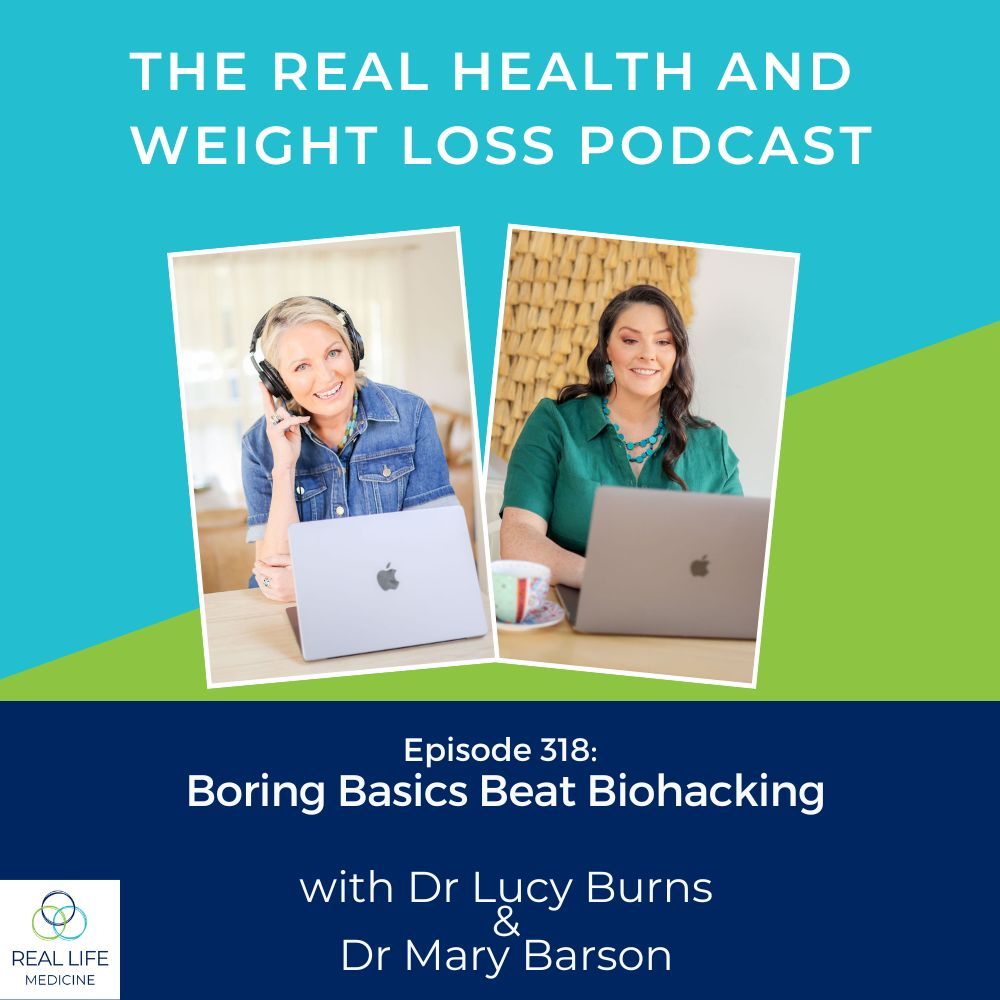

BORING BASICS BEAT BIOHACKING
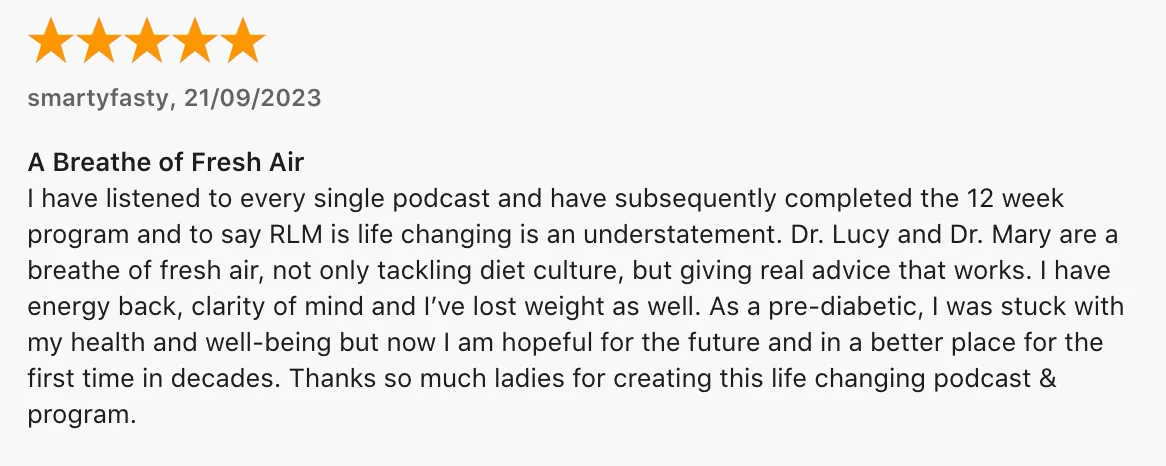
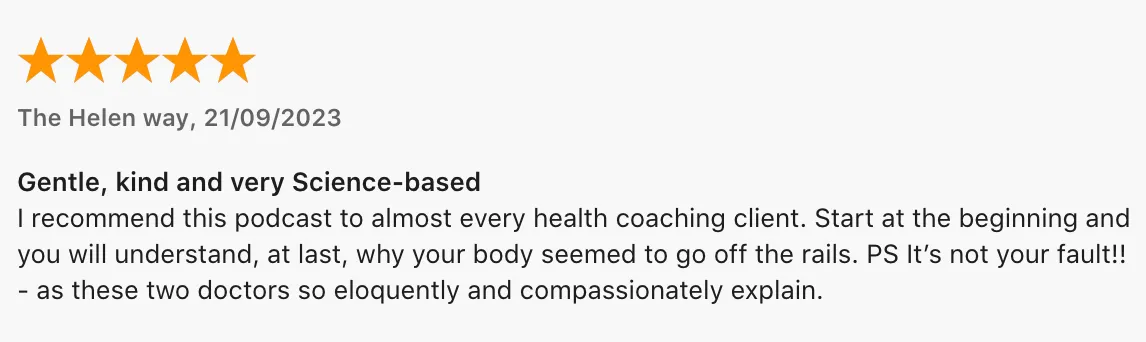
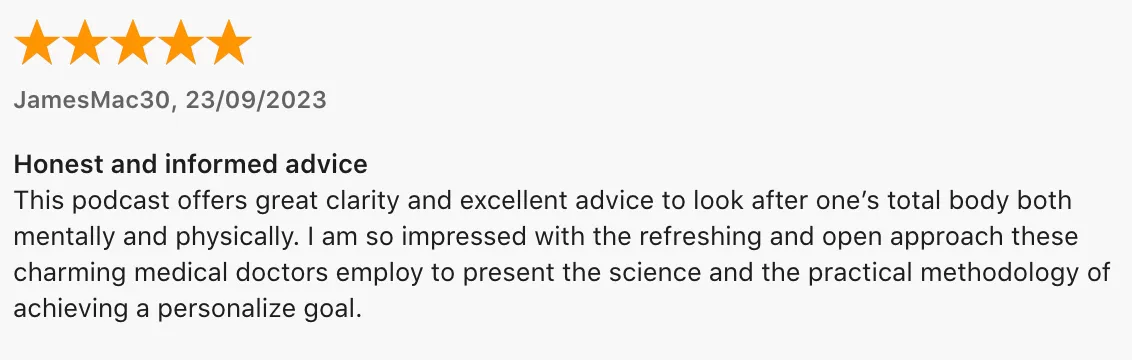
One of Australia's Most Popular Podcasts with Hundreds of 5 Star Reviews

Grab your FREE Ebook copy now!
Have you struggled to lose weight and keep it off?
Start your journey to boost metabolism and transform your body into a fat-burning powerhouse.
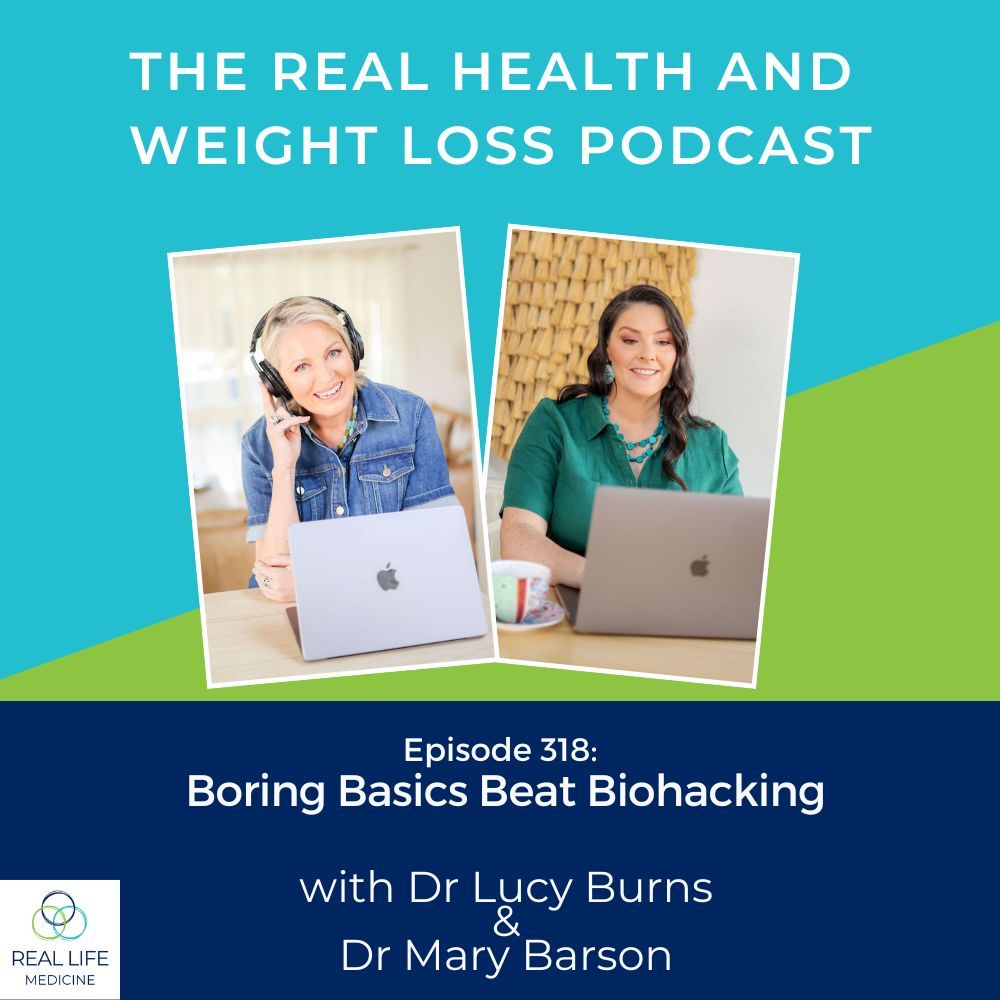
Episode 318:
Show Notes
This episode celebrates six years of Real Life Medicine by returning to the fundamentals of metabolic health, the "Six S's", and explaining why these basics outperform trendy biohacks.
Biohacking vs the basics
Dr Mary and Dr Lucy argue that biohacking (trackers, supplements, red light masks, cold plunges) usually requires buying something, whereas the Six S's simply require consistent action, without any purchase necessary. They note that biohacking often preys on our brain's love of novelty and "secret knowledge," but if quick fixes actually worked, chronic disease rates wouldn't be rising as they are. They use a Christmas tree analogy: the Six S's are the tree (the essential foundation), while biohacks are just baubles that serve no purpose without the tree already in place.
The Six S's explained
- Sustenance: nourishing the body with low carb, high protein, real food, and plenty of fibre; simple "cook hacks" like pre-chopped onions make this easier without needing fancy meals.
- Sleep: the body's overnight repair system, influencing appetite, hormones, mood and metabolism; going to bed on time and screening for sleep apnoea (especially relevant in perimenopausal women) matter more than sleep-tracking gadgets.
- Strength and movement: muscle acts as a metabolic organ, and regular movement protects against the harms of sedentary behaviour; the "10,000 steps" target was actually pedometer marketing, with real benefit closer to 6,000 steps.
- Stress management: focusing energy on what's within your control and practising genuine physiological relaxation (not just Netflix) via meditation, journaling, tapping or hypnosis helps regulate the nervous system.
- Sunlight and circadian rhythm: just 5 to 10 minutes of morning sunlight supports circadian hormone regulation; vitamin D supplementation is a reasonable substitute in winter or for those with darker skin.
- Social connection: an often undervalued S, physiological wellbeing depends on belonging and community, which can come through in-person or online connections, with no one-size-fits-all amount.
Key takeaway
Doing these six fundamentals moderately well, not perfectly, is said to outperform 95% of health influencers and trend-chasers, because these basics are described as foundational rather than simply "easy".
Work With Real Life Medicine
For a step-by-step approach to improving metabolic health in perimenopause, menopause and beyond, check out My Metabolic Action Plan. This doctor-led comprehensive programme gives you:
- Strategies to improve metabolism
- Skills to develop mindset
- Tools so you will implement!
Join My Metabolic Action Plan: www.rlmedicine.com/map
Episode 318:
Transcript
Dr Mary Barson (00:05) Hello lovely friend, I am Dr Mary Barson.
Dr Lucy Burns (00:09) And I'm Dr Lucy Burns.
Both (00:11) We are doctors, weight management and metabolic health experts. We are the creators of My Metabolic Action Plan, your two-step map to real health and weight loss, which is in fact the name of this podcast. Join MyMap now at rlmedicine.com.
Dr Lucy Burns (00:29) Good morning again, lovely friend. Happy Tuesday if you're listening to this on Tuesday, or happy other day of the week if you're listening on a different day of the week. I am joined by the fabulous Dr Mary, so welcome, friends. Hello, Miss. How are you?
Dr Mary Barson (00:44) I am well, Lucy. I would like to hear, how are you going? What's happening in your beautiful life?
Dr Lucy Burns (00:50) Ah, in my life, well, I am great. I have had a couple of little trips up to Queensland. I live in Victoria, which is in the depths of winter, and it's very dark and it's quite cold. We have had a reasonable winter, so I can't complain too much, but I am NOT a winter person. No, you are not. No, I don't like the cold, I don't like the dark, I don't like the drizzle. I much prefer sunlight and warmth. So we are heading back to Queensland again. One of my daughters lives in Queensland, so we've had a few little trips up there this year and, yeah, so I'm happy.
Dr Mary Barson (01:26) That sounds fabulous. I myself am feeling quite celebratory at the moment because we have recently, without much fanfare, ticked over six years of working together at Real Life Medicine, which is awesome. And it's been a wonderful six years. It's also kind of hard to believe that it's been six years. How time flies is always a marvel for my brain. It shouldn't be, but it is. So there you go. I thought this would be a great time for us to go back to basics. We've been in this game for six years, and a lot has changed in that time. What we talked about last week really highlighted that. This is an evolving landscape in weight loss and metabolic health, but the basics are still very, very important. The six S's, in particular, that we love to talk about are really important. So we thought we'd celebrate six years by going back to basics and talking about the six S's, but also about why the basics beat the biohacks. We could talk about biohacking and the six S's today.
Dr Lucy Burns (02:37) Yeah. And it's interesting, biohacking. Again, we can talk about diet culture as part of that because there is some diet culture, which is really this idea that your worth as a human depends on what you look like, essentially. It can even go back to aesthetic medicine, aesthetic non-medicine, health and beauty. They're all intertwined. And at some level, biohacking can easily morph into a different version of diet culture. There's a lot of promises. There's this idea that you're going to live longer if you do this. That's not always true.
And not only are you going to live longer, you're going to somehow look healthier, look better, because you're biohacking, whatever that means.
Dr Mary Barson (03:30) If you've spent any time on social media lately, which is probably most of us, you could be forgiven for thinking that getting healthy requires a complicated morning routine, a box full of supplements on top of your fridge, a cold plunge, a continuous glucose monitor, a red light panel on your face, and a long list of all of these hacks and shiny objects with the promise of a quick fix that will help us get healthy. But if that worked, then we probably wouldn't be facing the big tsunami of chronic disease that we currently do. I think after being in this game for six years, we have definitely come to a very different conclusion. Health isn't a series of biohacks. It really is about the fundamentals, which really doesn't make for a particularly clickbaity Instagram post, unfortunately. It's hard to make it sound super sexy.
Dr Lucy Burns (04:30) No, and you don't need to buy anything to do it. Biohacking involves buying something. It's buying a tracker, buying a supplement, buying a bloody sauna or whatever. You have to buy something. You can't just do it. Whereas the six S's that we love to think about, you just do them. If you do these six S's, and they don't have to be done perfectly, but if you do them moderately consistently, then you will beat the biohackers without buying anything. Instead of biohacking, it should be called buying hacking.
Dr Mary Barson (05:10) That's right.
Dr Lucy Burns (05:11) I think it should. Yeah. And to be honest, I think that a lot of people will buy something because it's part of that pre-contemplative phase that we talk about in behaviour change. We often joke that you never use the word pre-contemplative unless you're giving a talk on behaviour change. But it is this idea that when you're thinking about changing or you're thinking about doing something, you get ready. So if people are wanting to stop smoking, they'll go and download the Quit app, make a date to stop, get rid of all their ashtrays or whatever it is. It's the same when people are wanting to improve their health. They'll go and order a supplement, buy a tracker, get a new smartwatch, whatever it is.
Dr Mary Barson (05:58) And that's OK. I don't think that's necessarily a bad thing, as long as it doesn't come at the expense of those fundamentals, actually doing the do. Human brains are wired to love the concept of a biohack. It totally appeals to our fundamental psychology. We just want something to work. We're looking for the shiny object. We're looking for a tool that's going to make it inherently easy. We love the promise of, "Just buy this and you will have improved longevity, improved weight..." We are constantly bombarded with these messages, especially on social media. But before social media, we were still being bombarded with them, just through different mediums and different ways. These tools aren't necessarily inherently bad. Some of them are, but I would say that most of them probably aren't terrible in and of themselves. But if we get distracted by this idea of optimisation before we've really built the foundations and been able to key in on just doing the basic things right most of the time, then we're not going to get anywhere. How many people own a smartwatch but still don't get enough sleep?
Dr Lucy Burns (07:17) You know?
Absolutely. It's the promise of things, sometimes.
I was thinking, as we were talking about this, of useless things I've bought over the years with the promise of something. I reckon one of the most useless things I've bought is a foot spa bath.
Dr Mary Barson (07:34) Oh, I think I've bought three of them over my life. I know. And it's always ended the same way.
Dr Lucy Burns (07:41) Yeah. You've got this idea that you're going to sit down while you're watching telly and do your pedicure and blah, blah, blah. And you don't. It just becomes clutter. I think probably red light masks will be the same. I don't know if anybody's seen those things, but it's this idea that you wear this mask, you look like a Jedi, and somehow you're going to have perfect skin. So, yeah, anyone who wants to buy me a red light mask, don't bother. I'm not going to use it. We've used an analogy in the past, which I think is a good one, just to remind people of the Christmas tree. The Christmas tree is the foundation, the six S's, and we'll go through them again. The baubles are nice. Again, if you want to buy a red light mask and you're going to use it, go for it. But there's very little use doing it if you're getting four hours of sleep a night, not drinking your water, and you're stressed to the bejesus.
Dr Mary Barson (08:39) That's right. It's kind of like having your baubles just lying sadly on the floor if you haven't got that Christmas tree up. Even just a plain old Christmas tree can be quite festive. The baubles are great, but they serve no purpose without the foundations. Our brains are wired to want them. We love the one weird trick, the secret knowledge, the "Doctors don't want you to know this," or "This thing changed my son's life, my life." These are the messages we get, and our brains want them. Marketing preys on this very human psychological need for novelty, shortcuts, secret knowledge and optimism bias. "This is finally the answer." It can also provide healthy procrastination, where you research, you plan and you do all those things. But it is no substitute for what is far less dopamine-y: actually taking action and doing the do.
Dr Lucy Burns (09:39) Yeah. And again, we talked last week about trends, and I was thinking about this between episodes. No one's really talking about this so much anymore, but antioxidants were the biggest trend ever. You could buy super greens or whatever it was, full of antioxidants. No one's really talking about antioxidants anymore. They're still really useful, but again, you can just get them from one of the S's. Actually, all of the S's are antioxidant therapy. You don't need to sit in an oxygen tent. You can do the six S's, and you will improve your antioxidant levels and reduce the need for antioxidant supplements by a trillion percent.
Dr Mary Barson (10:20) That's right. Let's go through the six S's. As you and I have been working together for six years, lovely Lucy, what are the six S's?
Dr Lucy Burns (10:29) Yeah. So the first one is sustenance, which is always a slightly naff word, but it's the only S that fits for nutrition.
So, your sustenance. What do you use to sustain your body? What do you use to nurture and nourish your body and brain, which is part of your body? I don't know why we always talk about the brain as though it's a completely separate thing. It's not. And of course, following on from Is low carb still relevant? Yes. Low carb, high protein, real food, plenty of fibre. You'll get all of that. It is actually easy to do if you know how, and it doesn't have to be fancy. You don't have to cook a billion different meals. Again, I reckon rather than biohacking, I look at cook hacking. What are some hacks for cooking that make real food cooking easy? One of my favourites is buying chopped onions. Already done. Yeah, that is pretty easy. Yeah, it's a great hack. No extra additives. I just don't have to chop the onion. You know, Mingle seasonings, that's why we use them, because they're real spices. Easy. I don't have to measure them all out and do all that. It's just done for me. So we're not about making life hard. It's all about making life easy. But it's about bang for buck. Absolutely. Definitely. So yes, the first is sustenance. May I say the second is sleep? Tell us about sleep. Yes.
Dr Mary Barson (12:02) So sleep is our overnight repair system. Sleep is not just rest, although it is rest. Sleep is a complex, powerful process where our brain and body cycle through different physiological states, and we do all kinds of amazing things to repair, protect and heal. Sleep is precious, and we need it. Sleep influences our appetite, our hormones, our mood, our brain, our muscles, our metabolism, everything. We need to protect our sleep.
Dr Lucy Burns (12:42) Yes. We often steal from our sleep to somehow increase productivity in the day, but that is often a fallacy. Again, there will be people out there who might be getting anxious that they're not getting enough sleep, especially if they're wearing their smartwatch, which tells them they're not. So again, I think there are things we can make sure we're doing. Go to bed on time. You can't possibly get eight hours of sleep if you're not in bed for eight hours. So that's boring and basic, but go to bed. Then there's sleep hygiene, which is always a naff phrase. I really hate that phrase. It is a naff phrase. Yeah. Sleep hygiene. But just having a reasonable sleep routine. Don't lie in bed scrolling on your phone, then wonder why your eyes are wired and you can't sleep. Some people are much more sensitive to night light than others. You may find that you can do that. Well, yay for you. But if you're wondering why you're still not tired and it's one a.m., then that's where we look at some of your sleep routine. Sleep apnoea is really, really prevalent, really common and very underdiagnosed, particularly in the perimenopausal midlife woman. So it's definitely worth... That would be my biohack. Get a sleep study. Here's the other thing about biohacking. Biohacking has to be sexy.
Dr Mary Barson (14:07) Yes.
Dr Lucy Burns (14:08) Not very. Yes. Sleep masks.
Dr Mary Barson (14:11) They're not sexy. No. You've got to get health check-ups. Not sexy. Going to bed on time. Not sexy. And yet… Very, very helpful.
Dr Lucy Burns (14:21) Very helpful. Next S is strength and movement.
Dr Mary Barson (14:28) Yeah. Our bodies are designed to move. Muscle is a metabolic organ, and moving our body creates multiple healthy hormones and changes throughout the body. It helps protect against the damaging effects of being sedentary. Not moving is bad for our health. It is pro-inflammatory. It sets up physiological responses in our body that are bad for our health. So just moving, even just a bit, doing little movement snacks throughout your day, helps protect you from the damaging effects of being completely sedentary. It doesn't have to be going to the gym every single day. Just some movement is beneficial. Moving our muscles and building and maintaining muscle is also helpful. Doing a bit of heavy work, whether that's bodyweight exercises or lifting heavy things, is really helpful.
Dr Lucy Burns (15:36) Yeah. But here's an example of how I think biohacking has been detrimental. The magic 10,000 steps a day all came about from the marketing of a pedometer company. The pedometer company came up with this elusive 10,000 steps a day. You need to achieve this for good health, yada yada. Here's our machine. It will help you track this. You just put it onto your shoe, or whatever it was back then. Suddenly, that became the goal. But there's no evidence for that. In fact, the evidence really sits closer to 6,000 steps. Yes, you get a bit more benefit if you do a bit more, but it's the law of diminishing returns. So, you know, 6,000 didn't sound nearly as good as 10,000. It's all marketing.
Dr Mary Barson (16:25) That's right. Ten thousand has a nice roundness to it.
Dr Lucy Burns (16:28) Yeah. And what happens is people feel like they're not achieving if they're not doing their 10,000. Then they can feel deflated and think, "What's the point?" and just do nothing.
Dr Mary Barson (16:39) "I can't do that every day. If I can't get 10,000, I might as well just stick with my 800."
Dr Lucy Burns (16:43) Yeah, exactly.
Dr Mary Barson (16:45) Yeah.
Dr Lucy Burns (16:46) So again, being aware of your mindset, because sometimes it can be helpful to realise, "Oh God, I've hardly moved today. Gee, I better get my ass outside and do something." That can be useful, but you just need to know yourself well, I think. Yes.
Dr Mary Barson (17:00) Yeah. And a little bit goes a long way. I'm jumping ahead, but each of these six S's fits into the others. Just five minutes of movement can dramatically improve your sleep architecture. They all work synergistically. Next is stress. We haven't talked about stress yet, have we, Lucy?
Dr Lucy Burns (17:21) I'm getting lost in my S's. No, definitely not. It's really tricky. Somebody asked me one day which S is the most important. I was thinking, well, they all are. But I would say that when we're very stressed, we're less likely to do the others. We're less likely to eat well. We're less likely to sleep well. We're less likely to go and do some movement because we feel like we haven't got time. So if we can learn to manage our stress… It's interesting because, as we've spoken about many times, stress management is not the exclusion of external stressors. It's the way we respond to them. Well, there's two things. I think it's working out what's within our control and what's outside our control. Our brain loves to spend all of this energy on things that are outside our control. I don't know why. I haven't quite worked out why we do that.
Dr Mary Barson (18:15) It's a survival mechanism. I think we're just constantly looking for threat. That's hardwired into us. But when we are perseverating over what our adult children are doing with their lives, or perseverating over what foreign politicians are doing, it isn't very helpful to our lives right here, right now. You can't make foreign politicians behave themselves. You can't necessarily control the adult children in your life, the state of the economy, or all these other things. But you can work on how those things affect you by improving your own resilience.
Dr Lucy Burns (18:51) Yeah, absolutely. That's something we teach a lot at Real Life Medicine, focusing on the things that are within your control. Working out what's important to you. What is your brain spending its time on that it actually has no influence over? When it does that, it steals time from the things it can control or the things that are important. Then we also want to look at how we manage the metabolic or physiological effects of stress. At its most basic level, stress is a reaction to a perceived threat. That threat may be real or imagined. Our body has very clever built-in mechanisms that enable us to react to those threats. They're useful. But what's supposed to happen is that we also have times when we're not stressed, where we're just relaxing. That's it. Physiological relaxing, not Netflix relaxing.
Dr Mary Barson (19:50) Yes. And I'm not dissing Netflix relaxing. It has a place. But physiological relaxing, active relaxation as we call it, where you intentionally upregulate your rest-and-digest, parasympathetic nervous system, helps regulate your nervous system. Being in a stress response is helpful in the short term. We can run away from a sabre-toothed tiger. We can fight off people who are attacking our children. We can concentrate really hard on the exam we're sitting right then and there. Helpful? Yes. But if we spend too much time there, it is quite disastrous for our metabolic health, our appetite, our sleep, pretty much everything. So actively relaxing helps balance that, allowing your central nervous system to stay in a healthier balance. That is a crucial S, one of the six S's.
Dr Lucy Burns (20:51) Yeah. And the tools we use to help people get to that state include meditation. We all do progressive muscle relaxation. We teach people journalling, and journalling is really useful. There's some skill to it, I think, but it's really, really useful. You can do tapping. We teach hypnosis. Going for a walk outside, which ticks off a couple of other S's, is also a stress reduction technique. So they're all like little jigsaw puzzle pieces, these six S's.
Dr Mary Barson (21:30) Yes, they are. The next S is sunlight and circadian rhythm. We put sunlight in there to make it an S, particularly morning light and daily rhythms. This is really important and often overlooked, although the biohackers are encroaching on this with extreme circadian optimisation. I think you just need to take a step back and make sure you're not devoting all of your energy into this one S alone. It is important, but it doesn't have to be hard. It can actually be really, really simple. Like you were saying before, Lucy, biohackers overcomplicating circadian rhythms have been flooding your feed. But it can be as simple as getting five to ten minutes of morning sunlight sometime in the morning, ideally within an hour of waking. That's not always going to happen. Sometimes the sun isn't up when you wake up. Sometimes you just can't, for whatever reason. But getting five to ten minutes of sunlight in the morning sometime is great. Really good.
Dr Lucy Burns (22:43) Absolutely. We talk about the benefits of sunlight, and there are multiple. Morning sunlight gets into the eyeballs and goes to your suprachiasmatic nucleus, where our body clock rhythms are regulated. All of our hormones run on these rhythms. Insulin resistance increases in the evening. We've got melatonin, we've got cortisol. They are all circadian hormones. So getting some sunlight into your eyeballs is helpful. Getting vitamin D into your skin is helpful. We want to do it during safe times, where we're not exposed to extreme sunlight in the middle of the day. I'm going to be honest, though, it is hard to do in winter. Oh, it is. Especially if you live in a cold climate, because you might be able to go outside, but usually I'm in the equivalent of a ski suit because I get cold.
Dr Mary Barson (23:41) I'm not walking around outside in a bikini or my bathers on a cold day like today.
Dr Lucy Burns (23:47) No, because it's just not pleasant. Whilst people might tell you that's what they do on Instagram, we also know that human nature is unlikely to continue with a habit if it's unpleasant. So we want to make it as pleasant and as reasonable as possible. For some people in winter, they might need to supplement with vitamin D. That's actually OK. You'll see people on the internet saying, "Oh, that's terrible." It's not terrible. Sometimes it's a necessity, and there's nothing wrong with it. It just drives me nuts.
Dr Mary Barson (24:22) And some people have darker skin. If you live in an area where it's not super sunny all the time, then it is just harder to get your vitamin D because your body is adapted to protect you from brighter sunlight. If there isn't bright sunlight, then that's a slight disadvantage. So yeah, it's OK to find a way around these things.
Dr Lucy Burns (24:42) Oh, I know. Fun little fact. We used to have alpacas, and alpacas are from Peru. They live on the Altiplano at really high altitudes where the sunlight is strong. They've got this very thick fur, and that's where they get their vitamin D. When you bring alpacas to Australia, where we live without those high altitudes, they can become vitamin D deficient. We used to have this black alpaca, and we had to give him vitamin D because he developed a deficiency. Again, this is an example of a creature whose biology is not adapted to the environment. The same applies if you live in Melbourne and have darker skin. You probably need a vitamin D supplement. Just saying.
Dr Mary Barson (25:28) Yeah, it's quite likely. And the last S is probably not one we spend a lot of time talking about. We do talk about it, but perhaps not enough. I think it can be one of the more undervalued S's for health intervention, and that's social connection.
Dr Lucy Burns (25:44) Yeah, it's interesting. We don't talk about it a lot, except of course we talked about it all the time during the COVID lockdowns, which was six years ago now. It suddenly became something everybody noticed. I think it's one of those things people take for granted if they have it. If they don't have it, they're often very aware of loneliness. Loneliness is not good for humans. It affects people in different ways. Some people feel lonely even though they have a lot of friends because they don't feel connected to them or don't see them enough. Someone else might be quite content with solitary living and only need a smaller amount of social connection. So I don't think there's a magic amount. It's individual.
Dr Mary Barson (26:34) Yes. People can get it in different ways. There are people who are perfectly happy just hanging out with their kids. There are other people for whom only being able to hang out with their kids is nowhere near enough. So it is very individual. But as humans, part of our health, our actual physiology, requires us to feel connection, community, belonging and purpose. Social connection can also give us accountability, which is helpful in many, many ways. Having a tribe is important. It can even be an online tribe. I do think we need actual physical interaction as well. Human touch is really helpful. But online communities should not be dismissed as useless because they aren't. They can actually be very good for our health.
Dr Lucy Burns (27:24) Yeah, absolutely. I think you're right. There's a mixture of both. We saw this recently when we ran a retreat for our Momentum members, where we had 17 beautiful women connecting. We connected in a way that is different from being online. It's a bit like the exercise salad. You can have a social connection salad, a bit of everything. You might have a church community where you feel connected. You might have a community where you play cards with someone. You might have a community where you visit someone who's lonely. Or you might simply have a group of people you share hobbies with, like seeing the same people every day at the dog park. It can be all sorts of things. There's no magic formula, but there is something.
Dr Mary Barson (28:16) Yeah. Our physiology needs it. Without it, or even the perceived lack of it, our metabolic health suffers.
Dr Lucy Burns (28:26) Indeed. So that's the six S's. Sustenance. Sleep. Strength and movement. Stress management, or stress reduction. Sunlight and circadian rhythm. And social connection. This is what we teach all the time. This is what we do with My Metabolic Action Plan, which really is your map for metabolic health. It doesn't require you to buy things. You can absolutely do My Metabolic Action Plan by yourself. You don't necessarily have to be part of our community to do it. You can do all of those things on your own. If you want to do it with us, of course you can. That's what we've created it for. But we're not saying you can't do it without us. You can.
Dr Mary Barson (29:13) Yeah, that's right. Health isn't hidden. It's not locked inside expensive technology. It's not only for people with perfect discipline. We've created My Metabolic Action Plan as an accessible tool for people, but it's not the only way to achieve good metabolic health and feel well within yourself. These fundamentals are there for everybody. If you only did these six S's reasonably well, not perfectly, just reasonably well, you would seriously outperform 95 per cent of health influencers and people chasing the latest trend.
Dr Lucy Burns (29:51) Oh yeah, absolutely. And always have a look at what they're selling. Again, think about the supplements and the claims. That's the other thing. Many of these biohacking products make claims that don't need to be substantiated. Sometimes the claims… I went to a little market on the weekend, and there was magnesium oil, which I actually think is a good thing. But the claims? I'm thinking, "No way, mate." I don't have a problem with magnesium oil, but you're not curing this with a spray on your feet. Just be mindful. If you do the six S's, it's not a guarantee of perfect health because things can still happen. We see that all the time. But it is certainly the best place to start. No matter where you are in your health journey, the six S's will help you.
Dr Mary Barson (30:49) The basics aren't basic because they're easy. They're basic because they're foundational.
Dr Lucy Burns (30:56) Yeah.
Dr Mary Barson (30:57) They're the base that everything else is built on.
Dr Lucy Burns (31:03) Indeed. Indeed. All right, lovely friends. We will see you all next week. Have a fantastic, successful Six S's week. Bye now.
Dr Lucy Burns (31:06) See ya.
Dr Lucy Burns (31:10) The information shared on the Real Health and Weight Loss Podcast, including show notes and links, provides general information only. It is not a substitute, nor is it intended to provide individualised medical advice, diagnosis or treatment, nor can it be construed as such. Please consult your doctor for any medical concerns.