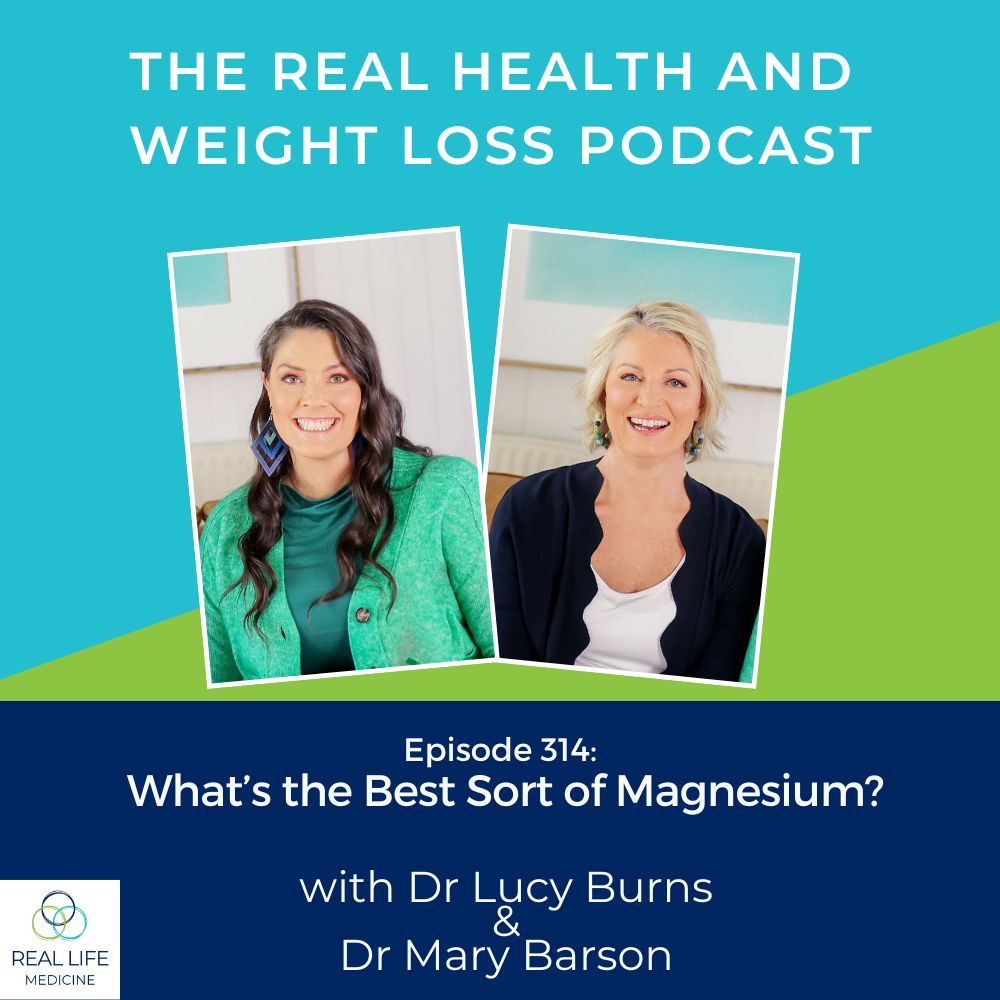


WHAT’S THE BEST SORT OF MAGNESIUM?
One of Australia's Most Popular Podcasts with Hundreds of 5 Star Reviews




Grab your FREE Ebook copy now!
Have you struggled to lose weight and keep it off?
Start your journey to boost metabolism and transform your body into a fat-burning powerhouse.
Episode 314:
Show Notes
Magnificent Magnesium
Dr Mary Barson and Dr Lucy Burns dive into the science behind magnesium supplementation, cutting through marketing hype to help listeners make informed choices.
Why Magnesium Matters
Magnesium is involved in over 300 enzyme reactions in the body, making it essential for survival. It plays a critical role in ATP (energy) production, insulin signalling, blood pressure regulation, immune function, and reducing inflammation. People with insulin resistance, PCOS, and type 2 diabetes are frequently found to be low in magnesium.
Food First
Magnesium is found naturally in nuts, seeds, dark leafy greens, avocado, and cacao/dark chocolate, all staples of a Real Life Medicine eating pattern. People eating a whole, real food diet can often meet their magnesium needs without supplementation.
When to Consider Supplementing
- During the transition to a low-carb diet, when the kidneys excrete more minerals
- For muscle cramps, particularly in athletes on a low-carb diet
- To support sleep and reduce mental "chatter" at night
- As an adjunct (not a cure-all) for stress management
- For people with insulin resistance or metabolic dysfunction
Choosing the Right Form
|
Form |
Absorption |
Best For |
Notes |
|
Magnesium glycinate |
Good |
General use, sleep, loose bowels |
Recommended most often |
|
Magnesium citrate |
Good |
Constipation, low-carb transition |
Laxative effect |
|
Magnesium L-threonate |
Good (brain-targeted) |
Sleep, cognition |
Promising but limited evidence; expensive |
|
Magnesium oxide |
Poor |
Not recommended |
Cheap but poorly absorbed |
Dosing and Safety
A safe daily upper limit is around 400 mg of elemental magnesium for most people. Always check the label for elemental magnesium content rather than the total compound weight.
Important Warnings
- Vitamin B6 toxicity is a real risk: many magnesium supplements contain hidden B6, which can cause peripheral neuropathy, especially if you are also taking energy drinks or hair and nail supplements. Always read the full ingredients list and choose a plain magnesium supplement.
- Magnesium can interact with prescription medications by competing for absorption. Speak to your pharmacist or GP, as simply spacing out the timing is usually all that is needed.
Work With Real Life Medicine
For a step-by-step approach to improving metabolic health in perimenopause, menopause and beyond, check out My Metabolic Action Plan. This doctor-led comprehensive program gives you:
- Strategies to improve metabolism
- Skills to develop mindset
- Tools so you will implement!
Episode 314:
Transcript
Dr Mary Barson (00:05) Hello lovely friend, I am Dr Mary Barson.
Dr Lucy Burns (00:09) And I'm Dr Lucy Burns.
Both (00:11) We are doctors, weight management and metabolic health experts. We are the creators of My Metabolic Action Plan, your two-step map to real health and weight loss, which is in fact the name of this podcast. Join MyMap now at rlmedicine.com.
Dr Mary Barson (00:22) Hello, lovely friend, and welcome to this episode of The Real Health and Weight Loss Podcast. I am Dr. Mary Barson, joined by my fabulous colleague, Dr. Lucy Burns. Hello, lovely human.
Dr Lucy Burns (00:36) Hello, Miss. How are you today?
Dr Mary Barson (00:37) Very good.
Dr Lucy Burns (00:38) How are you? Yeah, not bad. Not bad. I had the most magnificent chicken curry for dinner last night. And I don't know what it is, but I reckon I could eat chicken curry five times a week. I just absolutely love it. A packet full of veggies. It's got flavour. Really, you know, it's the ultimate real-life medicine builder plate thing. So, yeah, I'm happy.
Dr Mary Barson (00:58) Comfort food.
Dr Lucy Burns (00:59) Yeah. Yes.
Dr Mary Barson (01:00) Yeah, no, I love it too. I love it too. Yeah. It's good.
Dr Lucy Burns (01:03) Totally good, because it is winter. And today we're not talking about anything to do with winter. We're talking about magnesium. Magnificent magnesium. Yes. And the reason we're talking about that is because there's about 11 billion different forms, and we just thought we'd talk a little bit about what there might be and maybe just, you know, if people are a bit confused. Well, we are too, but we're just going to kind of try and unravel a bit for you.
Dr Mary Barson (01:29) That's right. We're confused in an educated way. Educated confusion, which we can sort through a little bit now here on the podcast while we figure it out for ourselves. Not quite. We do recommend, you know, that people get enough magnesium. It's an essential mineral that we need, and I think a lot of people would have heard that it's good for sleep, it's good for stress, it's good for cramps, it's good for insulin resistance. So I think we should dive into what, you know, the science actually says, because as always, the truth is a little bit more nuanced than, you know, Suffolk company marketing might want us to believe. And so, yeah, let's talk about magnesium.
Dr Lucy Burns (02:06) Absolutely. So, look, magnesium is super important. It's involved in about 300, you know, enzyme reactions in the body, which sounds sort of a bit kind of out there. It's like, what the hell is an enzyme reaction? And, you know, you being the biochemist guru, Miss, maybe you could explain some of these in a bit more detail about what the types of enzymatic reactions are.
Dr Mary Barson (02:29) Yeah, definitely. So magnesium is needed for so many of our cellular processes. Without it, we would be dead. So it is very important. And if we don't get enough, it has a propensity to make us more sick. So if we didn't have any, we would die. And if we don't have enough, then, you know, various processes in our bodies don't work optimally. As a good sort of cook's tour summary is, it's really essential for energy. So what keeps us alive is our ability to get energy from the food that we eat and the oxygen that we breathe and the water that we drink. Our body takes these things and we use it to create energy in the form of ATP, which is like tiny little batteries that our cells use to keep us alive. And magnesium is like a little helper that is required in almost all of the steps that we need to get that ATP production. We need magnesium. It's also really important in insulin signalling. And insulin signalling, for it to work properly, magnesium is required in the right amounts. And we do know that people who've got insulin resistance and/or have type 2 diabetes, which is a severe long-lasting insulin resistance, are low in magnesium, often are low in magnesium. And making sure that we have enough magnesium can help with insulin signalling. It is not the only thing we need to do for good metabolic health at all, but it is a helpful thing to do. It's really important for moving glucose around our body and getting the sugar in our blood to where it needs to be. It's important for our blood pressure and our vascular tone. It also plays a role in our immune system and in our inflammation. So we need it, basically, is kind of the shorthand version of that.
Dr Lucy Burns (04:36) Yes, absolutely. And I think we can think a bit, because I know lots of people take magnesium for cramps, and part of it is around relaxation, isn't it? So that vascular tone that you mentioned, it's relaxed. So we have little cells that get excited, you know, a bit like a toddler, and they're excited and they're a bit overexcited. And when tissues are overexcited, they don't behave like they should. And so the magnesium can just relax them a bit. It's a bit of a karma there. So that's part of that whole process. And, look, I remember first being introduced to it right back, you know, when I was a hospital doctor, when we would use magnesium sulfate, big doses of it, to prevent seizures in women who had gone from sort of preeclampsia to eclampsia. So I'm diverting off track here, but it's just an example of how important it is as a mineral.
Dr Mary Barson (05:38) That's right. And we also use it for people who are suffering from various arrhythmias. It helps support the other treatments. So people who have got AF or other arrhythmias will often be loaded up with IV magnesium in hospitals because it can help just calm everything down. And that is really good for people who have got seizures or arrhythmias of the heart. We want to just calm it down. And magnesium's ability to just calm things down is also helpful for muscle cramps, also helpful for sleep. And just feeling just generally relaxing our central nervous system, magnesium is a little bit helpful. It's not a case of you can have the most, you know, stressed-out existence, you know, in the entire world, pop a magnesium pill and, you know, be chill. It's not that powerful, but it is still helpful.
Dr Lucy Burns (06:32) Yeah, absolutely. And, you know, there are plenty of people with magnesium deficiencies, and these come about really because our dietary processes have changed. You know, the majority of people don't eat a whole food diet these days. Many people have diets that would be, you know, 80% ultra-processed food. And we know that magnesium is found in real food. Probably not to the extent that it used to be found because of the way our farms and our soils have changed, but I think we don't want to discredit the power of real food because I know there's people out there, you know, influencers who go, “Oh, real food doesn't work like it used to because soil's so terrible.” And it's like, well, actually, that's not the whole story either. But we know that plenty of foods and, again, all of the foods that we love to eat at Real Life Medicine, so nuts and seeds, green leafy veggies, chocolate, cacao or cocoa, avocado, they're all really high in magnesium.
Dr Mary Barson (07:36) So huzzah, they are. That's right. And I love the leafy greens because magnesium is quite rich in the chlorophyll-containing parts of the leafy greens. So, like, you know, the darker green they are, they're advertising how much magnesium they have in them. So it's always these really good foods to include in your diet. Plus, they're high in magnesium. And people who are eating a real food diet can often, very likely, get as much magnesium as they need from eating a real food diet. That can absolutely happen. So this is not, we're not saying everybody needs to be on a magnesium supplement. However, I think we should talk about magnesium supplementation now because it's very commonly done. There are a few things that could potentially go wrong if you're not aware of them. And if done well, it's going to be safe for most people most of the time, and it could well be helpful.
Dr Lucy Burns (08:29) Absolutely. So, yeah, there is certainly an upper limit of magnesium. You can't just, you know, pop 200 magnesium pills and think, “Oh, now I'll be really calm and my insulin will be great and my glucose will be optimised.” You know, like everything.
Dr Mary Barson (08:43) Please don't do that, people. Yeah.
Dr Lucy Burns (08:44) There is an upper limit. From memory, it's about 450 milligrams of magnesium. Elemental magnesium. Yeah, and that's the tricky thing. You go to read the back of the packet or the back of the box or the back of whatever they're called, container, jar, and it doesn't always, you know, you need a science degree to be able to read them.
Dr Mary Barson (09:07) But it is important that we read them at least to an extent because there are some really important pitfalls that we need to look out for. So, yeah, for most people, about 400 milligrams of elemental magnesium a day would be safe and may be helpful. Going over that is probably, A, unlikely to be helpful and, B, unlikely to be able to absorb it anyway if we're talking about taking it orally. And there are a few important caveats. So maybe we could just talk about what we know about the benefits of magnesium supplementation. So there's some evidence that it could be helpful as an adjunct to help with insulin resistance. It can be helpful for muscle cramps. It can be helpful for improving sleep and relaxation. It can be helpful for reducing migraines. It has a few potential roles that we know about in the evidence, and we're talking about just supplementation here. We're not talking about the IV treatments that we use in hospitals for specific conditions. Yep. And also, this is more, I think, anecdotally, when people first transition to a low-carb diet, it takes a little while for our kidneys to kind of get used to having less sugar. If you've gone from, say, a diet that was higher in carbohydrates to lower in carbohydrates, there's this transition phase that we talk about, and during that transition phase, we can be losing a lot of extra salts through the kidneys and losing more water, and we can feel a bit fluey, a little bit unwell. And one of the salts that we can lose during this time is magnesium. So certainly during that transition phase, it can be really helpful to have some extra salt and also to have some magnesium supplements. So they're sort of like the times that I would consider it. And the other thing that we know about that's the data of low-carbohydrate diets, particularly research looking at the performance athletes, is that it can increase their risk of getting muscle cramps. And so in that setting, magnesium can also help reduce the muscle cramps that sports people can get when they're on a lower-carbohydrate diet. And overall, it is pretty safe.
Dr Lucy Burns (11:26) All right, so I guess in summary we know that people with metabolic dysfunction, whether that's PCOS, whether that's insulin-resistant type 2 diabetes, already have low magnesium often. We know that supplementing with magnesium can improve that. So again, it's that sort of bi-directional relationship. So that's one thing to know. The second thing, and this is something that is of interest to me these days, it never used to be, but sleep. And lots of people will take magnesium for sleep. And we know that this is partly around—we talked about that excitement of cells. So neurons that are excited will not only stop us falling asleep, but they can also make our brain more active. So people that have a lot of chatter in their mind at night, magnesium may be helpful there. So that can be useful and, you know, can potentially just calm a little bit. Again, it's not, as you said earlier, Miss, if you've got an incredibly stressed-out life, you can't just take magnesium and expect to be calm, but it may be helpful.
Dr Mary Barson (12:34) Yeah, it's like a helpful little roadie backstage crew for all of your other stress management, sleep improvement pathways because it does help strengthen a lot of the relaxation receptors and the activities that happen in your brain that are associated with calming down and reducing that excitement. So it can be a really helpful adjunct to other things.
Dr Lucy Burns (12:57) Yeah. So let's talk a little bit about the types of magnesium that are available because the ones I think that people may be familiar with are magnesium oxide, magnesium citrate, magnesium glycinate. And more recently there's talk around one called magnesium L-threonate. So I thought we'd talk about all of these and what do they show, what's useful, what's not useful, and go from there.
Dr Mary Barson (13:25) Sounds good because it is a bit confusing which one you want to choose, if you wish, kind of depends on the various potential side effects and potential benefits of all of these different kinds. So we could start with the magnesium L-threonate, which is a relatively newer one. So this is a form of magnesium that is bound to an L-threonate acid, and this is typically the case. The magnesium salt is bound to some kind of carrier, and that is the L-threonate or the citrate or the oxide or the glycinate, because we don't just eat pure elemental magnesium metal because that's really corrosive and we wouldn't do that. So that's not how the biochemistry works, but the salt itself is attached to some kind of carrier. And the idea behind the L-threonate is that it can help improve the brain availability of the magnesium. We talked before about how magnesium can help calm the mind down, how it interacts with relaxation receptors like the GABA receptors, the NMDA receptors in our nervous system, and it can help promote those relaxation pathways. So it's thought that the L-threonate could help do that. I think the marketing is probably a bit overhyped, just personally looking at the evidence. So the idea behind this is probably it's not completely well understood exactly why magnesium L-threonate can increase the levels of magnesium around the brain, but we do see that with animal studies. So in animal studies, they've given their various animals the magnesium L-threonate and then they have gone and taken samples of their cerebrospinal fluid, which is the fluid that sits around the brain and the spinal cord, and they have noticed higher levels of magnesium. And in small studies looking at humans, they have seen increased improvements in stress, increased improvements in cognition. But it's all kind of small at this stage, and I think it's a bit of a watch this space, but it does seem to be safe. And so if you're mainly wanting it for the sleep benefits and the potential cognitive benefits, then magnesium L-threonate might be something that you would consider.
Dr Lucy Burns (15:46) Yes, well, I'm certainly considering it. I have ordered some, and so I will report back because it doesn't seem to be available just in the normal pharmacy. It's certainly not in the supermarkets here. So, yes, I've had to order it online. So I thought it's not cheap though. So this is the other thing. Whilst it's got, you know, perhaps low side effect risks, it's got a hip pocket risk. And so we want to make sure that we're not just spending money on something that really isn't that useful. But for me I thought I'd give it a crack because that seems to be something that is bothering me at the moment a little bit. My sleep is nowhere near as good as it used to be. And part of it is that I seem to just wake up with a bit of brain noise and it can be random. So it's not even stress related. The other day I was singing the North Melbourne Cheer Squad song in my brain. It's like, come on.
Dr Mary Barson (16:41) So just strengthen those GABA receptors.
Dr Lucy Burns (16:44) Yeah, just come on down.
Dr Mary Barson (16:45) A little bit less North Melbourne cheer song, a little bit more sleep, please.
Dr Lucy Burns (16:48) Yeah, just sleep, sleep, sleep. So, yeah, so it is certainly an expensive version. Now the cheapest version out there that is common is magnesium oxide. But to be honest, we don't usually recommend it because it's a bit of a false economy. It's cheap but poorly absorbed from the gut.
Dr Mary Barson (17:1) Yeah, so you're not really getting bang for your buck with it. So, yeah, I would probably give that a bit of a miss.
Dr Mary Barson (17:18) Yeah, I think that's reasonable. All the other magnesiums are pretty cheap though. There's lots of different brands available and we are talking about pretty cheap now. So I think the two that we probably recommend the most, and give people a bit of choice - what they would want to choose between - is magnesium glycinate and magnesium citrate. And both are, again, relatively well absorbed through the gut. It's not perfect, but it's relatively well absorbed. In those sort of doses of 400 milligrams of elemental magnesium are going to be safe for most people. Magnesium citrate, I think the main thing that we have to say about that is that it can cause loose bowels. So it's going to be really helpful if you already suffer with constipation, then it's great. Definitely use the magnesium citrate. In fact, gastroenterologists will actually prescribe it specifically for this reason, to help improve, yeah, to have that nice little laxative effect.
Dr Lucy Burns (18:25) Oh, and for some people when they're transitioning again to low carb, that can be a big problem. Their body's not used to it. They're used to, you know, big bulky meals that are packed with pasta and rice, and all of a sudden their meals are perhaps less bulky, and yeah, magnesium citrate can be fab for that.
Dr Mary Barson (18:43) Yes, yeah. And the other one, magnesium glycinate—we recommend this one quite a lot because it's cheap, it's been around for quite a long time, it's generally well absorbed, and it doesn't tend to have that sort of loose bowel effect of the magnesium citrate. So if you've already got issues with loose bowels, then choosing magnesium glycinate could be good. I reckon it's also important to talk about magnesium and other medications because the way that it's transported into the gut means that it can compete with the transport of other minerals and other medications. So not all medications, and I won't sort of go into a big list of it right now, but some medications. So for some people, if you're on prescription medications that you need, I reckon it's very helpful just to gently pull your pharmacist aside or your GP when you're next there and just ask, will taking magnesium affect the absorption of this? And if the answer's yes, then it's usually just a case of changing the timing. You know, if you have to take your medication in the morning, you can take your magnesium at night or vice versa, and then that's usually all that you need to do. But it is important to just be aware of that.
Dr Lucy Burns (19:56) Yes. And the other thing just to check with your magnesium is that some companies like to package it with other vitamins and minerals, and we've seen a big issue with vitamin B6, which is presumably cheap but added to lots of supplements, including magnesium, which doesn't even necessarily say that it's on it. And so we've seen people with vitamin B6 toxicity, which affects their nervous system and can give you a peripheral neuropathy. So just make sure that your magnesium is magnesium.
Dr Mary Barson (20:31) That's right. Read the back. They don't necessarily have to put it on the front. If it's below certain concentrations, this is looking at being changed because there is so much B6 toxicity happening in the community right now, but you could just go to the chemist and just grab a magnesium supplement and it says, you know, magnesium glycinate, brilliant, take it home and start taking it. But if you don't read the back, you might not know that it's also filled with B6. And doing that once might be okay, but people might also be having an energy drink or they might also be taking a hair and nail supplement, and they've all got B6 as well hidden in them, not written on the front, but it will be listed in the ingredients, and you really don't want to be doubling, tripling, quadrupling. I have seen people septupling up on their B6. It's not a good thing to do. We'd recommend probably just not, just getting one that's just plain magnesium and doesn't have any B6 in it at all.
Dr Lucy Burns (21:23) Absolutely. I like that word, septupling. Septupling, yeah. Yeah, I'm going to see if I can weave that into a conversation today. All right, friends, so hopefully that's helped. Again, there's a lot out there. It is confusing. You know, more expensive doesn't necessarily mean better. I will keep you updated on my L-threonate experiment and see whether it's any better than just plain old glycinate. Have I just fallen for the marketing hype possibly? If it improves my sleep, it will be worth it. If it doesn't, well, I've wasted $80.
Dr Mary Barson (21:57) It was an experiment, yeah.
Dr Lucy Burns (21:59) Indeed. All right, lovely friends, we'll be back next week with another episode of The Real Health and Weight Loss Podcast. Take very good care of your beautiful selves.
Dr Mary Barson (22:05) Bye now.
Dr Lucy Burns (22:09) The information shared on the Real Health and Weight Loss Podcast, including show notes and links, provides general information only. It is not a substitute, nor is it intended to provide individualised medical advice, diagnosis or treatment, nor can it be construed as such. Please consult your doctor for any medical concerns.