
COULD IT BE LIPOEDEMA?
One of Australia's Most Popular Podcasts with Hundreds of 5 Star Reviews


Grab your FREE Ebook copy now!
Have you struggled to lose weight and keep it off?
Start your journey to boost metabolism and transform your body into a fat-burning powerhouse.
Episode 313:
Show Notes
Dr Mary Barson and Dr Lucy Burns shine a light on this widely misunderstood condition affecting an estimated 12% of women - more prevalent than diabetes (5%), yet still significantly underdiagnosed.
What Is Lipoedema?
Lipoedema is a chronic condition characterised by an abnormal build-up of fat and connective tissue, typically symmetrically distributed around the hips, thighs, buttocks, lower legs, and sometimes arms. Key distinguishing features include:
- Painful, tender, and easily bruised fat tissue
- Legs that feel heavy and tight, with feet typically spared
- Fat that does not respond to standard diet and exercise
- Not simply "being overweight" - women of any size can have it
- Often metabolically normal (insulin, leptin levels unaffected), unlike visceral obesity
Three Pillars of Causes
Dr Mary outlines three interacting factors behind lipoedema:
- Genetics - strongly heritable, runs in families (mothers, daughters, sisters); likely polygenic
- Hormones - worsens at puberty, pregnancy, perimenopause, and menopause, implicating oestrogen signalling
- Local tissue factors - enlarged fat cells, inflamed connective tissue, fragile leaky capillaries, lymphatic dysfunction, and progressive fibrosis (felt as lumps ranging from grain-of-sand to knobbly stones)
The Emotional Toll
Women with lipoedema are frequently misdiagnosed or simply told to "lose weight," leading to years of failed dieting, higher rates of eating disorders, body shame, and chronic invalidation that the doctors describe as genuinely traumatising.
Lifestyle Management: The Six S's
The doctors emphasise that while lipoedema cannot be erased by lifestyle alone, their Six S's anti-inflammatory framework is highly applicable:
- Sustenance - real food, naturally lower in carbohydrates, adequate protein to reduce inflammation
- Sleep - reduces inflammation and pain sensitivity
- Stress management - nervous system regulation
- Strength and movement - swimming (acts as compression), walking, cycling, resistance training; consistency over intensity
- Social connection
- Sunlight
A seventh S - self-compassion - is proposed as equally important, given the body shame many women with lipoedema carry.
Additional Treatments
Beyond the Six S's, the doctors highlight:
- Compression garments to push leaked fluid back into vessels and prevent fibrosis
- Manual Lymphatic Drainage (MLD) performed by qualified professionals
- Specialised compression pumps for home use
Key Takeaway
Women with lipoedema are not lazy or non-compliant - they are dealing with a distinct biological condition. The empowering message is to focus on what you can control: reduce inflammation, move your body, and embrace self-compassion, regardless of body shape.
Work With Real Life Medicine
For a step-by-step approach to improving metabolic health in perimenopause, menopause and beyond, check out My Metabolic Action Plan. This doctor-led comprehensive program gives you
- Strategies to improve metabolism
- Skills to develop mindset
- Tools so you will implement!
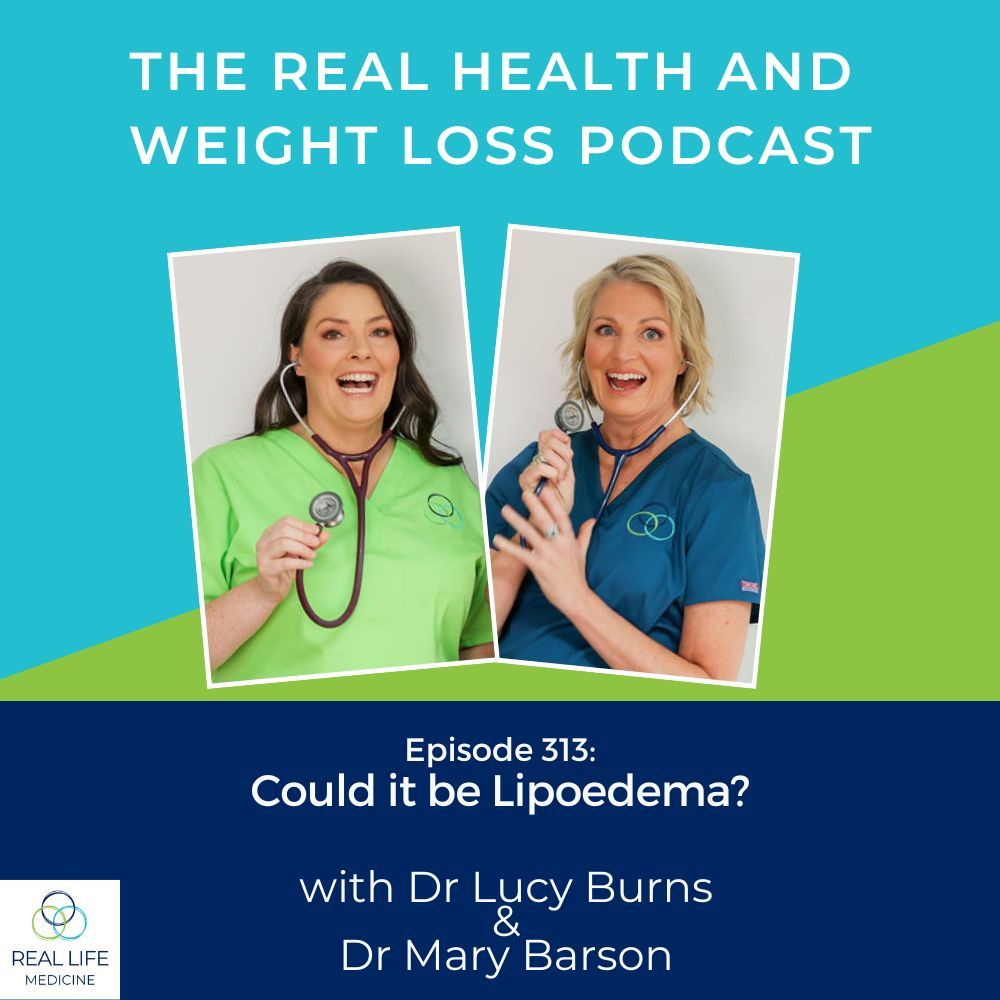
Episode 313:
Transcript
Dr Mary Barson (00:05) Hello lovely friend, I am Dr Mary Barson.
Dr Lucy Burns (00:09) And I'm Dr Lucy Burns.
Both (00:11) We are doctors, weight management and metabolic health experts. We are the creators of My Metabolic Action Plan, your two-step map to real health and weight loss, which is in fact the name of this podcast. Join MyMap now at rlmedicine.com.
Dr Mary Barson (00:22) Good morning gorgeous friends, Dr Lucy here on a wet wintery Tuesday morning with my beautiful colleague Dr Mary. Dr Mary, how are you this morning, my lovely friend?
Dr Mary Barson (00:32) Very good, warm and cozy inside my little cottage, which is nice, and excited to be here with you beautiful Lucy. Today we are shining a purple light on a topic that I think is still misunderstood, still massively under-recognised, a condition that mostly affects women, a condition that has not been well researched and does not have a lot of research supporting our treatments, and that condition is lipoedema.
Dr Lucy Burns (01:04) Absolutely, and you know some people may pronounce it lipoedema, both are acceptable, but what it isn't is lymphoedema and it's not lipoedemia. It is lipoedema or lipoedema. In Australia it's spelled with an O, in America it doesn't have an O in it, they're the same condition. And interestingly, I first learned about this about 10 years ago now from a patient because I had never heard it. When she first mentioned it, I'm going, "Do you mean lymphoedema?" She looked at me a lot horrified. Lucy, it's lipoedema or lipoedema, lipoedema, go lipoedema. The reason we want to talk about it and the reason you're banging on about the purple light is that June is Lipoedema Awareness Month. Purple is the colour and there are lots of buildings being lit up around Australia in purple. I think last year they had the Opera House, but this year it's lots of town halls, so kudos to the Australian Lipoedema Society for raising awareness for this condition.
Dr Mary Barson (02:17) Yes, because we do need more awareness. It is, I think, startlingly common and under-recognised, and it doesn't only affect women but it mostly affects women. So if you've ever felt like your arms or legs, just the body fat on your arms and your legs, just doesn't respond to diet and exercise the way that perhaps other parts of your body do, it might be that you have this condition called lipoedema. And typically women with lipoedema are often just told to lose weight, and that advice is incomplete to the point of being actually unhelpful. So let's talk about what lipoedema actually is, what we know about the causes and the underlying biology, and like, we still don't completely know everything, and why it often gets missed and how you can support your body with lifestyle, what the treatments are that are available and what we can do to actually support women who suffer from this, what can be quite a debilitating condition.
Dr Lucy Burns (03:18) Absolutely. And the thing to know, right, is it's actually probably about 12% of women. That's enormous... We don't have many other medical conditions that affect 12% of a population, the female population in this case. Even diabetes, which is considered, you know, an epidemic, runs at about 5%. So it is really, really prevalent, really common and misunderstood, misdiagnosed or underdiagnosed.
Dr Mary Barson (03:56) So let's start with the basics. Lipoedema is a chronic condition where there's an abnormal build-up of fat and connective tissue around the hips, thighs, buttocks, and lower legs. It can also affect the arms, though not as often, and it tends to be symmetrical. So it affects both legs, both arms equally, and it almost always affects women.
Dr Lucy Burns (04:23) Yes, and it's not just being overweight. So people at any size can have lipoedema. You can be what might be considered the normal weight range and still have lipoedema in your arms and legs.
Dr Mary Barson (04:36) Yes, and what makes a difference is it isn't just normal fat tissue or normal adipose tissue. It is fat tissue that is often painful and tender. It often bruises easily. It can feel quite heavy. It can feel quite tight. It spares the feet nearly always, and it has this sort of classic distribution that we can say that's quite typical of lipoedema. And we think of it as a disorder of fat distribution and tissue quality. So it's not simply having, you know, too much fuel in and not enough fuel out, you know, you need to burn more calories than you're eating. It's actually the fat cells and the surrounding tissue that make the fat that accumulates in lipoedema very biologically different, makes it difficult to lose with traditional weight loss measures, and it also makes it painful, inflamed, and can significantly impair quality of life.
Dr Lucy Burns (05:40) Yes, absolutely. Interestingly, it's not metabolically active though in the way that we would normally look at, say, visceral fat tissue. I've seen plenty of women who, you know, what people might think are overweight, you know, they have got a high BMI, and when you do all of their bloods, their insulin's normal, your leptin's normal, everything else is normal. But it's a separate condition. Having said that, some women can have both and have traditional obesity with lipoedema. And we know that the tricky bit is that women with lipoedema have often spent years dieting, so the prevalence of eating disorders is much higher, the prevalence of body dissatisfaction obviously much higher. They've often tried every diet, every boot camp, even, you know, had bariatric surgery for maybe the underlying obesity, but their leg shape can still be the same. It's not about being, you know, lazy, non-compliant, or any of that rubbish that they may have been told, and it's often just that we're dealing with two separate conditions
Dr Mary Barson (06:55) And there's a lot that we don't understand about what causes lipoedema. We have a much better understanding of the multiple causes behind obesity and metabolic ill health, but lipoedema is a little bit less understood. But we do have some pretty strong clues. There is stuff that we do know, so perhaps we should talk about what we do know about the causes of lipoedem.a
Dr Lucy Burns (07:20) Yeah, absolutely. And I think the thing to know is that for people wanting to understand about how fat tissue works, we've got fat tissue made up of sort of two components. We've got the fat cells, which are called adipocytes, and then we've got the connective tissue, or the extracellular tissue, that holds it all. And so we know that lipoedema is a condition that affects both of those. And we can break it down sort of into three pillars, if you like. So there's maybe you could go through those.
Dr Mary Barson (07:51) Yeah, absolutely. So the first one is genetics. That plays a strong part. We know that lipoedema often runs in families. Mothers, daughters, sisters can often have it. And your genetics aren't your destiny, but they do play a strong role in having that predisposition, so a tendency to have fat tissue and blood vessels that behave in a particular way. There's no single gene that has been pinned down, so it's likely going to be, you know, polygenetic is the word, and lots of interacting genes. It's likely going to be quite complex, but heritability does play a role. So people have a genetic predisposition. And then secondly, there's hormones. So lipoedema commonly appears worse around the big hormonal transitions, so puberty, pregnancy, perimenopause, menopause. And because we observe this in the women who have lipoedema, this tells us that the sex hormones, likely oestrogen, must play a strong role. And so there's some role that oestrogen plays interacting. It wouldn't be the only oestrogen, the only hormone, but the sex hormones play some sort of role interacting with our genetic predisposition. The genetically primed fat tissue, the oestrogen then sort of like turns on something, and so we get this oestrogen signalling that creates like more fat deposits in this area, and then this sort of disproportionate growth of fat cells and the related connective tissue in those areas. And then there seems to be some sort of local tissue factors. So when the tissue from lipoedema is looked at under a microscope, we do see the enlarged fat cells, we see more fat cells, but we also see lots more of the connective tissue. And it's inflamed connective tissue. We see more blood vessels. We see more blood vessels that are more fragile and likely to leak and likely to bruise, which then creates even more inflammation and even more scarring and increased fibrosis and fibrotic tissue. There's more lymphatic system involvement as well, and the lymphatic system is an important part of our immune system. And later on, as lipoedema develops, we get increased fluid accumulation and increased lymphatic dysfunction in that area. So it's not just fat, it's a whole microenvironment - blood vessels, lymphatics, connective tissue, immune cells, inflammation - all behaving differently than fat in other parts of the body.
Dr Lucy Burns (10:28) Absolutely. So something that I think is really important for people to understand is that there is probably, you know, we know it's some sort of connective tissue in here. There is probably some issue with the collagen. We don't have the exact details yet, but we do know that the little vessels, tiny vessels called capillaries within this adipose tissue become leaky, so they leak into the tissue causing swelling, and that starts up this, I guess, cascade of events and ultimately can lead to fibrosis. Which is why women often feel their legs are lumpy, and these lumps can start out either as like little grains of sand or even a bit more like rice, or then peas, or they're even really knobbly, hard, fibrotic sort of little stones in their legs. And so one of the treatments, which, you know, we can get onto a bit later with all the treatment options, but the idea is that if we can stop that accumulated fluid just sitting there, so squeezing it back into the vascular system, then we can hopefully prevent some of the fibrosis and some of the pain. So it's really important to recognise that this is not just the fat cells, not just the adipocytes, that are affected, but a large proportion of this is the fluid that accumulates around the cells.
Dr Mary Barson (11:52) I like that you've really sort of brought that back to real life, to what women are actually experiencing. And we learned this before, that many women with lipoedema have spent years being told that they're overweight, and perhaps also being told that they're non-compliant or lazy, or even just themselves feeling that they are failures because traditional weight loss measures have not been helpful at reducing that lipoedema fat. And they, especially if they're given generic advice, it's not helpful. And when that's done over and over again, that can create this chronic invalidation, which is traumatising for people.
Dr Lucy Burns (12:36) Yeah, absolutely. And you know, we all know that for many years the diet and exercise mantra of somehow that makes you thin, lean, everyone's gonna look the same is, you know, we now know it's just complete bollocks. People do need to understand there are different body types, different conditions that affect the way our fat is distributed, number one, but then the type of fat that we have on our bodies is so important to understand. Now some women might be feeling a bit hopeless about all of this, thinking, right, well then what can I do? And so I think it's important for us to recognise this. There's lots of things that we can do. Women with lipoedema, you know, unlikely to ever look like a gazelle, but women without lipoedema, many women without lipoedema are unlikely to look like a gazelle. Like, I don't think I'm ever gonna fall into the gazelle category. Probably not you either, miss.
Dr Mary Barson (13:39) No, no gazelles, yeah, yeah.
Dr Lucy Burns (13:42) So, and this is a societal thing and it's very, very complex at this current stage in the world with the trend back to thin and skinny talk everywhere. That's skinny stuff on TikTok, for any of those who are wondering. So it's about then going, okay, well these are my genetics, this is what these are the cards I've been dealt. What can I do to play them the best that I can? And that, I think, is if we can use that lens to look at the way we manage our health, our bodies, and that is empowering rather than feeling disempowered.
Dr Mary Barson (14:19) Yes, and there are things that we really can do. And we love to talk about lifestyle, you know, that is our favourite thing to talk about. And it can be so helpful and powerful. It doesn't magically erase lipoedema, but there are powerful lifestyle measures that you can take. And one part of the sort of precipitating factors with lipoedema is inflammation, and there are lots that we can do to reduce our overall inflammation. And food is a great place to start. Nourish your beautiful, wonderful body with like real food that's naturally lowering carbohydrates. Make sure you get that protein into you, and this way of eating can just reduce overall inflammation, which will benefit every aspect of your health, as well as inflammation that could be present and driving many of your lipoedema symptoms. It also improves insulin sensitivity and metabolic health and can help with your metabolic health and weight in other areas, even though it may not magically shrink that lipoedema fat. Similarly, good sleep and nervous system regulation, so that stress regulation, also are going to help. And they're going to help reduce inflammation, which is going to be helpful. They're also going to help reduce pain sensitivity, which is going to be helpful, and generally just improve your resilience to cope in every aspect of your life, including your ability to cope with the challenges of being a woman with lipoedema. Movement also is really good too. It helps improve your function, your mobility, and helps keep you like... also reduces inflammation, also reduces stress, keeps you strong and, in particular, swimming has got good evidence, as does walking, cycling and resistance training. Just pick something that you like and move your body regularly, and it'll help
Dr Lucy Burns (16:16) Absolutely this sounding remarkably like the six S's. The six S's that we talk a lot about for metabolic health. So applicable there. They're basically, it's a, you know, it's a little formula for anti-inflammatory living. So, you know, the first S being sustenance, your food. The second S being sleep. The third S being the stress management. The fourth S being strength and movement. And then the fifth and sixth S: social connection and some sunlight. The reason that swimming is really helpful for women with lipoedema is that it is a type of compression, and compression, manual compression or manual lymphatic drainage, which is called MLD, doesn't fit into the six S's framework, but is something that is really helpful for women with lipoedema. And it makes sense because we talked about these leaky vessels. We're wanting to push that fluid back in. We do that with the compression garments. We do it with women who can use specialised compression pumps that they can use, and manual lymphatic drainage is really a specific technique done by qualified professionals. I've got no idea how to do it, so clearly not in that category, but they help just move that lymphatic tissue around. So, you know, I think that the whole process is really, it can feel overwhelming, like you've got to do so many things. But if we pair it back to the basics, it's actually doing women with lipoedema do the same thing as women everywhere. You know, the six S's. Everyone should be doing that. Everyone can do those. They don't have to be perfect. They don't have to be intense. You don't have to, you know, lift 50 times a day. You just need to do some of the basics frequently.
Dr Mary Barson (18:10)Yes, small little movements can change the dial quite quickly. This is why I love working in this area. We don't need to, you know, join boot camps and exercise five hours a day to see benefits. Small bits, when done consistently, can change your life, which is just a beautiful, beautiful thing to see.
Dr Lucy Burns (18:30) Absolutely. The six S's sprinkled, in this case, with a, you know, big bow of self-compassion. Maybe that should be a seventh S, because our bodies are all different. Every, you know, some women have lipoedema, some women have disabilities, some women have polycystic ovarian syndrome or poly endocrine metabolic ovarian syndrome, PMOS. Not many of us are supermodels. We don't need to be to be worthy, to be valuable, to be, you know, enjoying our life. And I know for lots of women with lipoedema, the shame that has come with the way their legs look has kept them on the sidelines. And, you know, I would just say to any of you, if you can just get out there, no one honestly, no one gives a shit what your legs look like. I know that sounds trite, but honestly, I don't. They're so busy considering what they're, you know, so busy, most people are so busy thinking about what they look like, they don't even look at other people. So don't let that stop you. Just get out there and do it.
Dr Mary Barson (19:38) Yeah, I don't have lipoedema, but as you know, I did not have a gazelle-type figure either. And I was recently at Hamilton Island for a GP conference, which was really cool, and I took an afternoon off and went to Whitehaven Beach with my kids. And I just spent the whole day with lots of sunscreen on, spent the whole afternoon just walking around the beach, swimming in my bathers, and I just felt so wonderful that I could do that. You know, I was first of all just having a great time. I'm at this beautiful beach, considered one of the most beautiful beaches in the world, and also, you know, it was just modelling this kind of loving myself, loving my body for what it can do, for my daughter who was also there hanging around in her bathers, and my son in his bathers, with lots of sunscreen on. And just felt really good that I could do that. And also seeing everyone else in their bathers too, with all these different body types. And it was just a really beautiful moment for me to reflect that we've got to love ourselves, our bodies, for the vehicle that they are. And they don't need to be some ornament. We want them to be healthy, functional as much as they can be, and, you know, within the limits of the cards we've been dealt but also, put your togs on, get out there and have fun.
Dr Lucy Burns (20:51) Absolutely, absolutely. I love that. I love it. And, you know, that's the best type of model, isn't it?
Dr Mary Barson (20:58) Yes, that's right.
Dr Lucy Burns (20:59) Yeah. So yes, we're all models. We can all model behaviour. We can all model the way we want to, you know, that we would love the world to be. And yep, I reckon just get out there, my friends. Get out there. Good. All right, that's it for us this week. We'll be back next week with another episode, and we'll see you all then. Have a wonderful day.
Dr Mary Barson (21:19) Bye-bye, beautiful people.
Dr Lucy Burns (28:34) The information shared on the Real Health and Weight Loss Podcast, including show notes and links, provides general information only. It is not a substitute, nor is it intended to provide individualised medical advice, diagnosis or treatment, nor can it be construed as such. Please consult your doctor for any medical concerns.