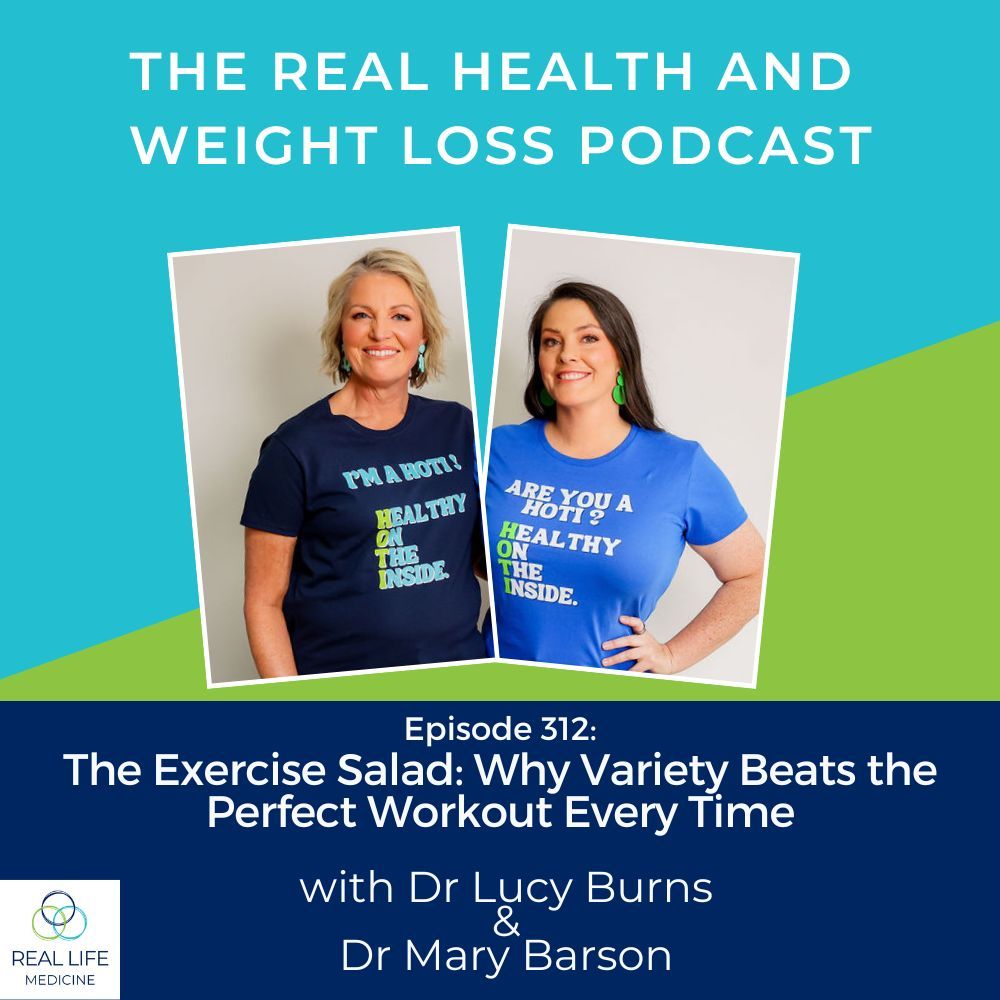

THE EXERCISE SALAD: WHY VARIETY BEATS THE PERFECT WORKOUT EVERY TIME
One of Australia's Most Popular Podcasts with Hundreds of 5 Star Reviews

Grab your FREE Ebook copy now!
Have you struggled to lose weight and keep it off?
Start your journey to boost metabolism and transform your body into a fat-burning powerhouse.
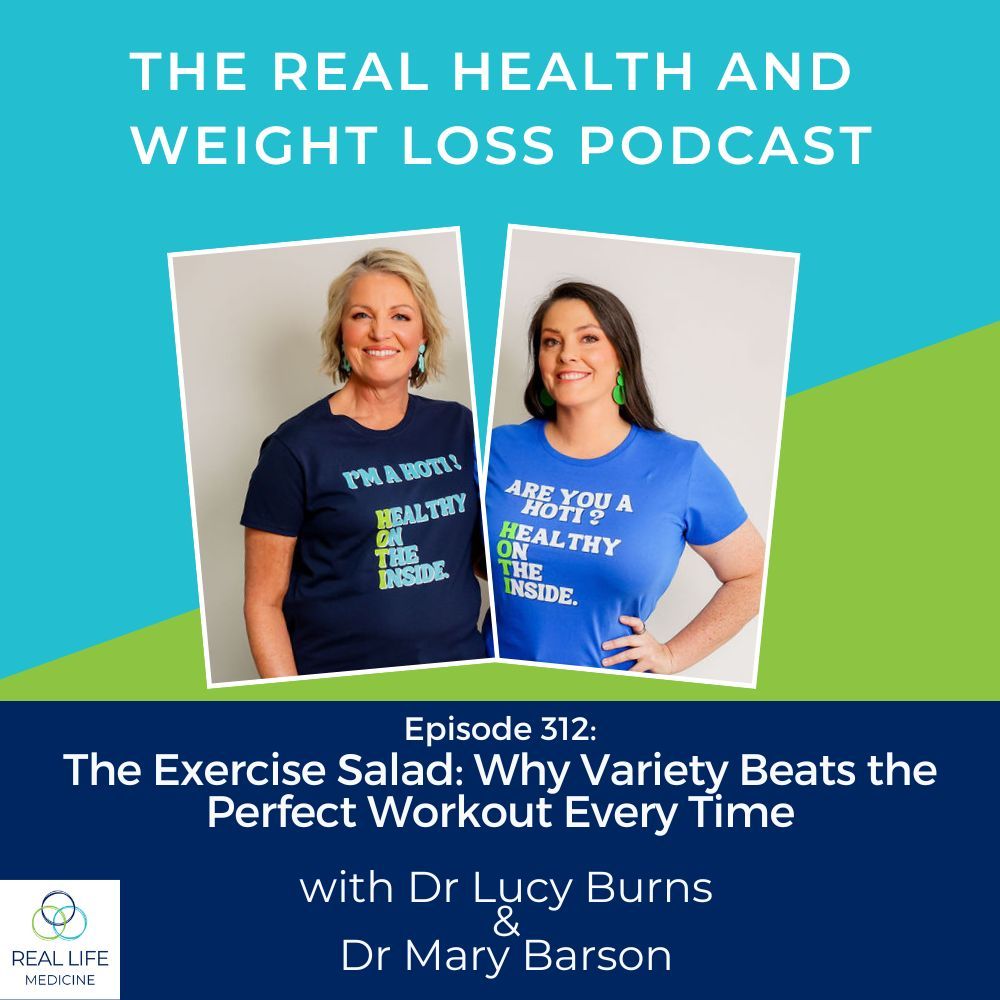
Episode 312:
Show Notes
Podcast episode overview
This episode of The Real Health and Weight Loss Podcast explores the idea of an “exercise salad” – a flexible, realistic way to use movement to support brain health, metabolic health and long-term dementia prevention. The discussion focuses on how small, mixed types of movement can fit busy lives, without pressure to follow extreme gym routines or influencer-style programs. Listeners learn how to make exercise more achievable, enjoyable and sustainable.
What is an “exercise salad”?
An exercise salad is a mix of different types of movement, just like a food salad is a mix of different ingredients.
Instead of relying on only walking, only the gym, or only Pilates, the exercise salad approach combines:
- Walking and gentle cardio
- Strength or resistance training
- Stretching and mobility
- Balance and coordination work
- Playful movement and everyday activity
The focus is on variety, flexibility and what is realistic in a busy life, not on perfection or extreme programs.
Movement, brain health and dementia
Metabolic health and brain health are deeply linked.
Conditions like insulin resistance, type 2 diabetes, fatty liver and high blood
pressure increase the risk of dementia over time.
Regular movement is one of the most powerful lifestyle tools for:
- Supporting blood sugar regulation
- Improving circulation
- Reducing inflammation
- Protecting brain function as we age
This episode highlights how simple, consistent movement habits can lower long-term dementia risk and support clearer thinking and better mood right now.
All movement counts
Social media often sends confusing, all-or-nothing messages about exercise:
- “Walking is useless.”
- “Pilates does nothing.”
- “Only heavy lifting counts.”
In this episode, all forms of movement are reclaimed as valuable. Walking, Pilates, swimming, cycling, resistance training and stretching each bring different benefits for strength, cardiovascular fitness, joint health, balance and cognition.
The key message:
The best exercise is the one that is safe, enjoyable and sustainable for the individual.
Cycling and brain benefits – a real-world example
The conversation includes research showing that people who cycle regularly have a significantly lower rate of dementia.
Cycling is used as an example of how movement can challenge the brain as well as the body because it involves:
- Continuous attention to the environment
- Balance and coordination
- Quick adjustments around obstacles
- A natural form of mindfulness and presence
Listeners are encouraged to look for other activities with similar elements of balance, attention and coordination if cycling is not suitable or appealing.
Link to scientific article https://jamanetwork.com/journals/jamanetworkopen/fullarticle/2835115
Making 150 minutes of movement realistic
The frequently quoted guideline of 150 minutes of moderate-intensity exercise per week can sound overwhelming. This episode breaks it down:
- 150 minutes per week
- ≈ 22.5 minutes per day across 7 days
- Or, across 16 waking hours, around 90 seconds of movement every hour
Short, consistent bouts of movement – a brisk walk, a set of stairs, a few strength exercises, stretching or dancing in the kitchen – all add up. The exercise salad approach makes the guideline feel practical, not punishing.
Compassion over perfection
A core theme of this episode is compassion. Many listeners are:
- Busy
- Tired
- Stressed
- Managing pain or complex life demands
This is not a “shame and blame” exercise message. Instead, movement is framed as a supportive tool, not a test of willpower.
Key compassionate reminders:
- Not hitting a hardcore gym program does not mean failure.
- Brains are tricky, lives are messy, and that is normal.
- Small, realistic changes are powerful and worth celebrating.
Sleep also receives special attention. A good night’s sleep often makes problems feel more manageable and helps people engage more easily with healthy habits like movement.
Practical takeaways from Episode 312
- Think of your weekly movement as an “exercise salad” with different ingredients.
- Mix walking, strength, stretching, balance and playful movement.
- Remember that metabolic health and brain health are closely connected.
- Use short movement snacks across the day to meet the 150-minute guideline.
- Choose realistic, repeatable habits over extreme or all-or-nothing exercise plans.
Ideal listeners for this episode
This episode is especially helpful for:
- Women in perimenopause, menopause and beyond
- People wanting to improve metabolic health and reduce dementia risk
- Anyone feeling overwhelmed, guilty or “not good enough” about exercise
- Busy professionals and parents who need flexible, realistic movement strategies
Work With Real Life Medicine
For a step-by-step approach to improving metabolic health in perimenopause, menopause and beyond, check out My Metabolic Action Plan. This doctor-led comprehensive program gives you
- Strategies to improve metabolism
- Skills to develop mindset
- Tools so you will implement!
Episode 312:
Transcript
Dr Mary Barson (00:05) Hello lovely friend, I am Dr Mary Barson.
Dr Lucy Burns (00:09) And I'm Dr Lucy Burns.
Both (00:11) We are doctors, weight management and metabolic health experts. We are the creators of My Metabolic Action Plan, your two-step map to real health and weight loss, which is in fact the name of this podcast. Join MyMap now at rlmedicine.com.
Dr Mary Barson (00:22) Hello lovely people, Dr Mary here, and welcome to this episode of The Real Health and Weight Loss Podcast, where I'm joined by my beautiful colleague, Dr Lucy. Hello lovely human, how are you?
Dr Lucy Burns (00:35) Hi Miss, I am well. I'm well because, again, I've done this a few times, but when I have a good night's sleep, it's like whatever was bothering me suddenly doesn't seem quite so big. So honestly, sleep is crucial to feeling well. So yes, I'm good.
Dr Mary Barson (00:53) It's like magic, isn't it? Sleep is very important for our metabolic health, as is what we are talking about today. So today we're talking about something that is very close to my biochemistry nerd heart, and that is movement, and specifically the effect that movement can have on our brain and our metabolic health. We've touched on this before, but today we're going to talk about how we can make this really practical and helpful. So, you know, before everybody switches off and thinks, "No," I promise this is not another lecture just telling you to exercise more. Please stay with us because that's not what this episode is about.
Dr Lucy Burns (01:31) Absolutely, because honestly, we all know, all of us, we're all busy, tired, maybe we've got stress, pain, and sometimes it can feel like, "Oh God, another job that we're failing at." So we want to make sure that people are really clear that if you're not nailing your exercise gym-bro goals, you're not a failure, just a human. We know that life's busy, brains are tricky, so we want this conversation to be really easy to listen to and actually give you some doable, practical strategies.
Dr Mary Barson (02:03) That's right. You don't have to have the gym program of a fitness influencer to be able to be healthy and protect your brain. So you came up with this concept yesterday, Lucy, and I loved it, so we could make it into this podcast today. What we're going to talk about is called an exercise salad. It's not some cute, over-the-top thing; it's just this simple idea that our brains and bodies do best when we have different types of movement available to us. So we're not just only walking, we're not just only strength training, we're not just only stretching, but we're doing a mix. Importantly, it doesn't have to be perfect, and it doesn't have to be a lot. It doesn't have to be intense, but it does need to happen to at least an extent. To get the benefits of movement, you need to move. So you need to be able to make it realistic for you.
Dr Lucy Burns (02:56) Absolutely. And I think it's really important to, I guess, just highlight that in the world of social media algorithms, what happens is you click on something and the algorithm then shows you more of the same thing. So it really kind of diverts you down a little funnel. There are people out there. I mean, I have seen posts where people are telling people that walking is no good for them, they need to do strength training, they need to lift heavy, or that Pilates is useless, you have to lift weights, or that swimming is no good, you have to do weight-bearing exercise. Honestly, that's all rubbish. Every type of exercise has a benefit, and the idea of an exercise salad is that you have little bits of all of them to create the perfect, delicious movement salad.
Dr Mary Barson (03:46) That is just beautiful for your brain health as well as metabolic health. That's right. You know, you don't have to just only eat greens or only eat red onions. You can have a nice mix. So I think it'd be good to touch on why movement matters, especially for our brain health and our metabolic health. We talked a few weeks ago, when we were talking about dementia, that dementia rates are rising worldwide, and at the same time we're getting more and more metabolic health problems, more and more insulin resistance, more and more type 2 diabetes, fatty liver, high blood pressure, and metabolic health and brain health are intimately connected. We know that poor metabolic health increases the risk of dementia later in life for a whole lot of really important reasons. We also know that our lifestyle, like the things that we do each day, and making positive changes in the things that we do each day, can improve our metabolic risk and reduce that risk of getting dementia and getting poor brain health as we age.
Dr Lucy Burns (04:48) Absolutely. As you mentioned earlier, there was an article on cycling, and it was my hubby that actually showed me this because he is a keen cyclist. So he was, of course, very happy to read this article that showed, I think, it was a 24% decrease in the rates of dementia for people who cycle. So, you know, immediately my brain goes, "Oh, well then everyone should be cycling, and we should all be cycling and be like the Dutch. They cycle everywhere." And then, of course, you realise, well hey, some people hate cycling. Not everyone has a bike. Some people live on busy roads. For some people, cycling is not that easy. So again, it's not about "you must do this," but it's an idea that some things are really helpful. My hubby and I were talking about why cycling would be helpful. I go, "Well, why is cycling so helpful?" And I guess he pointed out that it's not just the movement, and we're going to talk a little bit about that, but the idea that when you're cycling, you're also having to concentrate on what's around you. So there's quite a bit of mindfulness that goes on. You have to avoid hitting potholes, hitting sticks, you have to balance, and often you do counter-regulatory balancing, like when you're turning corners. So there are all these other kinds of benefits that happen just with cycling that you're not specifically even thinking about. So I guess that's why those sorts of movements or types of activities can be great. But again, it also doesn't mean you have to cycle to prevent dementia. You can get these sorts of benefits from doing other types, whatever suits you. So we're not going to become one-trick cycling ponies. The other thing that I want to hear, that I want to just draw attention to, is the idea of, you know, you have to do 150 minutes of moderate-intensity exercise a week. Again, when my brain hears 150 minutes, it sounds like a lot. It does sound like a lot, doesn't it, when we go, "150 minutes?" However, if you break it down over seven days, that works out to be 22.5 minutes a day. You don't have to do it every day. It's over a week, so you could have a day off. But when we break it down to that point, it's not that hard. Twenty-two and a half minutes a day. And if we then break it into the hours that we're awake, at 16 hours a day if you were to sleep eight hours, that means that you need to do about 90 seconds every hour.
Dr Mary Barson (07:35) It does sound doable when you talk about it like that. But yes, I think there is also this all-or-nothing trap that people can get stuck in. Like if you think, okay, 22.5 minutes a day, yep, that's doable, but you get to the end of your Thursday and you've done nothing, and it's 10 o'clock at night and you can't be bothered doing it right now. People can fall into this, "Oh well, I haven't done it. No, well, I just can't do it, obviously," and can then maybe not do anything on Friday or Saturday or Sunday. That all-or-nothing thinking is a real trap. It's a trap that can just keep us so stuck. So I just love the idea of all or something. Give yourself permission to do a little bit less. Although the recommendations are that 150 minutes of moderate exercise plus your strength training, you still get benefits from small amounts. We mentioned a while ago the studies looking at doing even just five minutes of movement, which can help improve your deep sleep quality at night, which has huge flow-on effects to every aspect of your health. So all or something. If it gets to 10 o'clock at night and you still haven't done anything, you could literally do five minutes and still reap some benefits. You could do one minute and reap some benefits. Even 30 seconds would give you the benefits of just psychologically having done something, having done something quite small. Allow yourself to celebrate that so that you can still get the benefits of movement, even when you shrink it right down. We really don't need to be perfect to see the benefits of movement. Any kind of movement is helpful, and any kind of movement is going to help improve all the different aspects of your health that are going to help improve that metabolic health and lower your risk of dementia. If we can just do something, then that is infinity times better than nothing.
Dr Lucy Burns (09:28). Absolutely. And, you know, you can either do it as a formal thing like we've mentioned, or you just do it as exercise snacks throughout the day. Every little thing that you do is helpful, and it all kind of, it's like putting money in the exercise bank. You might make a big deposit one day, and then the other day you might just put 20 cents in. So the key is that it all adds up. So I think that's a really helpful way to look at it rather than thinking, "Oh my God, I haven't done anything." The chances are you've done something, but you can just, I guess, leverage that a little bit. So even things like if you, I don't know, if you decide to do... Do people still walk to the letterboxes? Do people still get mail? I guess they do. My letterbox is nearly a kilometre away. Let's say the general person whose letterbox might be 20 metres down from their front door. If you can walk to that, you can either amble or you could march there. So the marching is going to be a bit better. Then, as you're marching back, there could be a step. You might have two steps, say, into your house. Well, you could just walk up and down those steps a couple of times. So all of a sudden you've turned a little job, which maybe previously you didn't walk to the letterbox, you just opened the box as you drove past it, but you've turned something fairly easy into something that's just a little bit more.
Dr Mary Barson (11:00) Yes, this is like the idea of this exercise salad. You've just got all your little tools, your little exercise, little things that you do, and you can sort of pepper them throughout the day. I like the idea of having a few different tools in your exercise toolbox, or a few different types of exercise within your exercise salad.
Dr Lucy Burns (11:20) Yes, yes, absolutely. And this is the key. It really is not about one being better than the other. It's not about, you know, "You must do strength training, don't bother with Pilates." That's garbage. Or, "You must do impact work, don't bother with swimming." Every single exercise has some benefit of some sort, and what we want to do is combine as many as we can without being ridiculous. Okay, you don't all need to become CrossFit trainers or anything, but as many different types as we can throughout maybe the week or even the month. It might feel a bit hard to do it every week because every single type will have some benefits. Absolutely. I guess there's a couple of ways to think about movement and maybe trying to just tick off one of these each week. So we've got strength. We talk a lot about strength training because building muscle is your metabolic organ. We can talk about aerobic capacity, doing some sort of huff-and-puff exercise. We can talk about mobility and flexibility. So if you try and hit those every week at least once, then you're doing really well. Okay, so let's just chat a bit more about how you might fit each of these into your life. So let's talk again about strength training. I know, again, there's a lot of "lift heavy" out there. You've got to lift heavy, all that stuff. But it's really not about becoming a bodybuilder. You don't need to have big muscles. You don't need to have abs, clearly. It's really about the idea of functional movement. We want people to be able to get up out of a chair without using your hands, for example. You need to be able to carry your shopping in and out of the car. If you've got grandchildren, lift them up. If you've got a dog, be able to put it into the car if the dog can't jump up. If you're on the floor because you're playing with grandchildren, or you've dropped something, or you're simply on the floor because you're doing your stretching, then we want you to be able to get up off the floor. Even more importantly, if you were to have a tumble and fall over, well, you need to be able to get up. So that's a lot of why we say to people, you need to be building muscle for functional purposes.
Dr Mary Barson (13:43) From a biochemical point of view, muscle is incredibly important. It acts like a sponge for the glucose in our body. It's our main metabolic real estate in our body. When you work your muscles, even with simple things like getting up and out of your chair a few times without using your hands, or just doing a few gentle little squats, or going up and down the stairs, your insulin sensitivity in your body improves. So this helps reduce insulin resistance. It lowers your risk of type 2 diabetes, metabolic syndrome, dementia, and all the horrible things that go with it. A little bit goes a long way. A lot of it can just be about activating and waking up your muscles because when we sit for long periods of time, they really do get quite inactive. Just stand up, tap your toes a few times, tap them to the left, tap them to the right, lift your knees up and down, march on the spot. These things actually do make a tangible metabolic difference if we can fit them into our life with some regularity.
Dr Lucy Burns (14:48) Yeah, absolutely. And I mean, the wonderful thing is we've spoken about many times my favourite word, pleiotrophic, which means one activity, multiple effects. Technically related to genes, but we're talking about it in lifestyle things. Resistance training isn't just about metabolic health and soaking up your glucose. It's not just about functional health. It's also about the brain. At the end of the day, if you're like, "No hoof, no horse. No brain, no human." We really value, as humans, our brains and what they can do for us. So we know that when people move their muscles, it improves critical thinking skills like planning and attention. It's pretty amazing that you can just be in your chair, you can do 10... I don't actually know what the word is, but it's like if you're in your chair and you stand up and then you sit back down again.
Dr Mary Barson (15:44) They have the amazing name of sit-to-stands. Yep. Yeah, excellent. That's what my physio calls them, a sit-to-stand. Yeah, I take my mum to the physio. It's like, "How many sit-to-stands can you do in 30 seconds? Go!"
Dr Lucy Burns (15:58) Yeah, yeah, perfect. So you can do those and you're not only helping your glutes, your hammies, and your quads, and preventing or helping your balance and preventing falls, you're also helping your beautiful brain. So yay!
Dr Mary Barson (16:13) Yeah, wall push-ups are one of my favourites. As I, you know, don't quite have the strength to do many push-ups, many proper push-ups. Knee push-ups, yes. Push-ups on my feet, struggle. But wall push-ups are great. They're just so accessible for everyone. That just means putting your hands on the wall, your feet a little back, you bend and straighten your arms, and you're working your back, you're improving your posture, you're doing a bit of core, you're doing some arms, and it's really easy. You could do it in a ball gown and high heels if you needed to, but you could definitely do it in your slippers and pajamas. You could definitely do it in your work clothes. All you need is a wall. Maybe no one watching you might be good as well, but even then, you could have people watch you while you do your wall push-ups.
Dr Lucy Burns (16:56) It wouldn't be that bad. Yep, absolutely. Wall, kitchen bench, anything that is helpful. Beautiful. So that's kind of the strength without being, you know, a strongman kind of way of adding some movement into your week. Then we've got the aerobic, or what we like to call the huff and puff. So it is helpful to be able to huff and puff. It's great for our cardiovascular system. It's great for our heart. So things that count as huff and puff include, obviously, walking, if you're walking at a brisk pace, not ambling, cycling, swimming, even dancing, obviously running. It's enough that gets your heart rate up. A lovely kind of way to work it out, if you're not obsessed with Fitbit watches and tracking and everything, is if you can talk but you couldn't sing. Yeah, yeah, that's still huff and puff. That's still enough.
Dr Mary Barson (17:52) Yes, absolutely. Physiologically, this huff and puff movement is really good for our health and our brain health. It helps improve our cholesterol profile, particularly helps increase the benign and beneficial lipoprotein particles. The HDL, sorry, HDL increases with exercise. It improves how well our blood vessels can function. It can also increase their size and number, increases blood flow throughout our body, and probably also increases blood flow to our brain, which helps support our brain cells. Over time, it's shown that people who have that regular physical activity, that regular huff and puff, particularly in midlife and later life, have significantly lower rates of dementia, even up to 40%. It's like for people who are regularly active. A little bit goes a long way.
Dr Lucy Burns (18:44) Absolutely. And it's not you know, dementia prevention is obviously one thing. Sometimes our brain will go, "Yeah, I'll sort that out tomorrow." What we also know is that huff and puff is very good for mental health, and that mental health improvement isn't in 10 or 20 years' time. It's that day. So it can make you feel better that day. For me, that is often one of the biggest drivers when my brain's kind of going, "Really? Can we just lie on the couch? Really? Do we have to go out?" I go, "Yep, because you will feel better. Mentally, you will feel better immediately." As soon as you finish, you hop out of, in my case, the pool, you come back home from the gym, or come back from your walk, and the minute you do, you just feel amazing. So mentally it's good. When we're talking about the brain, we're often talking about things like dementia and cognition, but mood is also controlled obviously by your brain.
Dr Mary Barson (19:43) That's right. Those beautiful myokines are released by your muscles, and they help improve mood. Studies show that regular movement, even just short bursts of walking, can be as effective for mild and moderate depression as antidepressant medications. So it is amazing. Movement is quite literally a medicine.
Dr Lucy Burns (20:06) Indeed, indeed. In fact, there is, and we'll talk a bit of, we'll finish off with the concept of an exercise prescription, but I guess the third little arm of our exercise salad, the third leaf, is around mobility and balance. Again, super important, and for a lot of us, particularly those who sit a lot, you do lose your proprioception, which is a fancy name. Proprioception is the idea that your brain knows where your body part is without looking at it. It's really helpful, particularly if you have a little stumble, that your body knows how to automatically correct itself without you having to intentionally think. So improving movement and balance is great for proprioception. We know that things like injuries, people often, as part of the rehab, improve their proprioception. But there's lots of things that, again, you can do. You don't have to be off at a gym doing this. You can do something like stand on one leg when you're at the kitchen bench waiting for the kettle to boil. You can swap legs when you're brushing your teeth. So you might stand on one leg for the first 30 seconds and then swap legs for the next 30 seconds. You might do things like stretching. Here's a little thing. I was thinking about this the other day as I was watching my little dog. Every time she gets up, she's only a puppy still, every time she gets up, she stretches. She does this big stretch, stretches out her legs, she stretches out her back, she does the downward dog. Humans, we just get up and walk. "A bit stiff. Oh well, just get going." Yeah, yeah. Or not even that. You just get up and go, whereas after any prolonged sitting or lying, a dog or a cat, you watch, they will get up and I love that.
Dr Mary Barson (22:04) That's what we need to do. I'm going to get up and stretch, maybe even do a downward dog after we finish recording this episode. That's a very good thing to do.
Dr Lucy Burns (22:12) Indeed. So, man, here's the thing. A lot of people go, "Yeah, yeah, okay, you haven't told me anything that I don't know. I know what to do, but how do I actually do it, especially when my brain goes, 'Oh, I'm so tired'?" What are your top tips for that?
Dr Mary Barson (22:28) Okay, so give yourself permission to do something small and then celebrate it. We can really just make it tiny, teeny tiny, especially to begin with. But the important thing is if you do that teeny tiny thing, you just need to take a moment and think, "Go me. Well done. I've done that." Some really good teeny tiny examples, I think, for making it doable when you're struggling are to make it small, pair it to something that's already happening, and make it small. When do you flick the kettle on in the morning to make your cup of tea or coffee? While the kettle is boiling, do some calf raises. Do some wall push-ups. Find a chair, do some sit-to-stands. Do some movement just during those two minutes while the kettle is boiling. When you're on the phone to someone, instead of sitting down, could you just get up and walk around? Could you balance on one leg while you're on the phone to someone? Do something. Could you walk to your letterbox? I do love that one. Can you park a few blocks away and walk? Can you take the stairs if you work in a place upstairs rather than the lift? Little moments like this can be really good. Every time you switch tasks, if you're sitting at your desk, just do four to five sit-to-stands. Just bring it in and then do it. None of these require special clothes or equipment. They're small, they're practical, but the key thing is that they are not nothing. So they really do add up over time. You want to do them and also take a moment to celebrate the fact that you've done them. It doesn't have to be a big song and dance. It can be. Singing and dancing is good exercise. And you don't need to post about it on social media, but you can if you want to. Even just mentally take a moment and go, "Ah, I did it," and let that dopamine flow through your brain because our brain loves that, and it's going to want it again. So you're going to be more motivated to do your calf raises the next time you boil the kettle. That is how our brain learns from momentum. It learns from success, and things can start to build.
Dr Lucy Burns (24:38) Yeah. Absolutely. I reckon a great sit-to-stand is when you're on the toilet, hey? I mean, we all go to the toilet, and no one is watching you, probably apart from your toddler. Yeah, if you're a woman, you're usually sitting down. Yes. Every time you finish, you can do even five sit-to-stands. Suddenly, by the end of the day, you've done 30 sit-to-stands, give or take, without even trying. And even if your brain goes, "Oh, what's the point?" all of these add up, which means if you're adverse to formal exercise or going to the gym, you can say to yourself, "I don't have to go to the gym because I've done this. I don't have to go to a class because I've done my calf raises while boiling the kettle. I don't have to put on my aerobics exercise gear because I've just done all my stretching throughout the day." So again, all that is working with your brain and helping it to make the decisions that are going to be in your best interest.
Dr Mary Barson (25:44) Yes, small changes add up. Small changes, small little course corrections over time can completely change the direction of your health ship, you know, from crashing into an iceberg to landing on a beautiful tropical island. So every small little thing that you do over time can have dramatic effects on where your health actually ends up.
Dr Lucy Burns (26:11) Absolutely. So I thought we'd just finish off with the concept of an exercise prescription. Now, the great news is you can write your own script here because you are the boss of you. But writing it out is helpful to have a little, I guess, intention. That idea that you think, "Oh yeah, that's a good idea," and then, of course, you forget all about it. Once it's written down, it's much more front of mind. It doesn't have to be perfect, and you can deviate somewhat a bit, but have it written down so that you've got an idea. An example might be that you're going, "All right, what strength things am I going to do? I'm going to do the sit-to-stand off the toilet. That sounds good. I can do that." "Yes, excellent. What's my small huff and puff? Well, I am going to take the dog for a walk because, honestly, we both benefit when we go for a walk with the dog." "Great. Good. Or I'm going to do that three times a week, and we're just going to walk around the block, which will be seven minutes." "Perfect." Then we go, "All right, what about mobility?" "Oh well, that's easy. I'm just going to brush my teeth on one leg. I'm going to stand up and brush my teeth." If you're a menopausal woman, you might stick your oestrogen gel on at the same time. Go, "Yay, good. I've done all of those things." Perfect.
Dr Mary Barson (27:23) Yes, and if you miss a day here or there, and you might, because you're human, because life can be a lot, that does not mean you've failed. So don't let your brain fall into that pit of all-or-nothing despair. Instead, really guard against that. If you miss a day, if you're not perfect, heaven forbid, you just pick it up again. Pick it up again the next day. Pick it up again. Remember that every little bit that you do is worth doing. Every bit counts. Celebrate every little bit and just keep going.
Dr Lucy Burns (27:54) Absolutely, and that's the way we look after our beautiful brains and our beautiful bodies in an environment that we, as humans, have set up for ourselves now, which really makes movement a little... We have to be very intentional about it because it's pretty easy to not move for very much of the day. So becoming intentional is key, and hopefully this little exercise salad is a step forward for you in the right direction. All right, lovely ones, have a fabulous week. Dr Mary and I'll be back next week with some more chit-chat on The Real Health and Weight Loss Podcast.
Dr Mary Barson (28:32) Bye now.
Dr Lucy Burns (28:34) The information shared on the Real Health and Weight Loss Podcast, including show notes and links, provides general information only. It is not a substitute, nor is it intended to provide individualised medical advice, diagnosis or treatment, nor can it be construed as such. Please consult your doctor for any medical concerns.