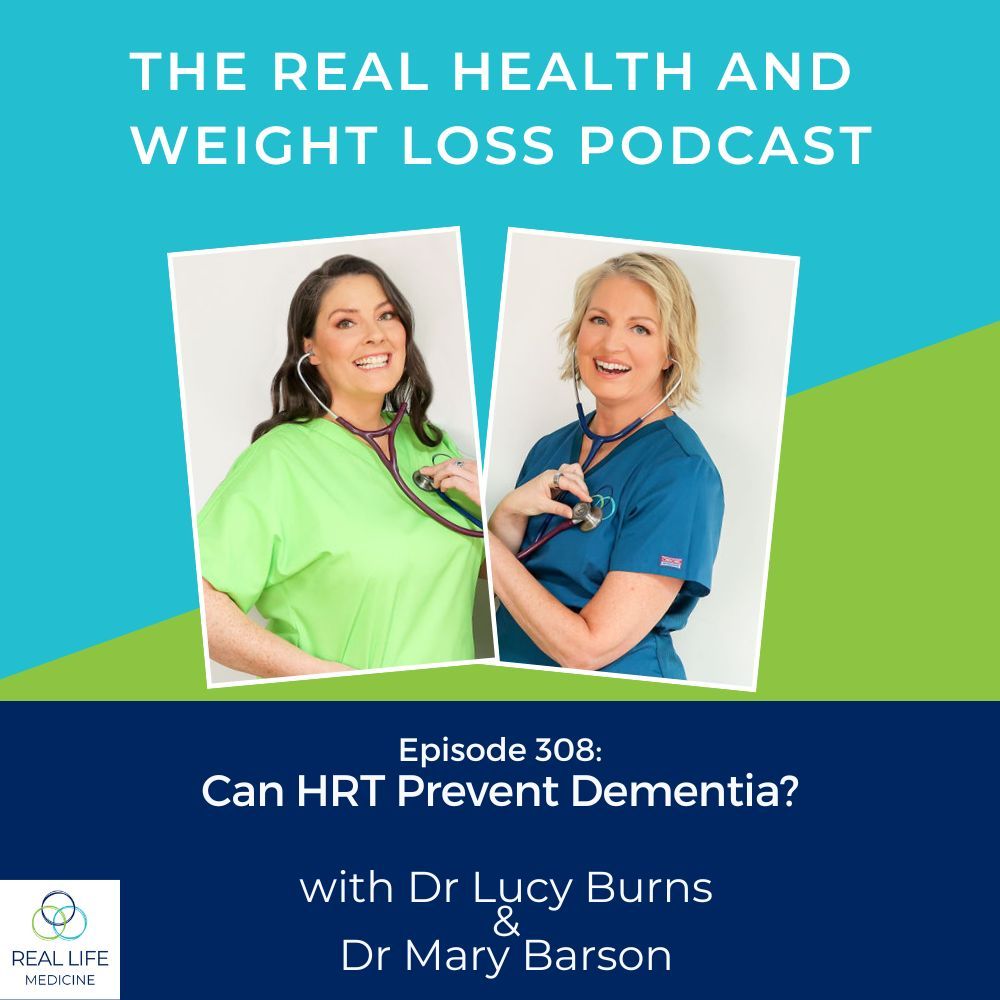

CAN HRT PREVENT DEMENTIA?
One of Australia's Most Popular Podcasts with Hundreds of 5 Star Reviews



Grab your FREE Ebook copy now!
Have you struggled to lose weight and keep it off?
Start your journey to boost metabolism and transform your body into a fat-burning powerhouse.
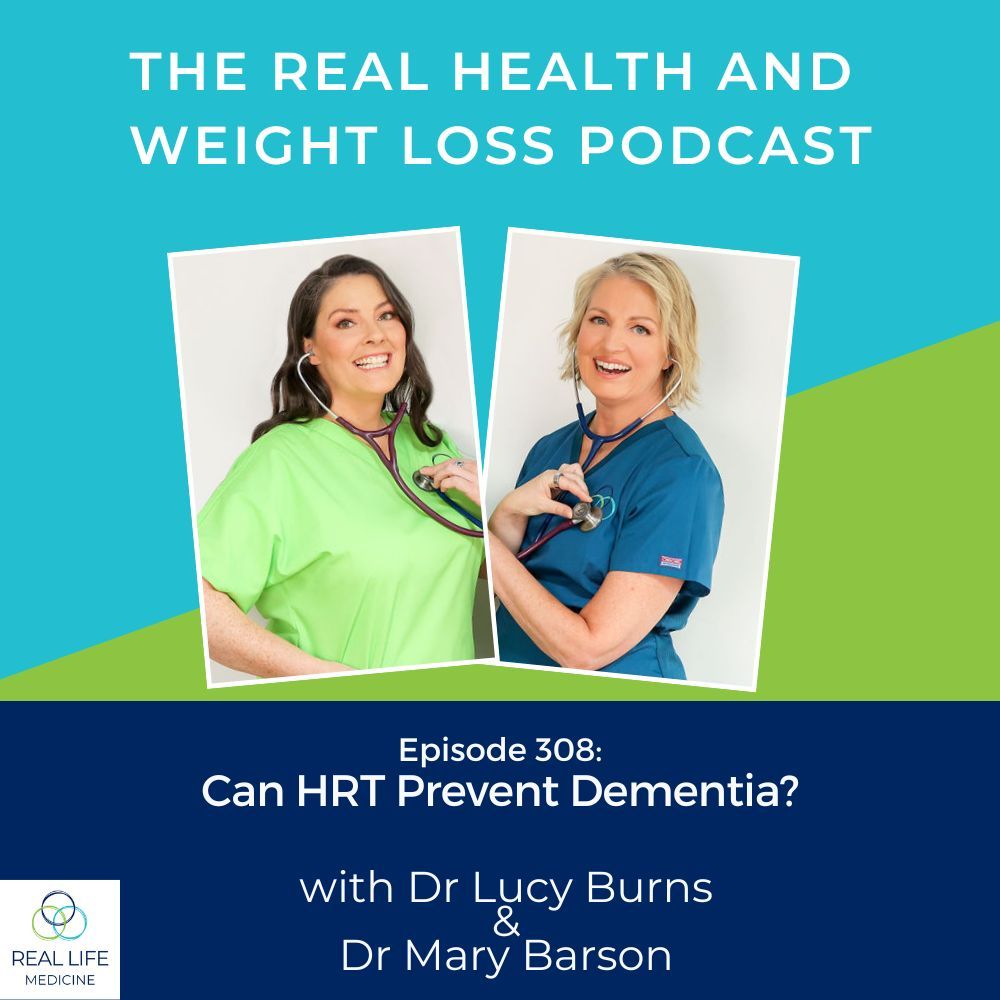
Episode 308:
Show Notes
In this episode, Drs. Lucy Burns and Mary Barson discuss oestrogen's role in dementia prevention, particularly the potential of Menopause Hormone Therapy (MHT/HRT) in protecting brain health for women in midlife and beyond.
Why Women Are at Higher Risk
- Women are twice as likely to develop Alzheimer's disease compared to men.
- Longevity is one factor, but hormonal changes at menopause play a significant independent role.
- Oestrogen is a neuroactive, neuroprotective hormone with receptors concentrated in the hippocampus and entorhinal cortex, the brain regions involved in memory and learning, and the earliest regions affected by Alzheimer's.
What Oestrogen Does in the Brain
- Reduces tau phosphorylation and beta-amyloid aggregation (key drivers of Alzheimer's pathology)
- Lowers brain inflammation and supports neurotransmitter function
- Improves cerebral glucose utilisation and blood flow
- A 2024 molecular review confirmed that oestrogen receptor loss directly contributes to Alzheimer's pathology at the cellular level
The Research Evidence
- A 1996 study of 9,000 postmenopausal women found a 35% reduced risk of Alzheimer's in oestrogen users, with a clear dose-response relationship.
- A 2021 study of ~380,000 women found a 58% reduced risk, particularly with body-identical formulations (transdermal estradiol + micronised progesterone).
- A 2023 meta-analysis found oestrogen alone reduced dementia risk by 32%.
- A WHO-commissioned Lancet review (2024) of 1 million women across 10 studies found no clear overall increase or decrease in dementia risk, meaning MHT is not currently recommended solely for dementia prevention at a population level.
The WHI Study Problem
The 2003 Women's Health Initiative (WHI) study caused a dramatic collapse in MHT prescribing by suggesting HRT increased breast cancer and heart disease risk. Key flaws in that study include:
- Used synthetic progestins (Provera/medroxyprogesterone acetate), not body-identical progesterone, which actually increases insulin resistance and may accelerate amyloid deposition
- Used conjugated equine oestrogen (oral), not modern transdermal formulations that bypass first-pass liver metabolism and avoid increased clotting risk
- Many participants were already more than a decade past menopause, outside the critical "therapeutic window" for brain protection
The Holistic Picture
- MHT is one tool, not the whole answer. Drs. Burns and Barson emphasise that metabolic health (particularly managing insulin resistance), sleep, nutrition, movement, stress, and social connection all independently protect brain health.
- Oestrogen receptors exist throughout the body (heart, bones, pelvis, muscle, brain), so women using MHT for any menopausal syndrome, whether vasomotor symptoms, musculoskeletal, genitourinary, or cardiometabolic, may gain dementia protection as an additional benefit.
- For women who cannot or choose not to use MHT, lifestyle interventions remain powerful levers for brain health.
Research mentioned in this episode:
- Paganini-Hill A, Henderson VW. Archives of Internal Medicine. 1996
- Kim YJ et al. Alzheimer's & Dementia. 2021
- Nerattini M et al. Frontiers in Aging Neuroscience. 2023
- Cipriano GL et al. International Journal of Molecular Sciences. 2024
- Melville NA et al. The Lancet Healthy Longevity. 2025
Key Takeaway
Oestrogen has a well-mapped biological role in protecting the brain, and body-identical MHT (transdermal estradiol + micronised progesterone) appears to be the most protective formulation based on current evidence. However, MHT should always be considered as part of a whole-person, holistic approach that prioritises metabolic health as its foundation.
Work With Real Life Medicine
For a step-by-step approach to improving metabolic health in perimenopause, menopause and beyond, check out My Metabolic Action Plan. This doctor-led comprehensive program gives you:
- Strategies to improve metabolism
- Skills to develop mindset
- Tools so you will implement!
Episode 308:
Transcript
Dr Mary Barson (00:05) Hello lovely friend, I am Dr Mary Barson.
Dr Lucy Burns (00:09) And I'm Dr Lucy Burns.
Both (00:11) We are doctors, weight management and metabolic health experts. We are the creators of My Metabolic Action Plan, your two-step map to real health and weight loss, which is in fact the name of this podcast. Join MyMap now at rlmedicine.com.
Dr Lucy Burns (00:30) Good morning, gorgeous friends. Dr Lucy here with my bestie, business bestie, medical bestie, real-life medicine bestie, Dr Mary. Hello, gorgeous one, how are you this morning?
Dr Mary Barson (00:40) Yeah, I'm good, I'm good. I'm a little tired. My beautiful toddler kept me up, bless them. And so I'm going to be potentially stifling a few yawns throughout this podcast, but I'm still confident that I will be engaging and entertaining despite this, at least I hope so.
Dr Lucy Burns (00:29) Absolutely, and it's interesting, isn't it, that we will often put yawning, the meaning of yawning can be, you know, that you're bored. And so, you know, I definitely think that you are not bored with this particular topic for this week's podcast.
Dr Mary Barson (01:14) No, I'm keenly interested in this particular topic, one that causes me, both personally and professionally, it is something that I am very passionate about, and it's about brain health and dementia.
Dr Lucy Burns (01:32) Absolutely, absolutely. So we are going to be talking today about oestrogen's role in dementia, and potentially MHT/HRT, they're the sort of interchangeable acronyms now for hormone replacement therapy or menopause hormone therapy, and its role in dementia prevention, what the guidelines say, what the evidence says. And as a little caveat for anybody who is unable to take MHT or chooses not to take MHT, a little reminder that dementia is not a one-trick pony. There are many things that contribute to the development of dementia. And if one of those levers is not available to you for whatever reason, we know that there are many others. And in particular, our favorite thing to talk on, on and on about is insulin resistance and insulin levels, and all of the sequelae of that in the role of brain health. So today's podcast is focusing fairly much on MHT, but it's not the only thing.
Dr Mary Barson (02:40) Yeah. And I'm really glad that we are talking about dementia because I think it's an incredibly important topic for women, particularly in midlife, because women are twice as likely to develop Alzheimer's disease than men. And there are a whole lot of important reasons why women are more likely to get Alzheimer's. And part of it is that women live longer. So that is just one of the reasons. If you live longer, you've got more chances because it is a disease that increases dramatically as we age. The incidence increases dramatically as we age, but there are other factors as well. And some of these we have control over. And you have mentioned all of those lifestyle factors that help improve our metabolic health. And MHT is another one. And I think that's why it's important for us to dive into the role that MHT could play. And first of all, Lucy, can you describe what we mean when we say MHT? Not everyone might know what that means.
Dr Lucy Burns (03:44) Yeah, no, fair enough. It's a good question. So MHT is some sort of modern version of HRT. HRT was hormone replacement therapy. MHT is menopause hormone therapy. They're still sort of used interchangeably. In technical terms, HRT is, they're the same medications essentially. But HRT is now reserved for women who have premature ovarian insufficiency, which is the modern term for premature menopause. And so for those women, we are replacing their hormones to the level that perhaps women who haven't gone through premature menopause would have. But MHT, it's now the phrase that we use to help women, support women through perimenopause. So through the symptoms, the upheaval, the crazy symptoms that seem to happen to women in perimenopause, and then into post-menopause and beyond. So the tricky thing with MHT is it's an umbrella term for hormones, but not all hormones are created equally, and not all hormones have the same response for women. So when we're talking hormones in this context, we're talking specifically our sex hormones, so not our metabolic hormones. We're talking specifically oestrogen, progesterone, and, you know, potentially testosterone. But we know with oestrogen, for example, there are multiple ways to deliver oestrogen to a woman, and they all have different effects. So you can't just say to somebody, oh, the studies show that MHT is effective, because you have to ask, well, what sort of MHT are we talking about here? And so it's really important to caveat that this is part of the issue, I guess, around working out whether MHT, and which sort of MHT, is going to be useful and for which people.
Dr Mary Barson (05:45) That's right. That's why it's really important to have these detailed conversations with your doctor about this, because there are almost no broad-reaching statements that are going to be true for all people in all circumstances all the time. And this is a very individualised and nuanced discussion. And I also think that if we rely on the evidence level of guidelines alone, not that I am ignoring medical guidelines at all, they are useful and important and have a role, but medical guidelines also can't take in a lot of the nuance in the data that they rely on. And so that's what we're going to dive into today. Also, why it is so important to have those nuanced conversations with the doctor you trust, so you get the care that you need.
Dr Lucy Burns (06:36) Yeah, absolutely. And look, we see this even with research, you know, when we look at research and research results and what is published, there is a component of people who will have a response, say, to an intervention. So let's say we're talking about a medication, there'll be a component of people, and the majority of those will have the same sort of response. But then there's, you know, the outliers, so hypo and hyper-responders. And the thing that is tricky is that that's individualised. So quite often, medications get approved based on what the majority of people do or how a majority of people respond, but not how each individual responds. Which, you know, I guess makes sense because, you know, we're a very big population. We can't be doing 6 billion individual medical guidelines. No, but it is, this is why they're guidelines and not rules.
Dr Mary Barson (07:36) Yeah. Let's start perhaps with oestrogen, and let's talk about this particular hormone, because it's arguably the most important for this particular conversation about oestrogen and brain health. Because oestrogen, it's not just a sex hormone, it's not just a reproductive hormone. It does a lot of things in our body, as pretty much all hormones do. They never have just one job. Oestrogen, among many other things, is a neuroactive hormone. It has this neuroprotective element to it. Its activity maintains our brain structure and our function. We've got receptors for oestrogen all throughout our brain, but they're particularly highly concentrated in our hippocampus and our interrhinal cortex. And these are regions of the brain that are responsible for memory, learning, navigation. And these are some of the regions that are also earliest affected in Alzheimer's disease. So oestrogen has this protective role in our brain. It helps reduce the accumulation of the tau proteins that we talked about last week. And the biochemist in me just loves saying this, it reduces tau phosphorylation. And phosphorylation is something that our cells do to change chemicals from one form to another. And it's beautiful to watch. It has these little, it goes through a little cascade, but I will just stop talking about that now because I'm nerding out. And it also helps inhibit the beta amyloid aggregation. So beta amyloid is another sort of neurotoxic thing that forms in our cells that can contribute to Alzheimer's disease. It also reduces the inflammation in our brain, and it helps support the neurotransmitters that we need for our memory, and also helps support how our brain uses energy. It helps improve the cerebral glucose utilisation and the blood flow. So oestrogen does a lot of important stuff in our brain. And so we need to pay attention to oestrogen specifically with brain health.
Dr Lucy Burns (09:50) Absolutely. And to be honest, this isn't new science. There was a study that was published right back in 1996 that followed 9,000 postmenopausal women for 14 years and found that women back then who were using oestrogen or, you know, had been prescribed HRT as it was called back then, they had a 35% reduced risk of Alzheimer's disease. And they found that there was a clear sort of dose response in the relationship. So the longer the duration and the higher the dose, the greater the protection. Now, caveat being not individualised advice, this, because like everything with medications and pharmaceuticals, we're always looking at the risk versus the benefits. And the risks can also be dose dependent, as can the benefits. So we want to make sure that we're always keeping that lens through which we make decisions on whether this is going to be a useful intervention for an individual, rather than looking again at population data. So what we know is that dose response relationships are a compelling signal for the biological causation of individual research. And this is one of the Bradford Hill criteria, for those of you who love knowing about science, Bradford Hill criteria, of which there are multiple, and we're not going to go through them all today. Nine. Yeah, nine. They help determine the, I guess, the validity and the quality of research. So not all research is created equal.
Dr Mary Barson (11:29) Yeah. And if we can assign an association, if it helps us decide if it's going to be an association or a causation, you know, like do umbrellas cause rain? Does oestrogen decline increase risk of dementia? Looking at the Bradford Hill criteria lets us figure out those things.
Dr Lucy Burns (11:45) Yeah, absolutely. And then there was a study produced, and we'll link all these studies in the show notes. There was a study in 2021 that looked at about 380,000 women and also found a 58% reduced risk of Alzheimer's disease in MHT users. So again, seems to be great protection, longer duration. And in particular, this study was very favourable for body identical formulations. So, you know, for those of you in Australia, that looks like estradiol, which usually comes in the form of either patches or gel, or there are some oral preparations of estradiol, and body identical progesterone, which is these days, we've only got one real form of that in Australia, which is Prometrium, the brand name Prometrium. So again, not all studies are created equally. But it makes sense when you look at this as a, there's a plausible mechanism for it. And again, it was confirmed in, I think, 2023, there was a big meta-analysis. So a meta-analysis is where somebody, usually a team of people, go through and review all previous studies looking at a particular point. You know, lots of studies have multiple endpoints. So what they'll do is they'll pull out one endpoint that is the thing they're interested in, pull it all together, and then, you know, come up with a result. And so this meta-analysis found that oestrogen reduced dementia risk by 32%. And that was for women just taking oestrogen. Again, if you've had a hysterectomy or something like that, and that combined therapy, there was still a reduction, but not quite as high. And again, that will be complex because progesterone, progesterone is one of the most polarising of all of the hormones, with some of the older, more synthetic versions actually causing or contributing to increased metabolic harm, I guess would be a word to use perhaps. So, you know, and again, these are all observational studies because at the end of the day, nobody's actually done a trial specifically looking at a double blind randomised control trial, which is the number one, I guess, gold standard way to do a trial, but it's extremely expensive. And it requires, for something like dementia prevention, you know, decades of follow-up. And so we're not getting, you know, to be honest, I don't think we will ever get that trial.
Dr Mary Barson (14:28) It's probably unlikely. Yeah. Yeah. Yeah. Which is sad. We may not get those big randomised control trials that will definitively be able to, you know, prove that, that the association between oestrogen use and reduced dementia risk and oestrogen decline and increased dementia risk, we may not get those trials, but there are lots of things that we can pull apart here to still allow ourselves to get a good picture because we do have a lot of data, and we've got a lot of data over a long period of time. And importantly, this is a really important part of this picture, is that we do have a very plausible biological mechanism, and that's now extremely well mapped. So in 2024, a molecular review done in the Journal of Molecular Sciences, just like saying that, it shows quite well how oestrogen receptor loss contributes directly to the Alzheimer's pathology at the cellular level for all those reasons we talked about before. So this is not just speculative. It's not just an alien looking down at earth and seeing umbrellas and thinking, um, umbrellas might make it rain. Every time it rains, there are umbrellas. We've actually got a plausible mechanism here. We've got a good biochemical explanation as to how oestrogen is protective for our brain.
Dr Lucy Burns (15:50) Yeah, absolutely. But here's the problem, and it really comes back to that big WHIM study that was released in 2003. And look, honestly, this is, I was a young GP back then.
Dr Mary Barson (16:0003 I was a medical student. I remember it.
Dr Lucy Burns (16:05) Yeah. And I remember distinctly, it was massive. All of a sudden, we were told as doctors that HRT was causing breast cancer, heart disease, and harming women, and that we, you know, were basically bad people for prescribing it. And so it put the fear, it literally put the fear of God in every doctor and every woman, because all of a sudden we've got this thing that's being, you know, an intervention. You know, as doctors, we, you know, our first thing is first do no harm. And here was an intervention that we were told was doing harm.
Dr Mary Barson (16:43) And it was pretty much dropped overnight. MHT prescribing just collapsed in the hallmark of that study being published.
Dr Lucy Burns (16:50) Yeah. And the ripple effect of that is still being felt now. So women are still, you know, there are still parts of the medical community that are still fearful of HRT or MHT. There has been, you know, an absolute decline in investment by pharmaceutical companies, because why would you invest what ultimately is millions and millions of dollars into something that won't or can't, or is unlikely to be prescribed. However, the tide is changing. The flaws in that study have now been exposed. People are now recognising that not only was the methodology perhaps dubious, but the reporting was somewhat inaccurate, which is really disappointing, because you kind of go, ah, you know, we are all about evidence based medicine. And here's something that was thought to be evidence based and probably wasn't. And on top of that, the types of MHT that were used within that study, or HRT as it was back then, were not the types that the modern prescriptions are now. ,It was not body identical progesterone. It was Provera. And Provera, I like to describe Provera, it's a bit of a dirty drug. It really, it's not good for women's metabolic health. It really isn't. It's pro-insulin. It increases insulin resistance. It increases, basically, it's almost like the opposite of oestrogen. It does everything that counters oestrogen's effect in many ways there. So it's really not ideal.
Dr Mary Barson (18:21) Yeah. And a lot of the participants, for a lot of participants in this study, therapy was started more than a decade after menopause. So they were already definitely outside that therapeutic window, particularly for what we're talking about today, for dementia prevention. It was already too late to really get any meaningful results. And there are multiple limitations to the data that this study produced, and limitations to how it was reported. And I think that a really important part of it is just what you said, that this was not modern MHT at all. ,It was really a completely different exposure, and in a completely different population than what we are talking about now. A somewhat different population to a completely different exposure, totally different medications and different interventions to what is available now.
Dr Lucy Burns (19:14) Oh, absolutely. And, you know, and again, just to kind of further ram the point home, that the medroxyprogesterone acetate, MPA, it's commercially known as, it increases the blood glucose, increases insulin. There's evidence that it can potentially accelerate amyloid deposition. So the opposite of what we're trying to do here for dementia prevention. And it is absolutely not the same thing as our modern body identical micronised progesterone. So, yeah, it's like a double whammy. Not only were the women older and potentially already developing effects of dementia, they were then given a medication that probably did exacerbate it. So completely different to what we've got now.
Dr Mary Barson (20:00) Yeah. And the type of oestrogen they were given was really different. They were, they sort of, conjugated equine oestrogen, I think, was what was used in the Women's Health Initiative. Whereas today we've got transdermal formulations, which have got significant advantages over that, particularly because they avoid going through the liver. And when we swallow medications, most of the medications, not all, most of the medications that we swallow then get absorbed from our gut into our bloodstream. And all of them then go to the liver first because our liver is our major detoxifying organ. ,And it will, anything that we've eaten that's poisonous, it'll try and deal with and keep us safe. And through that first pass metabolism, as it's called, the liver changes drugs. And most of the oral formulations that we have, either as they go through that first pass metabolism, they come back the other side still active, or they are actively changed in the liver to something that we need. But what happens with those oral oestrogen preparations, particularly the ones that used to be used, is that some of the byproducts of that first pass metabolism cause factors that increase our chances of getting clots. And that can increase the risk of heart disease and strokes, et cetera. Whereas nowadays, with the oestrogen formulations that can go through the skin, it bypasses that first pass metabolism. It doesn't have to go through the liver. So it doesn't get that increased clotting risk.
Dr Lucy Burns (21:31) Yes. So now people might be thinking, oh, right. Well, you know, everyone should be on HRT for dementia prevention. You know, it's, it's like, well, let's put it in the water. Well, obviously that is not appropriate. There was a WHO commissioned review that was published last year in The Lancet, and it looked at a million women across 10 studies. And what the, unfortunately, it's come out as going, well, we don't know the answer. The review seemed to conclude that MHT doesn't increase or decrease the risk of dementia overall. And so the recommendation, and again, this is part of looking at a population guideline, the recommendation then of prescribing MHT solely for prevention of dementia, it doesn't recommend that. However, I would also put that there are very few women for whom they are looking at MHT solely for prevention of dementia, because as women, we are not just our brain, and oestrogen receptors are all over the body. So they're in our heart and our bones. And as we know, the symptoms of menopause, you know, the transition, which extends often into the post-menopausal period, include bones. We look at the musculoskeletal syndrome of menopause. So there's oestrogen receptors in collagen, in ligaments, in bones, in muscle. We look at the genitourinary syndrome of menopause. So there's oestrogen receptors all throughout our pelvis. There is the cardiometabolic syndrome of menopause, our favorite one to be talking about, and, you know, the brain, I guess brain is almost part of that. But also interestingly, in brain, it's not just, we're not just talking about cognition and dementia. There's also evidence around oestrogen receptors and oestrogen's role in mood. And we know this, I mean, you know, postnatal depression, like we've known about hormonal mood disorders, PMDD, for decades, but yet we still seem to have separated them out from, you know, we won't treat them with hormones, even though we know that there's hormones involved. And then, of course, just vasomotor, which is what people would be looking at as common menopause symptoms, which is hot flushing, night sweats, you know, lightheadedness. And that is the usual thing that women get help with, but honestly, it's everything else as well. So, you know, I kind of look and go, right here, well, wow, this is good. So if anyone, anyone starting their MHT because of one of, or more of, these syndromes of the menopause transition, it's like a little bonus. You get dementia prevention in there as well.
Dr Mary Barson (23:23) Absolutely. And the thing is that, you know, you and I, Lucy, we would never use MHT in isolation. We wouldn't just treat the woman in front of us as a hormonal problem that needs to be corrected. We would also look holistically at her health, more holistically, her life, at her sleep, nutrition, movement, stress regulation, social networks, and all importantly, that metabolic health, because this influences everything, including brain health and brain aging. So it's never just one thing. It's all the things, and the beautiful thing about improving sleep or improving nutrition or improving stress is that it then improves every other aspect. And with even small interventions, you can start to get this beautiful spiral upwards where people can just get healthier and healthier and feel better and better. And MHT can be a part of that picture and can be a really helpful part of the picture, but it's never the whole picture.
Dr Lucy Burns (25:30) Oh, absolutely. And there is so much overlap between the symptoms of the menopause transition, things like brain fog, fatigue, low energy. They're also the same symptoms as people get with metabolic dysfunction, so insulin resistance. And men, men get tiredness, men get brain fog, it's got nothing to do with menopause. So it's one of our favourite sayings, it's not this or that, it can be both. And we need to look at both together, not in isolation. And for those women, again, out there, if you're not taking HRT, because, you know, there's a medical contraindication or because of your own personal choice, you don't have to, like, it's not the only thing, it's doing all those other things. And I think, in particular, we spoke a lot last week about sleep and the glimpse, which is my new favourite word. And so there are many, many things that you can do to optimise your brain health. MHT is just one of those. Which I guess, you know, again, part of the reason we developed My Metabolic Action Plan, not to bring it all back to us, but we always do, is because metabolic health is foundational to everything. If we can help people improve the way their metabolism functions, so the way their body processes, utilises, stores the food and drink that they eat, and turns that into energy, and we can help make that process more effective, more optimal, then women will have more energy, better thinking, better sleep, they will feel better now, and set themselves up for the future.
Dr Mary Barson (27:13) Yes. So we will link the studies that we talked about in the show notes, so you can have a flick through them for yourself. If this episode resonated, please like and subscribe, perhaps share it with a woman you think might need to hear it. And if you're interested in learning more about MyMAP, you can go to rlmedicine.com and learn more there.
Dr Lucy Burns (27:37) Indeed. All right, lovely ones, have a fabulous week, and we will see you next week. Take good care.
Dr Mary Barson (27:42) Bye-bye for now.
Dr Lucy Burns (27:46) The information shared on the Real Health and Weight Loss Podcast, including show notes and links, provides general information only. It is not a substitute, nor is it intended to provide individualised medical advice, diagnosis or treatment, nor can it be construed as such. Please consult your doctor for any medical concerns.