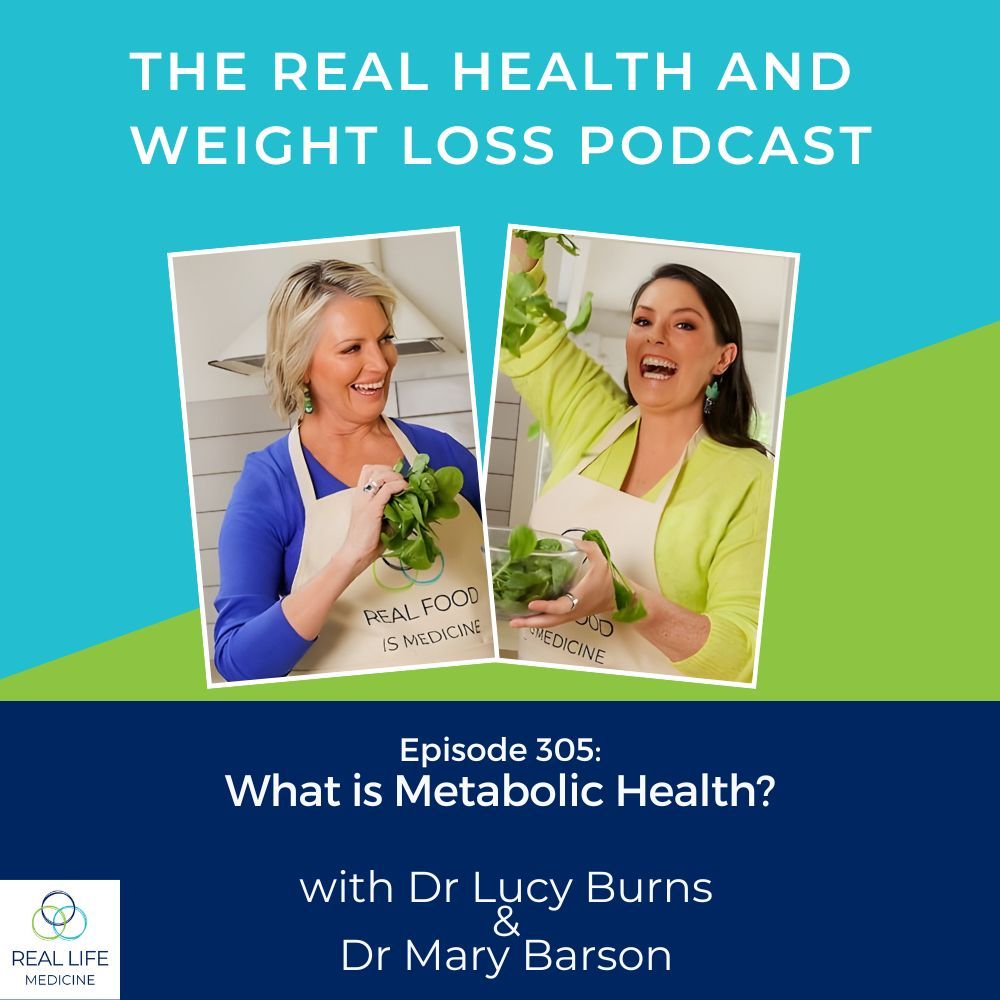


WHAT IS METABOLIC HEALTH?
One of Australia's Most Popular Podcasts with Hundreds of 5 Star Reviews




Grab your FREE Ebook copy now!
Have you struggled to lose weight and keep it off?
Start your journey to boost metabolism and transform your body into a fat-burning powerhouse.
Episode 305:
Show Notes
In this episode, Dr Lucy Burns and Dr Mary Barson take a deep dive into a foundational topic they realised they had never directly addressed: what is metabolic health? They break down the concept in plain language, explain why it matters, and offer hope that it is one of the most responsive areas of health to lifestyle change.
Key Points
What is Metabolic Health?
- Metabolic health is how effectively the body converts food into energy, regulates blood sugar, manages fat storage, and controls inflammation.
- It is fundamentally hormonal, driven by key metabolic hormones: insulin, glucagon, leptin, and incretin hormones (including GLP-1).
- Insulin is the "conducting hormone" of the entire metabolic orchestra.
When Metabolic Health Goes Wrong
- Poor metabolic health leads to metabolic inflexibility, meaning the body cannot easily access stored energy, similar to money being locked in a term deposit with no ATM access.
- Common symptoms include fatigue, cravings, brain fog, dysregulated hunger, and weight gain around the abdomen (shifting from pear to apple shape).
- Medical signs include high blood pressure, fatty liver, high triglycerides, and even an excess of skin tags (a sign of high insulin).
- Poor metabolic health is a root driver of type 2 diabetes, heart disease, stroke, dementia, and fatty liver.
Metabolism vs. Metabolic Health
- Metabolic rate (fast or slow) is just one small part of the picture; metabolic health is far broader, involving the whole harmony of hormones at a cellular level.
The Good News: It's Malleable
- Metabolic health is highly dynamic and responsive to lifestyle changes, with meaningful improvements possible within weeks to months.
- Small, consistent daily changes are more important than perfection.
Key Levers for Improvement
- Food is the biggest lever: aim for real, minimally processed foods as much as possible, acknowledging that food access is not always equitable.
- Prioritise protein: a real food, high-protein diet is one of the most powerful ways to stabilise blood sugar and rebalance metabolism.
- Combine low carbohydrate, high protein, and fibre: this slows the passage of food through the digestive system, reducing strain on the pancreas and mimicking some of the effects of GLP-1 medications.
Coming Up Next
- The next episode will focus on the specific levers that move the needle on metabolic health and how to make those changes stick.
Work With Real Life Medicine
For a step-by-step approach to improving metabolic health in perimenopause, menopause and beyond, check out My Metabolic Action Plan. This doctor-led comprehensive program gives you:
- Strategies to improve metabolism
- Skills to develop mindset
- Tools so you will implement!
Episode 305:
Transcript
Dr Mary Barson (00:05) Hello lovely friend, I am Dr Mary Barson.
Dr Lucy Burns (00:09) And I'm Dr Lucy Burns.
Both (00:11) We are doctors, weight management and metabolic health experts. We are the creators of My Metabolic Action Plan, your two-step map to real health and weight loss, which is in fact the name of this podcast. Join MyMap now at rlmedicine.com.
Dr Lucy Burns (00:30) Good morning gorgeous friends, Dr Lucy here, joined by the effervescent, fabulous and metabolically well, Dr Mary.
Dr Mary Barson (00:40) Hello my metabolically well friend, how are you today?
Dr Lucy Burns (00:44) I'm awesome actually, I am very happy with autumn. So autumn is my favorite season, and I just love the kind of crisp mornings, and so I've been going outside getting the sunlight into my eyeballs, a little bit of, you know, vitamin D on my skin without, you know, the tyranny of skin cancer, and playing with my dog. So sort of 20 minutes, it's setting me up for the day, I'm loving it.
Dr Mary Barson (01:08) I love it. For me autumn, you see I live on this rural property, this farm, it's really all about wood and water, which is quite fitting because we're talking about metabolic health today, but I need to get my wood going for the wood stove that heats my house, and it's a time where our water supplies normally start to replenish, so I anxiously look at the dams and the wood.
Dr Lucy Burns (01:33) Mmm, that's so interesting because you're absolutely right, we are talking about metabolic health today because it occurred to me that we don't have a blog post, a podcast on what is metabolic health, and you know you and I know what it is, and lots of, you know, lovely people out there will know, but for some people they don't really know, and it's understandable because it's a bit fake.
Dr Mary Barson (01:58) Yes, it is, and it's something that we say a lot, you know, we have my metabolic action plan, we talk about women improving their metabolic health and how metabolic health underpins all health really, and yet yes, I think it's a good time that we spend some time talking about what actually is metabolic health.
Dr Lucy Burns (02:18) Absolutely, and the thing I think that is going to be great in this episode is that we also bang on a bit about how metabolic health is one of the most malleable parts, components of health to lifestyle, and so as lifestyle medicine doctors there's many conditions that respond well to lifestyle, unfortunately not all of them, I mean some things, you know, require obviously very high end medical intervention, but metabolic health, it responds not just well but quickly, so you can see changes profoundly, and it's brilliant, so yeah let's bang on about it.
Dr Mary Barson (02:56) Yeah so Lucy, we're talking about this off air, what is metabolic health? How would you explain this concept?
Dr Lucy Burns (03:05) Yes, using a bit of wood and water, so metabolic health really, refers to the way our body and our cells convert our food into energy, how we regulate our blood sugar, how we manage our fat stores, and how our body controls inflammation is kind of the gist of it. The component of metabolic health is really hormonal, so it's metabolic hormonal health we could put that in, and there's multiple hormonal elements to it, and when I'm talking hormones I'm not talking specifically about sex hormones like estrogen and progesterone, which is what everyone thinks of understandably, we're talking about metabolic hormones, and they do interact with all of our other hormones anyway, but specifically insulin and then its friends glucagon, leptin and the incretin hormones, which you know again everyone knows this now, glp1, lots of people have heard of glp1, it is a hormone so yeah lots of that. So yeah that's kind of the way I think about it, so how effectively your body converts food into usable energy and then how flexible it is with managing its stored fuel would be a good way. What do you think?
Dr Mary Barson (04:26) I do, I agree, I think it is it's how our body handles food, how we store food, and then it regulates our energy, our inflammation, and that metabolic hormone insulin is it's the the conducting hormone insulin is conducts this entire orchestra of metabolic health, and it's incredibly important because when metabolic health is good, when things are running smoothly and in balance, then we are well, at least we have the absolute best chance of being well. We can have good energy, we can have functioning organs, we can have regulated healthy weight, we can use our energy, we can feel good, all of our systems can hum along, but when metabolic health is in a poor balance, then the wheels can fall off everything. This is what can drive type 2 diabetes, heart disease, main drivers of strokes and dementia, fatty liver, all of these horrible things that are actually depressingly very common have at their root metabolic health driving them.
Dr Lucy Burns (06:45) Yeah absolutely, and so when somebody has good metabolic health they have what we call metabolic flexibility. They have access to their ingested fuel, which is what food essentially is, it's fuel and nutrients, so they have easy access to that, they can utilise it well, they can store the leftovers, and then they can get access to the fuel. And so i was thinking about this the other day, i mean we've got, you know, our woodshed analogy that we have used a lot, but i was also thinking about because i love analogies, i was also thinking about this analogy of the bank. So and and there's a little bit of it that is I'm thinking oh my god this analogy is going to be outdated soon as nobody uses cash these days, but bear with me. So it's like, you know, so when you've got access to, you know, you've got a wallet that's got money in, that's your immediate fuel source, and that's what most of us will use initially, and then ideally you might need to go to the atm and get some more cash out, and that is what metabolic flexibility is. You can dip into your stored cash reserves if you like, but when you've got high insulin it's like there's no money in the atm, it's all in term deposit, yep i know that's deposits yeah, so it's there, you've got it, and it can be a big term deposit, but you can't get it, and so then you're left with an empty wallet and you're scrounging around trying to find, you know, the pennies on the ground to run your life yeah, and that's really what insulin resistance is like, instead of being able to just easily grab your cash out of the atm it's all locked away.
Dr Mary Barson (07:30) I love that analogy, I think it's good, and we want to be able to have easy access to, you know, both the cash in the wallet ideally and money in the bank yeah. How does this show up for people in everyday life though, like if your metabolic health is not well balanced what does this actually mean for people.
Dr Lucy Burns (07:47) Yeah so I guess people will feel so their feelings that they'll have is they'll be they can be tired because they literally run out of fuel, so you know that the wallet is empty even though you know society will imply oh you've got all this stored body fat you can use that in your calorie deficit air quotes you can't get it while your insulin levels are high, and that is the I think missing point for so many people, so many health programs, so many annoying friggin gym bros online who shit me to tears because they just keep banging on about the calorie deficit, not realising or recognising or probably willfully ignoring the fact that you can't burn your stored body fat if you have high insulin levels that's right.
Dr Mary Barson (08:42) Yes if your metabolism is struggling it's not okay so if you just don't have willpower or that you're weak willed it's just your body is crying out for energy and it needs to get that energy somehow, and if it can't get your stored energy then your body and brain will go eat give us some energy, and it will particularly crave the fast sources of energy which are your carbohydrates or your sugary foods or your processed foods, they're the things that your body's calling out for with that high insulin because of having your metabolic health out of whack.
Dr Lucy Burns (09:20) Absolutely and I think it's really important to also just define the difference between like metabolism and metabolic health, and I think that really metabolism has been reduced to metabolic rate so the metabolic rate is is how efficient you can convert this food into energy, and people will talk about having a slow metabolism or a fast metabolism and so you know the implication is that if you've got a fast metabolism you can eat tons of food and uh you know you you don't gain any weight for example whereas really that's your metabolic rate, but metabolic health is just way more than that like it really is this whole harmony of hormones.
Dr Mary Barson (10:08) And like I said it has a finger in you know the pie of every single aspect of your health.
Dr Lucy Burns (10:13) Ah and right down to the cellular level so metabolic health is more than just your metabolic rate and so as we've discovered you know if your metabolic health is is not ideal you'll be tired and probably hungry and interesting this a bit of a paradox here is that it's dysregulated hunger so I see people who have kind of no hunger signals but the minute they start it's like the brain goes oh my god thank god and then it feels then they feel like they can't stop and so there's this whole inability to regulate hunger and satiety or fullness which of course again back to my stupid gym bros has been turned into a willpower and discipline issue not a physiological process.
Dr Mary Barson (11:06) What I love about metabolic health and working in this space is how malleable it is, like you said earlier, and that it's really dynamic, so this process is not set in stone. If you are in struggle town at the moment and struggling with this dysregulated hunger, these energy crashes with fatigue, with cravings, with extra weight around your middle, all of these things are happening because of a metabolic imbalance, but it does respond to our daily life in this really dynamic way, and like you said it can change quite quickly. It's one of the most fun things about being a doctor is it works in these areas, you can see how fast people can start to get these wins and start to turn it around, so I think the key point here as well is that your metabolic health is not fixed.
Dr Lucy Burns (11:57) No no you may have predilection to dysregulated metabolic health, so it may be easier for your body to fall into I guess hormonal imbalance, and that can be people who are genetically blessed as we say who who can get away with a bit more if you like, and I mean that's just the luck of the draw, but what we see is that people you know people might be out there going well how do I know if i've got metabolic imbalance I'm a bit tired, so you know it's not just being tired and hungry. We know that it's you know people start storing weight around the middle, so waist circumference increases for women in particular, instead of being maybe a pear they become an apple. Blokes can develop the so-called beer gut or beer belly, and it really is this abdominal distribution where your fat is distributed viscerally or abdominally. People can have other kind of conditions that they may not realise are all part of the metabolic spectrum like high blood pressure or fatty liver disease or even you know cholesterol lipid problems, triglycerides, high triglycerides in particular, which look again I don't expect the general public to know about all of that half most half the doctors don't know about it, but that's all part of metabolic you know metabolic syndrome as it's now often called, and then something that is not part of metabolic syndrome but almost could be is the presence of excessive skin tags. Everybody has some skin tags that's normal, and they are normal as you age as well, but what we see is just an increasing or excessive number can be a sign that insulin levels are high.
Dr Mary Barson (13:43) That happened to me when I was pregnant with max I got lots of extra skin tags especially that third trimester, as women get more and more insulin resistant just naturally, and I did get a mild case of gestational diabetes as well thanks to my genetic predisposition, and yeah that was I think I noticed I just sprouted skin tags everywhere yeah please say they're gone they're gone now but it was troubling at the time.
Dr Lucy Burns (14:08) Yeah absolutely and again you know I don't want people to panic if they've got a couple because some are normal like it is normal to have some, but it's when you start realising that you're getting lots of skin tags especially under your armpits or around your neck even in your groin it's like what's going on here, so yes so I think then we go right so we've got you know symptoms for people of tired hungry you know difficulty brain fog you know cravings, we've got you know increased waist circumference, we've maybe got some medical conditions, and the big thing that and part of the reason we bang on about a lot of this is because these set you up for chronic disease in the future so the risk of as you mentioned earlier Miss, things like stroke heart attack dementia type 2 diabetes they're massively increased with metabolic disease.
Dr Mary Barson (15:01) And these are big scary things that everybody would want to avoid and if we're already down that path we want to be able to to manage and reduce as much as possible.
Dr Lucy Burns (15:13) Yes but as we know there is good news, good news folk, and the good news is as we've discussed is that this is highly malleable, highly adaptable to lifestyle interventions that don't mean you have to be perfect. You don't suddenly have to go and win a bodybuilding competition, and in fact probably most of those people aren't actually healthy, that's a story for another day, but some simple changes that start small and repeated day in day out over time make a huge huge difference.
Dr Mary Barson (15:51) Yes and they can make a huge difference pretty quickly, you know these are things that can start to improve in weeks to months not years.
Dr Lucy Burns (16:01) Yeah absolutely and you know we love talking about the levers for metabolic health so you know and we've called them well we've got either the six s's or the four s's depending on how much time we've got to talk about them yeah that's right the biggest lever for health is undoubtedly food, you know the whole idea of eating real food as much as possible. Now we were talking a bit off air about the privilege that comes with being able to access and eat and afford real food, the access to that is not equitable certainly not in Australia, and I'm imagining around a lot of a lot of the world there are pockets of the community who don't have access to the funds and the finances and the affordability for whole real foods that do have to rely on processed foods, and unfortunately that that does have an impact on their health and that is not their fault actually blame governments for that because they could regulate it and make real food more affordable and ultra processed food less affordable by just changing the system but.
Dr Mary Barson (17:11) Yeah these these big food companies are not particularly interested in our health nearly as much as they are in you know the health of their shares their share price and their bottom line yeah my sister works in a remote island community and they have highly unstable access to fresh food and people there sometimes do just have to eat processed food because it's what's available but as much as possible we want to aim for real minimally processed foods and do what we can.
Dr Lucy Burns (17:14) Yes absolutely and that's that's it it's never about I mean nobody's perfect and you know honestly no people don't have time. I don't have time to garden, I don't have time to pick my spinach leaves every day. I buy a lot of food, I try to buy as much whole foods as I can but yeah I'm I don't I'm not making my tomato sauce from scratch. I know there are people out there that do and yay and you know I've got recipes for homemade cottage cheese which I do from time to time but I don't do it all the time, I don't have time, so it's what you do most of the time that makes the difference.
Dr Mary Barson (18:22) Absolutely and within that real food another aspect that is really important is to prioritise the protein as much as you can, a real food diet that is high in protein is really going to help stabilise the blood sugar stabilise your insulin and help rebalance your metabolism and your metabolic health as powerfully as anything else.
Dr Lucy Burns (18:49) Oh absolutely and I think when you combine the low carbohydrate high protein with some fiber, that really does make a huge difference to the way the food is processed through the stomach and the intestinal tract to be able to deliver that food sort of slowly, which helps the poor pancreas, which has been going like the clappers trying to process really fast acting foods. And when we can slow it down, I mean that's really how one of the aspects of the glp1 injectables, they work by slowing the passage of food through your stomach. Now you know they are extremely powerful ways to do that, but we can mimic it. It doesn't necessarily be exactly the same, but it mimics the concept of slowing the food down through your stomach, which is again really why we ask people to consider whether protein powders are in their best interest or not because they pass quickly through the stomach compared to even something like yogurt berries and some nuts, which would go through quite slowly.
Dr Mary Barson (19:59) Yes and they allow the body's metabolism to work within its normal balance, its normal time frame, rather than placing extra strain on it.
Dr Lucy Burns (20:09) Yes to go through quickly absolutely.
Dr Mary Barson (20:13) All right, I think we should pause here for a moment because we have laid the foundation, which I think is a really really good takeaway for today, and I know we've got lots more to say. Metabolic health, it's not just about a number on the scale, it is about how effectively our body converts our food into energy, it regulates our blood sugar, our fat storage, our inflammation, pretty much every aspect of our health, and having that understanding is so important. When you understand that, I think everything else can start to make sense, you know why our energy crashes, why we get cravings. So in the next episode we're going to, you know, take this one step further and talk about what actually really moves the needle on our metabolic health, what are the levers that that we can use to be metabolically well and in a good balance, and so Dr Lucy I look forward to you joining me again then, and we'll talk about what we could do to improve our metabolic health and how we can make those changes really really stick. All right, people take care of your beautiful cells. We'll see you in the next episode.
Dr Lucy Burns (21:30) The information shared on the Real Health and Weight Loss Podcast, including show notes and links, provides general information only. It is not a substitute, nor is it intended to provide individualised medical advice, diagnosis or treatment, nor can it be construed as such. Please consult your doctor for any medical concerns.