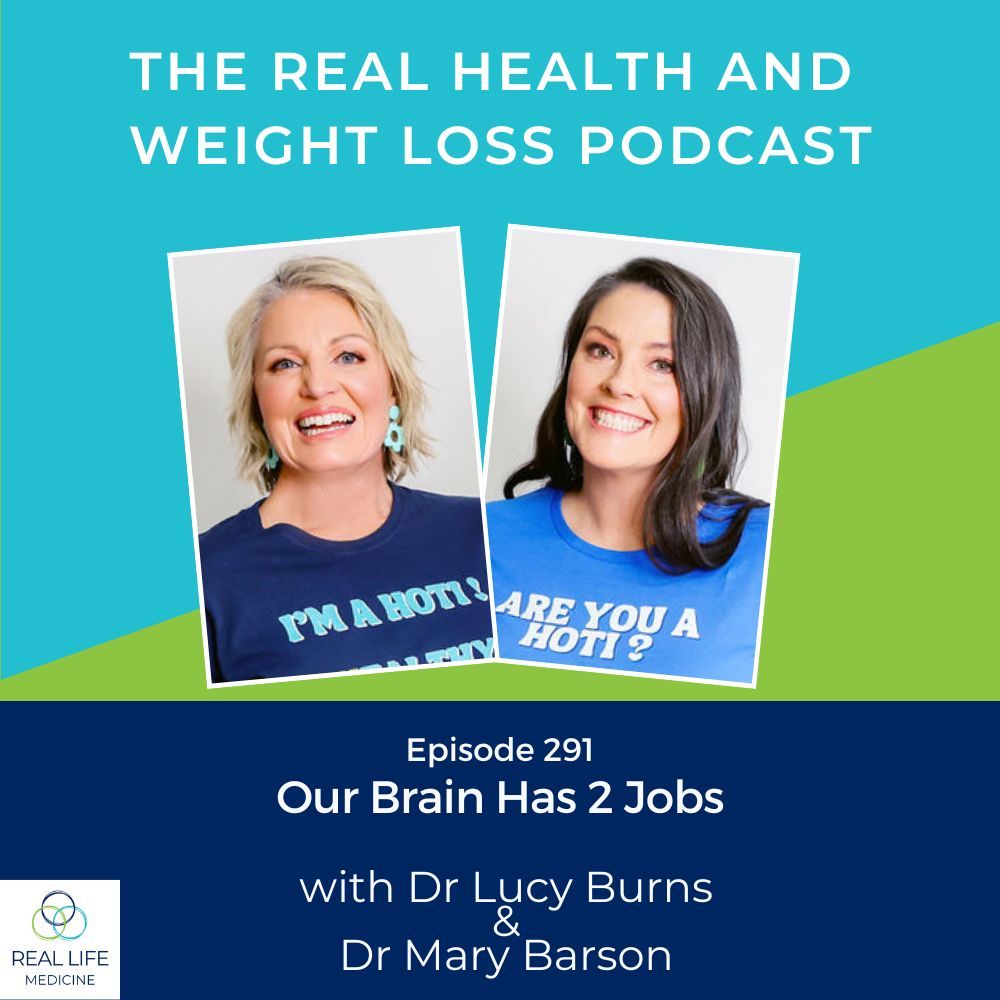

OUR BRAIN HAS 2 JOBS
One of Australia's Most Popular Podcasts with Hundreds of 5 Star Reviews

Grab your FREE Ebook copy now!
Have you struggled to lose weight and keep it off?
Start your journey to boost metabolism and transform your body into a fat-burning powerhouse.
Episode 291:
Show Notes
Our brains drive behavior through two main jobs: keeping us safe and helping us feel better, and both can unintentionally sabotage metabolic health and weight goals if left unmanaged. Understanding these drivers, then using compassionate mindset tools and small steps, allows sustainable behavior change without shame.
Core idea of the episode
- The brain is wired for survival (safety) and reward (feeling good), and these ancient systems strongly influence eating and lifestyle choices.
- When people “know what to do but don’t do it”, it is usually because these brain systems are prioritising short‑term safety and comfort over long‑term health.
Two main brain jobs
- Safety: The limbic system and amygdala act like a worrying “warrior/warrier”, constantly scanning for threat (including emotional threats like criticism, failure or embarrassment) and resisting uncertainty or change.
- Feeling better: The reward system seeks dopamine; food, especially ultra‑palatable food, becomes a quick tool to soothe stress, shame, resentment, loneliness or boredom and is prioritised over future goals like reversing diabetes.
Why shame and willpower don’t work
- Self‑criticism after overeating (“What’s wrong with me? I’m such an idiot”) is common but ineffective; if shame worked, everyone would already have changed their behavior.
- Pushing with willpower alone, or trying to “just resist the food” without other tools, leaves the brain without safe alternatives and often backfires.
SLAB and emotional eating
- A simple acronym for common emotional triggers is SLAB: Stressed, Lonely, Angry, Bored.
- Stress (overwhelm, worry), loneliness (lack of support or connection), anger/“seething resentment”, and boredom often drive eating or drinking as entertainment or emotional regulation, which can undermine metabolic health.
Healthy reward, small steps and mindset models
- The brain also produces dopamine from healthier rewards like real food, movement, social connection, small achievements and self‑care (e.g. a bath), which can be used intentionally instead of food.
- Breaking big goals into tiny, doable steps lowers the brain’s threat signal, builds confidence and gradually makes new habits feel safe and automatic.
- Psychological frameworks mentioned
- CBT: Thoughts, feelings and actions interact in a triangle; changing any point (including taking a small action) can improve confidence and results.
- Internal Family Systems: “Manager” parts try to keep you safe (often harshly), while “firefighter” parts rush in with quick fixes like chocolate to put out emotional fires; understanding these parts helps you work with your brain, not against it.
Key takeaways for long-term change
- Effective change requires both metabolic health strategies (what to eat) and mind management (why you eat and how you soothe yourself).
- Replacing food as the primary emotional tool, using compassion, understanding your triggers, and taking small consistent steps are presented as the twin keys to lasting health and weight loss.
We’re excited to share that a brand-new program is launching in February 2026. It’s your complete MAP to metabolic health — and our presale is happening now, so you can secure your spot today.

Episode 291:
Transcript
Dr Mary Barson (0:04) Hello, my lovely friends. I am Dr Mary Barson.
Dr Lucy Burns (0:09) And I'm Dr Lucy Burns. We are doctors and weight management and metabolic health experts.
Both (0:16) And this is the Real Health and Weight Loss podcast!
Dr Mary Barson (00:21) Hello lovely friend welcome to the Real Health and Weight Loss podcast. I'm Dr. Mary, and as ever, I'm joined by the beautiful blonde Dr. Lucy. How are you, my beautiful blonde friend?
Dr Lucy Burns (00:35) Oh, I am lovely. I am feeling very good. Again, summertime, you know, I don't need to bang on about it, but I feel very, very good. I've been getting up early, getting my eyeballs some sunlight into them, having my cup of coffee outside with my little puppy. So no, life is very, very good.
Dr Mary Barson (00:57) Sounds idyllic.I love that. Very, very good for your brain. Very good for your brain. And today we are talking about our brain and talking about what primarily drives our behavior, because our passion in life is to helping people get well, especially women in midlife, to just be well, shake off those shackles of chronic disease and excess weight, and just live their glory years in the absolute best health possible. And to do that, you need to often change your behavior, and behavior is all driven by our brain. And understanding how our beautiful brain works is vital to being able to live the life that we want. So yeah, we're gonna lift up the hood of our brain and have a little poke around and talk about how our brain kind of has two jobs, two primary jobs that drive our behavior. And knowing about this is going to be very helpful. So let's see, what are the two jobs?
Dr Lucy Burns (02:07) Yeah, the first job is our brain is primarily wired for survival. So it is all about keeping you safe, because humans are not, like we're not actually that very, we're not that good in the wild. We don't have any scales or wings or claws or anything. We're really, we've got very, very good and advanced brains, but we don't have a lot of physical defenses. And so for a lot of our behavior, it really is wired around safety and keeping us safe. And that can be physical safety or emotional safety. And the second thing, and again, this is part of survival, is our brain is trying to make us feel better. Because when you feel good, you're safe for a start, but also it's tied a lot of our behavior to reward because that drives for us to repeat that behavior. So again, thinking right back to, you know, really basic days where we had to perhaps fossick for berries. Well, the, you know, the berries taste good. They give us a little bit of dopamine. All food gives us dopamine because that drives us to do that behavior again. So humans are very much reward driven. So we lean into rewards, we lean into pleasure, we lean into the things that make us feel good. We lean away from things that make us usually not feel good because they don't always feel safe.
Dr Mary Barson (03 :40) Yes, that's right. And this really matters for behavior change in many ways, especially when it comes to, you know, change. Like, the safe brain wants to resist uncertainty. You know, the feel-good brain that craves immediate rewards, both of which can be, you know, highly damaging and sabotaging to change. So you think about that with regards to our brain wanting to keep us safe. You know, our emotional center of the brain, which has our limbic system and the amygdala, and its job is that it's always on the search for the potential threat. It's always looking out there. I like to think of it as our warrior, in that it worries, worrying about the future, worrying about that embarrassing thing we did in the past, always finding, you know, things to worry about to try and prevent uncomfortable experiences or dangerous experiences. And it's our warrior, like with its two swords out, ready to just fight off anything, any threat.
Dr Lucy Burns (04:41) Oh, warrior. Yeah. I was thinking you were doing worry, W-O.
Dr Mary Barson (04:45) Both. I'm being clever with words. It's our warrior. You are. With its weapons. And it's a warrior in that it worries. It is both a warrior and a warrior. It is both. Yes. And that's what our amygdala likes to do. We got that now. Was I being too clever? Yes. Yes. The W, two Ws. Warrior and a warrior. Yeah. Yes, that's right. And so the warrior in us, both warriors, they will resist uncertainty. And, you know, the fear of failure is a real fear. The fear of failure is a physical response that we feel in our bodies. And, you know, trying new things means we might fail. It can lead to quite avoidant behaviour in all kinds of things. And that can be really damaging to change. And that us wanting to feel good in the moment. See, our brains will prioritise feeling safe right now far more than any kind of future goal. We'll sabotage or, you know, forget any future goal in preference for feeling good right now. And as you've mentioned, if we feel good, if we've got that little dopamine hit, our brain also interprets that as us feeling safe. And sort of the two things are intermingled. So if you've got a rush of unhelpful emotions right now, feeling a whole lot of shame, a whole lot of resentment, a whole lot of embarrassment, then, you know, eating right now to help take that feeling away, to return to a sense of safety right now, where our brains are going to think that's more important than our long-term goal of reversing our diabetes or improving our metabolic health. And it's not to say that you have to eat the cookies just because your brain wants to do it, but understanding what your brain is doing and why it's doing it is the first step to awareness, so that you can work with your beautiful brain rather than trying to rail against it, because railing against it ain't going to work.
Dr Lucy Burns (06:46) No, absolutely. And I think it's really important for us to know how our brain works, because we also want to be able to change with compassion rather than just beating ourselves up or hating on the way we're behaving or being cross with ourselves for doing it again. Oh my God, I can't believe I ate the ice cream again. What's wrong with me? I'm such an idiot. If all of that worked, if that was actually useful talk, we'd all be changed. We'd all be just doing what we wanted to do, because we are all pretty good at berating ourselves to some level.
Dr Mary Barson (07:19) If shame was an effective change tool, my life would be absolute perfection. But it isn't, because it's not.
Dr Lucy Burns (07:31) No, no. So understanding what to eat is really important. Understanding why we eat is also really important. And I've got a number of acronyms that you can use depending on what's going on in your life. I quite like one that is simple, which is called the SLAB. So a lot of us will eat or drink when we're stressed, lonely, angry, or bored.
So stress, again, you can break it down. There's lots of things that people relate to as being stressed. It might be overwhelmed. You might have just too many actual, too many physical jobs to do. You might have a situation that you're worrying about something that's outside your control. So maybe you're worrying about one of your kids and it's really beyond your control. All of that, that's stress. Lonely, I think lonely is really interesting. Lots of us will eat, as I said, or drink when we're really craving social connection. But it could also be when you feel lonely in, like, a job. Maybe you've got no one to bounce the ideas off, or maybe you've got to make a decision that's difficult and you're the only one that can make it. So you feel sort of lonely. Or maybe you're a carer for somebody and there's no one else to help you. So you can feel lonely in that role. So it's not just, oh, I'm by myself. Or alternatively, your brain might be one of those ones that goes, oh my God, no one's at home. Eat all the lollies before they get home. So it can also be that. Anger is interesting because it's not just always ragey anger. Everyone can identify that, but lots of people, and maybe you're one of them, has what I call seething resentment. So it's just bubbling underneath. You don't want it to come out. And so you just keep shoveling it down with food. It's a very effective tool for that, the seething resentment, not very effective for your metabolic health.
Dr Mary Barson (09:34) No, indeed.
Dr Lucy Burns (09:38) And so then the B in this SLAB is bored. And so for a lot of us, we have been conditioned to use food as entertainment. And when you think about it, I mean, how many cooking shows are there on television? There's dozens. We eat when we're bored. We watch cooking shows when we're bored. We cook things when we're bored. So for a lot of us, food is entertainment, which again is fine unless it's causing you some disruption to your different activity to manage the boredom.
Dr Mary Barson (10:13) Yeah. Yeah. And manage. I love that you said that because we do need to respect our brain's need for reward and need for soothing and need for comfort. It's not like, okay, we're not going to shovel our anger down with chocolate biscuits anymore. Therefore, we're just not going to do anything to soothe ourselves. That's not going to be helpful either. Dopamine is healthy. It's natural. We need it. But our brain will create a dopamine response to things that are healthy, perhaps not as high, perhaps not as strong, but we get a dopamine hit from eating good food, from movement, from little achievements, from ticking things off your to-do list, from some social connection, from doing little things for ourselves, like having a bath. These things can still soothe us and at the same time, not sabotage our health goals.
Dr Lucy Burns (11:10) Yeah, absolutely. And I think you're right. I mean, so many people just try to resist the thing without understanding that you need to replace it. You can't just pull the wool out. No, the rug, the wool and rug. You can't just pull the rug out from somebody and leave them with no tools. And this is super interesting because I've seen this in the metabolic clinic where people have started on a GLP-1. So all of a sudden, they actually can't eat their food, their previous tool that they used to manage their mind, soothe their emotions, deal with disappointment. All of a sudden, their body's going, no, I don't want that. I'm feeling sick. And so they're just sitting with their emotions, not knowing what to do. And so really, mind management is so unbelievably important. And it's not just about resisting the food, it's about coming up with other ways to make yourself feel better. Yes.
Dr Mary Barson (12:10) Yeah. And to help make the changes feel safe as well. And to work with your brain when it's doing both of its jobs. And we teach these mindset skills. It has to start with that awareness and just being aware of what your brain is doing and being mindful and finding ways to feel calm, to feel safe, to soothe yourself that, yeah, are also healthy.
Dr Lucy Burns (12:42) Yeah, absolutely. I think really important when your brain, you've got something you want to do, but you don't do it. Again, so you've got the knowledge, but you're not doing the thing. And there's so many reasons for that. Some of it is, again, we resist change because it doesn't feel safe. It feels too big, feels massive. So our brain goes, oh my God, that's going to be big. You're never going to do that. A bit like that marathon I talked about a few weeks ago. So your brain goes, nah, too hard, not doing it. Again, our favorite thing, the small steps, the power of small steps. We've often been conditioned that the small steps are useless, that you either go hard or go home. If you're not going to do it properly, it's not worth doing it at all. Honestly, those well-intentioned lessons actually harm us more than help us.
Dr Mary Barson (13:38)
No, they provide that threat signal. It's too hard, it's dangerous, and your brain just won't want to go there. But instead, breaking it down into small, doable steps reduces that threat signal right down to the point where it still might be a bit uncomfy. It still might require a little bit of grit, a little bit of, I just have to do this, even though I don't quite want to, but it's not insurmountable. Then just that little bit of grit, you do the thing, you keep doing it, and you're like, ah, actually, this is doable. It becomes comfortable. It becomes a habit. Then you can add in the next little bit. Before you know it, you're actually sprinting towards your goals by taking those tiny little steps.
Dr Lucy Burns (14:20) Absolutely. We talk a lot in all of our programs around a number of psychological theories. We use CBT, which is where your thoughts and feelings and actions—thoughts create feelings, feelings create actions. Actions can also create thoughts or feelings. There's a little triangle that works with all of those, and that is actually what determines your results. You can activate that pathway at any point. Sometimes just doing the action gives you that feeling of confidence. Again, we talked about that a couple of weeks ago with thinking about the gain, not the gap. You do the action, you get your confidence, that gives you a little bit more safety to go, yeah, okay, I think you can do the next bit. Okay, good, good. You get momentum and off you go. So there's a number of ways to leverage the power of your mind in order to facilitate behavioral change. It's really important. Another theory that we use, probably both of us use more in our one-to-one patients, so in therapy, is something called internal family systems, and that uses, I guess, analogies of the manager and the firefighter. Again, so we can look, and the manager is trying to keep you safe. The manager's the one that's there micro-managing everything, sometimes very annoyingly and sometimes very harshly, but it ultimately thinks it's keeping you safe. The firefighter is the thing that comes in with the, woohoo, let's have the chocolate, let's have the lollies, because it's trying to put out a fire, and it's providing you a tool to quell an emotional flame. And they both have their roles, often it's around managing your mind around those and helping you to understand the way they work. So when we talk about mindset, we're not saying, oh, you just need to develop some grit and resilience. You actually do need to understand some of the drivers for your behavior or your lack of behavior, your lack of action, so that you can then go, okay, how can we unpack that? How can we reframe it? What's the first doable step I can take? That's it. And that, beautiful friend, is working with your beautiful brain. Indeed, indeed. So metabolic health, mind management, the two keys to long-lasting health and weight loss, brought to you by The Real Health and Weight Loss Podcast.
Dr Mary Barson (16:55) That's a beautiful place to end it. Gorgeous people.
Dr Lucy Burns (16:58) Indeed. Wishing you and your gorgeous brains a fabulous day and week ahead. Bye for now.
Dr Lucy Burns (17:07) The information shared on the Real Health and Weight Loss Podcast, including show notes and links, provides general information only. It is not a substitute, nor is it intended to provide individualised medical advice, diagnosis or treatment, nor can it be construed as such. Please consult your doctor for any medical concerns.