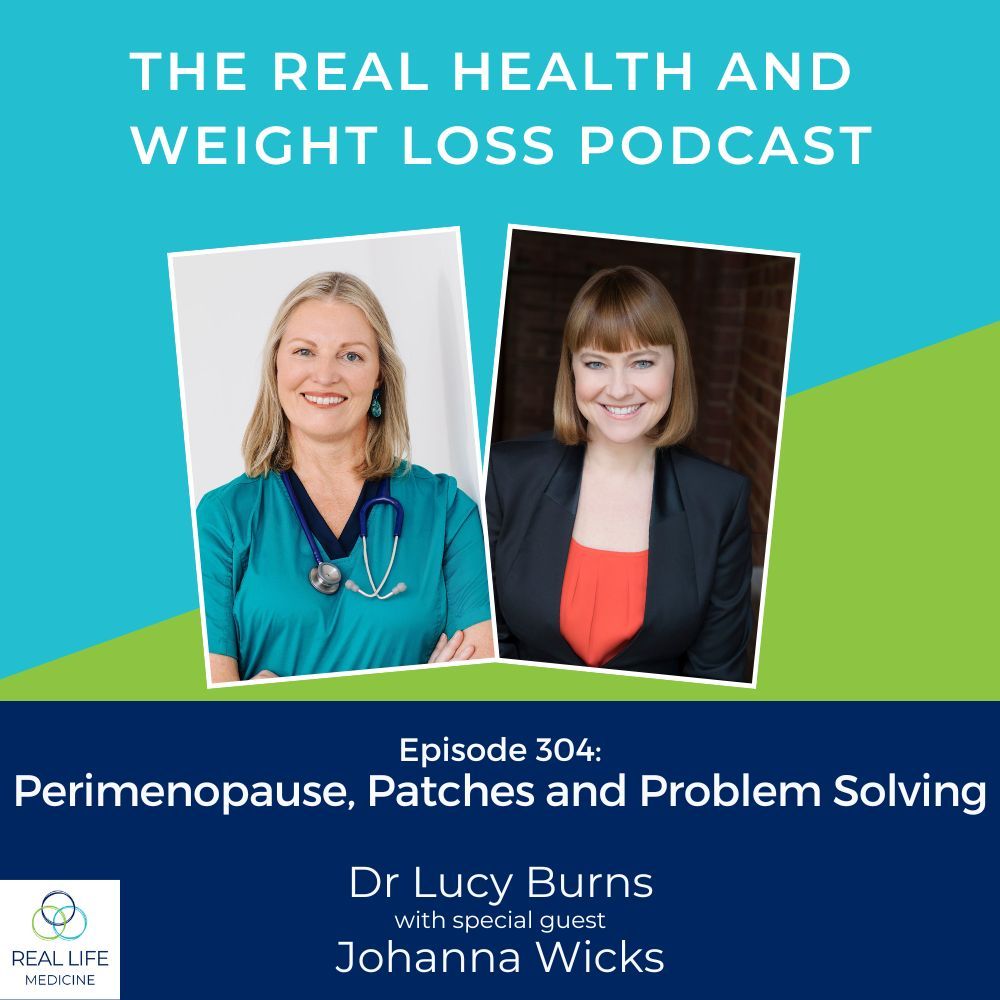


PERIMENOPAUSE, PATCHES & PROBLEM-SOLVING WITH JOHANNA WICKS
One of Australia's Most Popular Podcasts with Hundreds of 5 Star Reviews




Grab your FREE Ebook copy now!
Have you struggled to lose weight and keep it off?
Start your journey to boost metabolism and transform your body into a fat-burning powerhouse.
Episode 304:
Show Notes
Dr Lucy Burns hosts Johanna Wicks, menopause advocate and co-founder of Lorai, a groundbreaking Australian pharmaceutical startup co-founded with Raisa Monteiro (PhD in Material Science, Stanford), which is on a mission to manufacture a high-quality MHT estradiol patch for women, by women.
Menopause and Perimenopause: The Symptoms
Menopause is far more than hot flushes. Jo's own perimenopause journey began at age 42, and for two years no doctor mentioned the word "perimenopause" despite a constellation of debilitating symptoms. Common symptoms include:
- Weight gain, especially around the middle
- Joint and muscle aches and pains
- Brain fog and poor memory
- Fatigue and low energy
- Headaches
- Mood changes including irritability, anxiety, and rage
- Loss of identity, feeling unrecognisable in the mirror
Jo gained approximately 8kg within 12 months, her active lifestyle ground to a halt, and at 44 she felt like she was 104. Starting MHT reversed her symptoms within just three weeks, a powerful reminder of how transformative timely and accurate diagnosis can be.
The Metabolic Changes at Menopause
The decline in oestrogen at menopause triggers profound cardiometabolic changes, even in women who have not changed their diet or lifestyle. These include:
- Central weight gain and visceral fat accumulation, where fat redistributes to the abdomen and dramatically increases metabolic risk
- Increased insulin resistance, making the body less efficient at managing blood sugar
- Worsening cardiovascular risk, including elevated risk of heart attack and stroke
- Increased risk of type 2 diabetes
- Bone loss, accelerating osteopenia and osteoporosis
- Changes in body composition, with loss of lean muscle mass and gain of fat mass
These changes can occur rapidly, often within 12 months of entering perimenopause, and are not simply a result of ageing or lifestyle choices. MHT is not just about symptom relief; it carries significant long-term protective effects on bone, cardiovascular, and metabolic health.
Why Australia Has an MHT Patch Shortage
The WHI Study Legacy
The 2002 Women's Health Initiative (WHI) study incorrectly linked MHT with an increased risk of breast cancer. Usage plummeted overnight from 26% of Australian women to near zero, and pharmaceutical companies stopped manufacturing hormone therapies, gutting global production capacity.
Supply Cannot Meet Demand
Now that the science has been corrected and advocacy movements (sparked by Davina McCall's documentary in the UK) have driven a global menopause awakening, demand has surged but manufacturing has not kept pace. In Australia today, only approximately 14% of midlife women use MHT, yet this is already outstripping supply.
The PBS Price Problem
All three estradiol patches available in Australia are listed on the Pharmaceutical Benefits Scheme (PBS), which is excellent for affordability but creates a critical vulnerability. Every 5, 10, and 15 years, PBS medicines undergo mandatory price cuts. With all three patches having been on the PBS for nearly 20 years, Australia now pays some of the lowest prices in the world, meaning pharmaceutical companies send their limited stock to higher-paying markets first. The beloved Estradot patch has been in chronic shortage for nearly five years.
Big Pharma's Conflict of Interest
Companies like Bayer invested heavily in new non-hormonal menopause drugs (NK antagonists) after the WHI scare. Bayer subsequently removed its effective oestrogen patch from the Australian market, raising serious questions about whether commercial interests in their newer, more expensive drug are being prioritised over women's health needs.
The Lorai Solution
Jo Wicks met Raisa Monteiro at the So Hot Right Now conference in Sydney in 2024. Raisa's Stanford PhD in material science gave her the expertise to understand patch manufacturing, and together they asked: why wait for Big Pharma? Let's just make it ourselves.
Two-Stage Product Plan
- Gen 1 Patch is a "gold standard" version of existing patches with better adhesion, less skin irritation, and more consistent hormone delivery. Because it is bioequivalent to existing products, it only requires a bioequivalence trial (approximately 6 months, approximately 24 participants) rather than a full randomised clinical trial, with a target of being on the Australian market within 2 to 2.5 years.
- Gen 2 Patch is a truly innovative patch that is small, discreet, non-irritating, and lasts 7 full days. This will require a full randomised clinical trial, making it a 5 to 7 year journey.
Made in Australia, For Australia
The long-term manufacturing goal is to produce the patch in Australia, ensuring domestic supply is always prioritised. In the interim, Lorai is in discussions with contract manufacturers in Europe and the US while building the capital to establish a local facility. They draw inspiration from Lawley Pharmaceuticals, the small Australian company that manufactures Androfem, the only female testosterone product in the world, proving it can be done.
Funding Challenges: The Female Founder Gap
Jo and Raisa have pitched to approximately 65 venture capital and private equity firms, facing repeated rejections rooted in a fundamental misunderstanding of the women's health market. Common dismissals included: "Why would we need another patch?" and "Why start in Australia, just go straight to America?"
In 2025, less than 0.5% of investment capital globally went to female founders. With 51% of the population going through menopause and women now expected to use MHT for decades rather than years, the market is enormous but many investors simply cannot see it.
Jo notes that with over 6 million women aged 40+ in Australia, if each donated just one dollar, the entire $6 to $7 million needed to bring Gen 1 to market would be fully funded. Encouragingly, Medical Angels, a medical technology investment syndicate, has agreed to host Lorai's seed round, recognising what clinicians already know: the demand is real, urgent, and unmet.
The Bigger Picture: Women at the Helm
A striking theme throughout the episode is the absence of women in pharmaceutical leadership globally. Few women sit at CEO or executive levels in Big Pharma, and this goes a long way to explaining why menopause, endometriosis, PCOS, and other conditions uniquely affecting women remain chronically underfunded and under-researched. Lorai is deliberately values-driven, focused on equitable access to quality MHT for Australian women rather than maximising shareholder returns.
How to Support Lorai
- 🌐 Website: loraihealth.com
- 💛 GoFundMe with over $20,000 raised from nearly 400 women to date
- 📱 Instagram for regular updates
- 💼 Actively seeking seed investors, especially clinicians and impact investors
Work With Real Life Medicine
For a step-by-step approach to improving metabolic health in perimenopause, menopause and beyond, check out My Metabolic Action Plan. This doctor-led comprehensive program gives you:
- Strategies to improve metabolism
- Skills to develop mindset
- Tools so you will implement!
Episode 304:
Transcript
Dr Mary Barson (00:04) Hello, my lovely friends. I am Dr Mary Barson.
Dr Lucy Burns (00:09) And I'm Dr Lucy Burns.
Both (00:11) We are doctors and weight management and metabolic health experts. And this is the Real Health and Weight Loss podcast!
Dr Lucy Burns (00:21) Good morning, my lovely friends. How are you today? Dr Lucy here, and I am without Dr Mary, but I have a firecracker of a guest. I think every now and then you meet a woman who is a doer, who just sees an issue and goes, you know what, I'm going to help solve this. And so today I am super excited to introduce to you my friend, Jo Weeks, Joanna Weeks, who is a co-founder of a pharmaceutical company, which to me just blows my mind. But I think it is incredible to champion women founders, and she's seen a problem and is determined to find a solution. Jo, welcome to the podcast.
Johanna Wicks (01:02) Thank you so much for having me, Dr Lucy. I'm very excited to be here to talk about, yes, one of my favorite topics, even if it is a little bit bonkers.
Dr Lucy Burns (01:10) Oh, absolutely. Absolutely. And so, lovely friends listening, you know that we are always talking about health, we're always talking about insulin resistance. A couple of years ago, I started moving into the menopause space because I realised that at menopause, you know, in that perimenopause, but then definitely within menopause, your entire cardiometabolic profile changes. And what that means in plain terms is that your health risks for cardiovascular disease, like heart attack, stroke, diabetes, central weight gain, visceral fat, all change. It's almost like overnight. It's not quite overnight, but it is certainly within 12 months. And so you can go from just, you know, living your life, you're not doing anything different, you're suddenly not lying on the couch, you know, eating KFC 40 times a day, but yet your whole physique feels like it's changing. Your body composition changes. And, you know, hello, menopause. Yeah. So Jo, tell me, you're a woman in midlife. What was your menopause story like?
Johanna Wicks (02:15) Well, you've kind of described a big chunk of it. I think, you know, I was considered quite young. I spent two years trying to work out what was happening to me from about 42. All the wheels fell off my life. And I doctor shopped for a long time and had loads of tests and CT scans, and, you know, no one mentioned the word perimenopause as I was slowly feeling like I was going more insane. But one of the big symptoms for me was actually weight gain, especially around the middle, which then I also hit my other big symptom. Well, I had a few, but one of them was muscular aches and pains and joint pain. So between the weight gain and the joint pain, my very active lifestyle slowed right down. And like you said, within 12 months, I think I put on about eight kilograms. I was sluggish, everything hurt. You know, I also had terrible brain fog and actually just felt like, I'm 44, and is this it?
Dr Lucy Burns (03:16) This is my 44 feel like you're 104?
Johanna Wicks (03:18) Yeah, I just didn't, I didn't recognise who I was in the mirror. And it was so fast, I think is what really shocked me. And then I went and saw, I paid to see a specialist women's health practitioner. And within, you know, five minutes after I described all the things that were wrong with me, she's like, “Oh, you're in perimenopause. You know, take some menopause hormone therapy and see how you feel.” And three weeks later, I felt amazing. Like the brain fog, the headaches, the joint aches and pains had all disappeared. I had more energy. So I could, I took a long time to get fit again. I started with walking. But the rage, the rage dissipated. Now I have little bits of rage. It then has fuelled this, what has been, I guess, you know, nearly four years of menopause advocacy around how we know so little about what happens to us at midlife. And how, how by not knowing, it can really derail women's lives. And that's, yeah, it's been my passion for the last four years.
Dr Lucy Burns (04:15) Oh, amazing. And I mean, you're a wonderful advocate. And I think that it's across the board in women's health, isn't it? I mean, we still don't understand really what endometriosis, fortunately, there is a lot more information around menopause now over the last five years. And I am embarrassed about the way I used to manage menopause. I had no idea. And I remember somebody coming to me to talk about their weight around menopause. And I'm just thinking, well, you know, you're not doing it right, and had no idea. So it's so modifying. So I think that it's brilliant that we've now got much more advocacy. And it's coming from both the top and the grassroots level so that we're meeting in the middle. But what we now know, though, for women, and again, this is so tricky, is that actually getting… so first of all, you know, the barriers to getting hormone replacement therapy, or menopause hormone therapy, whichever we want to call it. So we know that in the past, it used to be, well, you know, we just have doctors with not the right knowledge, putting my hand up here going, I was one of them. Now we've got doctors with the right knowledge, but we can't get the medication. And this is where you step in, my friend. This is where you step in. So tell me, we know overall, and MHT is individual, but overall transdermal estrogen, so estrogen that you absorb through the skin, you know, through your arm or through your leg, is much, usually safer. So there's circumstances where orals are better or whatever, but in general, it's safer. So we are prescribing transdermal, but we have a big problem in Australia. And I'd love you to tell us about it.
Johanna Wicks (05:59) Yeah. So one of the things, you know, that has come out over the last couple of years is, you know, as more people are talking about menopause and there is a growing demand for menopause hormone therapy products. But if I can step back a little bit, the problem actually starts 20 years ago when there was a big study called the WHI study came out in 2002, which incorrectly linked menopause hormone therapy with an increased risk of breast cancer. Now, that study meant that everyone around the world basically stopped using menopause hormone therapy overnight. In America, 50% of women used it. In Australia, it was 26%. And that plummeted to almost zero automatically. So a lot of pharmaceutical companies stopped manufacturing and stopped producing menopause hormone therapy because there was no market. And what that means 20 years later is there is actually very few companies that manufacture hormone therapy in the market now. And as a result, now that the myths are being dispelled around menopause and menopause hormone therapy, we're seeing an increase in uptake. So in Australia, there's no exact figures, but it's thought that around 14% of midlife women use menopause hormone therapy. In America, it's still 4%. But it is growing rapidly. So what we're seeing,and what some of your listeners might be aware of, is basically there's been this big global menopause movement. And it started in the UK with a Davina McCall documentary and became this big grassroots movement that has since similarly occurred in Australia and is now beginning in America. And what that means is that there's a lot more women wanting to use menopause hormone therapy. So that is great. Menopause hormone therapy not only does it alleviate a lot of your menopause symptoms, but it can have some really great long-term effects, especially on bone health, and osteoporosis, and osteopenia. So this is all great news, but this is where it gets complicated in Australia. What we're finding though is that demand is outstripping supply. So there's only a finite supply of menopause hormone therapy globally, and now the demand is beginning to overtake that. And in Australia in particular, this is pertinent because at the moment there are three patches available in Australia, so menopause hormone therapy patches that you apply transdermally. And all three of them are on the PBS, which is brilliant, because, you know, in Australia, we love our PBS. It's a great way of ensuring equitable access to medicine, and it's a brilliant policy mechanism. And it does mean that government is able to negotiate really robustly, usually with pharma companies, to get a good price. But the downside to this is what I've learned over the past 12 to 18 months of digging into the shortages in Australia has meant the PBS means when you've been on the PBS, every 5, 10, and then 15 years, medicines undergo a mandatory price cut, which means the government pays less to the pharmaceutical company for that drug. Now, the three patches in Australia have all been on the PBS for nearly, if not 20 years. So they've all had their mandatory price cuts. Which means the pharmaceutical company, when you've got a global shortage, is basically sending their products to other countries where they can get a higher price. So Australia's bottom of the supply chain, which means we've had chronic rolling shortages of most of the patches, and especially everyone's preferred patch Estradot, now for nearly five years.
Dr Lucy Burns (09:36) Yeah, it's a really complex issue that I think I never understood. I saw it when there was an Ozempic shortage. When Ozempic was on the PBS, it still is on the PBS for certain criteria for type 2 diabetes, and it was the same thing. The government negotiated a great deal, which is really good on one level, except if there's a shortage, in which case it's rubbish. Because, you know, pharmaceutical companies are, you know, they've got shareholders, they've got profits, they're there to make a profit. They're not there to, as much as they might tell you they're there to help people, they're not. Their job is to make money. And so, of course, they're going to sell that to the highest bidder. And if you've come in and undercut at a lower rate, well, why would they send products to you? So that all makes sense. But the people that suffer at the end of it are the consumers or the patients.
Johanna Wicks (10:26) Yeah, and look, and I kept expecting, you know, my background is in sexual and reproductive health advocacy. Then I did two years working for a pharmaceutical company here in Australia, which gave me a really great insight into a lot of how that world works. And their product had also had a shortage, a global shortage. And what they had done is they ended up building a whole new manufacturing facility in Spain in order to keep up with global demand. And since they've done that, they have not had any shortages. So I kept expecting that that is what would happen with patches, that, you know, one of the pharmaceutical companies who manufacture Estradot or Estraderm or Estramon would boost manufacturing capability. But the more I've dug into it, the more I've realised that many of these companies do not have the ability to easily increase manufacturing capability. So they are literally moving their patches around the world based on where demand is, but also obviously where they can get the best price because, as we've mentioned, they're a commercial entity. And so really, Australia, you look at what the TGA says on their website, and it talks about how Estradot, you know, is expected back in December 2026. It's not going to be back in December this year because the chronic reason behind the supply shortage has not been addressed, which is the manufacturing capability.
Dr Lucy Burns (11:45) Yes, absolutely. And it is, it's like dangling this little carrot, isn't it? Oh, just hang on a bit longer, hang on a bit longer. You go, all right, all right. And, you know, in the meantime, you know, at least we've got something. We have got gel available, but it's not
Johanna Wicks (11:56) It doesn't work for everybody And, you know, I have used the gel for the last four years, but in the last six months it no longer works for my lifestyle. I forget to put it on at least a couple of times a week because I get up, I'm running the kids off to school, I'm doing stuff, and then I get to midday and I'm like, did I put it on? Did I not put it on? I can't remember. Did I run around in my bra for 15 minutes? And with my brain fog, I don't really always remember. And it's also, I would, my preference is I'd love a patch that I can set on my bum on a Sunday night and change it the following Sunday. But the current patches in the market for me irritate my skin, so I can't use them. And so that's been a source of frustration. And then the gel, having to wait for it to dry and then applying it daily, also is a source of frustration.
Dr Lucy Burns (12:41) Yeah, this three and a half day bullshit that is, you know, so it's three and a half days, which is like, oh, all right, Sunday night, Wednesday morning, okay. But then if it falls off Monday, then what do I do? Monday lunchtime, Friday, middle of the night, like, honestly, that was what drove me nuts.
Johanna Wicks (13:00) I have to say, a man is going to have designed it. Like, yeah, yeah, three and a half days. Like, yeah, do I do it in the middle of my board meeting? Like, do I just pop out and, you know, sorry, I've got to leave, I've got to change my patch? And then the other thing that you raised, like so many of the current patches, the other issues are that they fall off, you know, that they crinkle and start to peel, that they start to, in the last, you know, 24 hours, they sort of stop releasing the estradiol. So people's symptoms start to come back. There's a lot of complaints about, especially some of the emergency patches that have been brought in under the shortage, just how ineffective they are.
Dr Lucy Burns (13:39) Oh, and one of them is enormous. It feels like you're wrapping yourself up in bloody glad wrap, you know, a patch the size of Antarctica on your ass. It's ridiculous.
Johanna Wicks (13:50) Yeah, a few people have written to us and said, you know, it feels like they've got a chip packet stuck to it because it crinkles as well. Like, not only is it magical, but it kind of crinkles. And there was a seven day patch called Chimera, but they took that out of the market in 2023 out of Australia. And what's really interesting is, after WHI, obviously a whole bunch of companies stopped manufacturing hormones and started to try and make a non-hormonal product for menopause. Which, you know, is really good, because everyone thought, you know, menopause hormone therapy was terrible. But the downside to that, and this is where, you know, markets are complicated and who manages the markets and who makes decisions is so important when it comes to women's health. Two of these companies, Astalis and Bayer, have invested, I think, probably close to a million dollars each in a non-hormonal product for hot flushes. I think they're called like NK antagonists. So they're a very expensive drug that they've spent 15 years bringing to market. One of them's in Australia already, Bioza. And the Bayer one, I think, has just been approved by the FDA in America. Very expensive drugs. So the companies that make them have a very big vested interest in trying to claw back some of that million dollars that they've spent developing this drug. So Bayer has taken its old but very effective patch out of the market. And clearly, I mean, I'm potentially drawing a long bow here, but one could say, to help drive sales towards their new product, if they've taken a patch completely out of the market.
Dr Lucy Burns (15:24) Yeah, in a time when, you know, when demand is higher than ever, why would you do this?
Johanna Wicks (15:29) Why would you do that? And they were called in front of the Senate inquiry that was held in 2024 in Australia. And yes, if you read their transcript, it is a masterclass in how to say absolutely nothing. So, you know, I kept expecting someone to fill this gap and, you know, like, why is this not happening? Anyway, 12 months ago, I was at the So Hot Right Now conference in Sydney, which was brilliant, and got introduced to a woman called Rosa Montero, who introduced herself and said, “Oh look, I've got a PhD from Stanford in material science, and I'm really frustrated about the patch shortage, and I've just been thinking maybe I could just make one because I understand how to make patches. That's my background.” And I literally was like, this massive light bulb went off, and I was like, oh my God. Oh my God. Yes. Why don't we just do it? Why do we have to wait for Big Pharma? Like, we don't need to wait for Big Pharma. We're too smart women. Okay. Anyway, we started, and 12 months later, I'm like, this is the best idea in the world and also the stupidest idea in the world.
Dr Lucy Burns (16:38) Oh, well, I don't think the stupidest, I think the best. But like lots of things, we go into something, you know, maybe idealism and a bit of naivety, but you know, you're in, you're all in. So you are now the co-founder of a pharmaceutical company, which to me just sounds incredible. So tell us about it and tell us, you know, what's happening.
Johanna Wicks (17:01) So it's called, it's called the LORAI Health. Raisa and I are both midlife and both in our menopausal journey. So it's built out of the frustration for not being able to get the patch that we wish we could use. So basically, our tagline is we're designing an MHT, an MHT patch for women by women. So we're designing the patch that we… Now we have pivoted a little bit in the last year, so I'll try and explain it really simply. The first thing is we want to do, we did a market survey. We had 417 responses from Australian women, which was amazing and gave us really good data. Pretty much the most important thing on every Australian woman's wishlist right now is availability. They want a patch. So we're going to do two patches. We're going to do a gen one patch, which we hope to have in the market in two to two and a half years. And that is as quick as you can get a pharmaceutical product into the Australian market. And then our gen two patch will be our truly innovative patch that hopefully has no irritability, stays on, is small and discreet, and lasts for seven days. But because that's going to be truly innovative, it will have to go through the randomised clinical trial process, which will make it a five or six or seven year process. So that was originally where we started, because there's been no innovation in patch technology in 20 years. But then we realised, no, the demand's too high, we need to do something fast now. So the first patch is going to be what we call like a, it'll be very similar to what's on the market, but the gold star version. So that means we don't have to do a randomised clinical trial. We can just do a bioequivalence trial, which is more like six months. You only need, you know, say 24 women, and then we can apply for TGA approval. So the idea is fast, but better, but most importantly, available. And we're hoping it will be, you know, a little bit like everyone's favorite patch, but better. And so where we are in our journey is we're currently talking to contract manufacturers. The long-term aim is to manufacture in Australia. So our goal is to have manufacturing in Australia. So it's an Australian-made patch, made by women, for women, which supplies the Australian market, which means no one can ever take it away from Australia. Australia is first for every box that comes off. And then hopefully, we'll become a global supplier. And there's no reason Australia can't be a global manufacturing hub, we have done for other drugs. But, you know, pharmaceutically, there's not a lot of drugs still made in Australia. I'm very inspired by the manufacturers of Androfem, a Lawley Pharmaceutical, who are also a small, tiny pharmaceutical company that manufacture the only female testosterone in the world in Australia. So I'm like, if they can do it, we can do it.But the caveat to that is building a manufacturing facility, turns out, is very, very expensive. Millions, with lots of zeros. So that's a little bit longer. So the idea is that we will contract manufacture in either Europe or America, we're discussing, we're having meetings at the moment with manufacturers. So for a couple of years, you know, we'll manufacture remotely while we build the capital to build the facility here. But yeah, we're really optimistic that we are very close to signing agreement with one of the manufacturers. And fundraising, that's the other part. If you don't mind me rabbiting on for another minute, Lucy, the other challenging part that has been eye-opening and stressing and exhausting is who chooses to be a woman founder? Nobody. Nobody in their right mind. Because it's been a learning curve. I've come from a background in not-for-profits and NGOs and not business, and so this is all new. Raisa has more experience than I do in that space. But we've met with maybe 65 venture capitalists and private equity firms and investment firms. We got a hell of a lot of no's from not understanding women's health, not understanding the market, asking questions like, “Why would we need another patch when there's already patches available?” “Why would you start with Australia, just go straight to America?” And you're like, have you noticed that I'm an Australian woman who wants a patch? And once we dug a bit deeper, it actually turns out that very little investment funding goes to women founders. It's really, in this day and age in… well, I don't have the data for 2026, but 2025, at one point last year, less than 0.5% of investment capital went to female founders. So not even 1% of investment funding going to female founders. Yeah, you think equity is getting better, and then you're like, oh, that was naive of me.
Dr Lucy Burns (21:35) Yeah, it's so frustrating. And you know, like, we're recording this a couple of days after International Women's Day, where the tagline for that is balance the scales. And it's like, yeah, we need to stop talking. Yeah, stop talking about it and just, well, you, you know, you're not talking about it, you're actually doing it. You're out there knocking on doors asking. And look, my hope for you is that, like lots of people in the past who have their, you know, their rags to riches stories, they finally get their big break. And that'll be you. There'll be Jo and Reza up there going, yeah, we got our big break.
Johanna Wicks (21:13) Deeply sceptical after 12 months with no income. She's like, yeah, mum, this is never gonna work. Like, but I think, you know, there's a couple of things that, you know, I also like, between… if I was better at marketing, I'd probably run a campaign saying, every woman in midlife, if you could give a dollar, then I don't need to go to venture capital, because we roughly need six to $7 million to get gen one into Australia. So, you know, there is, there's over 6 million women above 40 in Australia. And I just think if everyone could give a dollar, done. I wouldn't have to speak to any of those sharks.
Dr Lucy Burns (22:48) Yeah, yeah, yeah, I know. And tech, I just call them tech bros because it usually is, it's this bloody tech bro world club.
Johanna Wicks (22:57) And it is. I mean, there's real value. There's also real values differential. So as much might be apparent from talking to me, I'm not just about making a million dollars. You know, that's the other thing. People are like, oh, well, can't you cut costs? No. We want to make a quality patch. We want to use really good adhesives and try and reduce the irritability. And that means making the patch that we want to make is going to be more expensive than the ones that are currently in the market. And the idea is that we'll get TGA approval, and then we'll apply for PBS. But, you know, it costs about $300,000 just to apply to go into the PBS. This is all money that, at this point in time, we simply don't have. But the idea is, hopefully, there'll be so much demand for our product that we'll have sales, then we'll start to make a profit, and then we can apply for PBS. And then we can build the manufacturing and blah, blah, blah, blah, blah. But, you know, Iser and I aren't in it to make a trillion dollars. Obviously, we'd like to make some money, and investors need to make some money. But I feel like in some ways, we're more of a social enterprise. And maybe I need to look at that or look at impact investing, because we're doing this for women, and so that women can have a quality product. We're not doing this because we've got shareholders who need to make a massive return, and we want to make them as much money out of the system as possible. And I think that's the difference with big pharma. Like, there is an impetus to make money. And I've had some interesting conversations where, you know, people have said, there's no money in menopause, why would you bother? And to a certain extent, there's a bit of truth in that because you can't patent estradiol, it's a natural hormone. So the only thing you can patent is the delivery mechanism, which, as I said, they're really old. They're 20 years old, the ones that are on the market aren't patentable. But what is possible is being in women's health, there is a big market. 51% of the population goes through menopause. We're now going to probably use MHT for well beyond five years, which was the guidance, you know, 12 months ago. I'm going to use it to the day I die. So whilst we might not be an Ozempic and be able to charge, or a Wegovy or a Mounjaro, and charge $400 a month, we're going to have longevity. Because women are going to use us day in, day out for up to 40 years. And therefore, having a modest margin means it can still be a profitable company. But we're just not price gouging to, you know… but that doesn't fit the VC model. So we're kind of… it's really tricky. And I'm like, I don't want to compromise my values. And sometimes I find it hard not to, like, show my feelings when I'm on a call with a tech bro.
Dr Lucy Burns (25:30) Oh, it is, it is hard and triggering. Because you're right, when their values are different to your values, and you're having a conversation with somebody who's… And it's like, what are we even bothering for? But at the end of the day, again, it's about, I guess, trying to get investment. So if people listening, you know, wanted to look you up or find out more, where do they go?
Johanna Wicks (26:53) That's a great question. So we have a website, larichelp.com, and you can find our email on there and a whole bunch of information about us and frequently asked questions. We are also running, we've been running a GoFundMe, which obviously is pure donations. And we've had nearly 400 women donate nearly, well over $20,000. And that has helped with things like paying our website fees and our beginning to explore the products that we use for manufacture. And, you know, so Racer and I have not taken any salary or money or anything for 12 months, which is, you know, slightly terrifying. But that is helping us keep this dream alive while we look for, you know, big investors. And we also have an Instagram, which is going really brilliantly, where we send little updates of what we're doing and share information. But yes, we are actually actively looking for investors at the moment for our seed round. And quite a lot of interest from clinicians. Interestingly, it's been Medical Angels, which are a sort of a, they do syndicates for investing in medical technology, have agreed to host our seed round, which is really exciting. So whilst the tech bros might not see the size of the market, all the clinicians that we're speaking to, they're the ones seeing patients day in, day out who are saying, I can't get my patches. What do I do? You know, they see the end results of what happens when a woman misses out on her MHT. So yeah, we're optimistic that this is going to be a real thing.
Dr Lucy Burns (27:25) Oh, I'm absolutely sure it will be. And I'll be so happy to slap a patch on, as you said, every Sunday night, even when I'm 70, because it will be, yes, absolutely.
Johanna Wicks (27:37) Quite funny because, you know, we've had a few investors say, well, prove to me that there's a market for your product. And I'm like, let's go into social media and look at the thousands of women who are cranky about not being able to get their patch. We're in a really unique position where it's not a product we're going to have to, you know, persuade people one at a time to use. We're doing this because the demand is so big, and nobody else was filling it. So we were like, oh, let's do it ourselves. And luckily, Rayser is super duper duper smart.
Dr Lucy Burns (28:05) Yeah, as are you. Question, how do you spell Lorai for anybody who's driving and just sort of goes, right, what, how do I spell this again? I only got five letters. So it's L-O-R-A-I. L-O-R-A-I. Perfect. Lorai. And it's, now again, we were having a discussion, I'm going, how do you pronounce it? And it's LeRae, Lorai. Lorai, yep. Or Lorai, or whatever you, however you want to say it, doesn't matter.
Johanna Wicks (28:30) However you want to say it, it's more about the intent. Absolutely. For women, by women. And you know, I did a bit of googling, like when I was like, oh, let's have a look at pharma companies, like why isn't anyone filling this? And it's fascinating. In fact, I do mean to do a substack on this at some point. If you look at who runs the pharmaceutical companies around the world, you'll be very surprised to learn there's very few women. Not even at the CEO level, there's very few women in the exec. And it starts to paint a picture of why endometriosis and pcos and menopause and, you know, all of the things that affect uniquely us don't tend to get the attention that, you know, we all know that they deserve. And we all know that the market exists for.
Dr Lucy Burns (29:10) Absolutely. Yeah. Yeah, totally. Women's health, you know, again, we keep banging on about balance the scales and we need more investment and all of that. But what I love, Jo, is that you are actually doing it. Like all very well for people to be yapping on about it, but you're doing it. So, you know, yay to you. I'm so proud of you and so happy that there is, you know, a champion doing something, not just talking about it.
Johanna Wicks (29:37) I really hope that in, you know, five years, we're at the other end and there's, you know, there's gen one patch and then there's gen two. And gen two is kind of exciting as well, because we've had interest, like there are other drugs that people want a unique transdermal application for, like ketamine and other drugs at the moment they want to get through the skin, but don't have an effective way of doing so. So it's kind of an exciting space into the future. But yeah, right now it's all menopause.
Dr Lucy Burns (30:06) Absolutely. I love it. All right, lovely friends. So look up Lorai, L-O-R-A-I for more info. Watch this space. And thank you so much for being on the podcast.
Johanna Wicks (30:18) Thank you for letting me talk about my favorite topic, Lucy.
Dr Lucy Burns (30:20) All right, lovely friends. I will catch you next week, probably with Dr Mary, where we know we're talking all things health, weight loss, menopause, whatever takes our fancy. Have a wonderful week, and I'll talk to you soon.
Dr Lucy Burns (30:37) The information shared on the Real Health and Weight Loss Podcast, including show notes and links, provides general information only. It is not a substitute, nor is it intended to provide individualised medical advice, diagnosis or treatment, nor can it be construed as such. Please consult your doctor for any medical concerns.