
IT’S OKAY TO CHANGE YOUR MIND
One of Australia's Most Popular Podcasts with Hundreds of 5 Star Reviews

Grab your FREE Ebook copy now!
Have you struggled to lose weight and keep it off?
Start your journey to boost metabolism and transform your body into a fat-burning powerhouse.
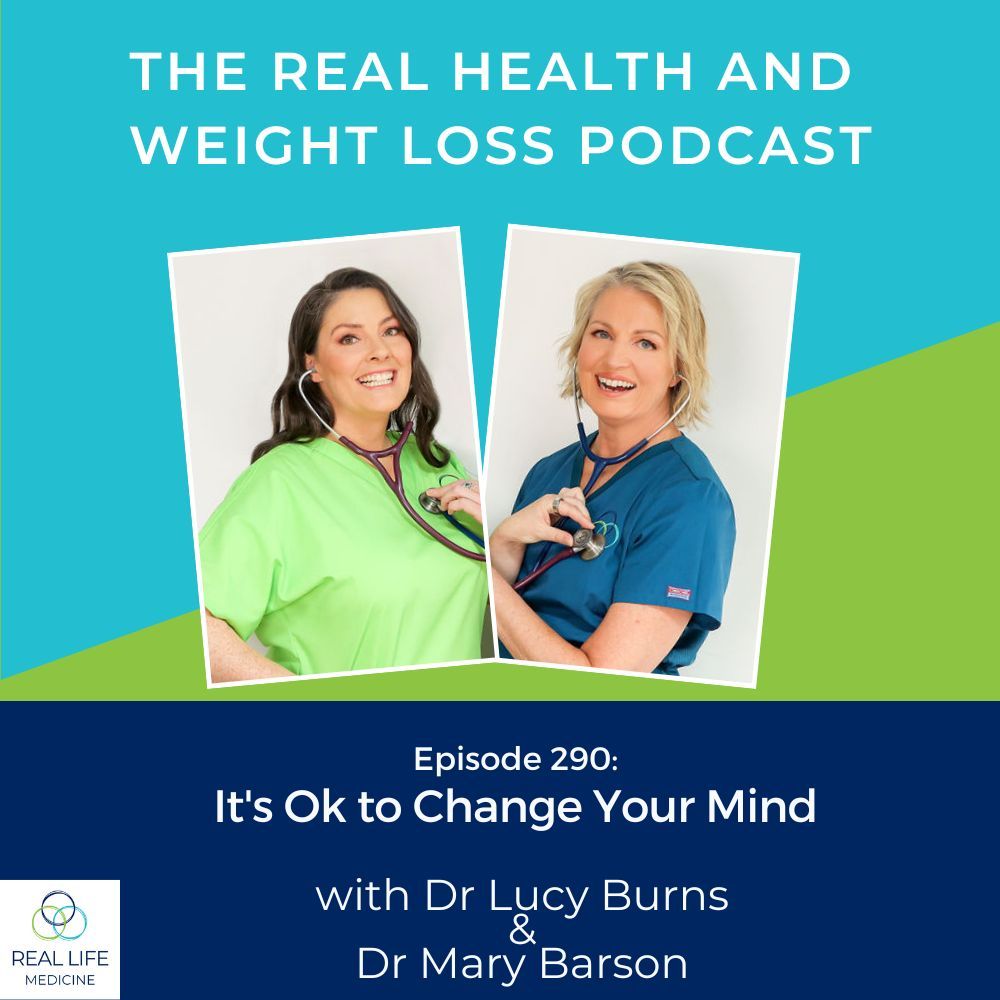
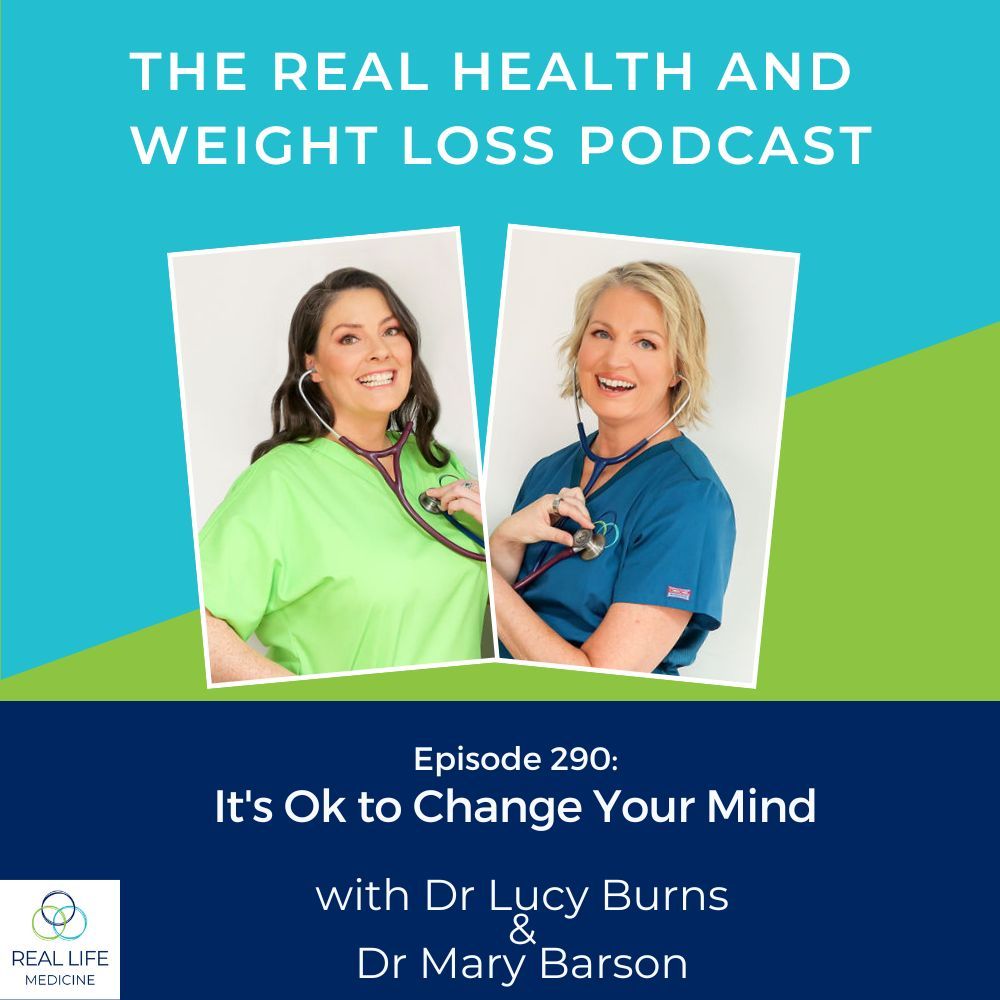
Episode 290:
Show Notes
It is absolutely okay—and often essential—to change your mind when new evidence, seasons of life, or your goals change.
Episode overview
- Dr Mary and Dr Lucy explore why humans resist changing their beliefs, linking this to cognitive dissonance and the comfort of familiar habits.
- They explain that science and good medical practice are meant to evolve as evidence grows, not stay fixed in old dogma.
Science, medicine and changing views
- The low-carb movement is used as an example: once fringe and even “persecuted”, it is now included in Australian diabetes guidelines as a valid therapeutic option.
- They discuss how their own clinical practice has evolved with evidence, including more cautious use of erythritol and interest in allulose, while still discouraging overuse of sweeteners.
Cognitive dissonance and identity
- Cognitive dissonance shows up when people cling to old beliefs despite mounting contrary evidence, often to protect identity or avoid admitting they were wrong.
- Tim Noakes is highlighted as someone who had every reason not to change (career, reputation, books on carb loading) yet still shifted to low carb after developing type 2 diabetes himself.
Information overload and algorithms
- Social media algorithms can trap people in echo chambers, amplifying fear about medications or treatments and making it hard to know what is true.
- The doctors encourage healthy skepticism—open-minded but not so open that “your brain falls out”—and sometimes even ask patients to show their feeds to understand what they are being told.
Evolution of their programs: from 12WMBR to MAP
- Their long-running 12 Week Mind Body Rebalance has grown into a “university degree” that can overwhelm busy people in the post-COVID world.
- They are evolving it into “My Metabolic Action Plan” (My MAP), a more streamlined, action-based program focused on small, doable steps rather than consuming lots of content.
Action, not overwhelm
- They emphasise that real change comes from implementing a few key behaviours, not from watching every video or learning every detail.
- Drawing on ideas like Duolingo-style gamification and the “minimum absolute must” (MAM), they aim to build a program where tiny but consistent actions (about five minutes) still move metabolic health meaningfully forward.
Core take-home messages
- Knowledge and guidelines should evolve; changing practice with evidence is refinement, not “flip-flopping”.
- Too much choice and information can paralyse action, so simplifying and structuring steps helps people actually implement change.
- In health and in life, flexibility of mind is a strength: sticking to your guns is sometimes useful, but often progress requires the courage to update your beliefs and your plan.
Launching in February 2026 — our newest program is your complete MAP to metabolic health. Join the waitlist to be the first to hear all the details.
Episode 290:
Transcript
Dr Mary Barson (0:04) Hello, my lovely friends. I am Dr Mary Barson.
Dr Lucy Burns (0:09) And I'm Dr Lucy Burns. We are doctors and weight management and metabolic health experts.
Both (0:16) And this is the Real Health and Weight Loss podcast!
Dr Lucy Burns (0:21) Good morning, lovely friend. How are you today? Dr Lucy here with another episode of The Real Health and Weight Loss Podcast, joined by my very special friend and colleague, Dr Mary. Hello, Dr Mary, how are you this morning?
Dr Mary Barson (00:35) I'm very, very good. And realising when this goes to air, I will be on a plane home from Japan. So yes, yes, we've been wound up my time there. So interesting. I'm looking forward to having some stories to share about my adventure over there.
Dr Lucy Burns (00:53) Indeed, indeed. I think it will be very exciting. Very exciting. And you know, for me, I'm just asking in summertime in Melbourne, which, again, hopefully—Melbourne is very unpredictable weather. In fact, today, as I'm recording this, it's supposed to be summer and it's about nine degrees and cloudy, so boo. But anyway, I also have to just let go of the weather because it's outside of my control.
Dr Mary Barson (01:21) Apparently, we've got no control over it. Yes. It's like the tides as well when they're not convenient, when I want to go for a swim. Well, yeah, can't do anything about that either. Yep.
Dr Lucy Burns (01:31) Indeed, indeed. So today, we're talking a bit about mindset, really, and the idea that it is actually okay to change your mind.
Dr Mary Barson (01:44) Not only okay, but sometimes absolutely essential.
Dr Lucy Burns (01:48) Indeed, indeed. And it's interesting because humans don't always like to change their mind. We like to learn something, and good—we've learned it. That's how we do it. That's how it's always been done. That's what we always do. And that's how it's always going to be forevermore.
Dr Mary Barson (02:07) Yes, we do. We have our cognitive dissonance. We don't want to admit that we were wrong or admit that we need to change. But for science to progress, for our lives to change, for us to be able to change our lives in a way that allows us to live a life that we want to live, sometimes we really do have to change our minds. In an ideal world, we would say that scientists have a head start with this one and that scientists are supposed to remain open-minded yet sceptical. But often, being humans, that's not the case. You can have career scientists that will hold onto their dogmatic beliefs to the absolute bitter end. But that isn't what science is about.
Dr Lucy Burns (02:52) No, absolutely. And like everything, there's a theory. Everyone believes that theory, or everyone has that belief, that system.
And then something comes along, and there are the early adopters, the people that wait and see, and then the people that almost refuse to adopt. Again, we can come back to sort of flat earthers in that department. No, Earth's flat, Earth's flat. Maybe the Earth's round. What? The Earth's round. Yeah, the Earth's round. No, the Earth's not round. Yeah, all of that. Totally.
Dr Mary Barson (03:26) And the whole low-carb movement has gone through this evolution. You and I, Lucy, we were early adopters, having had our own transformation and seeing transformations in our patients with insulin resistance early on. And then it was this strange world that we were living in, where doctors were being persecuted for suggesting that eating less sugar and starch might be good to help people with type 2 diabetes. And it was this bizarre world, and some people got thrown onto the bus, and then slowly, slowly, slowly, opinion changed, evidence mounted. And now Australian diabetic guidelines include low-carb as an effective therapeutic regime. They've got guidelines out there for helping doctors adjust medication when they're putting their patients on therapeutic carbohydrate restriction, which is a horrible term, but that's what they call it. As we've seen this, and you and I have evolved over time, we talked about this fairly recently on the podcast about how our practice has evolved over time. As we've gathered more evidence, more knowledge, more wisdom, we've seen the science evolve. And so we have evolved accordingly. And right now we're going through an evolution with our recommendations of alternate sweeteners. Where we used to say, we recommend the four least worst: xylitol, erythritol, stevia, monk fruit. ,Then erythritol has come under a bit of fire lately, being associated with increased cardiovascular risk. And we've been watching this, going, not sure, not sure, maybe, maybe. And now probably getting to the point where, overall, actually we do recommend that people limit their erythritol, especially now that there's a new alternate sweetener available in Australia. At least, I think it's been available elsewhere in the world for a while: allulose. And it looks like the science around allulose is promising. We still don't think you should overdo sweeteners for a whole host of reasons, but allulose probably is better than erythritol.
Dr Lucy Burns (05:24) Yeah, absolutely. And I think that's it. It's always around evidence or information and then adjusting your thoughts, views, opinions based on the available information. And again, I look at things like my practice around menopause. When I was a young doctor, it was right back in the 2000s where everyone was on HRT. Then all of a sudden, the WHI came out and it was all like, oh my God, this is terrible. We're killing women. We're giving them all cancer. No one should be on HRT. And that was the dogma for a long time. And then, you know, some other clever scientists reviewed the literature and went, oh, hang on, this actually perhaps isn't as clear-cut as it was seen. And then, you know, new medications came on the market. And now we've realised that there's been all these women who have just been suffering for such a long time who perhaps didn't need to. And so you change your practice based on evidence. And I think sometimes people will say, oh, they just flip-flop, but it's not flip-flopping. It is adjusting according to evidence and refining, I think, what works, what doesn't work.
Dr Mary Barson (06:40) And human knowledge is not this static thing. This is the whole basis of science: it is an evolving, amorphous thing that's always being edited, new bits being tacked on. Oh, actually that's wrong. Let's take that off. Oh, that bit right in the middle that we've always believed. I don't think that's true anymore. And it's just constantly moving and changing. And as doctors, we are expected to keep pace with the current state of science and current state of evidence. So if medical recommendations change, this actually is a good thing. I know it can be frustrating on multiple levels for multiple reasons, but this is what is supposed to happen. And that is the best way that we can help people: if we continue to allow our knowledge and our wisdom to grow, edit, change.
Dr Lucy Burns (07:28) Yes, absolutely. I think I love your thing. I'm sure you've said it before, which is: we want to be open-minded. We need to be open-minded with a little bit of skepticism, but not so open-minded that your whole brain falls out, which, again, is very tricky. We have lots of information, so much information with algorithms that feed you the information. And it's sometimes hard to work out what is true and what's not true. And humans have a tendency to want a shortcut. And that's been great. That has absolutely been essential for the evolution of humans. We invented wheels because we were sick of dragging things along the ground. And if we hadn't invented the wheel, we invent a lot of things because it provides us a shortcut. The tricky bit is that we are now almost shortcutting our lives short because we've created so many options to make things easier, but they're not always good for us.
Dr Mary Barson (08:35)
No, no, easier is not always better. Yes. And when you've got something you want to change about yourself, you want to have better energy, you want to have weight loss, you want to improve your health and you get bombarded by social media algorithms showing you these shiny new supplements or extorting the danger of this well-established treatment. We follow these little paths and we can get absolutely convinced. We can actually be siloed into these echo chambers on social media without even realising that it's happening to us because it's just the algorithm is doing it for us.
Dr Lucy Burns (09:15)Yeah, absolutely. It's a little bit evil if you go dive right into it. So again, healthy skepticism with all of your social media. And to be honest, I click on lots of things. I click on things I already believe. I also click on things I don't because that way I kind of feel like I'm a bit sneaky. I'm trying to keep ahead of the algorithm. I don't want it to only feed me things that it thinks I want to see. I want it to feed me. Well, I don't actually want it to feed me anything, but I want to have access to everything.
Dr Mary Barson (09:47) Yeah. I ask patients to show me their Facebook if they can. If they can look, I'm really, really concerned about this medication, this whatever it is, I'm my perineur prill. I've just heard the worst things about this medication, Dr Mary. And I'm like, okay, can you, can you show me what it is? I just want to know what's being said out there.
Dr Lucy Burns (10:06) Yeah. Yeah. It can be intense. So I think having an open mind, having some ability to be flexible and nimble in your thoughts, can help with that concept of cognitive dissonance, which is where you're really stuck in your firm, fixed belief despite mounting evidence to the contrary. We say this a lot. It's hard. There are people out there who I go, like Tim Noakes, for example, who, you know, I haven't spoken about him for a long, long time, but he was one of the founding fathers, if you like, of the low-carb movement because, and again, his own experience, he developed type two diabetes despite being an athlete and a runner. And he had invested all of his identity and everything around providing high sugar bars and energy drinks to runners to help them, you know, with running and all that stuff. He had every reason not to change his mind. Yeah.
Dr Mary Barson (11:07) He had chapters, chapters about nutrition and running and the importance of carb loading. Yeah. Yeah.
Dr Lucy Burns (11:14) So much sort of invested in this belief, but he changed his mind. And I think, oh, so anybody who has the courage to change their mind, I think really, you know, deserves our attention and is able to go, okay, this I've evolved. This is what I've done.
Dr Mary Barson (11:35) Yes. And we have evolved too. And very excitingly, one of our main programs that we offer is evolving too. As many of you will know, for like five years now, we've been doing—five years. Yes. Yeah. Five years, the 12-week Mind Body Rebalance. And we love it. It's our baby. And it's been a wonderful course for thousands of people to do this program with us, to improve their health, their insulin resistance, to, you know, get helpful, healthy, long-lasting weight loss. And we've decided that it needs to change a little, to get a bit of a re-sparkle. Yeah. To evolve. It needs to evolve. Exactly. Yes. That's right.
Dr Lucy Burns (12:22) So we're in the process of this evolution right now. Absolutely. And, you know, people might say, why would you do that? You've got this successful program and, and look, it is, it's wonderful. But I think a couple of things have happened. It's been growing over five years; this program has had bits added to it. People ask us for something, we go, yes, we'll add that in. And yes, we'll add this. Honestly, the course now—it is monstrous. It's like a university degree. It needs a huge time commitment to complete. And for us, it's like, right, our goal is for people to change, to change what they're doing so that they can improve their metabolic health. Our goal is not actually for them to sit through all of our videos. That is not the goal. The goal is for them to be able to implement that knowledge. And I think on one level, again, I love what we have created. It is, you know, the fundamentals of the successes, really the fundamentals of lifestyle medicine. It is profound, but it is a bit big.
Dr Mary Barson (13:33) Yep. Bit big. And times have changed, you know. It was a big course, you know, in COVID times. Well, that was great. You know, people had the time and the appetite to, to learn from home, and it was, it was, you know, it was great and it worked really, really well. But also, you know, we've changed, society sort of moved on. Thankfully, that COVID pandemic is largely behind us, and people are just back into the full busyness of life. And so editing our offering and targeting it to be really action-based, and focusing each step on those actions—the doable small steps that are going to create real change—is what we have decided to do.
Dr Lucy Burns (14:15) And I'm excited about it. I'm excited too. I am really excited, and I'm excited about the name, which I know sounds, it's really like the icing on the cake, but I think what it does is really embody the point of this new program, which is, and so we've called it My Metabolic Action Plan. And the reason for that is that it is a very action-based program, and the whole point here is not, not to just educate you and go, well, off you go, do it yourselves, which is, is not what we did in the 12-week Mind Body Rebalance. But it was pretty easy to get bogged down in some of the learning, the knowledge, because it was a lot. So we've really stripped it out, taken out things that you don't really need, giving you the absolute essentials and turning that knowledge then into action with really doable steps. Because we also know, this is the other thing again that we've learnt over time, is that an overwhelmed brain doesn't take action. If there's too many options, you do none, or you spend all of your time trying to decide what to do. I mean, you all do this every night when we put Netflix on. You go, what are we going to watch tonight? I don't know. You look through the 5,000 options available, whereas, you know, I'm old enough to remember when there were four channels, there were no DVDs. You just watched what was on. We were, you know, seemingly entertained. We certainly didn't spend three hours deciding what to watch.
Dr Mary Barson (15:56) I do remember, though, spending what seemed like hours walking around Blockbuster Video, trying to decide which new release video I was going to rent. Absolutely. It's a tyranny of choice. Yeah, yeah.
Dr Lucy Burns (16:08) Too much choice, yeah, really stifles action. So we love the My Metabolic Action Plan because it is absolutely action-based. I, of course, love a clever acronym. So it's My MAP to Good Health. So look out for MAPs and all sorts of references to that.And also we've, again, learned from our own experiences. So I do Duolingo, which I love. I knew about it, but my friend was doing it, and I went, oh, I want what she's having. And the gamification in that—the little zings, the little doing, the little reminders, the don't lose your streak—all of that has been so useful to me to keep it going. You only have to do a minimum. Like, the minimum is one lesson, which takes about five minutes. So I've got a MAM, as we learned from Dr G—the minimum absolute must. And so if we have a MAM, and that MAM is small enough that it's doable no matter what, but big enough that it makes an impact, well, that's where the gold is. So yeah, for me, I think gamifying this MAP, gamifying My MAP, is going to be the key. And I'm super excited about it. Like, really, really excited.
Dr Mary Barson (17:33) Yes. We're starting our first one soon. So yeah, if you want some more info on that, go to rlmedicine.com/map. That's rlmedicine.com/map. MAP.
Dr Lucy Burns (00:00) Yes. And obviously, if you're driving, the links will be in the show notes. Yeah. Yeah. Cool. Yes. So evolution is key, smart science key, and recognising that sticking to your guns, of course, can have its place depending on what it is, but sometimes sticking to your guns doesn't actually help you or anybody else. That's right. All right, lovely friends, we will leave you with that little tidbit. At the end of the day, it is absolutely okay to change your mind. It is indeed. Bye, guys.
Dr Mary Barson (18:21) Bye now.
Dr Lucy Burns (18:25) The information shared on the Real Health and Weight Loss Podcast, including show notes and links, provides general information only. It is not a substitute, nor is it intended to provide individualised medical advice, diagnosis or treatment, nor can it be construed as such. Please consult your doctor for any medical concerns.