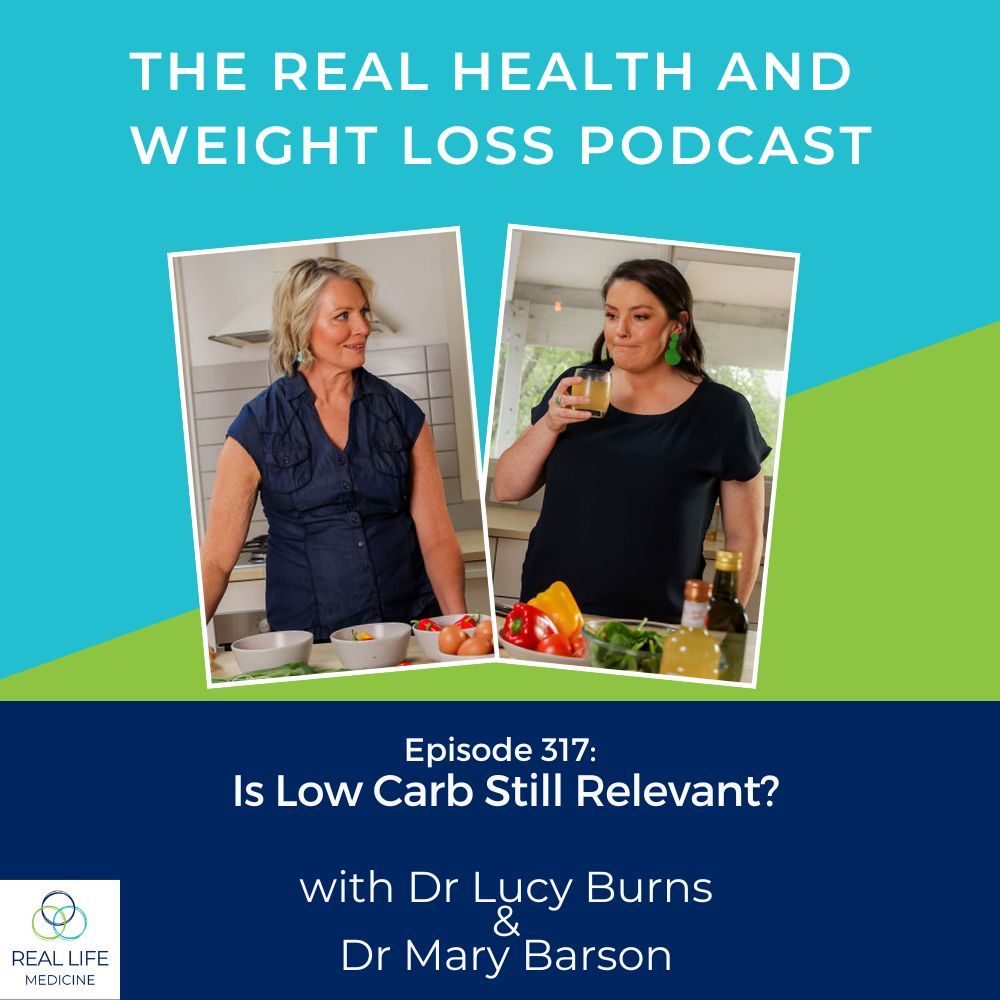


IS LOW CARB STILL RELEVANT?
One of Australia's Most Popular Podcasts with Hundreds of 5 Star Reviews




Grab your FREE Ebook copy now!
Have you struggled to lose weight and keep it off?
Start your journey to boost metabolism and transform your body into a fat-burning powerhouse.
Episode 317:
Show Notes
Summary: Is Low-Carb Still Relevant?
Drs Mary Barson and Lucy Burns tackle the question of whether low-carb eating has lost its relevance now that it is no longer trendy, and whether the rise of GLP-1 medications has made it obsolete. Their conclusion: low-carb is not fashionable anymore, but it remains physiologically important for metabolic health, whether or not someone is using weight loss medications.
Why low-carb fell out of fashion
Low-carb and keto were hugely popular around five years ago, with active Facebook groups and Diet Doctor as the leading resource, but that website has reportedly gone bankrupt and interest has fizzled. Two main forces have driven this shift: low-carb has become mainstream and "not edgy" now that the evidence is widely accepted, and GLP-1 receptor agonist medications (injectable weight loss drugs) have transformed the weight loss and diabetes landscape, pulling attention away from dietary approaches. Current diet trends have moved on to high-protein and "fibre-maxing," often co-opted by the processed food industry to slap onto packaged products.
The physiology hasn't changed
Human physiology was shaped in the Paleolithic era, when the ability to store fat and become insulin resistant during times of carbohydrate abundance was advantageous for surviving scarcity. In today's environment of constant access to processed high-carb food, that same hardwired response leads to chronic hyperinsulinaemia, which is detrimental over the long term. Because our environment has changed far faster than our biology in the last 60-70 years, the fundamentals of eating real food, higher protein, and lower sugar/starch remain broadly beneficial.
Why weight loss attempts fail
The doctors identify two common reasons diets fail: poor adherence (worsened by hyperpalatable, addictive processed foods) and metabolic adaptation from excessive calorie restriction, especially with inadequate protein. Low-carb eating can improve metabolic health without needing calorie restriction, helping to sidestep this metabolic slowdown when done properly with adequate energy and protein intake.
Where GLP-1 medications fit in
GLP-1/incretin medications can reduce "food noise," the intrusive, anxiety-driven preoccupation with food, making it easier for people to implement healthy eating strategies rather than replacing them. The doctors stress these drugs are not "cheating" but useful tools that work best alongside real food, adequate protein, and strength training, since muscle loss and nutrient deficiencies are known risks of the medications.
The synergy between low-carb and GLP-1s
Lower-carb eating and GLP-1 medications work synergistically: eating low-carb keeps blood glucose low, reducing the need for the pancreas to release excess insulin, which enhances the fat-loss efficacy of these medications. This also explains why people with type 2 diabetes on higher-carb diets often see less weight loss on these medications, since the drugs are being used primarily to manage glucose rather than facilitate fat loss.
Key takeaways
- Low-carb has lost cultural cachet but remains scientifically supported for metabolic health
- Diet Doctor's likely closure symbolises the decline in low-carb's mainstream popularity
- Two biggest reasons diets fail: poor adherence and metabolic adaptation from under-eating protein/calories
- GLP-1 medications reduce food noise but do not replace nutrition, strength training, sleep, stress management or social connection
- Combining low-carb eating with GLP-1 medications improves their effectiveness and can allow for lower doses
- A real-food, protein-centred, lower sugar/starch approach benefits nearly everyone, whether or not they are on weight loss medication
Work With Real Life Medicine
For a step-by-step approach to improving metabolic health in perimenopause, menopause and beyond, check out My Metabolic Action Plan. This doctor-led comprehensive programme gives you strategies to improve metabolism, skills to develop mindset, and tools so you will implement!
Episode 317:
Transcript
Dr Mary Barson (00:05) Hello lovely friend, I am Dr Mary Barson.
Dr Lucy Burns (00:09) And I'm Dr Lucy Burns.
Both (00:11) We are doctors, weight management and metabolic health experts. We are the creators of My Metabolic Action Plan, your two-step map to real health and weight loss, which is in fact the name of this podcast. Join MyMap now at rlmedicine.com.
Dr Lucy Burns (00:29) Good morning, lovely friend. How are you today on this spectacular morning? I am joined, of course, with the effervescent Dr Mary. How are you, lovely?
Dr Mary Barson (00:37) Very well today. I have just come off school holidays, which was fabulous and horrible at the same time. Now the kids are back at school and daycare, I'm back at work, and overall I am happy about it.
Dr Lucy Burns (00:55) I think it's an interesting concept that you can have opposing ideas or opposing feelings at the same time, and they can both be correct.
Dr Mary Barson (01:08) Absolutely. More than one emotion can exist at once. So I am both sad and relieved that school holidays are over, just as I was both happy and stressed that they were on.
Dr Lucy Burns (01:23) Yes, indeed, indeed. All right, so this week we are talking about whether low-carb is still relevant. You know, it's no longer the cool kid on the block, so we thought we'd break it down and go through it. Both you and I have noticed that, five years ago, low-carb was sort of riding the peak. There were low-carb Facebook groups, keto Facebook groups - they were everywhere. They were active, they had tens, if not hundreds, of thousands of members. Diet Doctor was the king website, and all of a sudden it's all fizzled. What's going on?
Dr Mary Barson (02:05) What is going on? Diet Doctor is potentially gone. It might be completely gone. I'm sure it's multifactorial, but yeah, we've just heard from the community that it's gone bankrupt and might fold entirely. It's a really interesting time that we're in because low-carb used to be cool. I remember it was cool, it was edgy, it was, you know, a bit rebellious. There were doctors getting impeached and pulled up by AHPRA for suggesting that lowering the sugar and starch content in your diet might be good for people with type 2 diabetes. There was a big uproar about protecting our colleagues who were speaking out, and now it's really become quite accepted. The evidence is quite clear. It's pretty much become mainstream, at least as a school of thought, so it's not kind of edgy anymore. But we've also had the advent of GLP-1 receptor agonist medications - your injectable weight loss medications - which have really transformed the landscape of weight loss and diabetes management and have really taken a lot away from the weight loss industry and the diet industry. I don't necessarily think that's a bad thing, but it is just what's happening. It's different, it's changed, and yet you and I, Lucy, still like to talk about low-carb. I'm comfortable with not being cool. I don't feel a need to be cool, but why do we think it's still relevant?
Dr Lucy Burns (03:43) Yeah, absolutely. I think it's a great topic to talk about. I think it starts with the history of food trends in general. You know, since Adam was a boy, if that's even a phrase, food trends and diet trends have come and gone. Initially, the low-carb/ketogenic diet was the Atkins diet back in the '90s. Then that went out of favour, and the Pritikin diet came in, which was sort of a high-carbohydrate but low-fat version. Over time, trends come and go, and humans are funny creatures. We are usually looking for the next magic trick, the next silver bullet, something that is going to make life easier. On a superficial level, people go, "You're just looking for a quick fix," but actually that's how engineering and innovation work.
Dr Mary Barson (04:38) That's why humans became civilised in the first place. That's why we started domesticating animals and growing crops rather than trying to find berries and hunt down the mammoth.
Dr Lucy Burns (04:47) That's why we invented the wheel, so we're not dragging everything around. Throughout history, we have created solutions for problems. We've probably got to a critical threshold, though, where we've now created solutions and they're causing problems. We've now created food. Yes, we went from, "We don't want to hunt, we'll just keep our cows in a paddock," to, "We don't want to keep them in a paddock, we'll just put them in the fridge," to, "We don't want to actually have to get it out of the fridge and stick it in a pan, we'll just get Uber Eats to the door." Our current society and the way we currently live mean that health is not automatic. We have to be very proactive about it.
Dr Mary Barson (05:37) Yes, yes. So it's totally normal for us humans to want to chase that bright, shiny object. It's just hardwired into our psychology, and those deep fundamentals of human psychology have been set in our evolutionary past, and they really don't change very quickly. Also, our physiology has been set deep in our Paleolithic past, and that doesn't change very quickly either. So although, you know, diet trends may come and go and move in cycles, the basic fundamentals of our human physiology don't really change. Our physiology is much the same as it was.
Dr Lucy Burns (06:23) Yes. The difference, I think, is that our environment has been changing so rapidly over the last 60–70 years. It has changed phenomenally. Every day, almost, it's like, "Oh, there's another thing that's changed," and our physiology hasn't adapted to that. So the things that served us well in previous times - you know, the ability to store body fat.
Dr Mary Barson (06:48) Our ability to sort of flick into insulin resistance when carbohydrates were abundant, back in Paleolithic times when there was lots of summer fruit available in summer and autumn. If we were able to eat as much of this as we could, and if our bodies could then raise insulin and put us into a fat-storing state, then this was really helpful because we could take advantage of this short-term boon of food to gain weight that could then help us through the relative scarcity of winter and spring. So this ability is hardwired into us, and it was helpful. But now, in our current food environment, we just live in a constant sort of metaphorical summer, with highly processed, high-carb foods available all the time. Having that hyperinsulinaemia - that high insulin pushed up all the time - is terrible for our physiology when it's sustained over a long time.
Dr Lucy Burns (07:45) Absolutely. And you know what? I don't even think we need to go back to Paleolithic times. We just need to go back to pre-industrial times - before electricity, before the refrigerator - which was only a few hundred years ago. It wasn't that long ago that we used to have to hunt, and even if we weren't hunting our food, we at least had to go out to a paddock. To eat was energy-intensive, and now to eat is not.
Dr Mary Barson (08:13) No, but our physiology was forged in that time when it was.
Dr Lucy Burns (08:20) Yes. So, as we've talked about, the current diet trends are high protein, which is a trend, and that's fine. We think it's a good one. It is co-opted by the processed food industry, who would like to slap "high protein" on everything to ridiculous levels. There's now high-protein ice cream, high-protein lollies - everything - because people are aware that protein is helpful. What's unhelpful is when it comes packaged with a whole heap of garbage. High fibre is now the latest trend. "Fibre-maxxing," spelt with two Xs, is the latest thing because gut health is now trendy. Gut health is important, but it is now trendy. So everyone's talking about increasing your fibre because it could help with gut health, and therefore there's "high fibre" on everything. And so low-carb? No one's interested in that anymore. It's boring - like yesterday's news.
Dr Mary Barson (09:20) Totally, totally. However, it is still really helpful for our physiology in the right context. So what is helpful for pretty much every single human being on this planet would be for us to eat real food - food as close as possible to its natural state. The food that we were designed to eat, the food that our ancestors were hunting and gathering, adapted to the modern world. So, just as little processing as possible. And yes, protein is really helpful for our metabolic health. So eating a higher-protein, real-food diet and also reducing your sugars and starches is going to be useful for most people, especially people who've got problems with their metabolic health or have a weight loss goal. So, real food, higher in protein, lower in sugar and starch, might not be trendy. The food industry can't make a lot of money out of it, but it is helpful for our physiology. Although it might not be cool, it's still what we firmly believe most people should be aiming for most of the time. You don't need to be perfect, but it is going to be helpful for pretty much everybody.
Dr Lucy Burns (10:31) Yeah, absolutely. And I think there's a little myth out there that low-carb means low fibre. Sure, you can do a low-carb, low-fibre diet if you want to, but you don't have to. And you can certainly have high fibre if you want to. Look, I do think there's some merit in having increased fibre in your diet, but it has to be done the right way. Lots of people, again looking at the processed food industry, will add really fermentable fibres, slap "high fibre" on the label, and people go, "Great, it's high fibre," without understanding that it's then going to contribute to fermentation in the gut in an excessive way. So people end up with bloating, pain, and it's all a bit much. So yeah, high fibre is great, but it does require a bit of nuance.
Dr Mary Barson (11:20) That's right. You want to be getting your fibre from real food sources as much as possible. Have some delicious salads, have some fabulous veggies, have some lower-starch, lower-sugar fruit and vegetables, and enjoy those.
Dr Lucy Burns (11:33) It's a great way. Nuts and seeds have lots of fibre. My current favourite is edamame, which is a trend again at the moment. Somehow edamame is having its moment in the spotlight, but it is great. It's a low-carb, high-protein, high-fibre legume, essentially, whereas most legumes are reasonably high in carbs, but these ones aren't. So it's great. Yeah, I'm an edamame fan.
Dr Mary Barson (11:58) I ate them a lot while I was travelling around Sydney with the kids because they were just convenient, easy to get, easy to store, and easy to eat.
Dr Lucy Burns (12:08) Yeah, perfect. So low-carb - yeah, low-carb is definitely not trendy. But does that mean it doesn't work? Is that why it's not trendy? Because people go, "I did it. It didn't work."
Dr Mary Barson (12:19) Well, I think there are two main reasons why attempts at weight loss can fail. The first one is lack of adherence - just not being able to stick to it. The processed food industry, with all of its hyper-palatable processed foods that are really quite addictive in nature, makes that hard. So that's one aspect. The other part is caloric restriction. Particularly if we're not eating enough energy, especially if we're not eating enough protein, then we can get this metabolic adaptation where our metabolism slows and responds to that caloric restriction. So they're two common reasons why people do not succeed with any attempt at weight loss. That could be anything - calorie restriction, any kind of dietary change, bariatric surgery, even GLP-1s if people choose to eventually come off them. The thing about low-carb, though, is that you can get great metabolic improvement without restricting your calories. So you can circumvent that metabolic adaptation if it's done properly, which is one thing that I just love about this way of life, this lifestyle. By embracing your protein, embracing real food, and getting enough energy, you can keep your metabolism ticking along, and you can still improve metabolic health. So I think adherence is hard in this world - in this high-carb world of hyper-palatable foods everywhere, being thrown at us. It is hard. Gosh, just paying for your petrol, you know, and all those shiny wrappers of chocolates that you have to walk past - or get your toddler past - just to pay for your petrol. It's not easy out there.
Dr Lucy Burns (14:06) No, no. The ultra-processed food industry is predatory. It is relentless. People can feel like they're weak-willed or hopeless. But often what has happened is their brain has said, "No, no, we're not having this," 25 times. Then on the 26th time, when you're perhaps tired, or there are some other extraneous factors - maybe you're stressed or hungry - the brain goes, "Come on, how about now?" So you may give in, and we like to call it being vulnerable to the siren calls of ultra-processed food. Then you have some, and people feel terrible - guilty. So then they feel like they've buggered it up, that it's not working, that they can't do it. And so they give up.
Dr Mary Barson (14:55) Yeah. And I think that is a real reality for a lot of people. And that is where the mindset strategies become really important. It's not about berating yourself and not about saying, "I've buggered it up. I'm weak-willed. I can't do this." It's about getting a toolkit so that if you know the shiny chocolate bars don't help you and they don't serve you, what can you do on your worst day, when you're super tired, you've had a super crap day at work, you're running late, you're driving home, it's raining, you need to get petrol, your children are texting you, there's a billion things happening, and maybe you worked through lunch so you're hungry, and you go and pay for your petrol? Just having strategies to help you deal with those situations can make it so much more sustainable. Absolutely.
Dr Lucy Burns (15:49) And the interesting thing, again, with the GLP-1 medications - which is actually a bit of a misnomer, because they're not all GLP-1s. I'd really love them to be renamed incretin hormone medications, because that's really what they are. The newer versions have multiple hormones - they're GIP as well. Anyway, whatever we want to call them - these metabolic hormone medications. Peptides, if we want to be trendy. Yeah, if we want to be trendy, because, you know, we're all about being trendy here.
Dr Mary Barson (16:26) I'm so cool.
Dr Lucy Burns (16:27) Yeah, me too. For some people, the key thing they can offer is reducing food noise. So if you've got a brain that is very food-driven, that thinks about food a lot, and you've developed some skills, but maybe you just find that, more often than not, the food noise is overpowering, then the way I think about the GLP-1s is they can turn it down a bit. We actually don't want to turn it off. People fear food noise, but actually food noise is part of human evolution as well, because it tells us to go and eat. And we need to eat to get our nutrition, to run our body, and all of those sorts of things. But I think what it can do is turn it from perhaps being something that is extremely loud - extremely loud for some people - back down to just, you know, a normal level, so that you can then use all of these tools that you've been taught or learned and implement the low-carb, high-protein, fibrey food approach, and actually then do it. So the narrative that it's cheating, that it's the easy way out, that people are just doing this because they want to look good.. You know, there may be some parts of society that do that, but that's not the purpose of them, and it's not the people that we see.
Dr Mary Barson (17:55) Yeah, I think that is fair. And, you know, we think that real food, higher protein, lower carb is useful for everyone. But it is especially, especially, especially useful for people who take GLP-1 receptor agonists and all these weight loss injectable medications as well, because it can help offset some of the quite significant risks with these medications, such as lean muscle mass loss. People losing their muscle is a potential side effect that needs to be addressed. You have to do your strength training, and you need to eat your protein. Also, nutrient deficiencies are another problem if people are just not able to eat enough. So eating really nutrient-dense foods, like we're talking about here with real food, is also going to be really, really helpful. So this low-carb, real-food approach is really good if you're not on GLP-1s, and it's also really good if you are on GLP-1s. Trendy or not, having that protein-centred, real-food, lower-sugar, lower-starch approach to most of your food, without being perfect, is going to be so helpful.
Dr Lucy Burns (19:09) Absolutely. We were talking about a word before called synergistic. So synergistic means you've got A, you've got B, and A plus B is like dynamite. So A makes B better, B makes A better, as opposed to them just being individual. More than the sum of their parts. Yeah, correct. Yes. And we know that there are actually studies on this that show lower carb can certainly improve the efficacy of a GLP-1 for many people, which mechanistically makes sense. We know that these medications, which were originally designed to manage blood glucose levels - that was their original intent. They were diabetes medications. So we know that when - and this is the critical point - glucose is high, these medications will actually stimulate the pancreas to make insulin, which sounds like the opposite of what we want. And it kind of is, because we don't really want excess insulin. We want some insulin, obviously, because it's important, but we don't want excess. Because excess insulin is the whole issue with fat storage and all of the complications that come with high insulin. So if you eat low-carb, then you automatically have lower blood glucose, no matter what. Therefore, there is no need for the pancreas to be stimulating insulin. It also explains why people with type 2 diabetes will often see lower weight loss on these medications because, particularly if they're not eating low-carb, they will just be using them to manage their glucose levels. Their glucose will be higher, so they're making insulin. The key is clearly to lower glucose for metabolic health and to protect your brain and your end organs and all of those things. But it doesn't then help with weight loss.
Dr Mary Barson (21:04) Yes, yes. I think it's also interesting to note how the advent of these medications has affected the diet industry and perhaps where we stand on that. I think it is undeniable that there has been a shift from endless commercial diets to the medical prescription of these medications. Many people have made that shift - from searching for the next diet or help with dieting to now searching for these medications - which I don't think is necessarily a bad thing, as long as it's done well. There are definitely aspects of the diet industry that we absolutely despise, and they're still running strong. You only have to spend a few minutes on Instagram to know what we're talking about - you know, 25-year-old influencers using their body to sell their programs. It's kind of annoying. My take on it is that I am comfortable with GLP-1 receptor agonists and related medications reducing the market for various diets, especially those shame-based programs that used to be so prevalent. As long as people are also addressing those fundamentals of good health - and these medications, as you mentioned, Lucy, can make that easier by reducing that food noise - they can make it easier. But you really need to focus on food quality, your muscle strength, your sleep, your stress, your circadian rhythms. Paying attention to that is so important, as is your social connection. The drugs can't do that for you. GLP-1 medications can be helpful, but they can't plan your meals and cook real food. They can't do strength training for you. They can't put you to bed on time. They can't regulate your nervous system. They can't go out and help you see your friends and nurture those meaningful relationships. But they do have a role
Dr Lucy Burns (23:13) Yeah, absolutely. And I think sometimes the way I explain it is that if your brain doesn't have as much food noise, it doesn't have as much worry or, you know, it's not feeling threatened. Because for some people, every social event they go to is a source of worry. You know, what food's going to be there? How am I going to manage it? Am I going to eat more than everyone else because I'm hungrier? Because we know that insulin resistance dysregulates appetite. So they do have a lot of anxiety around it. There's guilt if they eat, guilt if they don't eat. What if somebody comments? There's a lot of, I guess, subconscious or subclinical anxiety, potentially fear, around it. So imagine if we got to a place where you didn't have the food noise, where your appetite was regulated, eating wasn't a fearful event. You could then take all of that energy, that brain energy, and put it into things like planning your exercise, planning your gym… I just said the gym word. Yuck. But, you know, planning whatever movement you're going to do.
Dr Mary Barson (24:24) Gyms can have a place. Gyms are fine.
Dr Lucy Burns (24:25) OK. I think it's about diverting that food noise into more useful thought space.
Dr Mary Barson (24:33) Yes, that's it. So would it be fair to say, Lucy, that the key messages here are that GLP-1 receptor agonists are powerful allies, but they don't replace the fundamentals? And that low-carb might not be trendy, but a really well-formulated, protein-centric, lower-sugar, lower-starch approach that's based on real food is still highly relevant for our human physiology, for our metabolic health, and for our muscles, especially if it's combined with strength training and paying attention to your sleep, your stress, your circadian rhythms, and your social connection. Doing all of this is where we should be focusing our energy and our attention. Trendy or not, profitable or not, that's what humans who want to improve their health really need to be focusing on.
Dr Lucy Burns (25:20) Absolutely. One hundred percent. And I think, just to hammer the point home, if you're on a GLP-1, then low-carb will be helpful because it keeps your insulin levels low, makes the GLP-1 more effective, allows for a lower dose... yada, yada. If you're not on a GLP-1, you all know this - carbs make you hungry. It is easy to overeat carbs. You have them, and a couple of hours later it's like, "Oh, I'm hungry again." Whereas when they're reduced - and again, reduced doesn't mean none. To all the people who used to say, "Oh, what, are you cutting out a whole food group?" - we're not. But reducing your carbs means that you're prioritising protein and adding some fat in. That automatically keeps you full. That's what we want. It's much easier to manage your food when you're full.
Dr Mary Barson (26:12) And we all want ease. Coming back to that fundamental human need, ease is what we want.
Dr Lucy Burns (26:18) Indeed. So I'm happy to be an uncool, low-carb kid. I'm not interested in, you know, things that are new and trendy. I'm happy to always look at new innovations and challenge my thought processes, and we would encourage everybody to do that. But the fundamental thing is that if you're hyperinsulinaemic - which is such a big word - or metabolically unwell, low-carb is your friend.
Dr Mary Barson (26:51) Hear, hear.
Dr Lucy Burns (26:52) Hear, hear. All right, friends. On that note, we will see you next week, where we are talking about Boring Versus Biohacking, which I love. We'll be doing a bit more myth-busting. So we'll see you next week.
Dr Mary Barson (27:12) Bye now.
Dr Lucy Burns (27:17) The information shared on the Real Health and Weight Loss Podcast, including show notes and links, provides general information only. It is not a substitute, nor is it intended to provide individualised medical advice, diagnosis or treatment, nor can it be construed as such. Please consult your doctor for any medical concerns.