
IS GOLF GOOD FOR YOUR HEALTH?
One of Australia's Most Popular Podcasts with Hundreds of 5 Star Reviews

Grab your FREE Ebook copy now!
Have you struggled to lose weight and keep it off?
Start your journey to boost metabolism and transform your body into a fat-burning powerhouse.
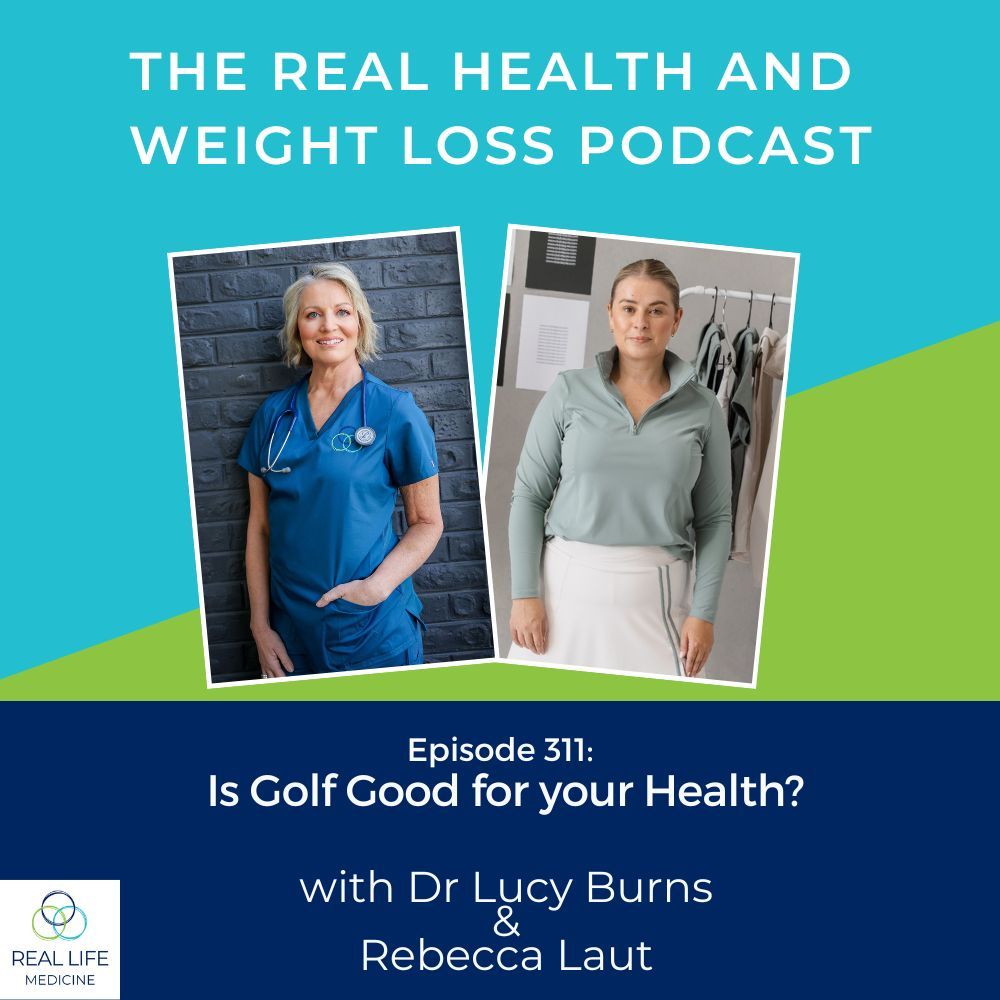
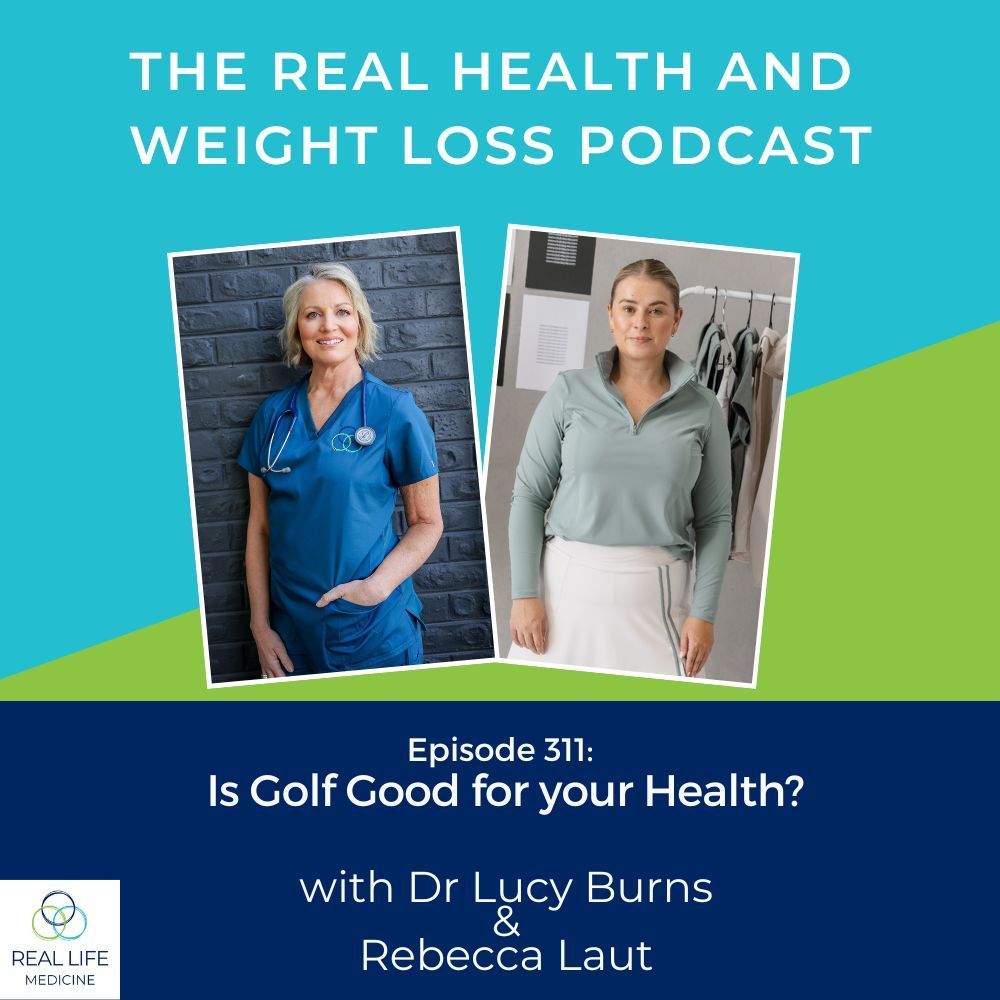
Episode 311:
Show Notes
Dr Lucy Burns interviews Rebecca Laut, founder of Clubdayze, a modern women’s golf apparel brand created to make golf feel more accessible, social, and part of everyday life. In this wide-ranging conversation, Rebecca shares her personal health journey with PCOS, her experience using a GLP-1 medication, and how golf became an unexpected part of her wellbeing journey.
Rebecca's PCOS & Metabolic Health Journey
- Rebecca was diagnosed with PCOS as a teenager and managed with the oral contraceptive pill, but was told conception may be difficult
- Her symptoms included acne, significant hair loss, low energy, irregular cycles (22 to 45 days), and weight gain that worsened during COVID
- Her GP recommended a GLP-1 medication to address insulin resistance; over a 9 to 10 month course she regulated her insulin, reduced inflammation, and lost weight while preserving muscle through consistent weight training and walking
- In October (prior to recording), she discovered she was pregnant - a result she had not believed possible - and was 29 weeks along at the time of recording
Key Health Insights Discussed
- PCOS is a metabolic condition, not just an ovarian one; the name is misleading
- Muscle preservation on GLP-1 medications requires concurrent resistance training - without it, muscle loss is a real risk
- Internalised stigma around needing medication can be a barrier; releasing the belief that one is "not trying hard enough" opened doors for Rebecca
- Dr Lucy introduced the concept of pleiotropy (one gene, multiple effects) as an analogy for how one lifestyle activity like golf can produce multiple benefits - physical, mental, and social
Golf as a Lifestyle Medicine Tool
- Golf provides incidental movement (steps), sunlight exposure (vitamin D), nature immersion, social connection, and mindful concentration - all in one activity
- 60% of new golfers in Australia are currently women, reflecting a significant cultural shift in the sport
- Accessible entry points exist beyond 18 holes, including driving ranges and indoor simulators, ideal for women with busy lives
- Rebecca noted that the focus required in golf creates a natural "flow state" that reduces stress and carries over into daily life
Clubdayze - Rebecca's Golf Apparel Brand
- Founded after Rebecca could not find golf clothing that suited a modern woman - rejecting both overly masculine cuts and overly sporty mini-skirt styles
- Designed with women of all sizes in mind (sizes 8 to 18, expanding to 22), with models on the website reflecting that range
- Key features include breathable cotton blends (particularly beneficial for women experiencing perimenopausal or menopausal heat symptoms), flattering cuts, and anti-chafe shorts in their bestselling skort
- Find them at Clubdayze Website or on Instagram at @clubdayze
Work With Real Life Medicine
For a step-by-step approach to improving metabolic health in perimenopause, menopause and beyond, check out My Metabolic Action Plan. This doctor-led comprehensive program gives you
- Strategies to improve metabolism
- Skills to develop mindset
- Tools so you will implement!
Episode 311:
Transcript
Dr Mary Barson (00:05) Hello lovely friend, I am Dr Mary Barson.
Dr Lucy Burns (00:09) And I'm Dr Lucy Burns.
Both (00:11) We are doctors, weight management and metabolic health experts. We are the creators of My Metabolic Action Plan, your two-step map to real health and weight loss, which is in fact the name of this podcast. Join MyMap now at rlmedicine.com.
Dr Lucy Burns (00:30) Good morning, lovely friend. I hope you're having a spectacular day today. Dr Lucy here, of course, without the gorgeous Dr Mary, but with an equally gorgeous guest. I have with me Rebecca Laut. Her story, her own personal story, is fascinating. And then the segue halfway through is going to be even more interesting. So I'm super excited to share this story today with you, my lovelies. Rebecca, welcome to the podcast.
Rebecca Laut (00:57) Thank you, Dr Lucy. Thank you for having me.
Dr Lucy Burns (01:00) Ah, you are welcome. You are welcome. My lovely friend, a couple of months ago, as I was just having a little scroll through Facebook, I noticed that you were growing a human.
Rebecca Laut (01:10) Yes, I am growing a human. Almost, oh, just over two trimesters in now. And it has been a huge surprise to me who, after growing two businesses, didn't really think I would ever be growing a human. I'm in a really good position now, growing my little bub due in July this year.
Dr Lucy Burns (01:31) Ah, very, very exciting. And just before, when we were off-air, you were mentioning how you'd sort of, you know, been told that probably conception or babies were maybe not on your health horizon. So I thought maybe we could talk a little bit about your health, if that's okay, and share with our people listening along, you know, what's gone on for you.
Rebecca Laut (01:57) Yeah, well, I mean, it's actually one of the early days when I met you, Lucy, and also Mary. I talked a lot and a lot about your stories about PCOS and insulin resistance, and I was one of those women. I was suffering from PCOS. I actually found out quite early compared to a lot of other women. So I was a teenager. I was essentially put on the pill and told that that was going to solve all of my symptoms. And then I was an adult and I was told that, you know, it could take some time to get pregnant, and I went off the pill for a significant period of time and I didn't actually get pregnant. So I had assumed that that was part of it and that I wouldn't necessarily be in the position that I'm in now. But I've had a really interesting sort of, say, 18-month journey, which actually started with my GP recommending to me to go onto a GLP-1, which was to help me with my insulin resistance. And then over that time, I have just seen significant health benefits and then, in October last year, found out I was pregnant. So the miracle thing that I didn't know that I could potentially do, and now, yeah, expecting in July. So super excited about the outcome. And while it's been a massive journey dealing with insulin resistance, dealing with my metabolic health, I've been listening to the podcast for such a long time now, and so following all of those things both naturally with movement, weight training, walking, et cetera, but then having that GLP-1 to be able to really support me and my metabolism was really the game changer for me.
Dr Lucy Burns (03:27) So interesting. And so if we just go back a couple of steps and maybe explain how does PCOS, or polycystic ovarian syndrome, how did it affect you? Like what happened to you? What did you know?
Rebecca Laut (03:38) Well, for me, a couple of the common symptoms as I came off the pill were typically acne or skin-related issues. So a lot of people obviously experience that. Significant hair loss for me was one of the things I definitely had at the time and was quite debilitating as someone who runs a business and is on social media and sort of fronting up to the camera quite often. It was really hard. But then also just things like really, really low energy, pain around ovulation time, and then that sort of shifting of ovulation from a 45-day cycle to a 22-day cycle and thereabouts, anywhere in between essentially.
Dr Lucy Burns (04:18) Yeah, absolutely. And I think, you know, yeah, you've given really some of the really common symptoms. And we know that PCOS is more than just cysts on the ovary, which is unfortunate. It's actually a dud name because it's really an entire metabolic process and, yes, the ovary is involved. But, yeah, so women with PCOS often develop, as you said, acne. You can have hair loss, like head hair loss, so almost like a male-pattern baldness. But for some women, they then get hair growing like hairy arms, hairy legs, moustache, and really the androgen component of it can be quite distressing. And unfortunately for lots of women, weight gain is really common and weight loss is really hard.
Rebecca Laut (05:04) Yeah, and I think I suffered with that for most of my life from probably, you know, 15, 16, suffered weight management across different periods of my life. And then coming off the pill, it was actually COVID at the time, so I was also, you know, experiencing increased cravings through emotional support as well as other things as well. So I had put on a significant amount of weight. The symptoms were worsening. Nothing seemed to really be a solution. And, you know, going back on the pill was not a solution. So I had to find one. And at the time, my GP had actually mentioned it a couple of months prior, had said to me about how much they were working around the GLP-1 space and how it was treating other things outside of what we were knowing it to treat at the time. And so then I went on a nine-month journey, or ten months in total actually, on the GLP-1 where I was able to regulate some of my metabolism, regulate my insulin, which was amazing, and lose some weight and also gain some muscle at the same time, which was really, really beneficial.
Dr Lucy Burns (06:09) Yeah, absolutely. So tell me, before you started the GLP-1, were you worried about muscle? Like, had your doctor mentioned it to you?
Rebecca Laut (06:16) Yeah, she had. I was actually really worried stigma-wise to start off with, you know, being a young woman, to go on a drug like a GLP-1. I was a little bit attached to what people had been saying, you know, in the media and all of those bits and pieces. But she had explained to me that I was already in a really good position because I was still concentrating on walking and exercise and, in particular, weight training frequently, like three or four times a week, that adding this in was actually not going to affect my muscle mass long-term. But if I wasn't doing those things, it would be a concern of hers that I would potentially lose some muscle mass as part of that journey. So it was really about bringing it in to supplement all the other things that I was trying so hard to do. And it really did pay off for me, bringing my insulin down, bringing my inflammation down as well. Even I can see it in photos of my face, like my face’s inflammation has come down significantly across that period of time. And I think it's one of the key roles in order for me to be here, you know, with a very healthy, happy 29-week gestational period. You know, it's an exciting time for me.
Dr Lucy Burns (07:25) Absolutely. And I think you've hit on a really interesting point too around the stigma because we've got externalised, but we've also got our own internalised stigma that, you know, and you mentioned maybe some emotional eating or whatever, but there are plenty of people that emotionally eat but their body doesn't store fat in the way that people with insulin resistance do. And it's like, you know, you just can't get away with it almost, and it feels therefore like, well, if I tried a bit harder and if I hadn't done that, then this wouldn't happen. Whereas I look at it and go, well, you can have two people who eat exactly the same thing. One of them has PCOS, or PCOS, and her body will store fat like crazy. The other person doesn’t, different genes, and nobody says anything about that.
Rebecca Laut (08:18) Yeah. I think for me, it definitely released that. For me, once I got that out of my mind, it released the idea that I was potentially not trying hard enough, not doing the right things. That stigma, once I released that, it really opened up an opportunity for me that I didn't know that I could have.
Dr Lucy Burns (08:34) Yes. Yeah, I love that. That's a really good way to think about it, yes, because you're right. I mean, so many people feel like they're somehow taking the easy way out and they just need to try a bit harder. And honestly, the majority of people that I see, the majority of women, they have been trying, and they've not been trying for just one week. They've been trying for like 30 years, you know, decades. So, no, that's great. And I'm so excited then to hear about you're 29 weeks pregnant, so you'll be going on maternity leave soon. So how's the third trimester going for you?
Rebecca Laut (09:09) Well, coming into the third trimester, I did get a lot of energy back in the 20 weeks from the second trimester, which was really nice. But unfortunately, I've had a symptom that wasn't really ever talked about, I don't think, prior to being pregnant, which is pelvic girdle pain, and it has really stumped me. So I'm an avid golfer, and I haven't been able to play golf since about week 14 of my pregnancy, and I was so annoyed slash frustrated with myself because I'm thinking it's a low-impact sport. It would be a great thing to be able to play throughout my pregnancy, pretty much right to the end. However, obviously, pelvic girdle pain is now getting in my way, and it's quite different to actually not being mobile, you know, there's very specific reasons why this is happening. And it's been a sad thing, but at the same time, it's allowed me to slow down a little bit and get ready for that prep before, you know, finishing up at work.
Dr Lucy Burns (10:05) Absolutely. Absolutely. Now, speaking of work, you have combined your love of golf with one of your businesses, and I think it's such a great idea. So tell us a little bit about Clubdayze.
Rebecca Laut (10:18) Yeah. So Clubdayze sort of started because I started getting into golf back in 2022. I was looking for something as a new passion, and then I started to look for golf apparel, and it was just a big struggle. I couldn't find anything that I wanted. It was either sort of like male-silhouetted products, which ended up quite, you know, dipped in pink, or I say Palm Springs style. And, to be honest with you, as a 30-something, Palm Springs retiree was not the vibe that I wanted. Or we would have the complete opposite of the spectrum, which was like tiny little skirts, tiny little shorts, you know, like I was trying to prove something on the course.
Dr Lucy Burns (11:00) Like tennis gear.
Rebecca Laut (11:01) Yeah, tennis gear. Yeah. And I wasn't really fitting in, and I couldn't feel that comfortability within a clubhouse. So I always thought, well, why don't I combine my passion with product businesses, which is what I do every day, and golf, and make Clubdayze a brand for the modern woman who wanted to get into golf but also had that lifestyle element. And it really is about making people feel better when they're getting into golf, making them feel confident to get on the course. And we see a lot of first-time wearers of Clubdayze also being first-time golfers. So it's a really exciting space to be in because, at the moment, 60% of new golfers in Australia are women in the last two years. And I think that's showing generationally how the game is really being rebranded for women in this space.
Dr Lucy Burns (11:47) Yeah, yeah, because you don't have to wear those stupid plus fours anymore. You can wear something else.
Rebecca Laut (11:52) Exactly. It feels good, looks good, all of those elements, but still fits the clubhouse so that you know you don't have to meet the restrictions that are in place.
Dr Lucy Burns (12:04) Yeah, yeah, there's some rules and all that sort of stuff. Yes, yeah. So tell me, so, you know, 2022, how old were you then when you started golf?
Rebecca Laut (12:15) So in 2022, I was 31, turning 32. I was so surprised that I started golf. You know, I just always thought golf is a game my dad plays on the weekend with his mates. I was never really thinking it was going to be for me, but I happened to be at a conference and my husband came along with me for a little holiday. And I sent him off for the day for his birthday to a golf course to play golf. And I'd often just, you know, sit in the car, be a passenger princess, as I like to call it, which is ironic because I'm a passenger princess again at the moment. But I was so frustrated that the clubhouse wouldn't even let me do that. They said that I couldn't come to the golf course if I wasn't playing. And I just knew at that moment that something needed to change. And I was like, one, this has to be way more accessible for women to get into golf. And then I literally returned home and I started that spring in the Give Golf A Go program offered by Golf Australia, and I have just loved it ever since.
Dr Lucy Burns (13:15) Yeah. Oh, I think it's amazing. Like so many of my friends who are women in their mid-50s, they've taken up golf. Yeah. And I think for a lot of people, like you said, the husbands may have played, and so now there's this opportunity for them to play with their partner, and then it can be a joint activity.
Rebecca Laut (13:34) Yeah, and I think even beyond that, for me, one of the things that surprised me is that it's also become a bit of a community for women as well now. With that 60% of new golfers in Australia being women, it means that more women are playing, which, you know, while it's always felt like quite an outdated or stuffy male sport, it now sort of has this wonderful, genuine friendship that you get, you know, spending hours on a golf course, walking around in the sunshine, thinking about things. It's been a really nice way to connect and build community that I was never expecting out of a sport like golf.
Dr Lucy Burns (14:09) Yeah, amazing, amazing. And I love that you mentioned then the other lifestyle aspects because you're right, you know, it is a walk, like there's some movement. And, again, for those people that struggle perhaps to walk a long way, well, of course, there's the cart option. But you're out in nature, and most golf courses are a beautiful environment, so health benefits there, tick. Sun, so lots of people play golf early morning, so they're getting their early morning sunshine. And so, of course, you know, for the midday golfers, you probably, you know, need to be mindful of sun protection, but it's a great way to get your vitamin D levels up.
Rebecca Laut (14:46) Yeah, so for me, sunshine and those steps in have all just become incidentals. I come home and I genuinely feel a little bit physically exhausted, but I feel mentally fantastic when I come off the golf course because I've sort of had some space as well in the walking between holes and trying to concentrate on something without your phone out and all those other things. And that's a huge benefit that I've found physically and mentally on the golf course, on top of the sun and the steps.
Dr Lucy Burns (15:16) Yeah, yeah, yeah. That's so interesting. I have just been talking about this idea that health, the current environment for us, is hostile to health. Like, you know, 100 years ago before, you know, cars weren't being invented, but they weren't as common. And let's even go back 150 years ago, health was kind of easy because it was built into our life. You had to walk somewhere. Electricity wasn't as prevalent, so, you know, you got up when it was light, and there weren't televisions. And so all of the things that we now have to be proactive about, you know, going to the gym or proactively being mindful or proactively doing strength training, you're getting all of that by playing golf. You know, you're getting your walk in, you're getting your sunlight in, maybe not that much in the strength training unless you have to lift up your clubs, I suppose.
Rebecca Laut (16:07) A little bit of rotation maybe.
Dr Lucy Burns (16:11) Yeah, some social connection. And, yeah, tell me, is there much golf rage on the golf course?
Rebecca Laut (16:20) Well, there is, yes. And it's really funny you say that because sometimes you do play with someone and you put it in the little back of your brain, I'm never going to play with you again because of that one thing, golf rage. Sometimes it's my husband, so I'll call him out on that. But I think, on the most part, because golf is such a concentrating game, it really does make you think about what is just in front of you and not what's for dinner, what's on next week's calendar, what do I have to get to do on my to-do list. It's quite a tangible game and quite a tactical game, so having that ability to sort of create that concentration on something so specific, it really does allow for a mindset that is quite open but also calm. And so I tend to walk away thinking how nice the pause was and how nice the slowdown was, and it sort of allows it to creep into the rest of my life, allowing me to sort of slow down a little bit when I'm making decisions, slow down when I'm reacting to things. And so I've really found that that's been a really nice sweet spot with what I have on the course to what I take off the course.
Dr Lucy Burns (17:30) Oh, I love that. And again, I think that probably the thing with golf rage is the crankier you get, the less you perform. Absolutely. We're trying to kind of really create a flow state. So it really is. There's another little favourite word that I've had this week which is called pleiotropic, and pleiotropy refers to genes normally, so genetics. So when you've got one gene that affects multiple areas of the body, and the easiest example to think of is the gene that codes for red hair.
Rebecca Laut (18:02) Oh, yep.
Dr Lucy Burns (18:04) So red hair and blue eyes are often paired together, and the interesting thing about that combo is that those people often have a decreased pain threshold. So, you know, for anesthetics, for example, they need a higher dose, and that is based on genes, not anything else.
Rebecca Laut (18:25) Environment or anything else, yeah.
Dr Lucy Burns (18:27) Nope, it's just their genetics. And so one gene, multiple effects. Whereas what you're describing here is one lifestyle aspect, or one game like golf, multiple benefits. So physical and mental and social benefits. Brilliant. God, sign me up, lady. Sign me up.
Rebecca Laut (18:46) And honestly, the best part for me is that you're doing it all in one. And, I mean, I'm well and truly happy to take up the four hours, but there are a lot of different ways now that you can play golf. You don't actually have to go down the traditional, you know, 18 holes, four hours. You can play a shorter game or, you know, there are different ways to get into golf now with online simulators or looking at driving ranges. And these are becoming more and more accessible because so many more people are getting into golf, and particularly women getting into golf who might not have the four hours because, you know, we're running a busy domestic life, we've got all these things going on. So there are other ways that are now also accessible for golf that weren't necessarily accessible before, which is also really awesome and a great way to dip your toes into the game of golf.
Dr Lucy Burns (19:34) Yeah, perfect. You're right. I mean, yeah, and I do know lots of people go to the driving range as an activity. So, yeah, fantastic. So with your golf clothes, and I love the way that you call it apparel, which is such a, you know, an owner of a clothing brand thing to use. Love that. Yeah. With your apparel, tell me a little bit about that. What did you specifically think was missing apart from, you know, the idea that you didn't necessarily want to be wearing kind of old-person clothes?
Rebecca Laut (20:06) Yeah, I think a couple of things. I think a lot of it had to do with, you know, there were a lot of amazing brands doing great things with really nice fabric. So the fabrication was really important. Remembering that if you are playing a traditional game of golf, you're in something for four-plus hours. You've got to be super comfortable in it. So moving away from just traditional polyester to certain blends, which allowed for, you know, our cotton polos, for example, to be super breathable. And particularly as women and, you know, as you're in perimenopause, menopause, and having that heat up and down, even in pregnancy for me, you know, having that heat up and down, having that cotton close to your body is such a lovely feeling. So really, fabrication was incredibly important from the start with how we went about things. We wanted something that felt great on, was durable, but also fit the sport for what it was. And then really thinking about flattering cuts, which were made and designed for women of all sizes. So we go from an 8 to an 18 currently, and we're looking to go to a 22 in the future. We've had a lot of demand from our 14, 16, and 18 size range, and this is really reflective of who we are as a brand as well. So on our website, we have models in an 8, a 10, a 12, a 14, and a 16 in all different varieties. And, you know, I was a 16 when I started designing the brand, so it was a really good opportunity for me to think about it from a size 16 and not necessarily a size 8, which is where a lot of brands start their design from, and then they just basically add fabric on. And I don't believe that a size 8 and a size 16 body have the same curves, and so it was a really beautiful way to sort of give homage to the woman’s body and be able to find something that fits great, feels great at a size 16, 18, et cetera.
Dr Lucy Burns (21:53) Yeah, perfect, perfect. And so I love that because it's what we often see in, you know, lots of things, is that the person who is doing the designing isn't actually the person who is doing the wearing. Whereas in your case, you were the wearer. You saw a hole in the market, a deficiency, and so you designed something to fill that hole.
Rebecca Laut (22:15) Yeah, in fact, it's actually really funny. Our skort, which is our core skort, we have it in three colours now, but it's our absolute, definitely most sold product. And one of the things was I was getting so frustrated. I was buying skorts from some of the major golf brands and some other, you know, major activewear brands, and every single time I would come home from a round and I'd get so shitty and I'd cut the shorts out because it was so uncomfortable and there was no way I wanted to cope with chafe on a four-hour round. Like, it was just impossible. So I actually wear-tested the skort for like 140 hours because I was so passionate about getting it right, about having the right fit. And the shorts in our skirt, or our skort, are incredibly comfortable and, you know, have been designed with that really long wear in mind. And so, yeah, for me, it was a really big passion project and something that I am so glad that I was able to spend the time doing to be able to put something in the market that I feel really proud and passionate about.
Dr Lucy Burns (23:19) Oh, I love that. And on top of all of that, it's a female-founded, small-business Australian brand. You're not a giant multinational who's bloody, you know, opening up sweatshops. It's just a really lovely kind of authentic way to create a product. I love it.
Rebecca Laut (23:26) Yeah, thank you. And I think it's been really nice to see the support as well from other Aussie women who are either new to golf. As I said, we've had a lot of new golfers, which has been amazing. But also seeing people incorporate the products into their normal life. We have a lot of products like our quarter zip, which I'm wearing at the moment. But, you know, I see women at Pilates. There's a couple of women locally who play golf with me, but then they wear it to Pilates. Or we sometimes get people send us photos with them in our shorts or in our pants just going about their day-to-day life because, you know, the fabric is great and it's so comfortable to wear. So it sort of fits within the lifestyle and not just at the golf course. Yeah, perfect.
Dr Lucy Burns (24:15) So it's sort of like activewear that doesn't look like activewear.
Rebecca Laut (24:18)That's it. Yeah, yeah.
Dr Lucy Burns (24:20) Perfect. Great. Wonderful. So how do people find Clubdayze?
Rebecca Laut (24:25) So we're on all of the social channels. So @Clubdayze, C-L-U-B-D-A-Y-Z-E. And the concept there was actually that, you know, it is about the days and it's about having that long opportunity to take rituals, take time out for the golf course, and then at www.clubdayze.com.
Dr Lucy Burns (24:47) Great. Excellent. And we will have the links in the show notes. If you're driving, do not look at them now. They will all be there and on our website. So fantastic. I love this, Bec, because I think that getting women moving is really good. I think for a lot of women, the word exercise has been traumatic. They're anxious and a bit worried about it, and you've given us a really great insight into how accessible and inclusive taking up a new sport could be.
Rebecca Laut (25:13) Yeah, absolutely. I can't recommend it enough to dip your toe in, give it a try. It might just be the thing that you find that helps you to break that barrier and to add something new to your routine that's great for you in many ways.
Dr Lucy Burns (25:26) Wonderful. Great. Well, thank you so much. Lovely friend, have a spectacular day, and I will be back next week, possibly with Dr Mary. Who knows? We will wait and see. Take very good care of yourselves. Bye for now.
Dr Lucy Burns (25:44) The information shared on the Real Health and Weight Loss Podcast, including show notes and links, provides general information only. It is not a substitute, nor is it intended to provide individualised medical advice, diagnosis or treatment, nor can it be construed as such. Please consult your doctor for any medical concerns.