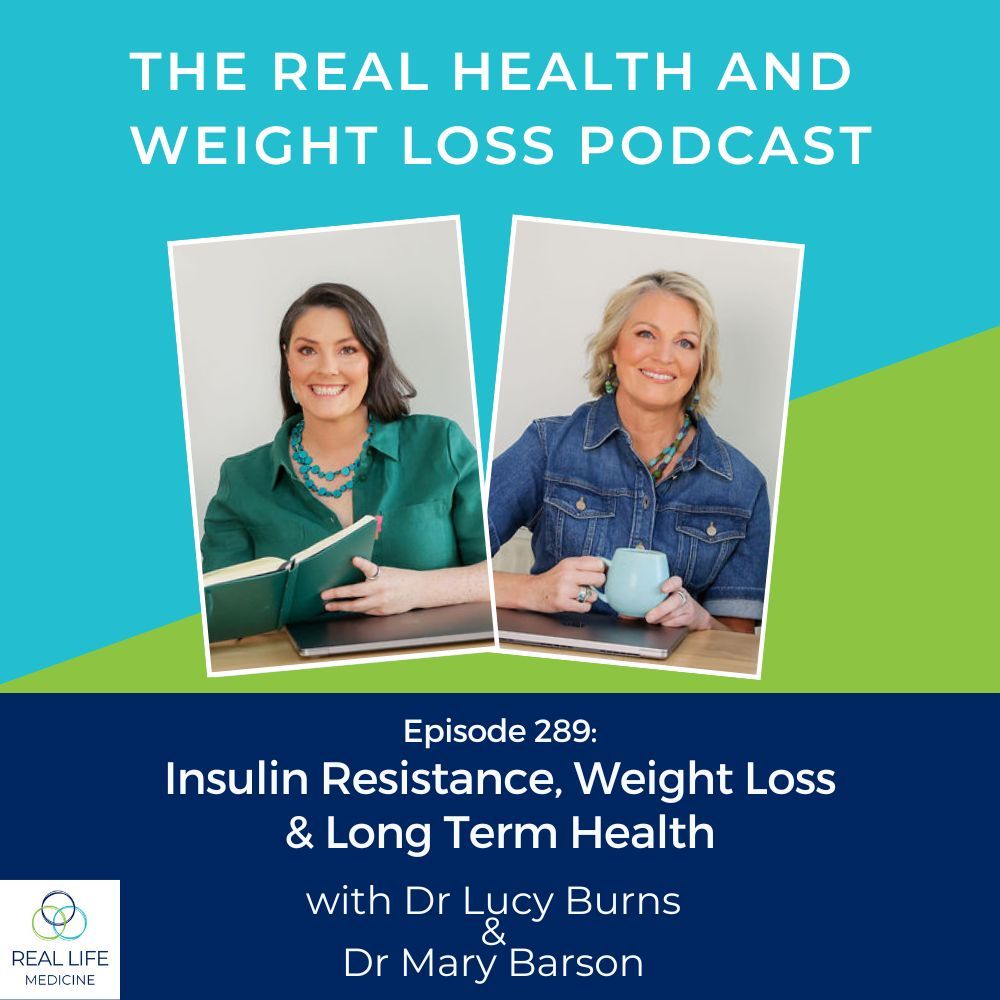


INSULIN RESISTANCE, WEIGHT LOSS
& LONG-TERM HEALTH
One of Australia's Most Popular Podcasts with Hundreds of 5 Star Reviews




Grab your FREE Ebook copy now!
Have you struggled to lose weight and keep it off?
Start your journey to boost metabolism and transform your body into a fat-burning powerhouse.
Episode 289:
Show Notes
The conversation centres on insulin resistance as a “silent”, extremely common metabolic problem that often exists for years before diabetes or other chronic diseases are diagnosed. The doctors describe how high insulin blocks fat burning, drives hunger and fatigue, and contributes to conditions like cardiovascular disease, fatty liver, PCOS, dementia and some cancers, then outline practical lifestyle tools to reverse insulin resistance, framed as the six S for success.
What insulin resistance is
- Insulin is an essential hormone that moves glucose from the blood into cells and into storage as glycogen and, once full, into fat cells.
- In insulin resistance, cells respond poorly to insulin, so the pancreas has to produce more to keep blood glucose normal, leading to chronically high insulin that blocks fat breakdown and promotes inflammation and disease.
Why it matters
- Insulin resistance is described as an epidemic and a “low‑grade emergency”, affecting up to 80% of people in some groups and now appearing earlier in life, even in childhood.
- Persistently high insulin is linked to type 2 diabetes, high blood pressure, cardiovascular disease, fatty liver, PCOS, kidney damage, dementia (“type 3 diabetes”) and increased cancer risk via growth‑promoting and vascular effects.
Causes and drivers
- Major drivers include refined carbohydrates and sugars, visceral (abdominal) fat, chronic inflammation, stress and high cortisol, poor sleep, low muscle mass and gut dysbiosis, interacting with individual genetics and epigenetics.
- Women have particular vulnerability at puberty (PCOS), pregnancy (gestational diabetes) and menopause, as sex hormones interplay with metabolic hormones to increase insulin resistance risk.
How to recognise it
- Clinical clues include central weight gain (waist >88 cm in women, >102 cm in men), multiple skin tags, and darkened, “dirty‑looking” skin patches in body folds (acanthosis nigricans).
- Blood markers include metabolic fatty liver, high triglycerides, low HDL, and elevated fasting insulin; tests like fasting glucose plus insulin (HOMA‑IR) or an insulin curve during a glucose tolerance test can show high insulin even when glucose looks normal.
Six S to improve insulin resistance
- Sustenance: Low‑carb, real‑food eating to reduce sugars and starches, lowering the demand on the pancreas and bringing insulin down.
- Strength & movement: Regular movement (especially after meals) uses glucose, while building muscle increases glycogen storage and makes the body more insulin sensitive.
- Stress: Simple, regular nervous‑system calming practices help normalise cortisol, which in turn supports healthier insulin and other metabolic hormones.
- Sleep: Adequate, good‑quality sleep improves insulin sensitivity; going to bed earlier and treating issues like sleep apnoea are emphasised as vital.
- Sunlight: Morning light exposure helps set circadian rhythm hormones (cortisol, melatonin), which then support overall hormonal and insulin balance.
- Social connection: Feeling connected and less lonely reduces inflammation and supports wellbeing, indirectly helping metabolic health and insulin resistance.
We’ve got something new and exciting launching in Feb 2026 — a brand-new program that gives you a complete MAP to metabolic health. Click below to learn more and join the waitlist.
Episode 289:
Transcript
Dr Mary Barson (0:04) Hello, my lovely friends. I am Dr Mary Barson.
Dr Lucy Burns (0:09) And I'm Dr Lucy Burns. We are doctors and weight management and metabolic health experts.
Both (0:16) And this is the Real Health and Weight Loss podcast!
Dr Mary Barson (0:21) Hello, lovely friend. Dr Mary here for another fabulous episode, joined by my delightful colleague, Dr Lucy. How are you going this summery day, Dr Lucy?
Dr Lucy Burns (00:34) Well, you know, summer is my spirit season. You can have a spirit animal. I figure you can have a spirit season. Yep. I do love a bit of summer. I love the sunshine. I love a bit of warmth. But as you all know, if you listened to one of our previous episodes, I have had another melanoma, so I am very careful with my sunlight and make sure I optimise my morning light, stay out of the, you know, harsh, you know, daytime light and use some sun protection.
Dr Mary Barson (01:02) Very sensible. Balance. In all things, balance is what we need. We do. And speaking of balance, one thing that we want to have in really good balance is our serum insulin levels. And I thought that, we thought that today we could get back to a bit of science, a bit of science-backed basics with talking about insulin resistance. And it's incredibly common. I can't tell you how many times as a GP I have, you know, perhaps met someone for the first time and it's a really relatable story. You know, the person might have normal blood sugar. They've never, ever thought that there was anything wrong with their insulin signalling. If they ever thought about it, blood sugars are normal. But their triglycerides are a bit high. They've got this weight that they are really struggling to lose. Their blood pressure is going up. Nobody has mentioned insulin resistance. It's quite a common story. I think more is more awareness about it now, but insulin resistance is the epidemic of our time, a silent killer, and something that we really need to be talking more about.
Dr Lucy Burns (02:09) Absolutely, because it really is. It's the canary in the coal mine for chronic disease. And people develop insulin resistance many years before they become unwell or before they have the hallmarks of chronic disease. But during this time, they're potentially still suffering. There are things that are happening to them, symptom signs that affect their wellbeing or the way they're living, particularly around hunger, and they have no idea that it's because they're insulin resistant. And, look, phenomenally common, particularly in some parts of our society, up to 80% of people have insulin resistance. And it does get worse as we get older. But what we're seeing with just the changes in health is that people are developing it younger these days. So instead of most people developing insulin resistance maybe in their 60s, 70s, 80s, we're seeing people developing it even in childhood, but certainly 20s, 30s, 40s, and then really manifesting with significant chronic disease in their 50s instead of in their 80s.
Dr Mary Barson (03:25) Yes, and it really is important. It's a low-grade emergency, I think, this epidemic of insulin resistance in our society right now because it isn't just benign. It's not just like, oh, well, you may or may not develop type 2 diabetes in 10 years' time. People who have insulin resistance, it is hurting them right now and significantly increasing their risk of chronic disease and all the things that can rob us of our joy in our retirement, in our glory years, diabetes, cardiovascular disease, fatty liver, strokes, cancers, lots and lots of issues, neurodegenerative disease, like dementia are all linked to insulin resistance. They all have this sort of similar root cause, which is insulin resistance, and you and I, Lucy, are passionate about helping people reverse insulin resistance. It's basically why we do what we do. I feel very, very strongly about it. Could we perhaps, Lucy, you could do this. You're the analogy queen. Could we explain to people what insulin resistance is?
Dr Lucy Burns (04:38) Yes, absolutely. So insulin is a hormone made by our pancreas. It is essential to life. We don't want no insulin. So again, it's very easy to demonise something and go, oh, insulin spikes. We definitely need insulin. It is extremely important because it moves glucose from our blood. So glucose comes from sugars and starches and is the fuel that runs most of our body, and it moves it from the blood into the cells, you know, into our muscle cells, into every single cell really, and any that is left over from the food that we've eaten, it will move it into the muscle cells to store as glycogen and also then into the liver. And then once those stores are full, it will move it into our fat cells. So that all happens because of insulin. So if we didn't have insulin, well, we know what happens. If you don't have insulin, you have type 1 diabetes. It's untreated. It's lethal. So insulin is good. We don't want to be, you know, cached on insulin. But like Goldilocks, too much of a good thing is unhelpful. So for some people, and we'll go through why some people are affected and some people aren't, what happens is that our insulin signaling, so our cells become a bit resistant to insulin. So what that means effectively is that you need more insulin to do the same job. And that's okay. The pancreas is a very, very good organ. We love the pancreas. It will make more insulin. Blood's happy because sugar's moved out back into the cells. Everything seems to be going along okay under the hood, except the pancreas is working really hard. So it's making more and more insulin. Our blood insulin levels get higher, and we can only know that on a blood test. Like we don't have a finger pricker or any other way to check. It's only a blood test that will tell you what your serum or your blood insulin levels are. And the problem for this is that insulin's other gig, it has a few, a number of other little jobs, but one of its other jobs is to stop fat breakdown because why would you want to be breaking down your fat when you're trying to utilise your sugars? Like that would be crazy. It's like having one of those cars that can run on petrol or on gas. They don't run at the same time. You switch between them. And why would the body want to be burning fat and storing fat at the same time? So when insulin is high, you cannot access your stored body fat. And this is a problem because this is not how we're meant to run. We're meant to be able to dip in and out of our stored fuel. That's what it's for, to be able to access easily so that we can just run our day-to-day life. We can think our day-to-day thoughts. We can move our day-to-day body by accessing stored fuel. And if we can't access it, well, then the result is that we're hungry, brain's way of saying you need some fuel, and we're tired, body's way of saying I don't have any fuel. This is really unhelpful for your day-to-day living to be tired and hungry.
Dr Mary Barson (07:55) And yet it is so very, very common. Beyond that, the high insulin is a pro-inflammatory state and it drives a whole lot of chronic diseases that rob us of years of our life and rob us of our quality of life. So it's very important that we do what we can to get our insulin just right, Goldilocks.
Dr Lucy Burns (08:18) Absolutely. And beyond that, I think the sequelae of having high insulin, one, you don't even know you've got it, two, you can't access your stored fuel, three, it actually has a direct effect on our kidneys. So there's a little cell in the kidney called the podocyte, which is, I don't know, called the podocyte because it looks like a foot or something.
Dr Mary Barson (08:40) Yeah, under a microscope.
Dr Lucy Burns (08:41) Yeah. It is toxic to kidney cells and causes the destruction of renal function long before the development of type 2 diabetes. It is a growth hormone and so promotes the growth of many cancers and it also promotes the growth of the endothelial cells in our blood vessels and so contributes to high blood pressure because high blood pressure comes from some vascular stiffening because these cells are bigger and thicker than they're meant to be. And that's just off the top of my head. Like I haven't even looked this up. I just happen to know all of these and I'm sure there's many, many other things.
Dr Mary Barson (09:26) Oh, so many. And back to that, how it promotes that endothelial cell dysfunction, so the endothelial cells, the lining of our arteries, which then promotes atherosclerosis and a prothrombotic state, which increases our risk of heart attacks and strokes. Fatty liver, insulin resistance drives fat accumulation in the liver. The liver does not like being a fat-storing organ, but high insulin forced it to do that. And now non-alcoholic fatty liver disease is the leading cause of liver failure and liver transplants in the Western world. My story, high insulin drives polycystic ovarian syndrome and causes increased androgens, the male sex hormones in women, and can affect ovulation. And so targeting insulin resistance is actually a key therapeutic role, a key therapeutic target in managing PCOS and that's been helpful for me. And our brain gets insulin resistance so we can get that neurodegenerative disease and dementia from insulin resistance in the brain and some people call Alzheimer's, dementia, type 3 diabetes. And you mentioned that it's a growth factor as well and so hyperinsulinemia, sorry, that's increased insulin in the blood and insulin resistance is associated with increased risk of many cancers, which could potentially be driven through that growth hormone effect. So, yes, lots and lots of reasons why you want to, A, know if you have insulin resistance and, B, do something about it. Do you want to talk about the potential drivers of insulin resistance? That would be, I think, helpful for people to understand as well. Sure.
Dr Lucy Burns (11:06) Yeah, yeah, absolutely. So, you know, what are the causes? Why do some people have insulin resistance, some people don't? So, yeah, absolutely.
Dr Mary Barson (11:15) I think one of the main drivers is refined carbohydrates and sugars. We've got strong evidence that these drive high insulin and that the body can get overwhelmed by the sugar and starches in our diet that can lead to insulin resistance and increase insulin over time. Visceral fat also, it's a bit of a chicken and an egg situation then. High insulin can cause that increased abdominal visceral fat, which is highly metabolically active, but it's also highly inflammatory and it releases signals and free fatty acids that then can impair insulin signalling, which can then make it even worse. And inflammation in general is a driver of insulin resistance, as is stress. High cortisol, especially chronic stress, can drive insulin resistance through various biochemical mechanisms. Poor sleep does that as well. Low muscle mass is potentially a driver, or it could be another way of saying that is just improving muscle mass helps us improve our insulin resistance. And gut dysbiosis has a role too, possibly through the inflammation, how having poor gut health can lead to systemic inflammation. But not everybody develops this the same way, so it really is quite complicated. And it's a complex interplay between your genetics and your environment and how your body interacts with your environment around you and how your body responds to your behaviours and your habits that are going to dictate who gets insulin resistance and who doesn't. But I think the empowering thing here is that by changing habits, we can do a lot to change our physiology and help reverse insulin resistance. Yes.
Dr Lucy Burns (13:07) And I think it's really important for people to realise that developing insulin resistance, it's not your fault. As you said, Miss, there's genetics at play. We know that genes are involved. Anyone who says, oh, you know, humans have been living for thousands of years, it's not the genetics, it's the food. They don't understand epigenetics. They don't understand that genes get switched off and on. And particularly a foetus in utero is very susceptible to epigenetics. So we've got, therefore, people that are more vulnerable to the environment that we now live in. And I think that's a much – it's a way less judgy way to be looking at it because you can have two people who eat the same, perhaps you live the same life, but yet one of them develops insulin resistance and stores body fat like crazy and the other person seemingly can eat whatever they like and doesn't seem to have any effect. So we do need to be really mindful that you can't make any judgement about someone's behaviour based on their external appearance. I think it's really easy for us to fall into that trap and think, oh, well, those people just, you know, the narrative is they are lazy and just eat McDonald's all day. That is often far from the truth. The other little blip I guess that happens particularly for women and women are susceptible to insulin resistance at puberty where, as you said, girls can develop polycystic ovarian syndrome, pregnancy, women develop gestational diabetes and then menopause. Women that weren't insulin resistant become insulin resistant. So the female sex hormones have a large interplay with the metabolic hormones.
Dr Mary Barson (15:00) Yes. So if someone's listening to this podcast and they're like, oh, geez, I wonder maybe I have insulin resistance. Number one, how could they find out? And number two, what should they do about it?
Dr Lucy Burns (15:12) Yeah. So number one, again, there's some things that you can look for that aren't necessarily blood tests. So we certainly know that if your waist circumference, you know, if you store most of your body fat in the middle, so, you know, you're the apple as opposed to the pear, so for women if your waist is over 88 centimetres, men it's a bit over 102 centimetres, your risk of developing or having insulin resistance is higher. If you've got lots of skin tags, again, skin tags are normal, everyone has some, but if you have more than perhaps is common, particularly around your neck, under your arms, groin, under your breasts, then that might be insulin resistance. And some people get funny little patches of brown skin or brown pigmentation that sort of feels like, you know, you're trying to rub off a stain like dirt or something. And, again, groin, under your armpits, they're more common. So you might have some of those. Or you might have some blood tests that you've had and you mentioned earlier, May, about non-alcoholic fatty liver disease, which has actually been renamed to metabolic fatty liver disease, although like everything, changing of names takes a while. You might have high triglycerides, you might have low HDL, but you might actually just have high serum insulin if anyone has ever checked it. And you can absolutely have pathology tests where we would check your fasting blood glucose with your fasting blood insulin and calculate something called your HOMA-IR, and that is certainly a good clue. Or a more extensive test for somebody who is not on a low-carbohydrate lifestyle is something called an insulin curve. And this is like a glucose tolerance test that many people have had either to check for diabetes or, you know, in either normal life or pregnant life. And you can actually have insulin levels done with these, and this is a super interesting test. It's quite arduous because it takes two hours and yada, yada. But I've seen many people with normal glucose responses to a glucose tolerance test with sky-high insulin levels. And, again, just indicates pancreas working really hard under the hood to keep your glucose levels low.
Dr Mary Barson (17:38) What should we do about it if we know or suspect that we have insulin resistance?
Dr Lucy Burns (17:43) Well, you know, our favourite things. So technically there's not a lot of effective medications because if we were just to reduce insulin, let's just say, oh, well, God, the pancreas is making too much insulin. Let's just bring the insulin down. Well, the glucose will go high because insulin's job is to move glucose into the cell. And so if you're insulin resistant, it has to make a lot of insulin to do that. So you're really trying to sensitise your body to insulin, to make insulin work more effectively rather than just stop high insulin. And so we can do that with lots of, there's a bucketload of lifestyle measures, which we love, of course. And we've sort of summarised these into the six Ss. So, you know, we've been through these before, but we would tell you the first S, sustenance, your low-carb lifestyle. Reducing carbohydrates and sugars and starches is the single best thing you can do to reduce the work the pancreas has to do. So the pancreas doesn't have to process all these sugars and starches. It doesn't have to make as much insulin. So therefore it lowers it. Like it's not rocket science. It's pretty basic, yes. Yeah. We can do strength and movement. So moving your body, after eating in particular, utilises the glucose. So the body doesn't have to store it, it uses it. So that's helpful. Building muscle, again, is a longer-term option, but building muscle means your body has more places to store glycogen. Your muscle is your metabolic organ. It uses more fuel at rest and so it sensitises your body to insulin. So that's helpful. Your favourite thing to talk about, Miss, is stress management. How does that help?
Dr Mary Barson (19:37) So stress management helps lower our cortisol levels, helps normalise them. And when we can normalise our cortisol level, this has a cascade that flows through all of our metabolic hormones, including insulin. And it just doesn't have to be a lot. It doesn't have to be sweeping changes. You don't have to get everything in your life that annoys you ever, but small moments of calm, small moments of relaxation can help regulate your nervous system so that you can have improved cortisol and metabolic hormones.
Dr Lucy Burns (20:12) Absolutely. Sleep, super important, really important, so important in fact. So we know that disturbed sleep, reduced sleep, reduced quality of sleep, worsens insulin resistance. We know that improving sleep improves insulin resistance. Like it's almost linear. There are lots of causes of sleep disturbance, so addressing that is important. Number one, though, you have to go to bed. Like honestly, half the reason people are sleep deprived is they actually don't spend enough time in bed. Like you can't get seven-and-a-half-hour sleep if you're only in your bed for five hours. So certainly going to bed is helpful. But, you know, again, making sure that you don't have sleep apnea, or if you do have sleep apnea, getting it checked and tested and treated is vital. And I guess part of stress management flows into sleep too because people often don't sleep well because they haven't, they've got a lot of stress and they haven't got enough skills to manage that. We often just wish the stress would go away. Quite often that's not possible. But we need to learn skills to be able to manage that stress so that we can sleep well and rejuvenate and reduce our insulin.
Dr Mary Barson (21:29) Yes, yes. And the other S, sunlight. Also very important for sleep. Sounds like a strange thing to say, but it is. Particularly that morning sunlight helps us set our circadian rhythms. And our circadian rhythms is also hormones. Everything is hormonal. But our circadian rhythm is a hormonal interplay in our body between cortisol and melatonin and other hormones. And they're like little conductor hormones that then can help regulate all the other hormones. And so getting some morning sunlight to help set your circadian rhythms is helpful for your insulin resistance.
Dr Lucy Burns (22:07) Absolutely. And, look, social connection. I don't know that there's a direct link on social connection and insulin resistance. But we do know that humans are social creatures. We need to feel that we belong somewhere. We need to feel connected to something. And without that, we really don't thrive. Loneliness is an inflammatory state. So developing social connection in whatever way that looks for you is really important, adding sort of meaning to your life. So the six Ss for success are really designed around improving insulin resistance, which is the root cause of the majority of our chronic disease and steals our glory years.
Dr Mary Barson (22:51) It's very important and largely, largely within our control to improve. Absolutely.
Dr Lucy Burns (23:00) So, friends, focus, six Ss for success, and we will be back next week with another episode of the Real Health and Weight Loss Podcast.
Dr Mary Barson (23:09) Bye now.
Dr Lucy Burns (23:13) The information shared on the Real Health and Weight Loss Podcast, including show notes and links, provides general information only. It is not a substitute, nor is it intended to provide individualised medical advice, diagnosis or treatment, nor can it be construed as such. Please consult your doctor for any medical concerns.