
HOW TO STAY CONSISTENT WHEN LIFE GETS MESSY MATTERS
One of Australia's Most Popular Podcasts with Hundreds of 5 Star Reviews

Grab your FREE Ebook copy now!
Have you struggled to lose weight and keep it off?
Start your journey to boost metabolism and transform your body into a fat-burning powerhouse.
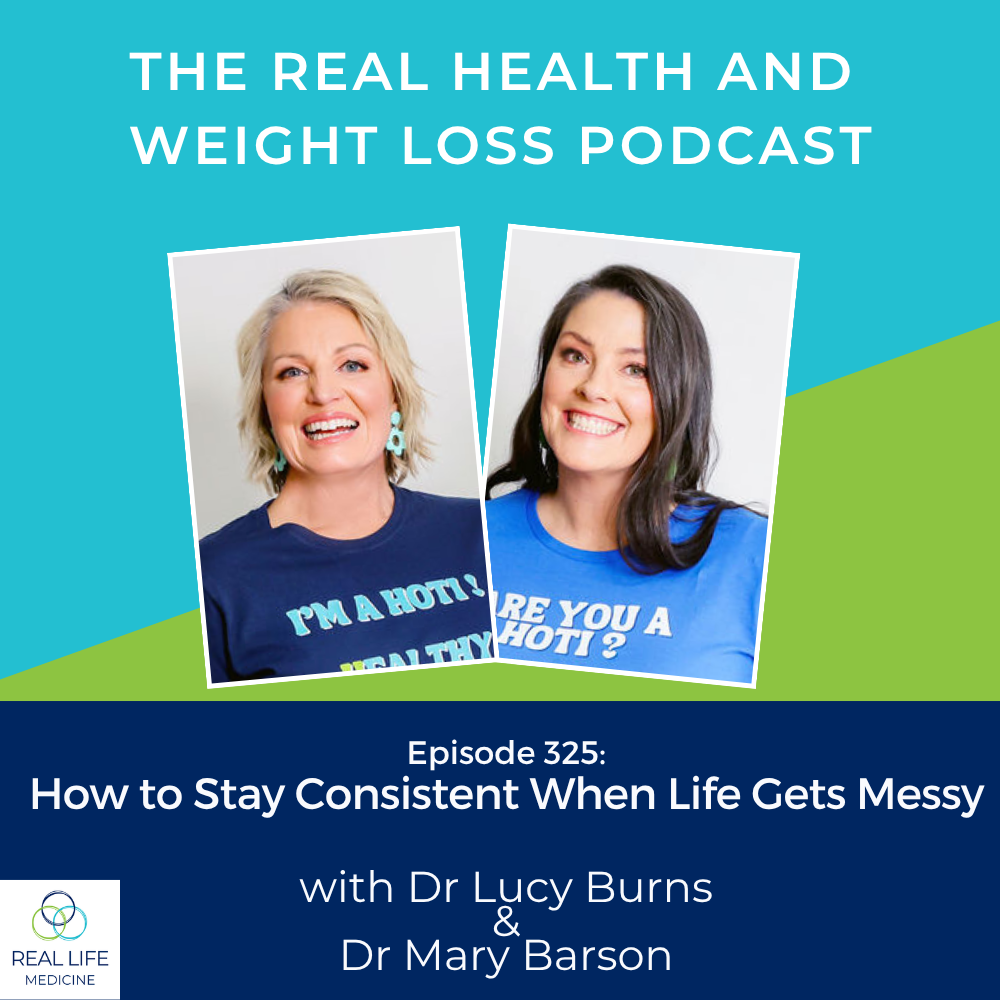
Episode 325:
Show Notes
Episode summary
This episode explores why consistency matters more than perfection for long-term metabolic health. Dr Lucy and Dr Mary explain that difficult days, slips and interruptions are a normal part of life, not proof that you have failed or need to “start again on Monday”.
The central message is to create a realistic “bare minimum” plan for hard days, reduce friction around healthy habits, and view unhelpful choices with curiosity rather than shame. Over time, small actions build confidence, self-trust and a healthier identity.
Key points
- Consistency is not doing the same thing perfectly every day. It is the overall pattern across months and years. Missing a few gym sessions, having a tough week or eating differently on holiday does not erase the habits you have built.
- Have a plan for bad days. Your minimum standard might be a simple protein-based meal, a short walk, a few minutes outside, or choosing not to turn one difficult moment into a whole difficult week. A realistic fallback plan helps prevent the “stuff it” response.
- Zoom out after a setback. Eating a block of chocolate or missing several workouts is a blip in a longer health journey. Looking at progress over time makes it easier to recognise that one choice does not send you back to zero.
- Perfectionism is a trap. Waiting for the ideal Monday, meal plan, motivation level or set of circumstances can keep people stuck. The belief that you must be perfect often leads to all-or-nothing thinking and repeated delays.
- Replace control with curiosity. Rather than labelling yourself as lacking willpower or “self-sabotaging”, ask: What was happening for me? What thought, feeling, need or situation was driving this choice? A perceived mistake can become useful information for the next experiment.
- Behaviours have drivers. When you repeatedly do something you did not intend to do, there is often an underlying thought or feeling. For example, a belief that cocktails equal fun may conceal a quieter thought such as, “What’s the point?” Identifying the deeper driver can help change the pattern.
- Small steps are not pointless. Tiny actions can strengthen self-efficacy: the belief that you can do what you say you will do. Repeated evidence of capability creates an upward spiral, making future healthy choices feel more achievable.
- Lower the friction. Make healthy choices easier by using practical shortcuts such as a regular protein delivery, pre-chopped or frozen vegetables, ready-made spice blends, or a simplified meal routine. The best system is the one that suits your life, not the most impressive-looking one.
- Meal preparation is optional. Batch cooking helps some people but feels overwhelming to others. Choose the approach that reduces decision-making and supports you, whether that is a full weekly prep session or simply keeping easy ingredients on hand.
- Make beneficial routines easier to start. The doctors use morning outdoor light as an example. Prepare in advance by having warm clothes, a lidded coffee cup or a simple reason to go outside, such as playing with the dog. Focus on the benefit, not the inconvenience.
- One helpful choice can lead to another. A morning routine that includes getting outside, caring for yourself and moving your body can create momentum and reinforce the message: “I matter, and my health matters.”
- Your worth is not earned through productivity or perfect health habits. The episode closes with a reminder that every person is valid and worthy of care. Supporting your health is an act of self-respect, not a punishment or a test of discipline.
Standout quotes
- “A plan for my bad days is, for me, far more important than having a plan for my good days.”
- “Consistency is measured over years, not days.”
- “Perfectionism is a trap.”
- “Mistakes are not identity flaws.”
- “It’s not self-sabotage, it’s information. It’s data.”
- “I am becoming a person who cares for myself because I matter.”
- “The most powerful ally that you have is yourself.”
Practical takeaways
- Choose your personal bare minimum for a hard day.
- After a lapse, ask one curious question instead of making a harsh judgement.
- Remove one barrier to healthier eating this week, such as buying frozen vegetables or planning an easy protein option.
- Create a simple morning-light routine that works with your real circumstances.
- Stop waiting for Monday. Make the next available choice a supportive one.
- Measure your consistency over the long term, not by one meal, one weekend or one imperfect week.
Work With Real Life Medicine
For a step-by-step approach to improving metabolic health in perimenopause, menopause and beyond, check out My Metabolic Action Plan. This doctor-led comprehensive programme gives you
Strategies to improve metabolism
Skills to develop mindset
Tools so you will implement!
Episode 325:
Transcript
Dr Mary Barson (00:05) Hello lovely friend, I am Dr Mary Barson.
Dr Lucy Burns (00:09) And I'm Dr Lucy Burns.
Both (00:11) We are doctors, weight management and metabolic health experts. We are the creators of My Metabolic Action Plan, your two-step map to real health and weight loss, which is in fact the name of this podcast. Join MyMap now at rlmedicine.com.
Dr Lucy Burns (00:29) Good morning lovely friends, Dr Lucy here on a beautiful Tuesday morning, if you're listening on a Tuesday, otherwise I hope it is wonderful wherever you are. I am of course joined, I don't know why I say of course, because sometimes I'm not joined. But today I'm joined by the beautiful Dr Mary. Hello my friend, how are you?
Dr Mary Barson (00:48) Hello lovely Lucy, I am good, I am good and yeah, I am good, loving life and at the same time life is extremely busy. I am grateful for my life and I love so many things about it, but I am a, you know, solo mum working nearly full-time, looking after aging parents and also having to help run a farm. Admittedly it's a much down-regulated farm, but yes we had a broken down generator on the weekend and I had to go and help and I was just sort of taking a moment to reflect on my life like this is, this is not how I expected things to go, but it's okay.
Dr Lucy Burns (01:32) Yes indeed.
Dr Mary Barson (01:33) I think this is kind of pertinent to what we want to talk about today, about consistency and perfectionism, because you know the day of the broken generator was, you know, a really busy day when things didn't go as planned and yet I still try as much as I can to have like this absolute minimum of acceptable effort that I put towards my health each day. A plan for my bad days is, for me, far more important than having a plan for my good days because I can sometimes be amazing, you know, sometimes I can just cook a whole week's worth of food and I can plan out everything and I can get my strength training done and I do my relaxation and I tidy up the house and I am just absolutely fabulous and there are days when I am not, but on those days I'll just have this bare-ass minimum that helps get me through and that helps with the consistency over perfection and I think if every day was my bare-ass minimum that probably wouldn't be great, but it does mean that I don't, you know, fall too far.
Dr Lucy Burns (02:48) Yes, absolutely. I think a bare-ass minimum is super useful and it's interesting, isn't it, to think about consistency and what that actually means because I think people, well, and I've certainly had this, the idea is that consistency means you're doing the same thing all the time and it doesn't actually mean that. We've been talking a little bit about this idea of zooming out, so taking a bird's eye look at something. So an example might be that, you know, you, let's say you go to the gym and normally you go, I don't know, four times a week and maybe for three weeks you don't go at all. So all of a sudden your brain's going, you're not consistent and if you were only looking at that three-week period, you would be right. That would be not that, you know, you've got no times. It's not very consistent or you're consistent in doing none. So consistently missing it. Yes, but if you were to then look at maybe the whole year and maybe the reason you didn't go to the gym was that you're away and for the rest of the year you did go three or four times a week, well then you'd probably say, oh yes, you've been consistent. And if you were to then look at say 10 years and out of that 10 years, every year maybe you missed a few weeks, but every year you've gone for, you know, 47 of the 52 weeks, well then we'd call that consistent. So consistency definitely has a time element to it.
Dr Mary Barson (04:28) Yes, and I like that idea that you can zoom out and that zooming out helps give you an idea of where you really are. And also zooming out is helpful for those days where you do fall over and you do stuff it up and, you know, things don't go the way that you planned and you don't behave in a way that you want to behave. It can be easy for our brain, like if we trigger our reticular activating system, like if we, you know, just are tired and just ate a block of Cadbury caramilk because we felt like we needed the dopamine or the energy or whatever the reason we did it to then get to the end of the block of chocolate and just think, well, I've completely stuffed it now and just want to hit the stuff it button. But if we zoom out like that little blip of eating the chocolate, you know, the entire block of chocolate, it's really only just a small little blip. And if we were to have to look at how far we've come over time, you know, on our health journey and how the skills that we've learned and the changes that we've made, it's still overall this upward trajectory. And if you look backwards and say, well, this is how far I've come, then it's much easier to look forwards and say, well, look, I can keep going. This little blip does not mean that I'm going to fall all the way down to the bottom. This little blip is just that. And then I could just pick myself up and keep climbing.
Dr Lucy Burns (05:53) Yes, exactly. I think when people have this idea, I've got to start all over, they think they're starting from zero. You know, we have a little phrase that it's never too late to start again. And it honestly isn't. And this is really helpful because it can stop the all or nothing mindset of, oh, well, I've buggered it. I'm going to start on Monday. And so when we're starting on Monday, our brain goes, oh, quick, eat everything in sight before Monday comes. And then Monday comes. And if we don't start on Monday, for some reason, our brain goes, oh, well, I'll wait till next Monday. And so we can end up then just never, never starting because we're waiting for kind of the perfect time. So perfectionism is a trap.
Dr Mary Barson (06:39) It absolutely is. And so many of us, I think, can get caught in its sticky tentacles and can just sort of stay there. I'm an all or nothing person, Dr Mary, so either I'm doing it perfectly or I'm not at all. If I had a discreet lump of money every time I heard that, I would be a wealthy woman. Absolutely.
Dr Lucy Burns (06:58) But it's interesting because I think, I mean, a lot of people have this mindset, many of us. And there are times where I think it's a product of our environment. And for some people, it's a product, you know, it's nature and nurture. So there, but at the end of the day, I think the reason we embrace perfectionism, if that's the right turn of phrase, is because our brain thinks it will keep us safe. That it will, you know, if we're thinking about it, say with weight management, our brain thinks, well, that means it will work if I'm perfect. And if it works, well, then I'm safe because I'm doing something that is working.
Dr Mary Barson (07:36) Yeah. It's about control too. Like we feel if we can control it, then we will feel safe. Perfectionism is control. And if it's not perfect, then it's out of control. Yes, that's a really good point. If we could practice trading that control for curiosity instead, then we can reframe our failure as just data. Like mistakes are not identity flaws. It doesn't mean we're spiraling out of control. It's just, we could use it as just feedback and information to adjust and keep going.
Dr Lucy Burns (08:08) Yes. Yes, I totally agree. I think it's thoughts are often messages like, what is my brain trying to tell me here? Even feelings where we have, in fact, feelings are definitely messages. What am I feeling? What message is my brain trying to send me? And recognising that sometimes what we're missing is a skill. It's not that we have no willpower. We have no discipline, that we're self-sabotaging. I actually hate that phrase, self-sabotaging.
Dr Mary Barson (08:40) People relate to it, but it isn't helpful.
Dr Lucy Burns (08:41) No, well, it actually doesn't even make sense because sabotage means to willfully stop or break or wreck something to prevent a success or something working. Now, I don't know anybody who willfully sabotages themselves. So it's a phrase I think that comes up with trying to explain a behavior when people don't understand it. So they don't understand why am I eating the biscuits when I told myself I wouldn't? I must be self-sabotaging. Or why do I go so well all week and then at the weekend, I go crazy. I must be self-sabotaging. And so I think it's really more of a, I don't understand what I'm doing here sentence rather than a, I am willfully wrecking my progress.
Dr Mary Barson (09:39) Yes. And when people think that I'm willfully wrecking my progress, they're like, well, I'm hopeless. I'm terrible. I can't do this. And it makes us fall into that sticky tentacle trap of the perfectionism and helps keep us stuck. So I totally agree with what you're saying there, that if we could change the terminology around, it's not self-sabotage, it's information, it's data. What is happening for me on the weekend? What is perhaps going on for me? Then it becomes easier to experiment with those tweaks and changes, which can help us build that consistency without needing that perfection.
Dr Lucy Burns (10:19) Yes, absolutely. And again, if you haven't listened to last week's episode, go and have a little listen to that after this. But it is really helpful to untangle our thoughts. And, you know, we've spoken many times on our podcast and certainly in our programs and in Momentum about, you know, thoughts create your feelings and your feelings and actions and your actions are what create your results. So when we're doing actions and we don't understand why, why am I doing this action? There'll be a thought or a feeling behind it. There is something driving it. And you may not be aware of what that is yet. It may not be loud enough. You may not have heard it, but there is something in there. And, you know, as we spoke about last week, for me, there was a little voice that started. It's very quiet. What's the point? It was dressed up as a disguise of something else in particular. And this is a little story in particular for me. I have a little story that cocktails are fun. Cocktails and alcohol are fun.
It's fun to drink cocktails. It's holidays to drink cocktails. I drink cocktails with my friends, blah, blah, blah. So there's all this little, I'm having fun and I deserve fun. But underneath all of that was, well, what's the point? I might as well just have them. So we can always listen if we, I guess, untangle, as you said, the web to find out what is really driving behavior. Our brain says we have to be either perfect and in control or we're out of control and not perfect. Whereas really life is more like little seasons. If you like, there are bits where it's going to be easy. That's where it's going to be a bit harder. Sometimes that's our own internal compass driving that sometimes it's external circumstances.
Dr Mary Barson (12:08) And to draw what we said a couple of podcasts ago about our reticular activating system and how when we start to make some healthy changes, our brain then realises that we are making healthy changes and we start to see more evidence that we're capable of making healthy changes. And then we build that self-confidence and that self-efficacy, and then making healthy changes becomes even easier and easier. And we kind of have that spiraling upwards. That can start and indeed continue with some pretty small changes. Small steps aren't useless. Our brain might want to dismiss them and go, you know, I need to revolutionise my, like, completely change my entire health. You know, I can't just make some small change, but actually those small steps help build that consistency and lowering the friction, doing what you can to make it easy. Like how I have my bare ass minimums, lowering it down, making it easy means that it's easy. Basically, when we make it easier, it's easier. And so we actually can do the things. So Lucy, you're great at this. I mean, you know, what are some good tips for building consistency, making it easier with healthy eating?
Dr Lucy Burns (13:25) Ah, easy. So yeah, well, this morning, actually, our cow delivery arrived. So I have a meat subscription and it literally just turns up. So, you know, again, I can change it if I'm going away or whatever, but it just rocks up. So then I go, oh, good. Here's all my protein sorted. I don't have to think about that. I have vegetables that I buy pre-chopped as many, as much as I can, pre-chopped vegetables. Because for me, that is a barrier now, the physical act of chopping food. But it's also a barrier for lots of people because it's time. It's totally a barrier for me. Yeah. And so, you know, people will go, oh God, I can't be bothered chopping up pumpkin. Well, I remember wishing that you could buy chopped up pumpkin, and now you can. So it's amazing the things that I used to wish for. I used to wish you could record television shows. No, you can't. Who knew? So yeah, buying vegetables that are pre-chopped. Mingle spices. Yeah, you can make up your own spice mix if you want to. If that's easy for you, you can go and buy all your different things of cumin and coriander seeds and whatnot. Or you can buy mingle sachets where it's already done for you and I just have to open a packet and it's suddenly flavoured. So really finding food methods, chopped up frozen onions, frozen cauliflower. Again, if you're wanting to make cauliflower mash and you haven't bought a cauliflower or you don't want to chop one up, you just get frozen cauliflower and bang it in the microwave and then mash it up with your stick blender. Like, it's easy.
Dr Mary Barson (15:00) I love it. Just lowering that preparation barrier helps on the road to consistency. It's fantastic.
Dr Lucy Burns (15:08) Yeah, and it's interesting because I think meal prepping is useful, but meal prepping can also feel like a barrier because suddenly people go, what? I have to spend a whole afternoon meal prepping for the week? And that suddenly feels like, wow, that's big. I don't have that much time or I don't want to spend my Sunday afternoon meal prepping for the week. I get that. Other people love it because they go, oh, good. Now I don't have to worry about the meal prepping for the week. You get to decide how you feel about something. But what you can decide is whether something is helpful to you or not. And I'll give you a great example of this. And this is morning sunlight into your eyes. So we all know, well, maybe you don't, but I'm telling you that metabolic hormones are run using our circadian rhythm. Humans are diurnal creatures, which means we like daylight where we do our activity and we sleep at night, as opposed to nocturnal creatures who are gallivanting around in the middle of the night. So all of our systems have diurnal variations. Our insulin levels are higher in the evenings than they are in the mornings. Our cortisol rises in the morning. It's our waking up hormone. Our melatonin rises in the evening. It's our going to sleep hormone. They're all designed for this. But our modern environment is not designed for this very easily. We now have lights, camera, action at nighttime. We've got televisions. We've got computers. We've got phones. We've got all of these things putting light into our eyeballs that isn't really meant to be there. So a little way to help your brain, literally, is to go outside in the morning, if you can. It is interesting how hard people find this. And I do get it. It is easier if you like to lie in bed. It is easier to stay inside a warm house. And you can tell your brain this is too hard, and it will find all of the reasons to tell you it is too hard. That's the reticular activating system for you. Or you can tell your brain, okay, this is something that is free, that has no side effects, that requires really a minimum of effort. You open the door and go outside. We live in a country where most of us have some access to external, whether it's a balcony or yard. We're not dodging bombs. We're not dealing with hideous pollution. So for most of us, it is doable if we tell ourselves it is.
Dr Mary Barson (17:54) Yes. For me, focusing on the benefit rather than the effort lowers the friction for me. So I pick up a ball and I go outside. I don't go far because I've got the kids usually asleep in the house, and I can't go for a big walk. But I just walk around the yard and the house, throwing the ball for the dog. And it's so much better for her, and it's so much better for me. And if I focus on it's cold, I can't be bothered, I don't know where my gumboots are, it's all too hard, then I will just stay inside and have my cup of tea inside. But if I instead look at the dog, look at, think of my sleep, think of the benefits, I'm like, okay, it actually, it's really not that hard. And it becomes not that hard when I focus on the benefit rather than the effort.
Dr Lucy Burns (18:41) Yeah, absolutely. And I love that because you're making it as frictionless as possible. And look, to be honest, I had to do the same thing because there were some friction points for me. I take my cup of coffee outside. So in winter, now I put my Udi on, like I get out of bed, put the Udi on, my scooter is charged. I have my coffee in a cup that's got a good lid on it, like a keep cup, because I kept spilling it as I was trying to get out the door in my scooter and it was going everywhere, it was driving me nuts. So I've made a system that makes it as easy as possible. It's still easier to lie in bed. Absolutely. Like, you know, I'm not going to pretend it's not, but it's not helpful to do that for your metabolic health. So, you know, being proactive, taking some active steps to counter this really hostile environment we're now in. And again, I use that word kind of, you know, it is hostile for metabolic, it is hostile for health. There is no doubt we've now created this hostile for health environment where nobody, half the people don't go outside, nobody sees the sunlight, blah, blah, blah. So, yeah, just be proactive about it.
Dr Mary Barson (19:58) I love it. You've created a way to make a frictionless sort of, you know, five minute routine. I'm not frictionless, but less frictionless. Frictionless would be lying in bed, but you've made steps to make it easier so that you could do something that's tailored to you and it's easier and you can have that consistency. And I love that. I've been to show if this is what you feel, but sometimes just that one helpful, positive choice can then make the next helpful, positive choice easier and the next one as well. And sort of prove to yourself that you can do it, then you sort of feel that you could do it. You might be looking for opportunities for the next healthful thing that you could do. And then we're working with our brain, working with that particular activating system, and then consistency becomes easier.
Dr Lucy Burns (20:45) Oh, absolutely. So, you know, the options I have, I could lie in bed. My beautiful hubby would bring me coffee in bed. I could easily do that. Lie in bed, you know, check my emails, check Facebook, check Instagram, you know, play a couple of games, and honestly, two hours could roll on by, or I get up, have my coffee outside. He tottles off to work. We've played with the dog like you. Then I go in, have my shower, do my personal grooming that I'm now spending, you know, some time on, like, as opposed to no time. And then basically all of that sends a really important message to my brain that I matter, that I'm important, that I deserve good health.
Dr Mary Barson (21:29) Yes. And it's like that identity change, those identity patterns, you know, I am becoming a person who cares for myself because I matter.
Dr Lucy Burns (21:38) Yep. And you know what? All humans matter. We all matter. And the most powerful ally that you have is yourself. So we don't need to rely on other people for validation or other people to say you matter. You can tell yourself that. And that's often the first step. So yeah, all of you out there, you all matter. And I, you know, would challenge you to prove it to yourself.
Dr Mary Barson (22:04) I love that. I was just getting kind of emotional hearing you say that. That is a beautiful thing. We all matter
Dr Lucy Burns (22:06) . We do. We do. I know. And it's so interesting, isn't it? To think about it. I remember you, Miss, when you talked about after you had Mirabelle and she was just a tiny little baby and you realised how she was worthy and valid and loved, you know, without any achievement. Babies, you know, we all know babies achieve nothing.
Dr Mary Barson (22:33) They drink and poo.
Dr Lucy Burns (22:34) Yeah. Yeah. There's no productivity.
You know, I guess they grow. They grow themselves. But they're not contributing. They're not being productive. They're not people pleasing. They're just there. And we love them.
Dr Mary Barson (22:47) Because they are valid, worthy, and they are worthy of love. Yeah.
Dr Lucy Burns (22:51) Yeah, absolutely. But the thing is, at the end of the day, the person who needs to give you love is actually yourself. And I know that's always icky. We hate talking about self-love as Australians. You know, loving yourself always feels a bit vomit in your mouth. But it is really this idea of you deserve to respect yourself. You deserve to care for yourself. And you can be your own biggest cheerleader.
Dr Mary Barson (23:20) Yes, don't let perfectionism get in your way.
Dr Lucy Burns (23:24) Absolutely. And consistency is measured over years, not days.
Dr Mary Barson (23:30) Yes.
Dr Lucy Burns (23:31) All right, lovely ones. We will be back next week with another mindset episode. Look forward to talking to you then. Bye now.
Dr Lucy Burns (23:39) The information shared on the Real Health and Weight Loss Podcast, including show notes and links, provides general information only. It is not a substitute, nor is it intended to provide individualised medical advice, diagnosis or treatment, nor can it be construed as such. Please consult your doctor for any medical concerns.