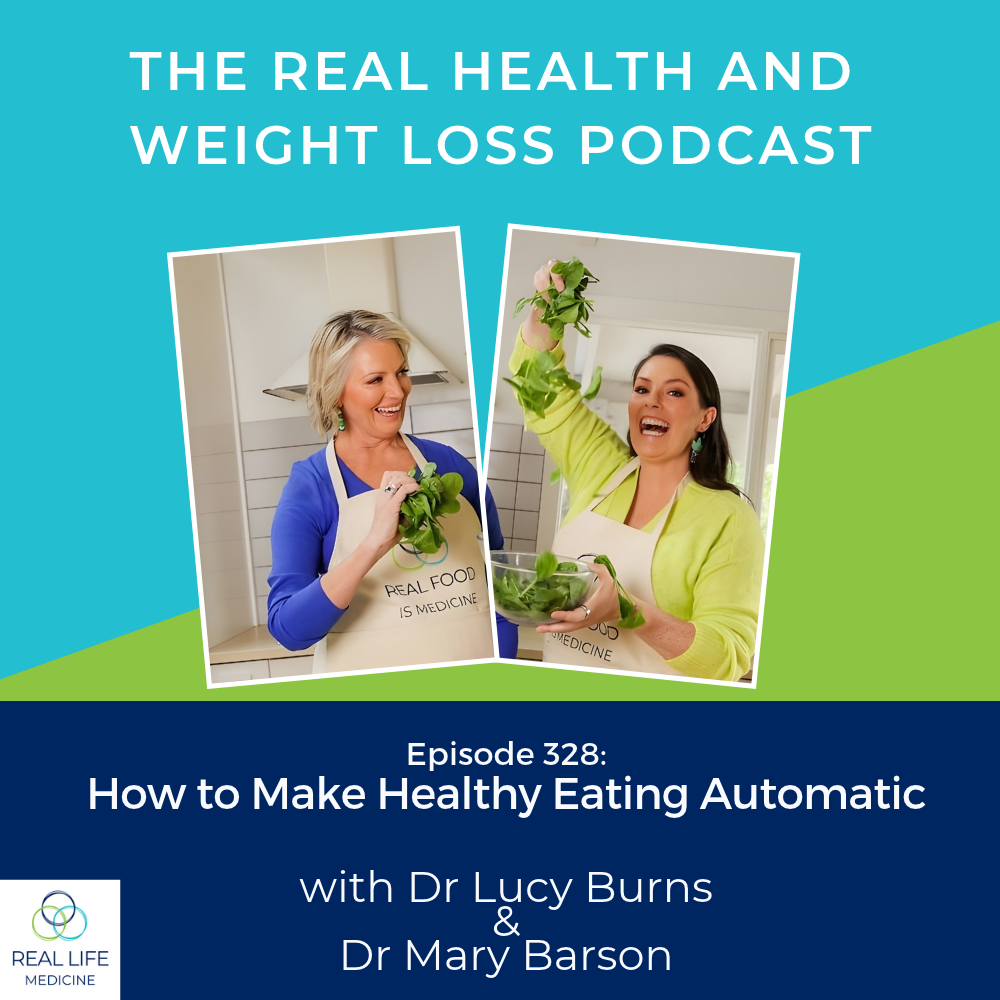

HOW TO MAKE HEALTHY EATING AUTOMATIC
One of Australia's Most Popular Podcasts with Hundreds of 5 Star Reviews

Grab your FREE Ebook copy now!
Have you struggled to lose weight and keep it off?
Start your journey to boost metabolism and transform your body into a fat-burning powerhouse.
Episode 328:
Show Notes
This episode explores how to make healthy choices more automatic by designing habits and environments that work for you, rather than relying on willpower. Dr Lucy and Dr Mary share practical ways to reduce the friction around nourishing food, movement and alcohol, particularly during busy midlife seasons.
Episode summary
Habits are behaviours that become largely automatic through repetition, such as brushing your teeth, putting on a seatbelt or making a morning coffee. The same capacity that creates everyday habits can be used to build habits that support metabolic health, including regular strength training, preparing simple meals and reducing alcohol.
The challenge is that modern life often makes less helpful choices effortless. Food delivery, takeaway, alcohol delivery, convenience foods and highly visible snacks can all become default options when we are tired, hungry or overwhelmed. The solution is not to demand more discipline from yourself. Instead, make helpful choices easy, obvious and ready to go, while making less helpful choices less visible and less convenient.
The doctors discuss easy meal ideas, the value of grocery delivery and food preparation, and the importance of seeing preparation as a gift to your future self. They also emphasise making small, sustainable changes rather than trying to overhaul everything at once.
Key points
- A habit is an automatic behaviour that requires little conscious thought or resistance.
- Your brain is capable of creating helpful habits as well as unhelpful ones. The goal is to intentionally build the behaviours that support the life and health you want.
- Modern convenience can work against health when it makes takeaway food, alcohol and sedentary behaviours the easiest option.
- Add friction to behaviours you want less of. For example, remove the food-delivery app, avoid keeping trigger foods at eye level, or do not routinely stock alcohol at home.
- Reduce friction for behaviours you want more of. Keep simple ingredients, prepared meals and high-protein options readily available.
- Your environment is often more powerful than willpower. A kitchen with visible biscuits, chocolate and lollies creates frequent cues to eat them. A kitchen with boiled eggs, pre-chopped vegetables, leftovers and freezer meals makes a nourishing choice easier.
- Visual and sensory cues matter. Seeing a food at eye level, smelling bakery items or having a bottle of alcohol in sight can trigger cravings even when you were not actively thinking about it.
- Decision fatigue is real in daily life. By the end of a demanding day, it is much easier to press a few buttons for takeaway than decide what to cook. A small amount of planning reduces the number of decisions required.
- You do not need to spend an entire day meal-prepping. Being prepared may be as simple as ordering groceries, keeping tins of tuna available, boiling eggs, buying bagged salad, pre-chopping vegetables or freezing an extra portion of curry, casserole or stew.
- Simple meals can be both nutritious and enjoyable:
- Bagged kale or coleslaw mix with air-fried chicken, marinated capsicum, pepitas and a dressing.
- Grilled chicken with steamed broccoli, butter, lemon and spices.
- Bacon and cabbage with eggs and feta.
- A cooked chicken with salad ingredients and goat’s cheese.
- For women in midlife with insulin resistance, the doctors describe their own approach as real food, lower carbohydrate, higher protein and moderate fat. They caution that “low carb” does not necessarily mean unlimited dietary fat.
- When changing an alcohol habit, it can help to shrink the change rather than going straight from a nightly drink to nothing. Dr Lucy shares how she transitioned from regular limoncello to a non-alcoholic substitute, then to soda water with lemon.
- Focus on the reward of the new behaviour, rather than only what you think you are giving up. Better sleep, more energy, fewer night sweats, improved wellbeing and feeling more in control can be powerful motivators.
- Small shifts matter. You do not need a restrictive diet or perfect routine. Consistent, ordinary actions that make the supportive choice your default can create meaningful change over time.
Practical takeaway
Ask yourself: What can I do this week to make the helpful choice easier and the unhelpful choice harder?
One example might be ordering groceries with ingredients for three simple dinners, putting a frozen meal in reserve, placing fruit or prepared protein at eye level in the fridge, and removing alcohol or snack foods from immediate view. This is not about being more disciplined. It is about setting up your future self for success.
Work With Real Life Medicine
For a step-by-step approach to improving metabolic health in perimenopause, menopause and beyond, check out My Metabolic Action Plan. This doctor-led comprehensive programme gives you
Strategies to improve metabolism
Skills to develop mindset
Tools so you will implement!
Episode 328:
Transcript
Dr Mary Barson (00:05) Hello lovely friend, I am Dr Mary Barson.
Dr Lucy Burns (00:09) And I'm Dr Lucy Burns.
Both (00:11) We are doctors, weight management and metabolic health experts. We are the creators of My Metabolic Action Plan, your two-step map to real health and weight loss, which is in fact the name of this podcast. Join MyMap now at rlmedicine.com.
Dr Lucy Burns (00:30) Morning, lovely friend. Happy Tuesday or Thursday or Saturday afternoon, depending on when you're listening to this episode. Yeah, it's me, Dr. Lucy with the gorgeous Dr. Mary. Hello, Mary.
Dr Mary Barson (00:42) How are you today? I am very well. I am feeling proud. I got up at 6 a.m. this morning and did my strength training, even though a significant portion of me did not want to, enough of me did. And I was able to utilise all of those helpful mindset techniques to get me out of bed and into the playroom and to start lifting my weights. So I feel really good about having achieved that.
Dr Lucy Burns (01:10) Well done. And I love that you do it in the playroom.
Dr Mary Barson (01:12) Yeah, it's in the playroom. That's it. It's the playroom slash music room slash exercise room.
Dr Lucy Burns (01:19) Yeah, the multipurpose facility. It's the spare room. Yeah, absolutely. So something we thought we'd talk about today then is really around habits and how you build habits and how, and even I guess the definition of a habit, because people often don't really, and I must say, I didn't know what a habit is.
Dr Mary Barson (01:41) Yeah. So habits are those kind of automatic behaviours that we do that we don't have to think about too much. They're the habits that just happen without much resistance that are just well ingrained into our day, into our behavior. And we've got lots of habits. We might not even know what they are, but they're there. We have the habit of getting into our pajamas at night. We have the habit of brushing our teeth. We have the habit of having a coffee in the morning. We have the habit of driving to work. We have all kinds of just behaviours that we just don't think about. There isn't too much resistance. You just do them. And it's great because we have this natural ability to create habits. Our brain has this ability to sort of have these sort of like well-groomed super highways of action that can just happen. And we can actually work with our brain to create helpful habits. So the things that we want for our lives, want to be healthier, want to be fitter, want to eat better, we can just help make them into habits so they just happen. And you can also work with your brain to break and reduce unhelpful habits. So habits are great. I love habits.
Dr Lucy Burns (02:56) Yeah, yeah, absolutely. And you're right. You don't think about them. An example would be, I think, putting a seatbelt on. And when the seatbelt rule came in in the 70s, I was certainly alive. I know you weren't. It was something, I think, that people took a long time to get used to because all of a sudden it was a compulsory thing to do. There was probably a lot of resistance. But these days, most people just put their seatbelt on. And most of the time, you do it exactly the same. You use the same hand. You pull with the same amount of pressure. You put it into the clippy thing the same way. And if you've got a sore hand or something and you try to do it with a different hand, it feels really awkward. And it's because you've got muscle memory, if you like, as part of that habit formation. And so if we can build as many habits as possible, then we're running our life on autopilot. The tricky bit is, I reckon, in this day and age is we have to be pretty intentional about it. Our environment is currently set up to do the opposite. It is easier to sit on the couch than get up and change the channel on the television. In fact, nobody does that. It is easier.
Dr Mary Barson (04:14) It's impossible to do now.
Dr Lucy Burns (04:17) No, I know. Yeah, you can't even, we don't even have knobs on the telly anymore. So that's how, yes, it is. But compared to back 50, 60, 100 years ago, it was much easier to move your body because you had to. There wasn't any option. You had to go and open the garage door because there weren't remote controls. You had to, well, we didn't have the same convenience. Again, convenience is a euphemism sometimes. It's not convenient. Well, sold as convenience, but we might be saving time now and we're paying the price later.
Dr Mary Barson (04:51) Yeah, I think this is not totally relevant to me because there's no Uber Eats where I live and no one delivers food to where I am. Well, that's Coles and Woolies will deliver groceries. That's relatively new. But even just the ease of being able to get everything at your fingertips for most people, just a literal push of a button and a meal arrives, that is easier than making your own food. But it is a relatively recent ease. And you're right, ease is potentially dangerous. There is a trade off. When we create more ease in our lives, we could also be creating more ill health.
Dr Lucy Burns (05:33) Yeah, absolutely. Because we're usually creating ease of habits that are not that helpful to us. So again, following on the Uber Eats thing, you can actually Uber Eats alcohol now. So suddenly you decide you want a bottle of wine, you just ring up and some person delivers it to your house. So we really want to be very intentional about that concept. And for some people, they will do things like get rid of the Uber Eats app. And of course, you can download it again, we know that. But you are creating friction. And so we want to add friction to things that are unhelpful and remove friction for things that are helpful.
Dr Mary Barson (06:16) Yes, I think friction is a really important one. You want to make the wrong thing as hard or the unhelpful thing as hard as possible. And you want to make the helpful thing as easy as possible. And I reckon we should talk about how you can do this with healthy eating, like eating that is helpful and useful to your metabolism. How can you reduce the friction? And the other one I think is decision fatigue, which is another thing we should talk about. We have to make so many decisions. But at the end of the day, we're kind of done and we don't want to decide. And clicking a few buttons on your Uber Eats app is easier than deciding what else you are going to do. And how we can set up our environment as well. Because what we want is to be able to make healthy eating as automatic as possible. We all hear these messages, you need more protein. Why aren't you eating more veggies? Ultra processed food is bad. Having extra takeaways is bad. You should drink more water. You should eat less sweets. Probably shouldn't drink so much wine. But how do you actually make it easy when you get home at 530 at night and you're exhausted? Kids are hungry. You're hungry. It's like, how do you make that actually work for you and your beautiful life?
Dr Lucy Burns (07:29) Yeah, absolutely. So again, this is where you can use some of these easy things for the power of good. So if grocery shopping is something you find difficult to fit in because of time, then you can get groceries delivered within an hour now, which is fantastic. I use that a lot. I use it because it's physically difficult for me to get groceries now, but I would potentially use it definitely for time poverty.
Dr Mary Barson (08:02) Yeah, that's pretty much the only way I get my groceries now is delivered to my door for me to go back now.
Dr Lucy Burns (08:08) Yeah. And it used to be that you had to plan in advance, like, you know, you had to do it the day before and I was never that organised. Now you can get it and it will deliver them within an hour. So it's like, hurrah. So yes, of course, there's a cost to that. And you have to be mindful of people's budgets. But the cost savings by avoiding takeaway, I think would balance out easily. Takeaways now, it's pretty expensive. Yeah. So I have like maybe 10 meals that I cook on relative repeat, but some easy, super easy things that I have that are easily available and I feel like a healthy and delicious is I have salad bags. So I love them because they're basically like, you know, the basic ingredients and they give you maybe four or five different vegetables without me having to do a scrap of chopping. So the one I slightly in love with at the moment is kale salad and it's got kale, it's got purple cabbage, it's got some beetroot and some carrot. And then all I have to do is either add a protein. And again, that something that has revolutionised my life has been the air fryer. So I'll just get some diced chicken. So last night we had this kale salad. I had some marinated capsicum. So I didn't marinate it myself. I had purchased marinated capsicum and I did some diced chicken in a mingle fajita spicy thing. And then I just popped all of that in a bowl with some sweet chili dressing with a bit of Jevati bone broth, good mayo, or whatever it's called. Mushed all that together. It was bloody delicious and a bit fancy. And I think I added some pepitas. And like, honestly, that's, it's easy. So easy. What's your easy, easy meal?
Dr Mary Barson (10:03) Yeah, I can go like super easy. When I was on call on the weekend, I had some grilled chicken that I just had a little bit of lemon juice, some nice little Mexican spices and some salt on with steamed broccoli that just had a bit of salt and butter on it. And look, it wasn't fancy, but it was really yummy and easy and everybody ate it. I had to cook for my mom and my oddly mom and for my son as well, as well as being on call for the hospital the entire weekend. So I was very tired, poor, but it was good. And the other thing I really like is bacon and cabbage. So chop up the bacon finely, chop up the cabbage finely, sort of fry it all together as a side dish for like whatever. And what I had with that, the other meal was some eggs and feta cheese. And that was yummy with the cabbage bacon. Easy, delicious, good.
Dr Lucy Burns (10:58) Easy. And again, what I would do is if you're time poor, you can just have a bag of coleslaw, which is essentially just cabbage, and you don't even have to chop up your own cabbage then. So you can easily do that. My other little thing that I am obsessed with that I've been obsessed with for years now is goat's cheese. I buy the goat's cheese. I don't buy the marinated one because it's marinated in rubbish, but also I just buy the one that comes in a little plastic sort of sleeve thing. And you can either crumble that into a salad or you can stir it through a hot protein like an air fried chicken. And it becomes a bit like a sauce without you having to make a sauce. So yeah, those sorts of things make healthy eating. And again, what is healthy eating? You need to refer to last week's episode to find out what it is for you as an individual. But for us, women in mid to late midlife, for me, with a history of insulin resistance, our healthy eating is real food, low carb, high protein, moderate fats. I think the danger with the low carb, high fat message is that people get too heavy on the high fats and that then tips them into energy balance, which is why they're not losing weight. Again, refer to last week's episode.
Dr Mary Barson (12:21) Indeed, yeah. It is a really crucial point here that that's reducing the friction. It just can be really easy and it can be really quick and you can find all those other ways. And another way that you can reduce the friction is to set up your environment for success because our environment is, I think, going to be much more powerful than our willpower or intentions. And you can imagine two kitchens, kitchen A and kitchen B. Kitchen A has got dairy milk chocolate in the cupboard. It's got crackers and biscuits. It's got just lollies and other random things, unhelpful things out on the counter. It's just, it's all there. You can see it. They might have all that sort of helpful, healthy food as well. But when the less helpful foods for our metabolism is there and it's just, it's front and center, it's so easy to reach for them. And it's actually harder not to. So that is doing the opposite of what we want to do. It's creating more friction for the helpful eating and less friction for the unhelpful eating. Compare that to kitchen B or maybe in kitchen A, there's like, there's no easy to go meals. There's no pre-chopped veggies and there's no, you know, helpful freezer meals just already prepared. Kitchen B has got in the fridge, there are boiled eggs, there's leftover curry, there's pre-chopped veggies and they can be bought. The freezer has got some leftover, you know, stews and casseroles that you've already made. On the bench, you know, there's just some salad veggies and not much else visible. And it is just makes it so much easier when your environment is set up to be disciplined. And discipline actually isn't really real in that I am using my inverted commas, which is a stupid thing to do when I'm doing a podcast because people can't see them, but we don't need discipline. Discipline is not what's going to get us to where we need to go. A little bit, yes, it's not completely useless. I'm not saying that it isn't important, but discipline is unreliable. Discipline, willpower, motivation, they are limited resources. If you've had a busy day, lots of people need a piece of you. Your discipline, motivation slash willpower is likely to be pretty depleted at the end of the day. And if you've got the chocolate Tim Tams right there at in arm's reach, it is going to be much easier to eat them than it is to go and get the eggs out of the fridge, boil them, wait for them to be cooked, shell them, do it. But if you've already got that food already there, it can be so much easier.
Dr Lucy Burns (15:06) Yeah, absolutely. And really, you're sort of drawing on again, a bit of James Clear, one of our favorite peeps, you're thinking about the cue. So the cues are the visual cues that can be visual, auditory, even olfactory, you know, bakeries rely on the olfactory cue of the smell of their bread. But for most of us, we're talking about visual cues. So it may be that you weren't even thinking about Tim Tams, but you open the cupboard, there they are right at eye level and suddenly your brain goes, oh, that's exciting. Let's have one of those. And then you're in this, oh, no, we're not doing that. We're not doing that. Yes, we are. Oh, that sounds fun. No, no, we're eating healthy. No, let's have a Tim Tam. Come on, just have one. Just have one. One won't hurt. Just have one. Put the rest away. Oh, an exhausting chatter. And so all of a sudden you're into that. Yeah, it's so, and you weren't even planning to have that. It just popped into your brain because of the visual cue.
Dr Mary Barson (16:00) That's it. You want to, we talked about making the right thing easy, the wrong thing harder. You also want to make the right thing obvious, visible, like metaphorically slapping you in the face. And you want to make the wrong thing invisible, you know, harder to find. So you also want to work with the cues, not just the ease, but also the cues of the helpful, healthy eating.
Dr Lucy Burns (16:25) Yes, absolutely. And sometimes you might even do like a transition thing. And I'm thinking of something recently I did where I had, again, in part of my spiraling downward sinks, I had developed a little penchant for limoncello. And all of a sudden we had bottles of limoncello in the house and I was having a limoncello every night. And limoncello is, for those of you who don't know, it's an Italian liqueur. It's pretty high in sugar. It's really like fancy alcoholic lemon cordial. And, but I liked it and my brain was looking forward to it. And it was sort of like a treat. I took myself into needing. And so to stop it felt a little bit hard at first. And I was a bit sad about it. So then I found online a limoncello alternative and it was no alcohol, low carb. I thought, oh, this is good. So I had it. And to be honest, I think it was just really lemon squash in a fancy bottle, but it did, it came in a fancy bottle. And so initially I sort of swapped and I took my limoncello for this fancy bottle of stuff that was quite expensive. And so I just had one a day and then I thought I probably don't need to keep buying that anymore. And so over time I then transitioned back to soda water with lemon juice, which is really, really quite delicious. And I am much happier not having alcohol every day. It doesn't agree with me. It, you know, interferes with my sleep, makes me drowsy in the evening. And then I get night sweats overnight, post menopause alcohol and menopause are terrible for night sweats. So all in all, there was a whole heap of reasons why having a limoncello or two limoncellos every day was unhelpful.
Dr Mary Barson (18:14) What you just described then is going back to our good old habit wheel again, is that you were focusing on the reward as well there. So you were focusing on the reward of not having the limoncello every night. You were also making it easy for yourself. You shrunk the change, which is a great thing to do. Like you didn't go from delicious limoncello every night to straight to soda water. You gave yourself a little step down, which I think is really good and great creative thinking as well. Like it can be hard to sort of think about how you can shrink down the change. That's a beautiful example, but you really focused on the reward of having a better sleep, of serving your body better, of just feeling better, better within yourself rather than the effort. So, you know, the effort is giving up this thing that gives you that dopamine hit, that gives you that relaxation, that feels a bit fancy, feels like a bit of a treat, maybe even a little bit cheeky, like, and you know, you were getting a reward from the limoncello each night. Otherwise you wouldn't do it. We only do anything if we get a reward. We have to be motivated to do something. All our behaviours give us a reward of some description. Even if it's not obvious, it's there. And then you had to then really focus on the reward of not doing it rather than focusing on the effort and pain, which I love.
Dr Lucy Burns (19:37) Yeah. Otherwise you feel like you're giving up something and it's, I'm actually not giving it up. No one's telling me to do this. I've decided that the cons essentially outweighed the pros. So the cons of having limoncello every night were, and again, they were mounting up. Apart from the sleep, you know, again, I've spoken about this. I was gaining some weight and I know we are not all about weight loss and weight gain. And I think that weight gain is sometimes just a barometer of what you're actually doing. Like, it's the result. What am I actually doing? Why am I gaining weight? Why, you know, why? Oh, why? Well, Lucy, limoncello every night is going to be part of it all. Limoncello, yeah, no swimming and limoncello and, you know, occasional carb creep all going to be resulting in pants are a bit tight. So, you know, again, four weeks, pants are back to being loose. So it's not a giant shift I had to make. I had to make some shift because, you know, nothing changes, nothing changes, but it wasn't, I haven't gone on some ridiculous, restrictive diet. And in fact, even in this four weeks, I have had alcohol three times, but that's quite a lot less than 28 times.
Dr Mary Barson (20:58) I would say it is. Yes. Yes. Yeah. And it's you're doing all these things like a gift to your future you. And I think that's a beautiful way to think about meal prepping or food prepping as well, because that can feel like, uh, you know, I, my life is already so full and he is these two stupid doctors on this stupid podcast, telling me I do some stupid meal prepping. I could say that, you know, that's something that my brain might want to have a little tantrum about. I don't want to spend my Sunday meal prepping. And I think that it is a good idea to spend at least a portion of your Sunday. It doesn't have to be a Sunday, a portion of your week prepping meals. And it doesn't, you don't have to cook, you know, 21 meals in one day. I don't think that that is, is necessary, but, but being a bit prepared, ordering the food online, having the things they're ready to go, boiling some eggs and putting them in the fridge. If that's your thing, having the tins of tuna available, if that's your thing, having, you know, when you make a stew, casserole, curry, make an extra portion, freeze it, label it, put it in your freezer, doing these things, they are a gift to your future self. And you can really, you can reframe it while you really focus on the benefit of doing it rather than the hardship. Makes it easier to do because as much as we might like homemade meals, aren't going to magically appear in your fridge and freezer and on your dinner plate. Uber Eats may nearly magically appear in front of you, which is part of the problem. Why eating healthy can be harder than not eating healthy, but it doesn't have to be a lot, does have to be something. And if you can see it as a beautiful gift to your future self and how wonderful it will be to have that food in your freezer and your fridge, then it can be easier. You can reduce the friction, you can make it happen.
Dr Lucy Burns (22:54) Yes, absolutely. And you know what? I loved it when you just said that. So there is some reframing that we have to do in our head. Like when your brain goes, I don't want to do, I don't want to meal prep, I want to spend my Sundays meal prepping. And then you did a little correction of, well, it's a portion, but our brain will go my whole weekend, my whole day dedicated to meal prep. When really you could probably sort it out in an hour and you don't have to prep the entire thing, but being prepared is perhaps the key. So having the food available. And I always like to counter it with a story of, you know, that it wasn't that long ago that we didn't have supermarkets and fridges, that we had to go and hunt our food every day or every couple of days. And imagine that you get to the end of the day, you think I'm so hungry. You open the cupboard. There's nothing in there. You go, Oh my God, I've got to go out and hunt and gather, hunt and gather. I've got to go and hunt some buffalo or something.
Dr Mary Barson (23:52) I've got to stalk a wild boar with my sharpened sticks. Exactly that compared to boo-hoo. I've got to go and pluck a chicken. I have done that before and I can contest the fact that it's quite time consuming.
Dr Lucy Burns (24:09) Yeah. Plucking a chicken. Can you imagine? Instead, we don't have to pluck a chicken. We don't even have to chop a chicken. You can buy diced chicken. Like you actually almost don't even need to touch the chicken meat in order to be able to cook chicken.
Dr Mary Barson (24:21) You can open the packet of tenderloins and just sort of shake it into the air fryer.
Dr Lucy Burns (24:28) Throw them in. And even then, even in the worst case scenario, you can buy a cooked chook.
Dr Mary Barson (24:37) I do quite like a cooked chook, I must admit. Yes.
Dr Lucy Burns (24:41) Yes. So we don't have to make it hard. We can make it easy. It might be not quite as exciting, a bit like limoncello, might not be quite as thrilling, but it is, you know, a boring basic thing that will move the needle so much more than anything else you can do.
Dr Mary Barson (25:03) It is, I think, one of the most powerful levers we have for our future selves.
Dr Lucy Burns (25:09) Yeah. And do you know what? Not even, even our current self, because current me, current me feels so much better now that I've got, you know, regained the reins of my spiral and I'm upwards compared to previous me who was sort of, yeah, just passively blimping and, you know, on the couch with limoncello. It was, it didn't feel good. Whereas I feel good now. I feel energised. I feel, you know, like I'm living, not just existing.
Dr Mary Barson (25:38) Yeah. I love every part of that.
Dr Lucy Burns (25:40) Good. All right, lovelies, that's it for us. I would love to know, again, you know, we'll do it on socials, but what, what do you do that makes the helpful thing easy and the unhelpful thing hard? Have a little think about that. Think about friction and we'll see you all next week.
Dr Mary Barson (25:56) Bye now.
Dr Lucy Burns (26:00) The information shared on the Real Health and Weight Loss Podcast, including show notes and links, provides general information only. It is not a substitute, nor is it intended to provide individualised medical advice, diagnosis or treatment, nor can it be construed as such. Please consult your doctor for any medical concerns.