
HOW TO FIX METABOLIC HEALTH
One of Australia's Most Popular Podcasts with Hundreds of 5 Star Reviews

Grab your FREE Ebook copy now!
Have you struggled to lose weight and keep it off?
Start your journey to boost metabolism and transform your body into a fat-burning powerhouse.
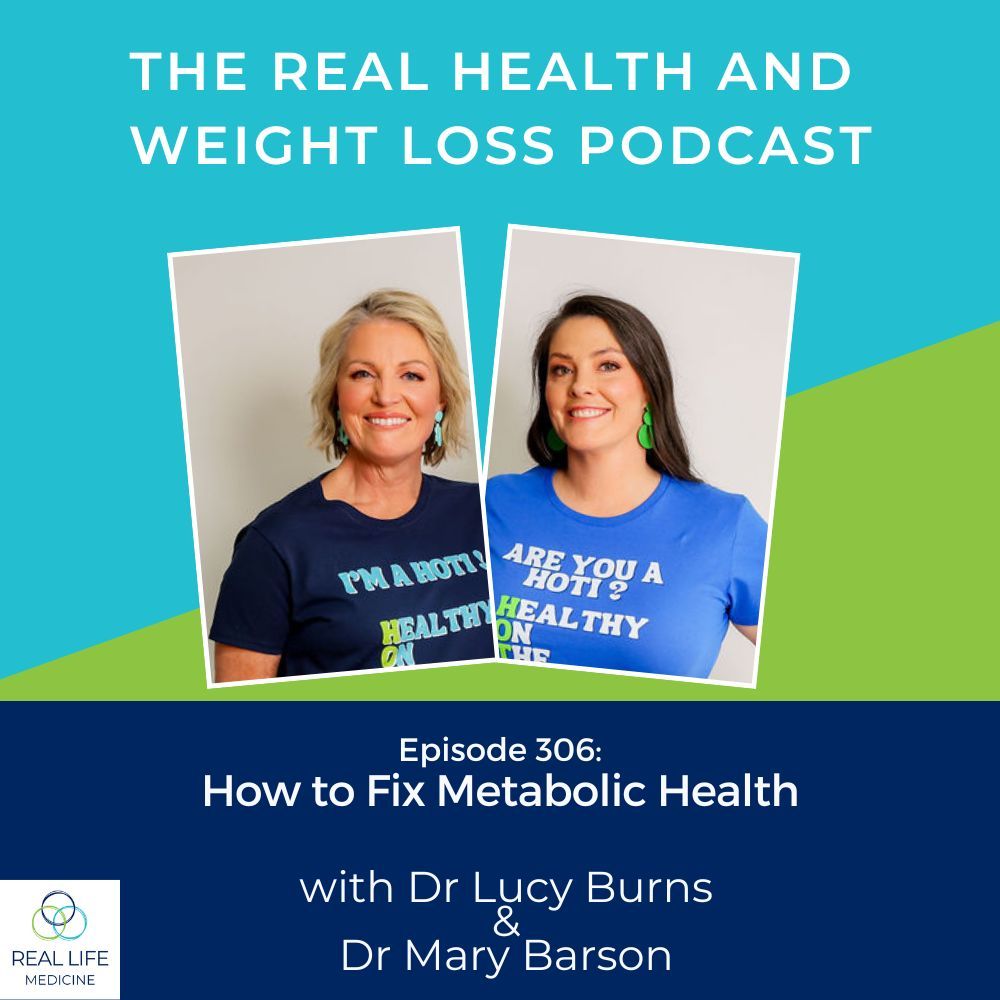
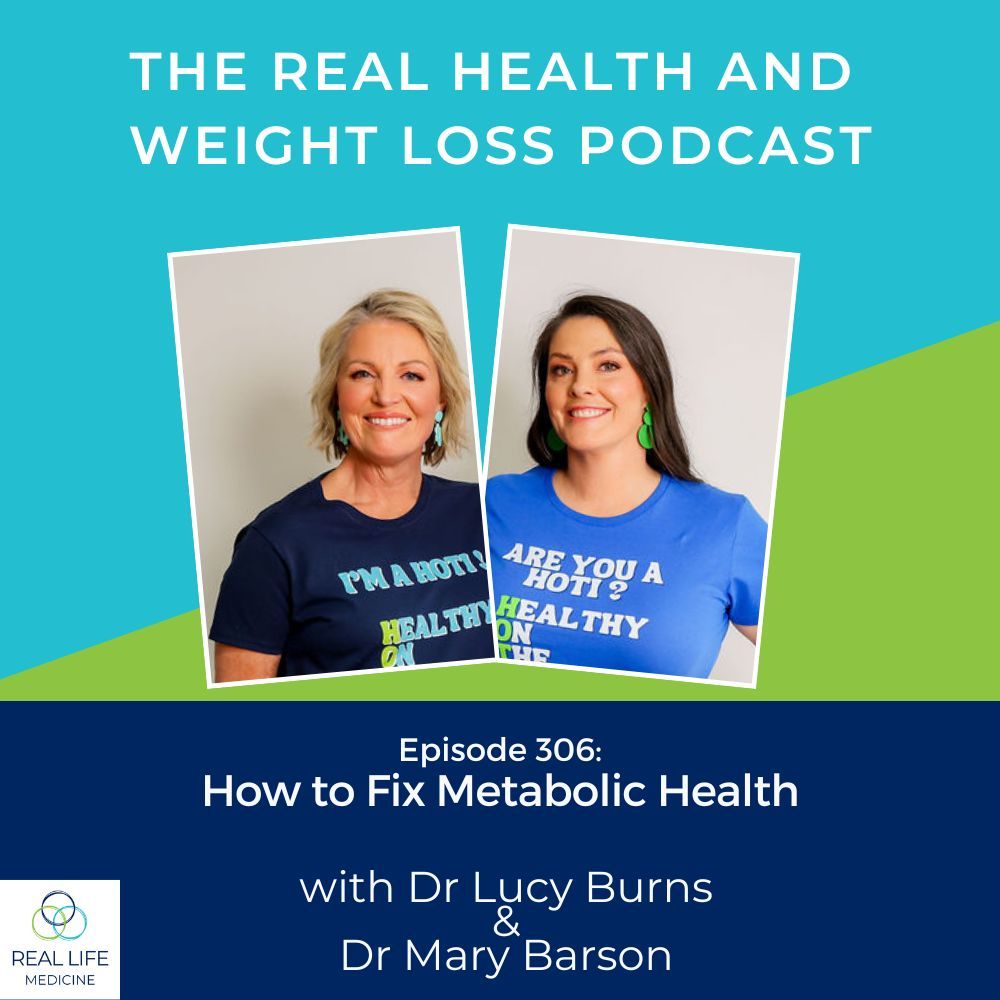
Episode 306:
Show Notes
In this episode, Dr. Lucy Burns and Dr. Mary Barson follow up their previous discussion on what metabolic health is by focusing on how to optimise it. They walk through the key lifestyle levers that anyone can action, regardless of genetics or environment, with an emphasis on making changes simple, sustainable, and evidence-based.
Key Points
Food as a Foundation
Food is a critical lever for metabolic health, but it doesn't have to be complicated. Their approach through My Metabolic Action Plan requires no tracking or calorie counting and can be done simply and deliciously.
Movement and Muscle
A 10-minute walk or some squats after meals can significantly lower blood glucose levels, as demonstrated using a continuous glucose monitor (CGM) during Dr. Mary's pregnancy.
Muscle acts as a "metabolic sponge," storing glucose and improving insulin sensitivity over the long term.
Even just 5 minutes of movement per day has been shown to improve sleep quality and multiple health markers.
The reframe here is powerful: exercise is not punishment or calorie-burning, it is about nourishing and balancing your body.
Sleep is Non-Negotiable
Inadequate sleep directly drives insulin resistance, increases cravings for processed foods, raises inflammation, and undermines healthy decision-making.
The simplest fix is going to bed at least 8 hours before you need to wake up. Many people are not in bed long enough, regardless of sleep hygiene practices.
Stress Management
Chronic stress elevates cortisol, raises blood sugar, and increases visceral fat. Managing stress is therefore a metabolic priority, not just a mental health one.
Practical strategies include auditing and removing unnecessary commitments, limiting news and social media exposure, and building small moments of calm and self-compassion throughout the day.
The key reframe: it is not about eliminating stress, it is about supporting your nervous system to regulate itself.
The Pleiotropic Effect of Lifestyle
Dr. Lucy introduces the concept of pleiotropy applied to lifestyle: one healthy action (like movement or sleep) positively affects multiple body systems simultaneously, largely by improving insulin sensitivity.
Knowledge is Not Enough
The doctors emphasise that knowing what to do is not the same as doing it. My Metabolic Action Plan (MyMAP) was specifically designed to bridge the gap between knowledge and implementation, combining education with practical, mindset-based tools.
Work With Real Life Medicine
For a step-by-step approach to improving metabolic health in perimenopause, menopause and beyond, check out My Metabolic Action Plan. This doctor-led comprehensive program gives you:
Strategies to improve metabolism
Skills to develop mindset
Tools so you will implement!
Episode 306:
Transcript
Dr Mary Barson (00:05) Hello lovely friend, I am Dr Mary Barson.
Dr Lucy Burns (00:09) And I'm Dr Lucy Burns.
Both (00:11) We are doctors, weight management and metabolic health experts. We are the creators of My Metabolic Action Plan, your two-step map to real health and weight loss, which is in fact the name of this podcast. Join MyMap now at rlmedicine.com.
Dr Lucy Burns (00:29) Hello friend, welcome back to another episode of the Real Health and Weight Loss Podcast, where I am of course joined by the beautiful Dr Mary. Last week, we spoke about what is metabolic health, which is interesting because we realised we've never done an episode actually discussing that topic and the definition. So if you haven't listened to last week's episode, then I recommend you return, go listen to that, put 20 minutes aside, because we go through exactly what metabolic health is. In this week's episode, we're talking to you about what you can do to optimise your metabolic health. So we can't always change our genes, we can't always change our environment, but we can quite often change our actions, and so we're diving into that today, and I look forward to sharing with you all of the things.
Dr Mary Barson (01:22) Food is one really important lever, and we talk about food a lot, so I think that it is a really important lever. It can be done simply and easily. We have simple frameworks that we use in our My Metabolic Action Plan, and it doesn't require lots of tracking, it doesn't require counting, it doesn't require a lot of mental effort. It can be done simply, easily, and deliciously, and it's important, but it's definitely not the only important lever.
Dr Lucy Burns (01:50) No, absolutely not. And strength and movement, stress and movement, there is a bit of a Freudian slip there, we are going on to stress. Strength and movement are really helpful as well, and it's tricky because I grew up in the 80s doing aerobics, and it was all about burning calories. That was the whole point of exercise, that I learned to exercise to burn calories so that I could stay thin. I never really understood how muscle is important, and up until recently, really only learned about the power of some movement after meals. So the idea being that you had to, my brain used to earn its food, so I would go and do some hard slog, high-intensity aerobics so that I could then have an ice cream or something. Whereas it is actually the other way around. You have the food, and then if you do some 10 minutes of movement after the food, that is much more effective and a really great way to then utilise that food and reduce the amount of storage that your body needs to do with it, because it has used it straight away.
Dr Mary Barson (03:07) Yes. Going back to my pregnancy with Max, I do not want to make this all about me, but I saw that happen in real life. I had a CGM going, a continuous glucose monitor, on that whole time to manage my blood sugars during that pregnancy, and they were good. But I would see them rise after eating, obviously. But if I went for a walk, or just did some squats or lunges, it did not have to be much. It could be something quite simple, just like a walk after dinner, and those blood sugars just came back down without me having to do anything other than that. And it was very comforting to see.
Dr Lucy Burns (03:39) Oh, absolutely. And there are multiple ways to do that. She said walking, just doing some squats at your desk if you're inside and you're stuck at work or whatever. So it's about finding a way that works for you. So that's like an immediate impact on your blood glucose and metabolic health. And then building the muscle is more of a longer term process because we know the bigger your muscles, the more glucose they store, the more insulin sensitive they become, the less insulin your pancreas has to make.
Dr Mary Barson (04:15) Yes. Your muscle is like your metabolic sponge. I love that. Just the reframe that you've described there, Lucy, is exercise was something that was all about punishment and calories and you had to earn your food by exercising your body. And it has all this sort of punitive transactional element. But now the reframe is that it's about nourishing your body, about balancing your metabolism and finding that movement that just fits into your real life.
Dr Lucy Burns (04:46) Oh, absolutely. And look, we've also mentioned in the past around how movement is helpful for mental health. And there's hugely documented evidence for that, that it really does help your mood and manage your stress. But again, I never had that as a focus. That was never mentioned. It was all just about burning the calories, burning it off, burning, burning, burning.
Dr Mary Barson (05:16) You'd be running on the treadmill and it would tell you, you've burnt 30 calories. Oh, I know. Keep going. 120 calories. I can't stop till I get to 300, you know.
Dr Lucy Burns (05:25) Yes. Yes. Now that I can then have a Mars bar. Absolutely. And so then, you know, again, we talk a bit about movement in My Metabolic Action Plan. The thing is that so many of us think you have to do tons of it. Even the Australian exercise guidelines talk about 30 minutes of moderate exercise five times a week. And that feels really hard for lots of people and undoable. So it's not about going, well, if you're not doing that, you might as well do nothing. It comes back to the all or something. You start small and over time, build it into your life. And eventually you may well get to that 150 minutes a week. But even if you don't, 100 minutes is better than no minutes. 20 minutes is better than no minutes.
Dr Mary Barson (06:19) Absolutely. There are beautiful studies demonstrating that even five minutes of movement can improve several markers of health. In particular, even just a small amount of movement during the day helps improve your sleep, your sleep architecture, to use a sort of technical term, like how the quality of your sleep would be a probably a better way to explain that. Five minutes of movement improves the quality of your sleep. Five minutes. I know.
So small amounts really do have a huge impact. And so if you just start with five minutes a day, you're already making very important improvements to your health.
Dr Lucy Burns (07:02) Absolutely. And you know that we've talked about this word before, but I'm going to bang on about it again, which is the pleiotropic effect. So for those of you who haven't heard it, pleiotropy technically refers to genes and genetics, and it will refer to how one gene can affect multiple systems. And a great example is the gene that codes for red hair. And the majority of people with red hair also have pale skin. So it's hair and skin, and many of them have blue eyes. So it's hair, skin, and blue eyes. And then the fourth little bit of it, which blows my mind, is that people with that particular gene also have a lower pain threshold, and so often need higher doses of anaesthetic if they're having any dental work. So the dentist, for example, again, I'm calling out all dentists out there, you probably know this, that your patients with red hair and blue eyes will often need more local anaesthetic if they're having any dental work. And I think, wow, how amazing is that? So that's pleiotropy in genetics, but we can apply it to lifestyle, where one lifestyle action affects multiple systems, because at the end of the day, it often all comes back to affecting your insulin. And if we can manage that, then everything else falls into place.
Dr Mary Barson (08:31) Yes. These are levers that move many, many parts of our health.
Dr Lucy Burns (08:37) And so again, sleep, you know, you mentioned sleep. If we move five minutes a day, we can improve our sleep. And we know that people who have reduced sleep have increased insulin resistance. There is a direct correlation between hours and quality of sleep and likelihood of insulin resistance. And so for us, again, we go, well, the problem in our modern world is that lots of people aren't even in bed long enough to get enough sleep. So it doesn't matter how great your sleep hygiene is, if you're not in bed for eight hours, give or take, then you cannot get that amount of sleep.
Dr Mary Barson (09:20) That's right. It just doesn't work that way. If you have to get up at 6.30 for work, if you're still up at 12am, you're just not going to get that eight hours. It's an impossibility. But I think it's a little lie that a lot of us tell ourselves that we don't need it. It's okay. I can keep doing this. I need to stay up and watch Netflix because I've been doing everything for everybody else all day. And this is finally my me time. But not getting enough sleep and not getting enough quality of sleep has the opposite of a pleiotropic effect. It adversely affects every aspect of our health. It increases that insulin resistance. It also increases inflammation. It also increases our cravings, particularly the cravings for high carbohydrate or highly processed foods. It makes us more impulsive, less able to follow through on healthful decisions. It can just sort of knock the wind out of everything. It can sabotage the entire thing. So sleep is a really important lever. And just going to bed on time, just going to bed at least eight hours before you have to get up, is one of the most powerful things you could do for your metabolic health.
Dr Lucy Burns (10:34) Absolutely. I remember people used to say, I wish I had more hours in the day. And I'd say, God, I wish I had more hours in the night, because I was constantly stealing from my night sleep to do more things during the day. And again, not realising the impact that had being in a chronic sleep debt, which I was for decades. Hopeless. You know, always the alarm would go off and I would be dragging myself out. Nowadays, I actually just wake up. It's amazing. So yeah, I think that it is really important. But the next lever can play into sleep, which is around stress management. And stress management, stress reduction, it can be tricky because you feel like it's impossible. But the way we talk about it is really not always the absence of stress. It's not the absence of stressors. It's how do you manage your mind around these? You know, I like to do an audit every now and then and go, right, what's pissing me off? What's causing me stress? What's in my life that I actually don't really need to do? What things can I let go of that are causing me angst that are actually in my control? Sometimes you forget there's stuff in your control that you can just get rid of. It's like, right, yeah, I don't want to be on that committee anymore. I'm out. See ya. And so suddenly, you know, you're not on that, I don't know, white West Highland Terrier club that is pissing you off or whatever.
Dr Mary Barson (12:10) For me, it is limiting my exposure to the news. So, you know, the sad and destructive events that are happening around the world have an impact on me and on my nervous system. And our nervous system is a key metabolic player. Chronic stress elevates cortisol, which elevates blood sugar, which increases visceral fat, all of these things. And so I don't want to be ignorant and uninformed, but I don't watch the news anymore. Instead, I will just read a few curated articles here and there. And I'm just not bombarding myself with stressful images. That was something that I could control because I can't control what's happening in the Middle East, but I can control how I expose myself to that information.
Dr Lucy Burns (12:55) Yes, absolutely. And I think that's a highly relevant point because it can be slightly addictive, even slightly addictive, entirely addictive. Social media, you know, news feeds, you kind of have this idea that you need to keep informed. And so that's why you're watching them. But of course, the algorithm doesn't actually keep you informed. It puts you into an echo chamber of the same old stuff, just revisited from different people. Whereas, you know, you can go to like maybe even a news app that isn't using dopamine to hook you in. It's just articles or a newspaper. You know, if you've subscribed, these days you have to subscribe to most newspapers. But again, it's not all of this clickbaity, hooky hoo-ha to draw you in and create outrage, because that's the whole point of them. And so I would say that social media, and it's hard, we're obviously on social media, but it is designed to create outrage. And society seems to love it. It's part of why people are kind of addicted to watching Married at First Sight and My Kitchen Rules and all of those shows that are divisive and just create outrage.
Dr Mary Barson (14:13) Yeah, that's right. We're social animals, so it creates this kind of quasi-society for us. We do, we love gossip, we love these things. This is just perfectly human and perfectly natural. But yet these companies that wish us to consume their products will hijack this. So there's reducing the stress that you can, letting go of the things that you can, but then there's also increasing your resilience to the things that you can't let go of. You can't let go of the fact that you need to put petrol in your car to drive to work and that your child has to deal with their peers at school or whatever it is that is causing you stress. Some of it we just have to deal with. It's just life, and you can improve how well your nervous system manages that and how regulated your nervous system is with really, really simple, small interventions, little moments of calm, of active relaxation, being able to set those boundaries. Moments of self-compassion can actually have a big impact throughout your whole day.
Dr Lucy Burns (15:22) Yes, absolutely. And I loved what you just said there, that it's around helping your nervous system. Because I think for a lot of people, they internalise stress, again, their reaction to stress as being weak, or even resilience has been weaponised in many workplaces. It's like, oh no, they're just not resilient enough. Sometimes, no, your work environment is just absolutely toxic, and the tropical plant doesn't thrive in the desert. But it is around, rather than thinking of it as part of you and your mind and who you are, if we just think about it, how can I support my nervous system to regulate itself and kind of, again, calm down. Never are two more words triggering. Just relax. Yeah. How can we help support it? So that's, I think, I love what you're describing there. So yeah, supporting your nervous system to survive or thrive within stressful environments is really important and a skill, and an absolute skill.
Dr Mary Barson (16:34) And one that you can cultivate with relative ease.
Dr Lucy Burns (16:37) Totally. And I guess this is everything that we talk about all day in, week in, week out on the podcast, but also the My Metabolic Action Plan, which is our newest program. They're the pillars, aren't they, that help people?
Dr Mary Barson (16:53) Yes. Yes. Why we created My Metabolic Action Plan is because lots of people have got knowledge, people can understand the importance of these pillars of real food, of movement, of sleep, of stress management, but actually implementing it in your super busy life is the struggle. So that's why we shook things up and created this new program. That's really all about implementation, is people knowing isn't enough. You need to be able to bridge that gap between knowing and doing.
Dr Lucy Burns (17:32) Absolutely. And I mean, we've even jiggled it up a bit more. We've now got Phase 1, which is the knowledge, because again, it's interesting how knowledge evolves with evidence. And I think that's important to keep on top of that. And so without the knowledge, then you're going in the right direction or the wrong direction.
Dr Mary Barson (17:55) Yeah. Yeah. Implementing the wrong things, which would not be helpful.
Dr Lucy Burns (17:58) No, no. So yeah, you've got the wrong knowledge, you go in the wrong direction. So if you think about it like a car, you need the right map, and then you need to turn the car on. There's no point just sitting in the seat with your map going, yeah, I know where to go, and not going. So the action part of MyMAP is turning the key, the ignition, getting started, because you cannot get momentum if you haven't started.
Dr Mary Barson (18:28) Yep. It gives you the map, where to go, and gives you the tools to be able to get there.
Dr Lucy Burns (18:33) Absolutely. So lovely friends, MyMAP, you can join whenever you like. You can join today and get started. I mean, one of my other favourite sayings, I've got lots of them, but is the best time to plant a tree is 10 years ago. The second best time is today. So I think so many people we work with often say, I don't know why I didn't start sooner. And that becomes a regret, to which we say, just let it go. But it is something that is just get cracking.
Dr Mary Barson (19:07) Yep. To start, even if you just do one small step today, just do something. Have a high protein brekkie, go for a 10-minute walk after your lunch, go to bed. That's a good one. Say something kind about yourself.
Dr Lucy Burns (19:25) Yeah, absolutely. And remembering that sometimes the blocks for action, again, there are science-based, evidence-based tools that we use to help people implement. Because sometimes the thing of telling yourself to just do it doesn't always work. And we know that because if you all did what you knew, then things would be pretty easy. We probably wouldn't have a job. So there we go. All right, lovely friends. We are coming back next week with more on metabolic health, and we're having a little focus on brain health. So look out for our upcoming episodes on metabolic and brain health so that we can look after our very, very important organ, the brain.
Dr Mary Barson (20:17) So important. See you then, beautiful people.
Dr Lucy Burns (20:19) Bye now.
Dr Lucy Burns (20:22) The information shared on the Real Health and Weight Loss Podcast, including show notes and links, provides general information only. It is not a substitute, nor is it intended to provide individualised medical advice, diagnosis or treatment, nor can it be construed as such. Please consult your doctor for any medical concerns.