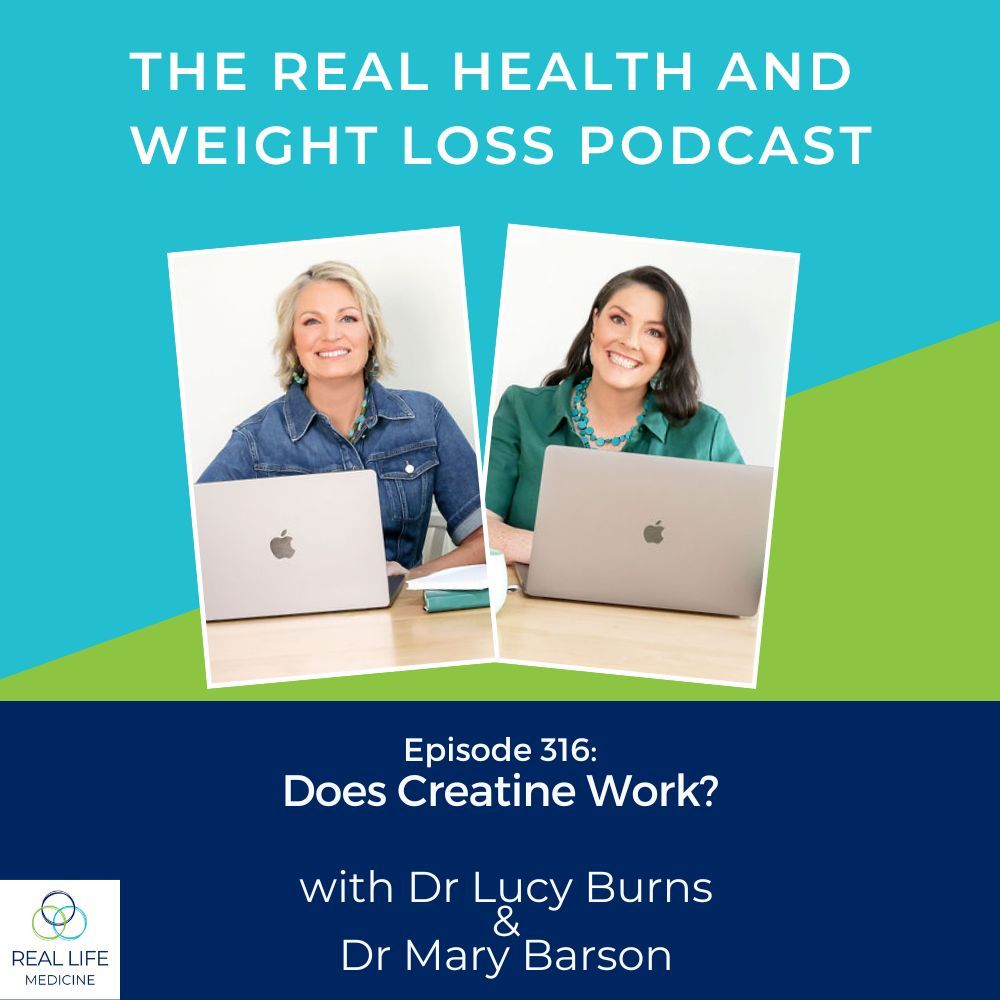

DOES CREATINE WORK?
One of Australia's Most Popular Podcasts with Hundreds of 5 Star Reviews

Grab your FREE Ebook copy now!
Have you struggled to lose weight and keep it off?
Start your journey to boost metabolism and transform your body into a fat-burning powerhouse.
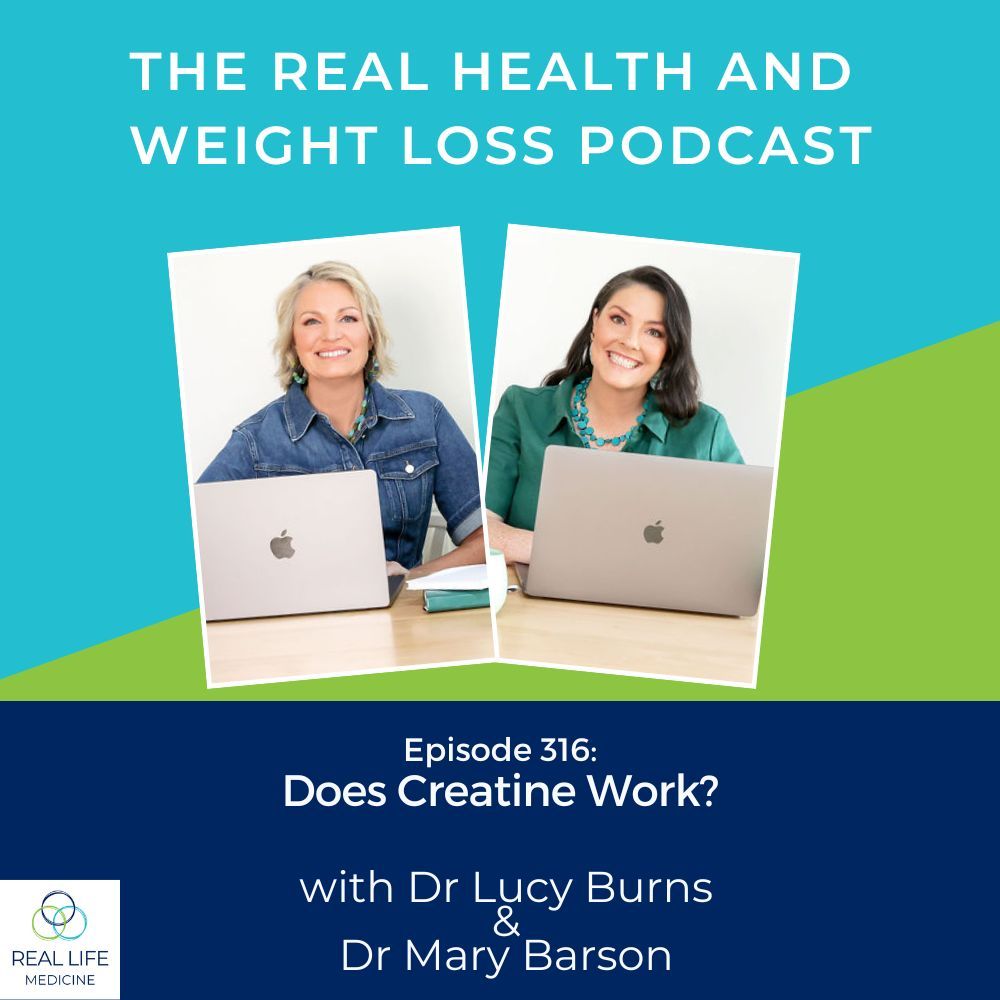
Episode 316:
Show Notes
Episode Overview
Dr Mary Barson and Dr Lucy Burns take a deep dive into creatine supplementation, revisiting the topic given the explosion of creatine content across social media. Their goal is to translate the science so listeners can make truly informed decisions, free from hype or scare tactics.
What Is Creatine?
Creatine is a small molecule made from three amino acids (glycine, arginine, and methionine) that is essential for life. The body produces it naturally in the liver and muscles, and it is also found in dietary sources, particularly red meat and fish. Its core function is to rapidly recycle ADP back into ATP, essentially acting as the body's energy recharge system.
Evidence-Based Benefits
- Muscle building: Solid evidence supports creatine supplementation helping to increase muscle mass when combined with strength training, though benefits are modest and it is not essential for muscle growth
- Post-menopausal women and older adults: Particularly beneficial for those at risk of sarcopenia (muscle loss) due to declining oestrogen, in addition to strength training
- Brain and cognition: May help buffer brain energy demands under stress, sleep deprivation, or heavy cognitive load; also relevant to perimenopausal brain fog
- Vegetarians and plant-based eaters: Show amplified benefits as they consume less dietary creatine from food sources
Myths Debunked
|
Claim |
Verdict |
|
Creatine causes cancer |
No human evidence of carcinogenicity; one of the most studied supplements globally |
|
Creatine damages kidneys |
No meaningful kidney harm shown; raised serum creatinine is a marker nuance, not kidney damage |
|
Creatine causes baldness |
Theoretical only; a small DHT rise was noted in one study but not linked to actual hair loss |
|
Creatine causes massive bloating |
High doses (20g) can cause issues; 3--5g daily is well tolerated by most people |
|
Everyone must take creatine |
Not true; it is a useful tool in specific situations, not a universal requirement |
Practical Recommendations
- Dose: 3-5 grams of creatine monohydrate per day
- Form: Plain powder is best - avoid gummies (under-dosed and full of additives), fancy proprietary blends, and products with added high-dose vitamin B6, which carries a toxicity risk
- Cost: No need for expensive brands; a standard, plain creatine monohydrate from a supermarket, chemist, or online retailer is perfectly adequate
- Hydration: Keep fluid intake up to avoid cramping
- Scales: A temporary 1-2 kg weight increase may occur due to water retention, not fat gain
Work With Real Life Medicine
For a step-by-step approach to improving metabolic health in perimenopause, menopause and beyond, check out My Metabolic Action Plan. This doctor-led comprehensive program gives you:
- Strategies to improve metabolism
- Skills to develop mindset
- Tools so you will implement!
Episode 316:
Transcript
Dr Mary Barson (00:05) Hello lovely friend, I am Dr Mary Barson.
Dr Lucy Burns (00:09) And I'm Dr Lucy Burns.
Both (00:11) We are doctors, weight management and metabolic health experts. We are the creators of My Metabolic Action Plan, your two-step map to real health and weight loss, which is in fact the name of this podcast. Join MyMap now at rlmedicine.com.
Dr Mary Barson (00:29) Hello lovely friend, welcome to this episode of the Real Health and Weight Loss Podcast. I am Dr Mary Barton joined by the beautiful Dr Lucy Burns looking lovely in red today. How are you my dear friend?
Dr Lucy Burns (00:41) I am fab, totally fab, happy to be excited and happy to be talking about this topic. So today we're talking about creatine. We actually did a podcast on this over 12 months ago now, but the internet, social media, and the world seem to be pumped full of creatine recommendations, claims, and advice. So we thought we'd go back because we know that, more than a year on, maybe people haven't found the episode. So it's good to be contemporaneous and produce one at the moment. We're basically going to go through what creatine is, the myths, the non-myths, who should take it, who shouldn't, who might benefit, who's going to benefit the most, and give you a wrap-up on what we reckon.
Dr Mary Barson (01:36) Totally. We are definitely not here to sell you supplements, but we're here to help translate the science so you can make informed decisions, because there's been a lot of controversy too. Lots of people are saying creatine is amazing and we should all take it. And other people are saying creatine is terrible and we should never take it. Usually, the truth, kind of boringly but importantly, sits somewhere in the middle. So our hope is to help you make an informed choice.
Dr Lucy Burns (02:04) Absolutely. And I love what you talked about then with, "We're not here to sell you supplements," because I can tell you now, not only is the supplement industry booming, but this ridiculous gummies industry. Everything now is packed into a gummy. And it's like, honestly, the gummies are not only full of garbage, but they're usually under the recommended dosing anyway. You have to eat like 25 gummies to get the proper amount. You might as well just go and have a bag of lollies. It's just bullshit. So I just wanted to get on my gummy...
Dr Mary Barson (28:38) Yeah, yeah. No, I can tell you've got strong feelings about the gummies out there.
Dr Lucy Burns (02:41) No, I would like to have a campaign: Gummies for Dummies.
Dr Mary Barson (28:48) Gummies for Dummies. I love it. Yeah, which just highlights the fact that this industry is not well regulated. So it is the Wild West out there. Making as informed choices as possible, I think, is going to be helpful because we are literally talking about your health here, and there are few things more precious than that. So, good old creatine. What actually is it? Creatine is something that is essential for life. It's just a small little molecule made up of three amino acids: glycine, arginine, and methionine. Amino acids are the building blocks of our proteins - the tiny little Lego bricks that all of our proteins are made out of. It's so essential for life that we make our own. We make it in our liver and in our muscles, with small amounts in the brain and other tissues. But we also get it from food, and particularly rich sources of creatine are animal foods - red meat and fish. It's muscle. We need it. Muscle. Exactly. Yeah. Yes. It's in high quantities in muscle, and it has multiple functions in our body. But its core function inside our cells is that it helps us recycle our energy production machinery. Our cells - the reason that we are alive, biochemically speaking - is that our bodies can take the energy from our food and, in the presence of oxygen, burn it. In that burning process, they make ATP (adenosine triphosphate), these tiny little batteries. These batteries are then used, and ATP goes from adenosine triphosphate to adenosine diphosphate in these phosphorylation cascades. Then we can recycle ADP back into ATP again. Creatine is really helpful because it helps us rapidly convert that ADP back into ATP. So we need it. It's our energy recharge system. Absolutely. And like I said, we make it because it's so essential for life that we've got systems in place to make sure we've got it. It's really important not only for staying alive, as we've talked about, but it's also really important for metabolic health, for supporting muscles, and for our brain health too. It helps buffer the energy demands of our brain, particularly when we're stressed and particularly when we're sleep deprived. Having enough creatine is really helpful to make sure that we can grow more muscle, especially when we're strength training, and to make sure that our brain can work properly and that all of our cells function clearly. So that's kind of my Cook's Tour of what creatine is.
Dr Lucy Burns (05:42) Very similar to the Cook's Tour of what magnesium did, just saying.
Dr Mary Barson (05:46) Yes, right. Similar but different. Yeah, it is. It comes down to energy production, which is pretty much what all life comes down to at that biochemical level.
Dr Lucy Burns (05:55)Yeah, absolutely. Which all comes back to - and we've done many episodes on - the magnificent mitochondria, or the mighty mitochondria, which are the little factories in our cells that make all of our energy and keep us functioning. So, yay. Okay, Miss, we mentioned muscle and brain, and I guess they're the two big things that are out on the internet at the moment: that creatine will help muscles and creatine will help the brain. The brain claim is that it'll help your current cognition and stop dementia. So let's just talk a little bit about some of this. So, what are your thoughts here?
Dr Mary Barson (06:36) So my thoughts are where it is helpful. There is solid evidence that creatine supplementation does help improve muscle deposition and improve muscle mass when done with strength training. So it can help support strength training - be like a backstage roadie to your strength training efforts - to help you build that muscle mass. If you take a creatine supplement and, you know, lie down on the couch all day, nothing will happen. But creatine supplementation with strength training can be helpful. The benefits are modest. It's not going to absolutely change your life, but they're there. And we see that really clearly in the scientific literature. So I think that that is a very solid, evidence-based claim that we can make about it.
Dr Lucy Burns (07:31) Yeah. If you don't take creatine, you can still build muscle, though. It's not absolutely essential. So if, for whatever reason, you can't or don't take creatine, you can still build muscle if you do strength training or other muscle-building training.
Dr Mary Barson (07:49) Yeah, absolutely. So it has a minimal, supporting, backstage role to your strength training regime. It could be a bit helpful. Yeah. And that's good. But, yeah, by no means is it essential. We also know that there's good evidence for older people who are at risk of muscle loss - that's sarcopenia - and in post-menopausal women, who are also at risk of muscle loss as estrogen levels decline. Creatine is helpful here too, in addition to strength training. So it doesn't turn you into a superhero. It just nudges the gains up a notch if you're already doing the strength training.
Dr Lucy Burns (08:31) Absolutely. So, brain and cognition - the next little thing. Look, it kind of irritates me. There are people out there making claims that creatine will prevent dementia. That's actually rubbish. It is actually rubbish. Again, when we think about the mechanism of action, we've already elucidated that this helps energy production. Our brain, when it's trying to think, sometimes can't think properly because it doesn't have access to its fuel. We see this in insulin resistance, which also happens at a brain level. We see it with menopausal and perimenopausal brain fog, when estrogen is up and down. And all of that is to do with the brain's ability to access its energy source. So we think that creatine can be helpful in this aspect, particularly for people who have a brain that's a little bit under stress. So if they're not sleeping properly, if they've got a big cognitive load, or if they're literally under threat, then our brain is prioritising surviving, not necessarily solving complex maths problems. So creatine can be helpful in these situations.
Dr Mary Barson (09:46) Yes. And the science shows that the benefits are, again, modest, and they're not universal, but they could well be helpful. I also think that it's worth talking about the fact that it's also pretty safe. I think it's important to understand the safety and side effects of what we see, especially since there are claims out there saying, you know, "Creatine causes cancer. Don't take it." I think it's important to understand the context there.
Dr Lucy Burns (10:21) Yeah, absolutely. In fact, this is part of the reason we're doing today's podcast. A friend of mine had sent me another podcast, asking, "What do you think of this?" She has a history of breast cancer. She's now a post-menopausal woman. She's taking creatine to help her build and maintain her muscle, and now she was all worried because this other person had made a claim that it can cause cancer. So let's unpack that mess.
Dr Mary Barson (10:46) Yeah, absolutely. Let's do that. So, first of all, I can say that it's well studied. We've got lots and lots of good-quality randomised controlled trials looking at creatine supplementation with doses of around three to five grams a day. It has a good safety record in healthy adults - the adults that have been studied. There are some common minor issues that do pop up in the literature and for some people. It can cause a bit of extra fluid retention. Some people can get gastrointestinal side effects, like an upset tummy, especially if they go a bit too hard and start with doses that are too high. Occasionally, it can cause cramps, particularly if you're not drinking enough fluid. You do need to make sure that you maintain sensible hydration if you're taking creatine supplements. So that's sort of where we're at. Then there are some potential fears out there about creatine wrecking your kidneys or creatine making you bald. Yeah, that's right. I only learned about that today, actually, when I was researching this - some of the social media claims. I went onto social media and had a look. What are the social media claims? So I think let's talk about the cancer one first, because I think that obviously would have definitely piqued people's attention. So, creatine metabolism really matters in cancer biology. Cancer cells have abnormal metabolism. They grow too fast, and because they grow too fast and too much, their ability to turn off their growth has been inhibited. Multiple steps have to go wrong for a cell to become cancerous. There is this theoretical risk, this theoretical concern, that because creatine helps improve cellular energy and cellular machinery, you could also be helping improve the cellular machinery of a cancer cell and improving the cancer cell's ability to survive, keep growing, and keep causing all of its problems. I would say that we don't really have good data on that yet. It is not well understood. It's still very much a theoretical risk.
Dr Lucy Burns (13:10) I would actually go further and say we have no data on that. We've got a couple of animal models, but there is no human data on it. There's potentially a rat study that was suggestive of it. Equally, we also have studies showing that creatine can slow tumour growth. So, again, the science is clearly not well conceptualised and certainly not proven.
Dr Mary Barson (13:39) Yeah. And I think, just to put it into context, creatine is one of the most studied supplements globally. It is one of the supplements that we have the most information about. Lots of people take it, and we've got lots of studies on it. There has been no associated increased risk of cancer in humans that has been found. So the consensus opinion, based on all the evidence we currently have, is that there is no evidence of carcinogenicity. It's not likely to increase the risk of cancer. I would always be open-minded and humble, knowing that there's always more we can learn and things can change. But definitely, where we are now, we're in a position where there is really no evidence of carcinogenicity and no evidence of organ toxicity for the populations that we're talking about.
Dr Lucy Burns (14:30) Yes. And this is in relation to creatine monohydrate. Again, there are a few different variations of creatine, but creatine monohydrate is the one that's been studied. It's the one manufactured in factories by combining these three amino acids together. It's not taken from skeletal muscle or animal cells or anything like that. As a little side note, you can buy this anywhere. One isn't more fancy than another. They're all the same, as long as you're looking at a supplement that is creatine monohydrate. Yes.
Dr Mary Barson (15:04) Yeah, absolutely. And I'd say the kidney function thing is also worth talking about. We could talk about the baldness thing as well, although that was new to me today. Yeah. So again, multiple systematic reviews and randomised controlled trials consistently show that there is no meaningful harm to the kidneys when people take creatine monohydrate.
What we do sometimes see is an increase in serum creatinine, which is not creatine. It sounds like creatine, but it's not - it's creatinine. Creatinine is a breakdown product of creatine, and we see more of it in the blood. This is an important nuance because increased levels of creatinine in the blood can be an indicator of kidney damage, or it can be an indicator of increased creatine breakdown. So just because you've got extra creatinine in the blood doesn't mean that the kidneys are damaged, but it is one of the markers we look for when we're wondering, "Hey, how healthy are these kidneys?" So it doesn't cause kidney damage, but it can create this slightly confusing picture. That's an important thing to understand.
Dr Lucy Burns (16:18) Yeah, absolutely. And it can be a bit tricky because sometimes, if a doctor were to do blood tests and see that there's raised creatinine, you'd be obligated to investigate whether somebody has kidney damage, because you'd be a total twat to miss that. Interestingly, the times I've investigated have also been in people with a lot of muscle bulk. So young blokes, or anybody who's gone to the gym and has more muscle mass than perhaps the average person, will often have raised creatinine as well. They don't have kidney damage.
Dr Mary Barson (16:51) Yes. And you can also see it in people who eat very high-protein diets. They're not necessarily damaging their bodies, but they've also got increased protein breakdown. There's creatine in most of the animal protein sources that we eat, so we see it there as well. So, yeah, you would still investigate, but that's just an important nuance to understand. And the going bald one, which I just saw on social media, is again a theoretical risk because there's been a small rise in DHT, which is a hormone that can be associated with male pattern baldness. A small study has seen this, but it wasn't linked to any measurable hair loss. So I'd say, at this stage, we don't have convincing evidence that creatine supplementation causes clinically meaningful hair loss. Okay, look, be humble, watch this space, but that's definitely where we're at right now.
Dr Lucy Burns (17:47) Yeah, absolutely. Myth four: creatine causes massive bloating. Look, to be honest, creatine can cause bloating. Partly what happens is that people - again, the internet is... I think the myth should be "more is better," because that's not true. There are people out there recommending big doses, like 20 grams of creatine. And, you know, the studies are really on three to five grams. There are studies looking at higher doses, but they've not been published yet. And this is the danger at the moment. We're all jumping the gun and quoting research papers as being conclusive when they're not even published. Certainly, big doses will definitely cause bloating and gut upset. Smaller doses, for most people, may cause some temporary bloating, but most people can tolerate it, and it usually settles. I think sometimes people get worried, especially if you're someone who watches the scales and you're trying to lose weight. People start taking creatine and their weight might go up one or two kilos. Again, anyone who's been following us for a while knows that we think most people should throw their scales away. It is not a fat mass. You are not gaining fat by taking creatine. You may be gaining some water, and that may not cause you any problems at all. Some people might feel a bit puffier initially, but it usually settles down. At the low doses, it's not a problem for most people.
Dr Mary Barson (19:15) Yeah, that's fair. I reckon the final myth that we might be seeing out there on social media is that everybody needs to be on creatine, and if your GP is not recommending creatine, they're doing you a disservice. I think social media has leapt from "the evidence suggests it's helpful for some" to "it's essential for all," which is a really nice story. It's really good for clickbait. It's something that our human brains want to do. We love a rule that just makes us feel comforted. It makes the world feel nice and straightforward. But it is not the rule that everybody must be on creatine supplementation. I think it is a tool that is helpful in specific situations. We did talk about the fact that the benefits of creatine seem to be amplified in vegetarians and people who eat plant-based diets. That's probably just because they're not getting as much creatine from their food. So people who are vegetarians who take creatine tend to have more benefits than people who are not vegetarians taking creatine. But it's probably just because there's lots of creatine in meat and fish. Yeah, absolutely. In certain situations, if done thoughtfully and cautiously, it can be helpful, but it's not a miracle cure-all for everything.
Dr Lucy Burns (20:32) No. And I think, look, you don't have to take it regularly if you don't want to. You could take it intermittently. I'm hopeless at remembering to take things regularly, but, back to my magnesium story, if my sleep has been a bit rubbish for whatever reason and I've got a big cognitive load, you know, a big workday or something I need to concentrate heavily on, then I do find that sometimes creatine can be helpful. I'll have it before my afternoon and go, "Right, okay, good. We're good to go." There might be some placebo in that. Again, we've got to count the placebo effect. It's 30%. Thirty percent of people benefit from the placebo effect of something. That's okay. It doesn't matter. But, yeah, I reckon you're right, Miss. You don't have to take it. Don't feel like you're missing out if you're not taking creatine. You don't have to take an expensive version. And for God's sake, don't take gummies unless you feel like throwing your money down the drain. If you want to throw your money down the drain, by all means, get gummies. Otherwise, you can just buy creatine monohydrate. There's a zillion companies out there that sell it. You can buy it from the supermarket, the chemist, or online. If you want to do three to five grams a day, that's it. Keep it simple.
Dr Mary Barson (21:52) I would also be cautious of super-fancy blends that are expensive, and anything that says proprietary on it. Proprietary means, "We've got stuff in this, and we're not going to tell you what it is." So you don't know what you're taking. Just be cautious. Also, a word about vitamin B6. There will be companies that like to throw lots of vitamin B6 into their creatine because it can make people feel a little buzz of energy after taking it. If they put that in their blend and you take it, you might think, "Oh, geez, it's really working. I feel really good. I feel like my brain is working." But you can run the risk of getting B6 toxicity, so just be very careful of that. If you're going to do it, just pick a bog-standard, cheap version that only contains creatine monohydrate.
Dr Lucy Burns (22:42) Yeah, absolutely. You just get a little scoop of the powder. You can pop it into, you know, yogurt, sprinkle it on your hemp seed porridge, or whatever breakfast you're having. It's easy. It doesn't have to be fancy. Good. All right, friends, that's it. That's creatine in a nutshell. Absolutely. As you know, we're pretty skeptical of most supplements. This is probably one we would recommend if it suits you. But if it doesn't suit you, you can absolutely live your life without it. We have done so for many, many thousands of years beforehand.
Dr Mary Barson (23:18) Correct.
Dr Lucy Burns (23:19) Yes. No cavemen were sprinkling creatine on their steak. No. All right. Bye for now, lovelies. See ya.
Dr Mary Barson (23:29) See ya.
Dr Lucy Burns (23:32) The information shared on the Real Health and Weight Loss Podcast, including show notes and links, provides general information only. It is not a substitute, nor is it intended to provide individualised medical advice, diagnosis or treatment, nor can it be construed as such. Please consult your doctor for any medical concerns.