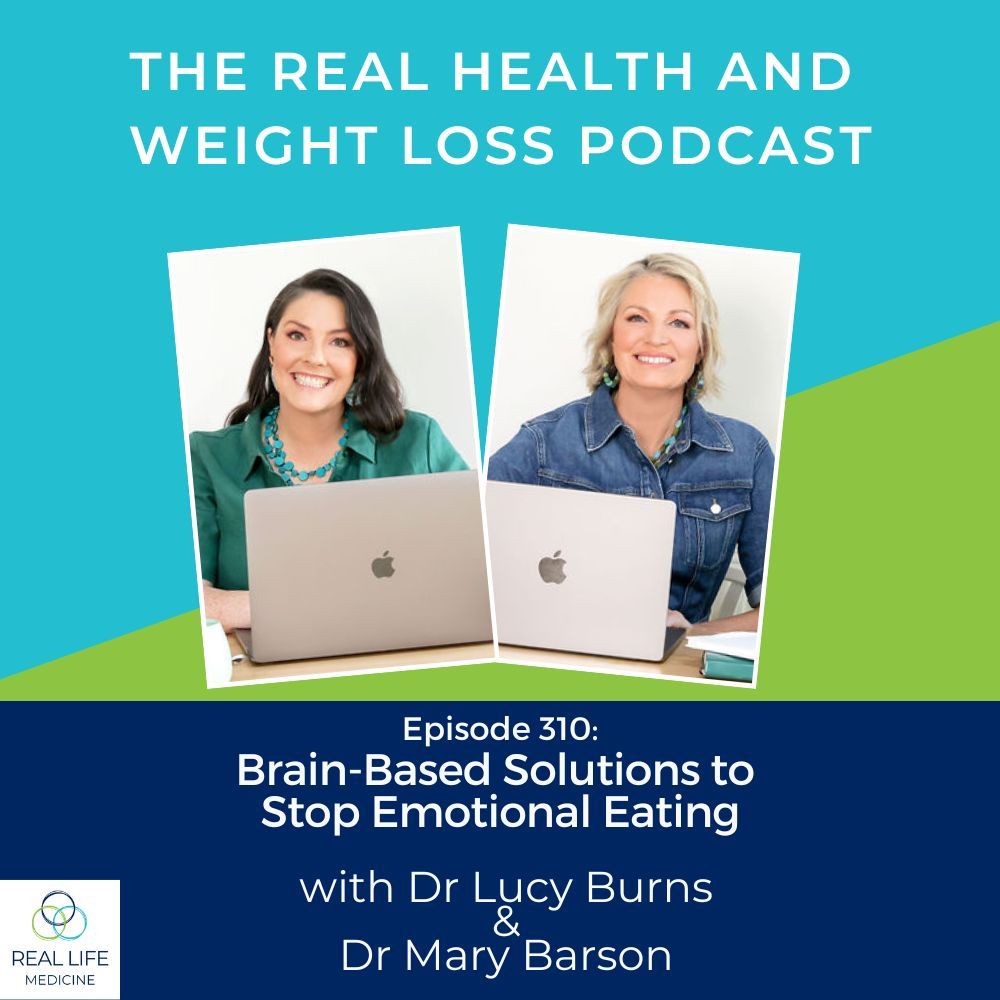

BRAIN-BASED SOLUTIONS TO STOP
EMOTIONAL EATING
One of Australia's Most Popular Podcasts with Hundreds of 5 Star Reviews

Grab your FREE Ebook copy now!
Have you struggled to lose weight and keep it off?
Start your journey to boost metabolism and transform your body into a fat-burning powerhouse.
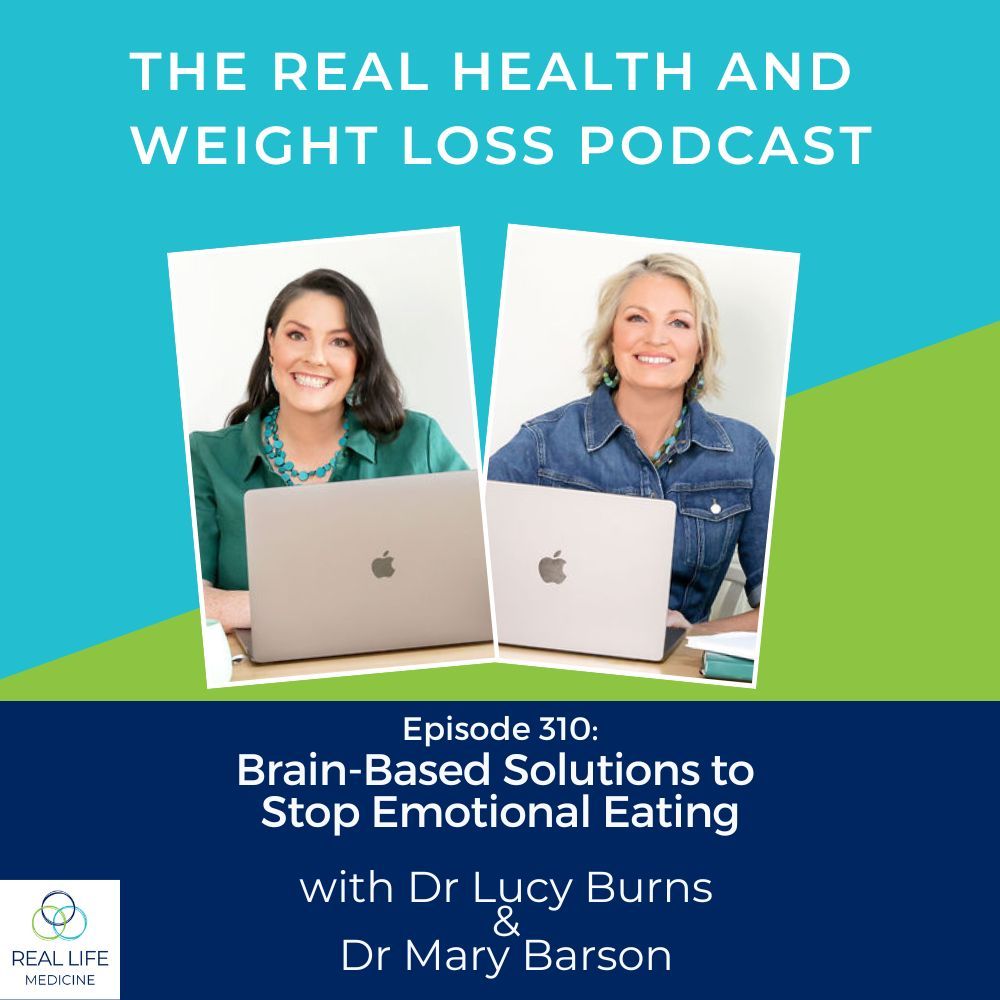
Episode 310:
Show Notes
This episode reframes emotional eating as an understandable brain-based coping strategy, then offers compassionate frameworks and practical tools to move from automatic eating to genuine emotional regulation and choice.
What emotional eating really is
- Emotional eating is described as eating in response to stress, discomfort or “big yucky emotions”, but also to many small daily stressors that build up over time.
- It is not labelled as “bad”; instead it is seen as a tool that once helped you cope, but now often has unwanted consequences for metabolic health.
PHALTS: common triggers
- The PHALTS acronym captures frequent triggers for non‑hungry eating: Pain, Hunger, Anger, Lonely, Tired, and Stress or “Stuff it”.
- Listeners are encouraged to personalise this, for example using STAB (Stressed, Tired, Angry, Bored) to capture their own most common emotional triggers.
Brain, stress and safety
- At a brain and biochemistry level, emotional eating happens when the subconscious brain interprets a situation as danger, creating intense discomfort it urgently wants to relieve.
- Food becomes a “safe regulator” because it is accessible, legal and cheap, so the brain learns that eating reliably dampens emotional “fires”.
- People with high allostatic load from chronic stress or adverse experiences may be more reliant on emotional eating because their nervous systems are more easily dysregulated.
Parts work: managers and firefighters
- The episode draws on Internal Family Systems / parts therapy, explaining that different “parts” of the mind have different roles.
- “Manager” parts use rules, criticism and “shoulds” to control behaviour, while “firefighter” parts rush to put out emotional fires, often with food.
- Emotional eating is likened to a firefighter flooding one burning apartment, not worrying if the rest of the building (your health) gets damaged in the process.
Compassion instead of shame
- Internal parts work is valued because it removes shame and blame, instead inviting a compassionate dialogue with managers, firefighters and inner critics.
- Emotional eating is framed as an old tool that no longer fits, like a once‑favourite pair of shoes; you can honour how it kept you safe without hating yourself for using it.
- They note that the brain gets the immediate relief, but the body pays the cost, which is why changing brain patterns is central for long‑term metabolic health.
Curiosity and the power of the “gap”
- A key shift is moving from “I must obey this urge” or “I must resist this urge” to asking “What do I need right now?”.
- That question invites curiosity and self‑compassion, creating a gap between trigger and response where different choices become possible.
- Repeatedly choosing new responses in that gap gradually rewires patterns, changing your brain, health and life, but this is emphasised as a skill that develops over time, not an overnight fix.
The SLC reflection tool
- The SLC (Self reflection) framework replaces “I’ll just start again tomorrow” after emotional eating.
- It guides you to reflect on what happened, identify antecedent causes, and consider what you could do differently next time.
- This reflection is explicitly “wrapped in a giant bowl of compassion”, breaking the old pattern of shame and all‑or‑nothing thinking.
Hot tools vs cold tools
- “Hot tools” are in‑the‑moment strategies when urges or compulsions feel intense, aiming to activate the parasympathetic (calming) nervous system and lower emotional arousal.
- “Cold tools” are longer‑term practices that build emotional regulation and nervous system capacity, making it easier to “make the right thing easy and the wrong thing hard”.
- Both are needed: cold tools reduce how often you reach crisis, but hot tools help you cope safely when dysregulation inevitably happens.
Practical take‑aways for listeners
- Notice your personal PHALTS triggers (or your own acronym) and see them as information, not as moral failures.
- After slips, use SLC: gently review what led up to it, learn one small lesson, and plan a tiny next‑time tweak instead of “stuff it” spirals.
- In urges, treat cravings as signals pointing to unmet needs and ask “What do I actually need right now?” rather than simply fighting or obeying them.
- View emotional regulation as a trainable skill set; with practice, your brain can choose new ways to soothe itself without falling into the metaphorical “bucket of ice cream”.
Work With Real Life Medicine
For a step-by-step approach to improving metabolic health in perimenopause, menopause and beyond, check out My Metabolic Action Plan. This doctor-led comprehensive program gives you
Strategies to improve metabolism
Skills to develop mindset
Tools so you will implement!
Episode 310:
Transcript
Dr Mary Barson (00:05) Hello lovely friend, I am Dr Mary Barson.
Dr Lucy Burns (00:09) And I'm Dr Lucy Burns.
Both (00:11) We are doctors, weight management and metabolic health experts. We are the creators of My Metabolic Action Plan, your two-step map to real health and weight loss, which is in fact the name of this podcast. Join MyMap now at rlmedicine.com.
Dr Lucy Burns (00:30) Well good morning gorgeous friend, Dr Lucy here with the effervescent Dr Mary. How are you, my lovely friend?
Dr Mary Barson (00:35) I am well. I have a little bit of toddler-induced tiredness, but I like that you still think I'm effervescent and bubbly, even if perhaps I'm feeling a little bit flat.
Dr Lucy Burns (00:46) Oh well, look, you know, fake it till you make it, as they say.
Dr Mary Barson (00:50) Absolutely.
Dr Lucy Burns (00:51) Yeah, we're allowed to be tired when we've got toddlers, it's part of life, and you know our favorite saying: life doesn't throw you a curveball, life is a curveball.
Dr Mary Barson (01:00) That's right, and I'd say fortunately for my toddler, he is very cute, and I imagine you have similar feelings about your puppy. A lot of work, but at least they're cute.
Dr Lucy Burns (01:00) Yeah, absolutely, absolutely. And, you know, speaking of life being a curveball, we are talking today about the concept of emotional eating because, for many people, in times of stress and distress, they will turn to food for comfort. And for many people, this is a decade-long pattern, and it's not bad, it's not good or bad. Like, people get worried about, oh, emotional eating is so bad. It's not bad, it's a tool that has either served you well in the past or serves some part of you now, but for many people, it does have some other consequences, particularly around their metabolic health. And so we're going to talk a little bit about, I guess, you know, your experience with emotional eating, Miss, and my experience, and what some of the strategies that we've used that have helped us overcome it.
Dr Mary Barson (02:02) Yes, that's a good one. I think one of the biggest shifts for me has been just understanding what I got out of emotional eating, you know, what did I need? So I used to really struggle with this. I could be super disciplined at times with food, you know, I could do what my doctors and dietitians told me that I needed to do for my PCOS. I could do the low-fat, low-calorie thing, I could be hungry all the time, I could white-knuckle my way through it, and I could, you know, lose weight short-term. I could do it, you know, I just did it, but I would frequently come unstuck because of emotional eating, and I didn't have that many tools to deal with my big emotions. And sometimes it wasn't always big emotions, although it definitely was. I'd feel a big yucky emotion, I just wanted some ice cream in my face right then and there just so it would go away. Sometimes it would also be just the little stressors throughout the day that just sort of build up and build up, particularly in that stressful junior doctor period where, you know, the system is designed to chew you up and spit you back out again. At the end of that day, it would just be like a little, like a death by a thousand paper cuts. It wasn't any big thing, but it was just this overwhelming... and I wouldn't emotionally eat all day, I'd be too busy. I wouldn't have even peed all day because I was too busy, but then I would get home and I would just fall into, you know, a bucket of ice cream because that was the tool that I had to help me feel better.
Dr Lucy Burns (03:40) Absolutely, and in fact, you've just described several of the triggers that we use in one of our frameworks. So we've got several frameworks around the triggers for emotional eating, and they really describe the commonest, not the only causes, but the commonest causes for non-hungry eating. And we use an acronym called PHALTS, which starts with a P, so it's P-H. So pain, hunger, anger, lonely, tiredness, and then the S can be either stress or stuff it, which is where you just kind of go, oh, I've made a mistake, I'm gonna go the whole hog. But you just absolutely described, in that little scenario, hunger, so you hadn't peed or eaten all day, so your body was probably hungry, and then tired because you were physically and probably cognitively exhausted from working hard all day, potentially with a bit of under-fueling in there.
Dr Mary Barson (04:34) Yes, yes.
Dr Lucy Burns (04:35) So we look and go, you know, triggers are common, and so we think identifying what your emotional triggers are can be really useful because, you know, identifying doesn't solve the problem, but it can give you some insight into what are the most common emotional scenarios for you. So for some people, you know, and again using the PHALTS acronym, let's say we take L for lonely, so that might be that you're literally lonely, you feel like you've got no friends, so you think, well, what is that, you know, if we scratch below the surface there, what are the emotions below loneliness? Sometimes they can be rejection, you might feel rejected, you might feel isolated, you might be happy that you're alone, but it might also be that you actually feel like that when you're alone, like you've, you know, you can secretly eat, there's nobody judging you here. And so it's like, oh, I can quickly, you know, scavenge out a block of chalk, no one's gonna see it, it's like it doesn't happen, doesn't exist. So the L word for lonely or alone can mean many things to many people, and that's okay, it's about working out, well, what are your particular triggers? And using that as a framework: pain, hunger, angry, lonely, tired, stressed, or stuff it, that can be a really useful one. And the other day, I was working with somebody around their emotional eating, and we shrunk that acronym a bit to make it really applicable to them. So for them, it was four emotions, and we called it STAB. So the STAB was stressed, tired, angry, bored. So they were their four triggers. Now again, it doesn't mean because there's a trigger that you have to emotionally eat or that you have to eat to feel better, but it just gives you some insight, particularly if you can recognise what's going on for you. Because brains work on patterns, so what you do in the past will predict what you do in the future, unless you take active steps to change it.
Dr Mary Barson (06:49) Yes, I love biochemistry, I love trying to understand the biology behind things, and for me, it's helpful to just understand what is actually happening in my brain, what emotional eating is at that sort of brain, organ, cellular, biochemical level. And it's eating in response to a trigger or a stress or something that signals a threat to our brain, and it feels uncomfortable. So it might not be a high magnitude, like a really high magnitude stress, you know, being chased by a bear, debt collectors are there knocking, intimidating, on your door right now. These things are incredibly stressful, and they have a high-magnitude stress response. But it can even just be little things, you know, just feeling a little bit resentful at your partner, that could tie into being lonely. But what actually happens is, if it triggers a stress response in our brain, our brain, not necessarily the conscious part of our brain, but the subconscious part of our brain, which, in fact, is most of our brain, interprets it as danger. So it's intensely uncomfortable. These feelings, these uncomfortable feelings, are uncomfortable for a reason. And we want to get rid of them. And indeed, we are allowed to want to get rid of them. That's not the problem. It's helpful to have distress tolerance, to be able to understand that, okay, this crappy feeling is just a feeling, I'm not going to die, it will last, you know, I can cope with it. It's helpful to sort of practice and build that. But also have some compassion for yourself and understand that, at that brain level, your brain literally thinks that you are in danger. And that the fact that you want to get rid of that feeling is totally understandable, and you're allowed to want to get rid of it. But finding ways to help get rid of it that don't involve falling into a bucket of ice cream is probably going to be helpful.
Dr Lucy Burns (08:45) Yes. Something that is also really important, obviously, to address with emotional eating is the psychological aspect of it. I mean, there are many frameworks that you can utilise. Something that both you and I have done work in Miss, is a framework called internal family systems, which, look, if I was inventing this framework, I'd give it a different name. But one of the... because anyway, that's fine. And an alternate name for it, I guess, is looking at the different parts of your brain. And I think that's a much more relatable framework because lots of people will use the idea that goes on: one part of me wants to do this, but the other part of me wants to do that. And that, for me, goes, yeah, that's exactly what, you know, this parts therapy is all about. But a little concept, I guess, is, and again, it's not words that I would use, but this is the framework, and they talk about one part of your brain as what's called the managers. So it is the bit that is trying to kind of, you know, manage you. And it's the same, it's the bit that says, you know, you shouldn't do this, you should go for a walk, you should do this. You know, you shouldn't eat bad food, you should blah, blah, blah. And it can be quite critical at times, depending on which person it is. And that part of your brain can use shame and judgment as a tool to try and motivate you to, you know, inverted commas, do better. And then there's another word, another sort of part of the brain that is collectively called the firefighter, which, again, wouldn't be a word I would use. But the way I think about that part of it is that part of our brain, its job is to perhaps help with emotional fires. And so we can think about it in the firefighting role as it's helping you deal with an emotional fire. And at some point, at some level, like, let's say, a real firefighter, let's say there's a giant building. So you're the building, and there's one apartment that's on fire. Well, the firefighter's job is to put that fire out. And it will do that. And it kind of doesn't care that much about whether all the water goes in the lobby of the building, whether the apartment next door is a bit damaged, it doesn't really care about that because its job is to put out that one fire. And in many aspects, that is how emotional eating works. It is the brain going, I've got this really terrible fire burning in me, and I need to put it out. What can I use? And, you know, food is a brilliant choice in that case because it's often accessible, particularly if you're young. It's legal, it doesn't cost much. And so it's got lots of benefits and reasons, and it's easy to access, reasons that we would use it. But sometimes when that tool is used over and over again, well, it's damaging perhaps the apartments around it and the lobby. That's right.
Dr Mary Barson (11:46) Yeah. But it's still just it. I love seeing it as that adaptive survival behaviour, that food is one of our safest regulators in that it helps us regulate. And as I mentioned before, the dysregulated brain, at some level, actually feels that there's a real threat, that you are in danger. And so we want to be regulated again. And the need to be regulated, the need to have active firefighters, is even more heightened in people who've had, you know, adverse childhood experiences, people who've got chronic stress, people who've got attachment insecurity, all of these things that we can't necessarily control. They can all increase what we call an allostatic load, which is just a cumulative stress burden. And everybody has a different allostatic load. Some people have a huge allostatic load because of their life circumstances. Other people have less. Some people have more reliance on emotional eating. Some people have less. But it is just trying to keep you safe. And what I love about internal family systems therapy is that it tries to abolish and just knock away the shame and the blame and invites people to actually get a dialogue with these parts of their body, with parts of their brain, sorry, with the managers, with the firefighters, with the parts of your brain that want to guilt you into doing the things, want to tell you that you're terrible, with your inner critic, with the firefighters who just want, you know, to use ice cream to put out the emotional fires. You could tell which was my emotional eating food of choice. It was definitely ice cream. I pretty rarely eat ice cream these days. You just see how things change. But it is just, it's just all natural and understandable. As you said before, there were tools that served us once in the past, but they don't serve us anymore. That doesn't mean that those tools are terrible and that we need to hate them. We don't need to feel ashamed that we had these tools. You can actually love and honour them. I've heard the most beautiful analogy for this, that a tool that used to serve you well, that helped you feel safe, and let's say that's emotional eating, maybe that was something that helped you get through a really horrible time, your twenties, your thirties, before you had more emotional awareness, before you could develop more skills. Think of it like a pair of shoes that just don't fit you anymore. And that doesn't mean that you have to hate the shoes. You don't have to hate yourself because you used to wear these shoes. You don't need to look at these shoes and feel filled with self-hatred and shame. Instead, you can love these shoes. I'd say, you were so helpful. Thank you, shoes. You don't fit anymore. I don't need you anymore. But I'm just gonna let you sit on the shelf and just sort of be there. But I'm grateful for what you did. Now I'm going to find another way to help me walk through life.
Dr Lucy Burns (14:47) Yep, absolutely. Absolutely. And that again, we know you cannot hate yourself thin, you can't shame yourself into being well, but yet it is a really strong default in our society. And understandably, because again, there is still a narrative in there that looking after yourself, and particularly around weight management, is just discipline and willpower. And if you, you obviously don't want it enough because you're lazy. You know, the enlightened amongst us know that that is bullshit. But, you know, there are some Neanderthals out there that are still peddling that garbage. And they make people think that by making people feel bad, that will motivate them to change. And it doesn't, it does make them feel terrible. A couple of weeks ago, when we talked about ADHD, we again linked ADHD and emotional eating quite closely because paired with ADHD commonly is emotional dysregulation. So difficulty with managing emotions, and it can feel like you go from naught to 100 in about two seconds. And just to add in, you know, the third little thing that we've been speaking about recently, perimenopause can absolutely do that. You feel like you've gone from calm to raging in 10 seconds. And, you know, you don't know what to do with this rage, like what do you actually do with it? Because, you know, you don't want to get out and smash things. So you shovel it down with food, which, you know, seems like a reasonable option. And, you know, compared to smashing things, probably is. But we can also develop probably more effective strategies over time.
Dr Mary Barson (16:33) And I'd say it definitely depends on what you're smashing as well. I reckon there's probably a few things you could smash.
Dr Lucy Burns (16:39) Yeah. Yeah, for some reason, I had this image of smashing somebody else's windscreen with a hammer. Yeah, probably don't do that.
Dr Mary Barson (16:45) Yeah, not so ideal. Understand the urge sometimes, yes, but probably best not to do that. Before, Lucy, you said something which I thought was so profound and helpful about how our body needs an advocate sometimes. Yeah. Elaborate on that.
Dr Lucy Burns (17:09) Absolutely. So when we think a bit about our body, our body doesn't actually get to make any decisions, really. It's at the mercy of the brain. So the brain runs the show. But the body quite often has to wear the consequences. And so this is, again, not about guilt and shame. It's about the idea that we don't always have to listen to the first option the brain offers us. So remembering the brain, one part of the brain is looking for relief, looking to help put out the fire, looking to soothe. And it will go through all of its repertoire, a bit like a waiter. And it will say to you, "Oh, right. Okay, in this scenario, when you feel tired and angry, this is what we do." And we eat ice cream, and then you just sort of automatically go with that. You can actually put some options in, and again, it doesn't happen overnight, it takes time and practice. But coming up with that gap, which you've talked about many times, Miss, the gap between, you know, your reaction and your action, so that you can potentially make a different decision. And working out over time, how easy is that alternative decision? And what you do by doing that is help your body. So I had this little phrase where I realised my body had been at the mercy of my brain, my brain was running the show, and my body was dealing with the consequences. So I needed to change something about my brain. And so helping it recognise, again, starting with awareness, what are my particular emotional triggers? What are the circumstances for which I usually, you know, went to food? Using, again, another lovely framework that we have around the SLC. SLC stands for self-reflection. So rather than just going, "Oh, well, I'll start again tomorrow," it's actually reflecting, you know, what happened for me? What was going on? What were the circumstances? What were the antecedent causes? What else was in the mix there? Learning from it, going, "Okay, yep, I can see how that happened. What could I have done differently?" That's the learning bit. And you do it all wrapped up in a giant bowl of compassion. Because, at the end of the day, your brain is trying to help you.
Dr Mary Barson (19:29) Yes, it is. And when our body, our brain, makes those decisions, reactive decisions to eat the ice cream to help soothe this feeling, our brain gets the relief, but our body then has to absorb the cost, really. And if we could change it to, you know, instead of, I have to obey this urge, or even I have to resist this urge, if we could just reframe it to, what do I need right now? Yeah, what is it that I need? It flips the script to something that is curious, something that invites self-compassion. And it creates a little bit of space, a little bit of space between the stimulus, the reaction, the thing that is making you feel really crappy, and the response, finding that gap. And in that gap lies your power to choose a different response. And when you are able to, you know, consistently choose different responses, you can change your life, you can change your health, you can change your brain, you can change everything. There is so much power that exists within this gap. But it's an easily accessible power for everybody. And it starts with curiosity, awareness, and curiosity.
Dr Lucy Burns (20:49) Yes, absolutely. I love that. And yeah, it is cravings or urges, compulsions, whatever word sort of fits for you. We can look at them as signals or signs, what's going on? They're not, as you said, I love the idea that your brain will immediately go, Oh, no, don't do that. You're going to be bad. And it'll try and resist, resist, resist. But, you know, again, resisting isn't the answer. It's asking, what do I actually need here? What am I really wanting? And recognising that you don't have to fix this, or even, you know, fixing it, it's not even fixing it, you don't have to manage it overnight. You know, it takes a long time to develop these skills. And that's okay, because it's skills. So, you know, I think it's a combination of what you like to call hot tools and cold tools. So tools in the moment when you've got that urge, that compulsion, and you don't know what to do with yourself. We call those the hot tools.
Dr Mary Barson (21:51) To help down-regulate you from that high arousal state.
Dr Lucy Burns (21:55) Yeah. And then our cold tools are things that are looking at how do we regulate in the first place? So how can we, before we get into that, you know, kind of acute, what almost feels like a crisis period? How can we learn, you know, some sort of, it's sort of a bit like emotional mastery, isn't it? What are the things that we need to do to help us with this emotional regulation?
Dr Mary Barson (22:22) And to help build our capacity, and just dial down the intensity of our nervous system overall, to help our nervous system be generally more regulated, generally less reactive, to help us build skills to help us make the right thing easy, the wrong thing hard. They're all your cool tools, you know, but the hot tools are the ones that, in that moment, that moment of crisis, and we need both, really. And the more we practice our cool tools, the less often we can get into those moments of dysregulation. But those moments of dysregulation are always going to happen regardless. So yeah, some of my favourite hot tools, just really sort of simple examples, like the goal of a hot tool is, when you're in that hot state, to activate your parasympathetic nervous system, just to activate your calm, the calm side of your autonomic nervous system, and to just reduce the intensity of what you're feeling. It's not to make it go away.
It's not like you suddenly go from feeling overwhelmed and horrible to amazingly fine and feeling like you're the happiest person in the world. It's just, you just knock the intensity down. And when you do that, it becomes much easier to find that gap and to make that helpful choice. There's so many, I mean, it's limited really only by your imagination, but that goal is to increase that parasympathetic nervous system. So there are lots of things you can do. You can take some slow, deep breaths, you can run up and down on the spot, you can splash cold water on your face, you could do tapping, love tapping, emotional freedom technique, make yourself a hot cup of tea. Anything that can ground you to the moment is really good. When we're in a heightened fight-or-flight state, our brain is often going to be worrying about the future or ruminating about the past, or impressively, it can actually do both at the same time. Anything that grounds you, I can do that, grounds you to the moment right here, right now, is going to help regulate you. So just holding a hot cup of tea, holding a cold drink, noticing the temperature, a body scan, relaxing the muscles in your feet, all of these things are going to be helpful. And it's just about picking one or two that you think you like and practicing them.
Dr Lucy Burns (24:43) Yeah, patting your dog.
Dr Mary Barson (24:44) Dogs are great for mindfulness, really feel the fur underneath. Absolutely. You can pat yourself, you know, you can just pat your own arms. And even a good one in panic attacks can be to cross your arms across your midline and tap your shoulders, tap your elbows. And that helps activate various parts of the brain. And when we activate different parts of the brain, we can integrate our whole brain, which turns down the intensity of our emotional brain. So in that heightened state, our emotional brain, the amygdala, the limbic system, has taken over, it's deep in our brain. I'm making hand gestures here, which is not helpful at all for anybody on the podcast, I'm sorry. So just imagine the emotional center is deep inside your brain. And the thinking part of our brain is over the top, it's really quite sort of superficial, particularly behind our forehead. And when our emotional brain is in charge, the thinking brain is just not nearly as active. But anything you can do to help bring on the rest of your mind, even just naming how you feel. My name is Mary, I'm in the study, and I'm feeling overwhelmed by this angry email from someone, for example, just even just saying what you're feeling can help integrate your brain. Moving your body helps integrate your brain. Feeling the hot tea, the cold water, helps integrate your brain. All of these things are hot tools that just can downregulate that high-arousal state.
Dr Lucy Burns (26:15) Absolutely. And I think the thing that is important is that this is not about good food and bad food. This is not about, you know, you should never eat sugary food or you should never have dessert. It's not about any of that. This is about the idea that we want you to make decisions you're happy with. So the decisions are yours, you're the boss of you. There is no need for judgment or shame, you know, you get to eat whatever you want. But what we want for you is to be able to feel happy with your choice and feel like you've made that choice, that you're in control of it, rather than feeling like the cravings or the food is somehow in control of you.
Dr Mary Barson (26:55) Yes, yes. And the other type of tools that we talk about, we call them the cool tools. They are just the things that you can slip in during your day, not in times of crisis, but, you know, at times of relative calm, that help strengthen your relaxation response. So just generally help, you know, upregulate the relaxed part of your central nervous system, help you just be more regulated, or help you build skills, or just help make things easier. And there are, again, it's limited only by your imagination. But good examples of cool tools are to have a little regular meditation practice or, you know, regularly listen to hypnosis for just a few minutes a day, you activate and strengthen your parasympathetic nervous system, your parasympathetic nervous system is going to be stronger and more active throughout the whole day, even beyond that period. Movement, socialisation, practicing skills like doing the tapping or emotional freedom technique, we do this a lot with our momentum members. These things, when you do them regularly, are going to compound and have a really significant impact on your nervous system, and therefore your brain overall.
Dr Lucy Burns (28:12) Yes. And you know what, I mean, the cool tools almost boil down to the six S's. So we talk a lot about the six S's because we know that, you know, to reduce emotional reactivity, which is really what our cool tools' job is to do, well, you know, prioritising our sleep, managing and reducing stress, moving your body, mood and food are absolutely connected, morning sunshine, social connection. So reducing emotional reactivity, six S's. Managing cravings, compulsions, urges, hot tools. That's it. We talk about this all the time in MyMAP, and then following MyMAP into Momentum, which is where we really spend a lot more time, I guess, developing the skills around your hot tools, so that you can, as I said, make decisions that you're happy with, that feel good to you. And you are confident in what you're doing with yourself. I think a lot of people have this idea that they don't trust themselves anymore. And really, the development of self-trust is around often your response when you're emotionally heightened. When you're confident that even when, you know, the curveball is curving, when the shit has hit the literal fan, that you are going to make a decision that, most of the time, you're happy with, then life feels more manageable.
Dr Mary Barson (29:50) Yes, it really is all about being able to live life on your terms, with your values, and making it easier rather than trying harder.
Dr Lucy Burns (30:00) Indeed. Alright, friends, we will catch up with you next week. Have a spectacular week. Practice your emotional regulation. And we look forward to seeing how you go. Take care.
Dr Mary Barson (30:12) Bye for now. Bye.
Dr Lucy Burns (30:16) The information shared on the Real Health and Weight Loss Podcast, including show notes and links, provides general information only. It is not a substitute, nor is it intended to provide individualised medical advice, diagnosis or treatment, nor can it be construed as such. Please consult your doctor for any medical concerns.