
WHAT'S THE DEAL WITH PEPTIDES?
One of Australia's Most Popular Podcasts with Hundreds of 5 Star Reviews


Grab your FREE Ebook copy now!
Have you struggled to lose weight and keep it off?
Start your journey to boost metabolism and transform your body into a fat-burning powerhouse.
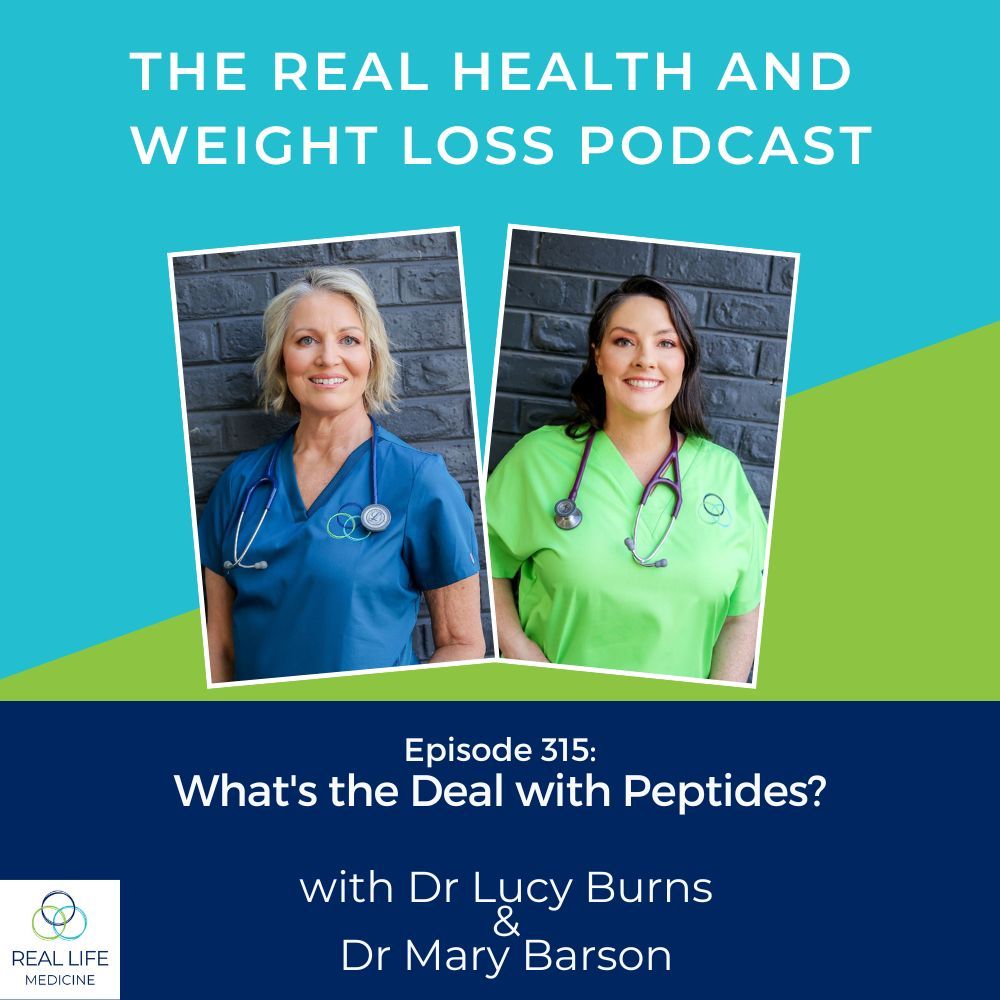
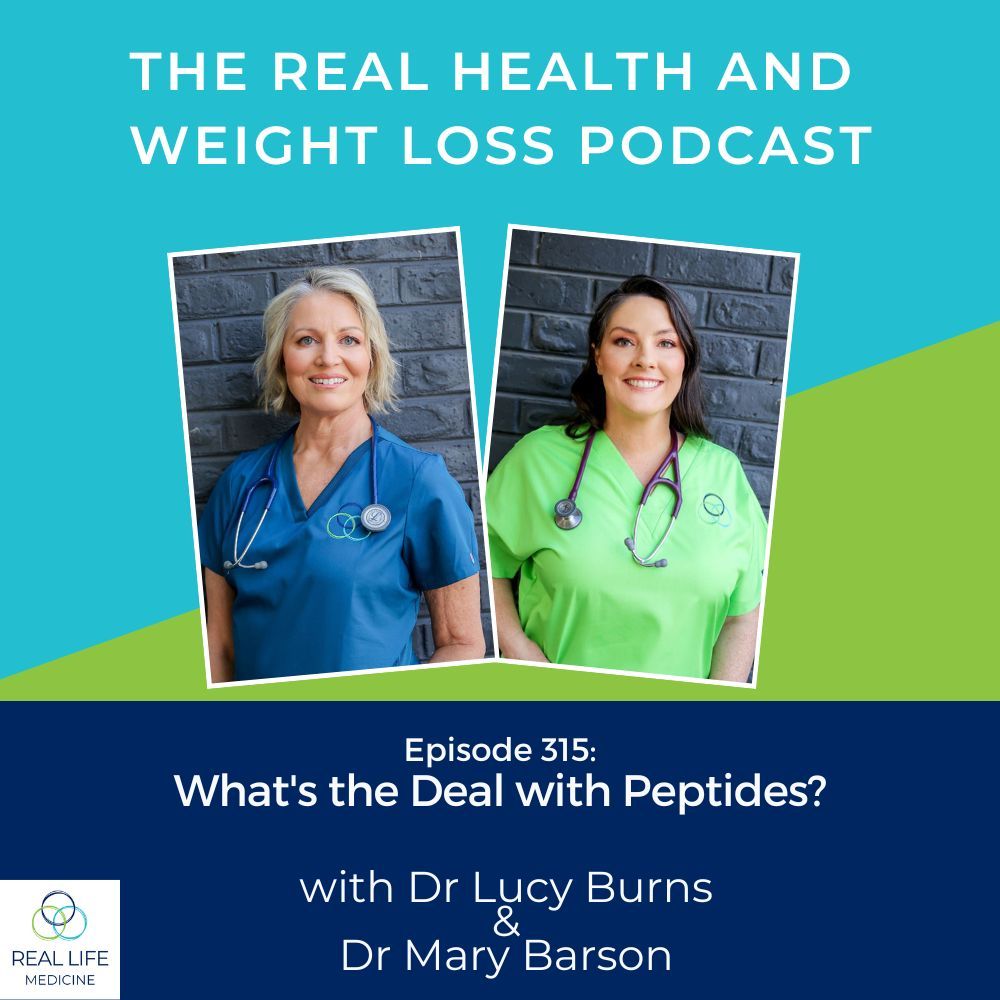
Episode 315:
Show Notes
This episode features Dr Mary Barson and Dr Lucy Burns unpacking the "hot topic" of peptides and peptide hormones, aiming to give listeners an unbiased look at what they are and the risks of unregulated use, particularly in Australia.
What Are Hormones and Peptides
Hormones are chemical messengers made by endocrine glands that travel through the bloodstream to target tissues, regulating appetite, metabolism, mood, stress, and reproduction. Doctors broadly categorise hormones into three types: steroid hormones (fat-soluble, made from cholesterol, e.g. cortisol, oestrogen, testosterone), peptide hormones (protein-based, water-soluble, act via cell surface receptors, e.g. insulin, GLP-1, GIP, leptin, oxytocin, growth hormone), and amine hormones (small amino acid groups, e.g. adrenaline, thyroid hormone). A key clarification made in the episode is that all peptide hormones are peptides, but not all peptides are hormones (e.g. collagen is a peptide but not a hormone).
The GLP-1 Drug Revolution
GLP-1 is a natural gut peptide hormone that reduces appetite and increases satiety, and medications like semaglutide and Monjaro mimic this hormone but last much longer than the body's natural short bursts. These drugs have transformed obesity and type 2 diabetes treatment, with newer options like retatrutide (with a triple hormone action including a glucagon arm) still in investigational trials and not yet released to market.
The Unregulated Black Market
Because approved GLP-1 medications are expensive and hard to access, a parallel black market has emerged, with unregulated versions sold through gyms and apps.. Unlike TGA or FDA-approved drugs, which undergo rigorous testing for dose, purity, and safety, black-market peptides carry risks of contamination, incorrect dosing, poor sterility, or even being entirely different substances. So-called "telehealth" peptide sellers are flagged as concerning since many operate as pure ordering platforms without genuine medical consultation or oversight
Real-World Harms Highlighted
The doctors cite a case of a 17-year-old who used an unregulated tanning peptide that stimulated melanocytes, resulting in hundreds of precancerous moles and lifelong melanoma monitoring. This illustrates the broader point that every hormone affects multiple body systems, so manipulating the endocrine system outside proper medical supervision carries serious, unpredictable risks.Key Takeaways
- Peptide hormones are legitimate, essential body messengers, but injectable peptide products bought outside regulated medical channels are a different, risky proposition.
- Approved medications undergo rigorous testing for safety and dosing; black-market versions offer no such guarantees.
- Young people are increasingly targeted with beauty and anti-aging peptides, often marketed with catchy nicknames before drugs are even approved.
- The doctors strongly recommend consulting a trusted doctor before trying any hormone or peptide product sourced online.
Work With Real Life Medicine
For a step-by-step approach to improving metabolic health in perimenopause, menopause and beyond, check out My Metabolic Action Plan. This doctor-led comprehensive programme gives you:
- Strategies to improve metabolism
- Skills to develop mindset
- Tools so you will implement!
Join My Metabolic Action Plan - www.rlmedicine.com/map
Episode 315:
Transcript
Dr Mary Barson (00:05) Hello lovely friend, I am Dr Mary Barson.
Dr Lucy Burns (00:09) And I'm Dr Lucy Burns.
Both (00:11) We are doctors, weight management and metabolic health experts. We are the creators of My Metabolic Action Plan, your two-step map to real health and weight loss, which is in fact the name of this podcast. Join MyMap now at rlmedicine.com.
Dr Lucy Burns (00:29) Good morning, lovely friend. How are you today? It is winter in Melbourne. I've got out my winter woollies, but I am warmed by a conversation with my beautiful friend, Dr Mary.
Dr Mary Barson (00:41) Hello, lovely human.
Dr Lucy Burns (00:44) And we are talking, just to bring it all in, talking about a hot topic.
Dr Mary Barson (00:48) It is a hot topic.Which hopefully will warm you all up as well.
Dr Lucy Burns (00:52) Indeed, indeed. So, lovely friends, today we're actually going to talk about peptides. We're talking about peptide hormones. We're going to talk to you about the difference between just a plain old peptide and what is a peptide hormone. We're also going to break down what are normal hormones and non-peptide hormones. We're going to talk to you about the pros, the cons, the ins, the outs, the ups, the downs, and just hopefully give you an unbiased, informed kind of recount of the situation as it stands currently in Australia.
Dr Mary Barson (01:22) Yes, absolutely. And, you know, there's a lot of unregulated peptides on the market out there, which is making this kind of the hot topic that it is, that has us a little worried for the health of our beautiful people out there. So that's why I want to talk about it, what we want to talk about today. I think it'd be sensible to just recap on what hormones are, because it's not always completely obvious. Often, when we think of hormones, we think of estrogen, progesterone, testosterone, being on your period, being hormonal, the hormones becoming unreliable during perimenopause. That's the common narrative in our society, for good reason. But hormones are so much more than just our sex-signalling hormones. Hormones are chemical messages that are used in our body for pretty much every single thing that we need to do to be alive. And they're all made by different, we call them the glands, different endocrine glands in our body. Collectively, we call the whole hormonal system the endocrine system. So, hormones: chemical messages made by our endocrine glands. They are released into our bloodstream. They travel through our blood to their target tissues. Once they reach their target tissues, they get that target tissue to do something, such as an ovary releasing an egg. But that's definitely not the only thing. They regulate our appetite, our weight, our metabolic health, our blood sugar, our stress responses. They are important for our mood and our motivation, reproductive health we've talked about, but also our energy balance. They are actually essential for everything.
Dr Lucy Burns (03:16) Absolutely. And the interesting thing is, which you just reminded me when you said glands. So often, people think of glands as, like, your lymph glands, and people will go, "Oh, my glands are up." And, you know, glandular fever is called that. But, in actual fact, glands are things like the thyroid gland, the adrenal gland. I love saying the word gland now. It reminds me a bit of glymph. It's a good word. Yeah, it's the "gl" in it. The gland. So the glands are important. And yeah, we're talking about the hormonal glands, not your lymph glands. And that's, you know, we can have a conversation about that one day, but that's a different one.
Dr Mary Barson (03:55) That's right. Lymph glands release other things into our bloodstream, but the endocrine glands release hormones into our bloodstream. And we, in medicine, like to categorise hormones into sort of three groups. This isn't perfect, but it is a good way to think about the three main types. They are the steroid hormones, which are small and they're fat-soluble. They're made from cholesterol. And that's why they're called the sterol... Actually, we also call them steroid hormones. That includes cortisol, estrogen, testosterone, and progesterone. The "-one" is a bit of a clue. Because they're made largely of cholesterol, they're what we call fat-soluble. That means they can very easily slip through the fatty membrane around all of our cells. They're slower acting but tend to be longer lasting. Then we have the peptide hormones, which are getting a lot of media coverage at the moment. These are hormones that are protein-based. They're little short chains of amino acids, amino acids being the tiny little building blocks of all of our proteins. A peptide is just like a little short protein, essentially. Examples of peptide hormones are our good friend insulin, as well as our good friend GLP-1, GIP, leptin, and the pituitary hormones. There's actually quite a few of them, but they're kind of the main ones. These guys are not fat-soluble; they're water-soluble. So they can't really enter the cell. Instead, they have to act on receptors. Our cells have little protein docks outside of their membrane, waiting to latch onto these hormones as they swish past in our bloodstream. Once the hormone docks onto the receptor outside the cell, that chemical change in the receptor then signals a whole lot of chemical changes within the cell. So these ones tend to be quite fast-acting, but they also tend to have quite short half-lives.
Dr Lucy Burns (06:08) Yeah. When they're in their normal state, like GLP-1, for example, they only last a few seconds. It's like bing, bing, bing, bing. The other one people may be familiar with is oxytocin. It's a peptide hormone and is considered the connection hormone, but we also use it in medicine to help manage labour. So it has really powerful implications there. Interestingly, the majority of peptide hormones - in fact, all of them that I can think of at the moment, although no others are coming to mind - are injectable. We can't use them orally because they get broken down by the stomach acids.
Dr Mary Barson (06:45) Yes. And the liver, through first-pass metabolism. So if you're talking about giving someone extra hormones, so not the hormones that they make, then yeah, with the peptide hormones, we haven't yet developed a way for people to get the hormone without injecting it. Growth hormone is another peptide hormone that people take - bodybuilders, for example, may take it to get bigger - or it's also a life-saving medication in certain situations that has to be injected. Insulin has been around for a very long time, and the only way people can reliably get extra insulin into them is by injecting it. So yes, we need to inject those hormones. When we're talking about it in a medicinal, medical way, there are formulations where we can swallow steroid hormones, like the oral contraceptive pill, which is a pretty good example of that. There are also ways that we can swallow the third type of hormone, which is called the amine hormones. They're just smaller little groups of amino acids - not quite big enough to be called peptides, they're a bit smaller. They include adrenaline, noradrenaline, and thyroid hormone. They are really small and fast, and many of those can be taken in oral form, although sometimes they also have to be taken in injectable form. So that's the broad brushstrokes of how we classify all the different types of hormones.
Dr Lucy Burns (08:13) Absolutely. And I think we need to just sort of talk about the peptide hormones, because the common vernacular that's going around on social media is that people are just calling them peptides. It's funny - I don't know why - it's funny how language evolves. I don't know whether people feel better injecting peptides than injecting hormones or what it is, but we need to be really clear that these are hormones, whereas peptides exist everywhere in other forms. An example is collagen, which we eat. We can eat collagen, and it is a peptide. It gets broken down into amino acids, which is why we always say that just because you're having collagen doesn't mean you're suddenly going to have shiny hair, necessarily. So all peptide hormones are peptides, but not all peptides are hormones.
Dr Mary Barson (09:04) Yeah. There's nothing quite magical about the word peptide. It just sort of means a few amino acids strung together. We've got gajillions of different peptides in our bodies that do different things - structural things, signalling things, all kinds of things. And yet they're not all hormones.
Dr Lucy Burns (09:21) Definitely not. No. I think the thing that's coming out - and again, we might as well address the elephant in the room, so to speak - is the absolute normalising of injectable peptides, particularly on the internet, social media, and many people's feeds. Whilst you listening to us may be thinking, "Oh, I'd never do that," people you know maybe. And really, I guess what we want to do is just have an open discussion about why our society is doing this and what the problems are.
Dr Mary Barson (09:52) Yeah. Because there definitely are some problems out there. It is a highly unregulated area. It's a bit dark and murky. And wherever there is money to be made, dark and murky and shady characters will swoop in to make money. We've certainly talked quite a lot about the pharmaceutical industry and how the pharmaceutical industry will try to monetise its medications. It will do that because it is an industry at the end of the day. There are, though, some very important differences when we are talking about largely regulated medications that are, in America, FDA-approved, and in Australia, TGA-approved. They've got rigorous testing standards around them, rigorous testing around the dose and the constituents, and we know exactly what is in them. That is a different conversation compared to sourcing peptide hormones at the gym, from somebody, or through a Telegram app, and just not knowing what is in them. But maybe we could just talk about the GLP-1 drug revolution, because I think we're definitely well into that. GLP-1 is a peptide hormone that many of us know about. It is found in medications such as semaglutide, Mounjaro, and Ozempic. These medications mimic the effect of our own GLP-1. We make our own GLP-1. GLP-1 is a gut hormone - a gut peptide hormone - that we make. As you mentioned, Lucy, normally it's just short, sharp flashes. That's how peptide hormones normally work. They get released, they do their thing, and then they're gone. We have these little flashes of them. That's the normal biochemical process. We normally make little flashes of GLP-1 here and there. It has important jobs: reducing appetite, increasing satiety, helping with insulin signalling - really important things for life. Then we've got these drugs that work on the receptors. As I told you, peptide hormones go through the blood, they latch onto the receptors, and then the receptor tells the cell what to do. So we've got these medications that latch onto the receptor and get it to respond as if we had our own GLP-1 hormones there. These receptor agonists, as they're called, last longer. They mimic the effect of GLP-1, but they last much, much longer. These medications - rightly, wrongly, however you feel about them - have absolutely transformed the treatment of obesity and type 2 diabetes in our modern world. They're here. They're probably here to stay. And they're definitely part of the landscape. There are newer drugs coming along as well, which are probably going to change the whole landscape again. In the midst of all of this, these medications are expensive. They're not always easy to get. There is a murkier sort of revolution coming through where these medications, or things much like them, are becoming available on the black market.
Dr Lucy Burns (13:08) Yeah. And look, I get it. The black market exists in all forms. There is now black market tobacco. There's chop shops, or whatever they're called. There's the black market. There's now bootlegging alcohol re-emerging, which absolutely floors me because alcohol is cheap as chips. But there is a black market version, which is also dangerous in that it's methanol being produced, and people are being harmed. I think the thing with all of this is that, at the end of the day, we've got to be very mindful about harm that is caused from products and working out the seller. What is the seller's motivation here? And I can tell you, it is highly unlikely to be your health. Interestingly - and I showed this to Dr Mary - for those of you listening, I had this ad pop up in my Facebook feed. It looked sort of like a legitimate corporate ad with some numbers, some letters. I can't remember - they were something like HCPP. Then it had some dude in a suit as the image. It was talking about the next gold rush being the peptide industry. "Start your telehealth company now and make $100 million overnight," was the claim. So it was like, again, Facebook - I'm thinking, "Meta, you're so strict with ads. How are you letting this get through?" But anyway, this is what is just coming up in a 58-year-old lady's Facebook feed.
Dr Mary Barson (14:48) Yeah. Demand for these GLP-1-type drugs has absolutely exploded. The demand is there, and so the market has responded. There's this whole parallel market to the prescribed drugs, which has exploded as well. And, you know, we're seeing these semaglutide-like products that don't come from standard pharmacies. They're available.
Dr Lucy Burns (15:22) And apparently they aren't hard to get. They're definitely not. I just did a Google search. You can get them online easily. The thing, I guess, that is coming up is that there is a new one, a new incretin. Incretin hormone is probably the technical term for these hormones, or these peptide hormones, because they mimic GLP-1 and GIP. The new one, retatrutide, has a glucagon arm to it as well. So it's got like a three-way action, a three-pronged effect. And look, my suspicion is that it will blow the other two out of the water. But here's the caveat, right? It hasn't finished human trial testing. No, it's still investigational. So it hasn't actually been released. Whatever people are buying, it's not the actual drug. It's a version thereof. And in my mind, I've got this Breaking Bad image. If any of you have watched Breaking Bad, you've got the cook in that little minivan making his... instead of making crack, they're making peptides.
Dr Mary Barson (16:25) That's probably a far more sanitised version of what is possibly happening. Yeah. I work in youth mental health, where there are quite a lot of people there for alcohol and drug support as well. A few of the alcohol and drug workers have real actual photos of laboratories where drugs are made. They'll show them occasionally when they think it will be helpful, to demonstrate how unbelievably disgusting these places are. Absolutely fetid, foul sheds where this stuff is being made, that people are then putting into their bodies. I guess the main issue is that you just don't know what is in there. I work with people who've got issues with substance abuse. And I know that, for this group of people, not knowing what is in the drugs they're buying can cause great harm. There are big statewide and nationwide processes in place to try to minimise harm, and for us to stay ahead of and understand the illicit drugs that are out there, what's in them, and what could be causing harm. People don't set out to harm themselves. They just set out to get their drug of choice. To get their hit, exactly. But sometimes, because we don't know what's in these substances, they can be terribly harmed. And just as with the illicit drug market, where people are trying to get their hit, with this illicit peptide hormone market it's a similar situation. You just don't know what you've got. It could be contaminated. It could be poor sterility. It could be the wrong dose. It could be misidentification. It could be water. It could be water. There's no monitoring. Love them or hate them, pharmaceutical companies are at least held to rigorous standards of testing, rigorous standards of safety, and rigorous standards around knowing what the constituents are, what all the different parts of the medication are, and what the doses are. So you can be fairly confident that when you take a dose of prescribed Mounjaro, you know exactly what is in it. You can pull out that enormous big leaflet of paper - you know, it's about the size of a dining room table - and it has all the information in it. You know that thing? Yeah. It will tell you exactly what is in it. And you can be fairly confident that it's true. But that is definitely not the case when we're buying things at the gym or off an app.
Dr Lucy Burns (18:56) Yeah, I know. It's so interesting to me. And again, the marketing of these companies - I'm slightly hackled by the fact that they're called telehealth, because a lot of them, there is no health. You don't even speak to anybody. It's just an ordering platform. So again: unregulated, no actual healthcare, not even a prescription needed. I mean, that'll be a whole other thing. It's just an ordering service. You can just... it's like buying a pair of jeans. You just order them online. And it's not just weight loss or the incretin hormones, the metabolic peptide hormones, that are being sold. It's lots of things. There is this huge swell at the moment of youth and beauty and anti-ageing. There was this terrible case reported about a young boy who was, I think, about 17, who had taken a peptide to increase tanning. Again, people think, "Oh, well, I don't want to go out in the sun. I'm going to get cancer." Or, "It's winter." Or, "You don't have to go out in the sun and get cancer - you can just inject this stuff and you'll be brown or tanned." What this hormone did - because it's a hormone - was stimulate his melanocytes, which are the cells that make pigment. It created hundreds of precancerous moles all over his body. So he now, at only 17, is on melanoma watch for the rest of his life. Because, you know, hormones tell the cells what to do. So the cells were just being told what to do. But it's untested. It's unregulated. It hasn't been… You know, for every drug that makes it to market, there are hundreds that don't because of something like this. Because they suddenly go, "Oh God, we injected this thing. We thought it'd be so good, and all the rats got cancer," or something like that. You know, there are so many. Totally. Then they go through human trials, and there are all of these things. So I guess, for us, we just really want people to have very good conversations. If you've got young people at home… Because it's not just a young people issue, this peptide world. But I suspect young people are accessing it because it's potentially more affordable for them. It's beauty-enhancing. It's coming back to the introduction of the thinness world. You know, they've got cute little names like "Reda" instead of retatrutide, which is a bit of a mouthful. And its actual trade name hasn't even been released because the drug itself hasn't been released yet.
Dr Mary Barson (21:41) No, that's right. Another thing is that every single hormone - every single hormone - has more than one effect on the body. Outside of medications, outside of adding more hormones in, it's a really tightly regulated orchestra within our body. When we mess with it, we need to be very careful. We need to be monitoring. We need to be looking for potential side effects. That is obviously best done in a situation where someone can get some kind of whole-person care. Ideally with a qualified health professional or medical practitioner with whom you have a good rapport and with whom you can have these good conversations. When you're doing it outside of that situation, there's just a whole lot of risks. This big whole can of worms of risks just starts wriggling around everywhere. And I'm just so… I think it's pretty obvious to the listener that I am deeply uncomfortable with this.
Dr Lucy Burns (22:00) Ah, absolutely. And, you know, we have seen medication disasters even within the pharmaceutical industry that had rigorous testing, because they don't necessarily know the long-term outcomes. Which is why a drug doesn't come to market before it's been approved. Again, this is not about turf wars or anything like that. This is really, I guess, a plea to the world to be safe. It's not worth it. The aesthetics, particularly the tanning ones and the anti-wrinkle ones - it's just not worth it.
Dr Mary Barson (23:17) So yeah, if you're considering any kind of hormone or peptide treatment, especially something off the internet, I definitely encourage you to have a good chat with your doctor who knows your story before you inject anything. Our health is just too precious, you know, and too important to hand over to a mystery vial.
Dr Lucy Burns (23:35) Indeed. A mystery vial. Absolutely. All right, lovelies, that's it from us this week. Stay safe, stay well. You know, focus on the boring basics, because that is really where the gold is. And we'll see you all next week.
Dr Lucy Burns (23:50) The information shared on the Real Health and Weight Loss Podcast, including show notes and links, provides general information only. It is not a substitute, nor is it intended to provide individualised medical advice, diagnosis or treatment, nor can it be construed as such. Please consult your doctor for any medical concerns.