
THE LOWDOWN ON LONGEVITY
One of Australia's Most Popular Podcasts with Hundreds of 5 Star Reviews

Grab your FREE Ebook copy now!
Have you struggled to lose weight and keep it off?
Start your journey to boost metabolism and transform your body into a fat-burning powerhouse.
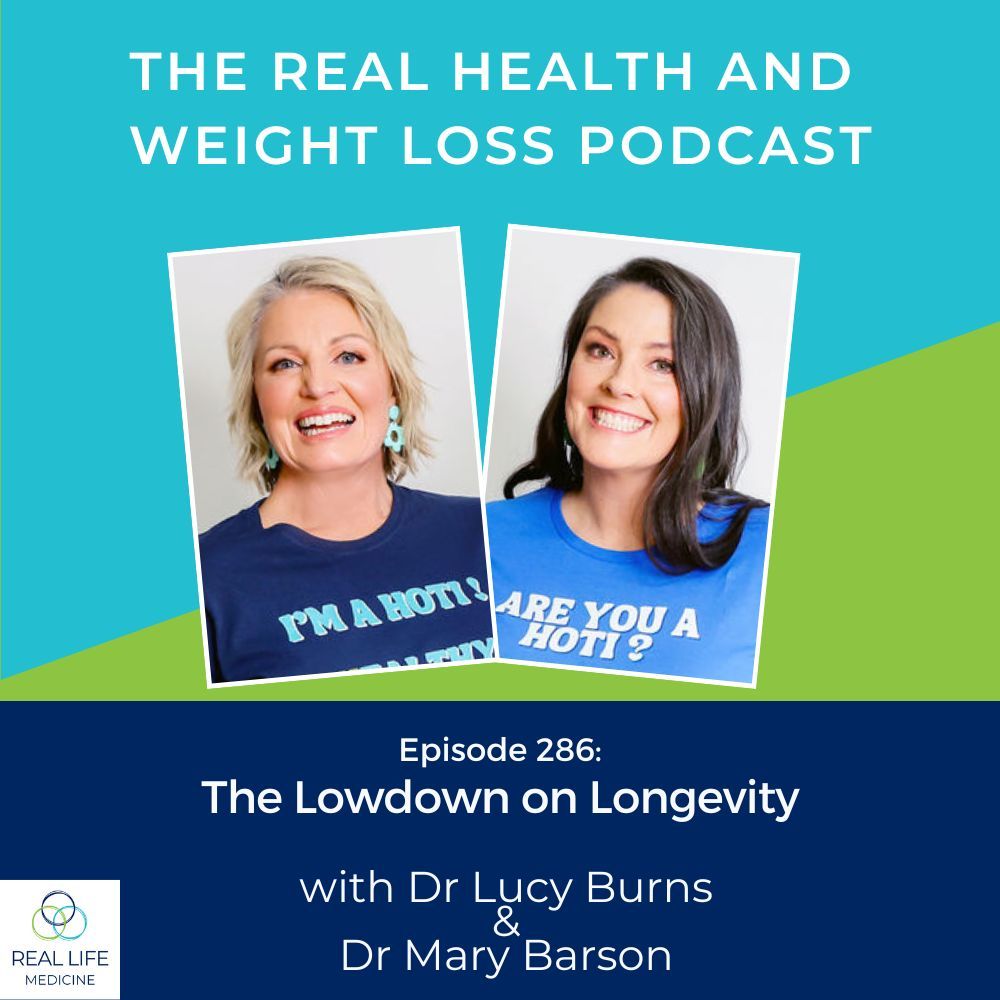
Episode 286:
Show Notes
The episode focuses on “better-jevity” – prioritising quality of life and health span over chasing trendy longevity biohacks and supplements.
Dr Mary and Dr Lucy contrast flashy longevity products with the unglamorous but powerful basics that actually protect DNA, telomeres and metabolic health over time. They present “six S’s” (plus extras) as core pillars for living longer and better, alongside mindset, self-compassion and cautious, secondary use of supplements.
- Longevity vs “better-jevity”
- Living longer without good health means more years with pain, pills and disability; the goal is extended health span, not just lifespan.
- Aging biology centres on protecting DNA, telomeres, mitochondria and activating repair pathways via lifestyle rather than relying on pills and peptides.
- Cellular science of aging
- Telomeres shorten with age; shorter telomeres are linked to poorer health and earlier death, and are worsened by chronic stress, inflammation and toxins.
- Hormesis (small, controlled stressors like exercise, mild fasting, heat/cold) activates “longevity genes” and repair systems but cannot compensate for poor fundamentals such as chronic sleep loss.
- The six core “S” pillars
- Sustenance: Emphasis on whole, minimally processed food with prioritised protein, plenty of fibrous vegetables, and low-carb patterns when insulin resistant to reduce inflammation and support the microbiome.
- Sleep: Described as the nightly repair cycle where DNA repair, brain waste clearance and metabolic resetting occur; even one poor night can markedly worsen insulin sensitivity.
- Strength: Muscle is framed as a “longevity reserve”; regular strength training improves insulin sensitivity, lowers inflammation, releases protective myokines and boosts mitochondrial health.
- Stress: Chronic, unresolved stress accelerates inflammation, telomere shortening and metabolic dysfunction, so daily stress-management skills are essential rather than relying on holidays.
- Social connection: Loneliness is compared to a high-risk health exposure; a few safe, close relationships strongly support both mental and physical health.
- Sunlight: Moderate, mainly morning sun helps circadian rhythm, mood, sleep and vitamin D, while sunburn and overexposure increase melanoma risk (illustrated by Lucy’s melanoma experience).
- Additional “S’s” and habits
- Substances: Removing or minimising smoking, drugs and excess alcohol is assumed as a base requirement for better health and longevity.
- Small hormetic stressors: Brief fasting windows, cold exposure or heat (e.g., saunas) can be useful add-ons once the main pillars are in place, not substitutes for them.
- Mindset, self-regulation and compassion
- Self-regulation and “self-mastery” skills are presented as key to maintaining habits over time.
- Self-compassion is encouraged as a firm-but-fair inner stance; harsh self-criticism is likened to working for a bullying boss and is seen as undermining long-term change.
- Supplements and longevity products
- The hosts describe supplement trends (e.g., creatine, vitamin D, NAD-related products) as cyclical and often overhyped compared with evidence-backed basics.
- Their guidance is to prioritise spending on good food and meaningful social experiences, and to see supplements as optional “baubles on the Christmas tree” only once foundations are solid.
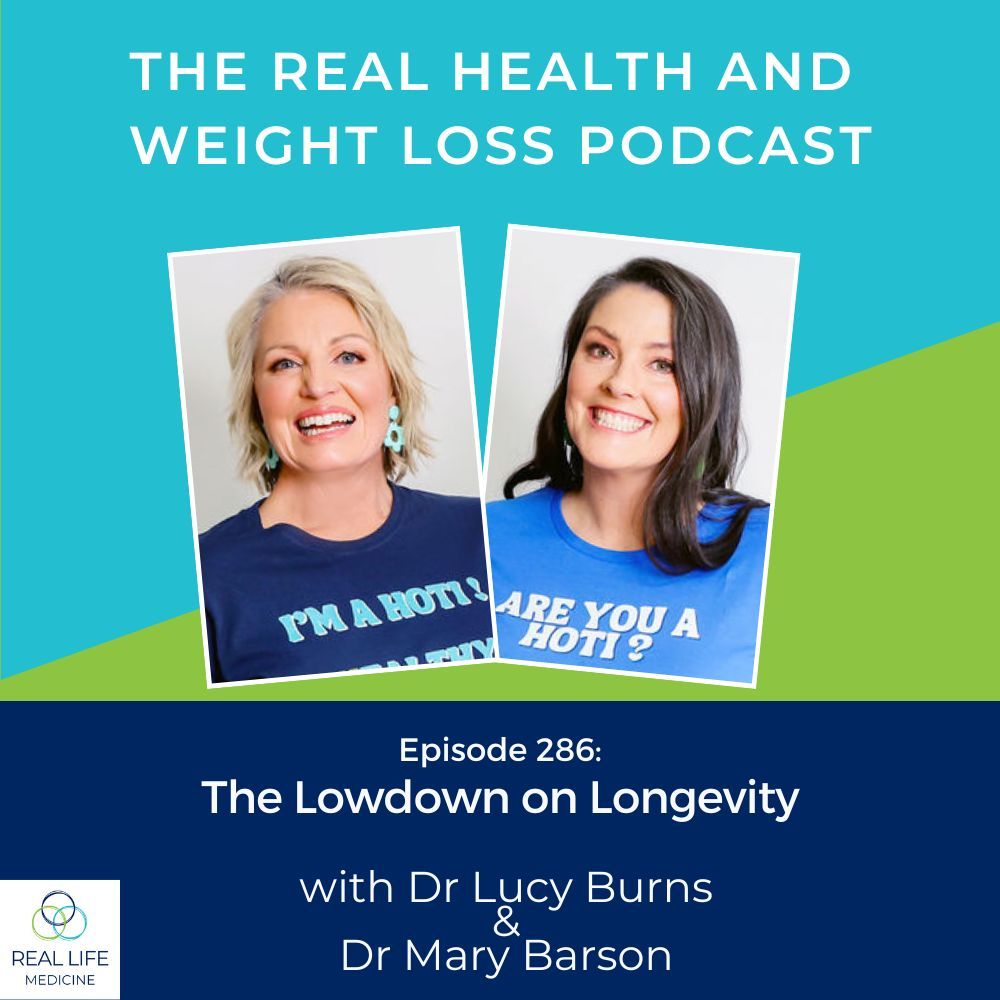
Episode 286:
Transcript
Dr Mary Barson (0:04) Hello, my lovely friends. I am Dr Mary Barson.
Dr Lucy Burns (0:09) And I'm Dr Lucy Burns. We are doctors and weight management and metabolic health experts.
Both (0:16) And this is the Real Health and Weight Loss podcast!
Dr Mary Barson (0:21) Hello, lovely friend. Dr. Mary here for this episode of The Real Health and Weight Loss Podcast, joined by my fabulous colleague, Dr. Lucy. Dr. Lucy, how are you today? You've had a few adventures lately. How are things going?
Dr Lucy Burns (00:37) Oh, yes, things are going well. So, for those of you who don't know, I actually had a melanoma removed, which is very sad for me. Fortunately, it was a level one. So, there's no long-term sequelae per se. But, you know, I had a melanoma and sun and vitamin D, lots of interesting discussions around that. But I don't think it disputes the fact that melanoma is due to repeated burnings on very sensitive skin. And probably I spent a lot of time outside as a child, frequently without sunscreen on.
Dr Mary Barson (01:11) We all did. We all did.
Dr Lucy Burns (01:13) I know, but you want to know something weird. So, I see a dermatologist every year anyway, because I had a melanoma 10 years earlier. But here's something amazing. So, one of our members in Momentum is a dermatologist, and she was watching one of my videos where I was just bagging on about meditation or something. Anyway, she took a screenshot, circled this lesion, and sent it to me and said, “When you go to the dermatologist, make sure they check this.”
Dr Mary Barson (01:38) Oh, I love that.
Dr Lucy Burns (01:39) I know. So I diligently did that. And it was interesting because it would be easy to miss it. It wasn't really raging, you know, sometimes you see melanomas, and they're ragingly obvious. It wasn't. So he did a biopsy, and that's how it was confirmed. So, a big shout out to my lovely dermatologist Momentum friend. Thank you very much.
Dr Mary Barson (01:58) Well, love you. Yes. And that's community at its best. I love that.
Dr Lucy Burns (02:04) Absolutely.
Dr Mary Barson (02:05) I think that you engaging in all this fantastic preventative healthcare feeds in really well to our topic today, which is talking about longevity, because I seem to be bombarded more than usual at the moment with all of these longevity supplements being targeted towards me. And this was because I was Googling it after a conversation I had with another doctor. I was looking up some stuff. And since I did a longevity search, oh my goodness, it was just like a firehose. And so it just got me thinking how, if we go off chasing the shiny things, the supplements, the addition to our morning shakes, all of these things that are going to promise to improve our longevity — the supplements, the peptides, the biohacks — that we really do miss the opportunity to focus on something that's probably not nearly as sexy, but far more important, which is the fundamentals.
Dr Lucy Burns (03:02) Indeed. Indeed. And look, longevity is, you know, the wellness world is, and we're part of the wellness world. So, you know, no shade on the wellness world, but the wellness world is always looking for the latest, greatest thing people love, something that's sort of new and exciting. So, yeah, longevity has become the word, and biohacking, another word. And so, people are doing all sorts of things, some of which are useful, some of which are not useful, some of which are helpful, possibly a few that are harmful, all in the name of longevity. So, first of all, let's talk about longevity. So, what does that even mean for you out there listening? And for us here, you know, do you want to live to your 120, for example?
Dr Mary Barson (03:47) Indeed. No, thank you. For me, longevity is about living well. So, people live pretty long these days, but we're not necessarily living better — living longer without living better. So, longevity, yes, it is definitely the length of your lifespan, and having a longer lifespan, I think, could be wonderful, as long as it's also matched by a good health span so that you stay relatively well and relatively able to do all the things that give your life meaning, so that, you know, you can not just live long, but also live well.
Dr Lucy Burns (04:24) Yes, absolutely. And unfortunately, we do — Australia and similar demographic countries, the ageing population, yes, we are ageing longer, but our health span is declining. So, we are living with chronic disease for more years, which means, you know, more years of potentially pain, more years of pills, more years of reduced function for some people, more years in supported aged care. And so, we're really thinking, well, it's not actually about longevity per se, but better-gevity, whatever that means.
Dr Mary Barson (05:03) Better-gevity is good. I like that. Yes.
Dr Lucy Burns (05:08) Yeah. We just want to live better so that we can, you know, enhance the quality of our life as much as possible. So, listeners, if you're like Mary and have now been bombarded with ads for longevity supplements or testing or anything like that, here's the thing that you need to know. There are basics, there are basics. And if you're not doing the basics, then what's called the law of diminishing returns by adding in a few shiny objects just means you're wasting your money. So, one of the things I think that's really useful is to just go right back a bit more and just explain perhaps the science of aging. And again, this is not anti-aging, but the science of aging, or the science of longevity. In fact, that's what longevity actually is. Now that I think about it, it's just anti-aging wrapped up in a little different message. But yeah, tell us about it — what does it mean?
Dr Mary Barson (06:05) Yeah, so really, right down at the cellular biochemical level, it is about protecting your DNA, protecting your cells from the degradation that naturally occurs with age. And this is going to happen — like, it's naturally going to happen with age. We are programmed to age and to eventually die. But there are many things that happen internally, like in response to our external environment, that can speed the process up or can reduce health as well as our life. So, things that protect our longevity are anything that can help protect the integrity of our DNA and our chromosomes. And this is one important part of it — all of our chromosomes. So, our DNA is packaged up into these chromosomes. And at the edge of our chromosomes, we've got little protective caps. It's very much like the protective cap at the end of your shoelace, that little metal thing at the end of your shoelace. And if you lose that, the shoelace can unravel and get a bit manky. A similar thing is happening with our chromosomes. So, telomeres, these protective caps at the end of our chromosomes, they do naturally get shorter as we age. But the shorter your telomeres are, the shorter your health span and your lifespan is. And there are multiple things that we can do that can help improve how our bodies make telomeres and to help slow down their shortening. Can't stop it completely, but we can slow it down. And a lot of these things — it's not super sexy, shiny little supplements. It's the basics. It's exercise. It's managing your stress. It's sleep. It's getting good nutrition. The other aspect is we want to be able to turn on our healing and repair pathways as often as we can so that we get just normal wear and tear of life. Just being alive creates a whole lot of toxins for our bodies. A whole lot of damage is happening just through the wear and tear of your cells having to just do what they need to do to be you. But we have repair pathways, and we want to be able to boost those repair pathways. And things that can do that — we have all these longevity genes, is what they're called. And there are certain activities and certain habits that will turn these on. And exercise is a really good one. So is having periods of time when you're not eating — not necessarily talking about fasting, but just not eating all the time. Having periods where you give your body a break from food, allowing yourself to get a little bit cold sometimes, to get a little bit hot sometimes, to not always be seeking comfort. Little doses of discomfort, little doses of things like fasting, exercise, heat, cold — help turn on these longevity genes through a process called hormesis. So, that's part of it. And we also want to avoid the things that are going to increase that rate of damage. So, we want to make sure that we're doing things that are not going to increase our oxidative stress, that's not going to increase inflammation, that's not going to increase our toxin exposure. So, that's kind of like a very broad overview of the science and what we're trying to achieve through longevity and improving our health span. And the way in which we do that is by supporting our bodies. We are incredibly complicated, no doubt. Human beings are very, very complex biological organisms. However, when viewed with a certain light, we are also actually quite simple. And our bodies do have all of these repair mechanisms, all of these mechanisms to get us into a good balance and to help us stay in a good balance if we let them. If we sort of take away the things that are stopping our bodies from being able to heal and be balanced and support the ways that our body can, then our body will just do it. It's quite extraordinary. And the best way is with our main pillars, our main pillars — or, as I have to talk about this analogy again, Lucy, I think the pillars of the Christmas tree that are far more important than the shiny little supplement baubles.
Dr Lucy Burns (10:31) Yeah, absolutely. So, the six S's for success. I know we say it a fair bit, but it really is, you know, if you get the foundations — so that's like the branches of your Christmas tree, the foundation — so your sustenance. And again, none of these have to be perfect, but the majority. So your sustenance: whole food, prioritised protein. If you're insulin resistant, then low-carb eating is a fabulous way to improve insulin resistance. So, you know, again, there's lots of people out there having food wars. At the end of the day, if you prioritise your protein — can be animal, can be plant, doesn't matter. You know, for us, we are omnivores. We add some veggies, fibrous veggies, greens, broccoli, cauliflower. As we are both insulin resistant, we avoid some of the starchier vegetables. But again, I fling a little bit of beetroot in some salad every now and then. I have a bit of pumpkin every now and then, you know, hell hasn't struck me dead. It's fine. I think people get worried, you know, about eating a bit of carrot, that somehow they've eaten a root vegetable and therefore they've buggered it up. So, yeah, we want to really, really focus on whole food.
Dr Mary Barson (11:46) And how that helps, particularly with longevity, is that improving that insulin sensitivity with this food pillar reduces ageing and inflammation. All those micronutrients that we need, the antioxidants from our food, the polyphenols from our plant foods — they help protect our DNA. They support our gut microbiome, which in turn reduces inflammation and improves our immune system. So, lots of beautiful things are happening at that cellular biochemical level when you feed yourself real food.
Dr Lucy Burns (12:12) Absolutely. So, eating. Next one is sleeping. Like, sleep. Sleep is the most phenomenal thing. Your body — a lot of this DNA repair that you're talking about, Mares, happens while you're asleep. But many of us live with chronic sleep deprivation. Either time of sleep or quality of sleep is probably our most underrated epidemic. And the rates of sleep apnea, particularly amongst postmenopausal women, or, you know, menopausal women, is phenomenal and incredibly underdiagnosed. Yeah.
Dr Mary Barson (12:53) Sleep is your nightly repair cycle. Like, you know, repair is critical and sleep is critical to repair. In deep sleep, our brain does this beautiful thing. We get this lymphatic system where all this waste gets removed from our brain. Sleep fascinates me. It's such a complex neurological process. And if we also — we talk about this a lot — if just one night of poor sleep can reduce your insulin sensitivity by 30%. So, you know, feeding back into what we talked about insulin before, sleep is crucial. We need to do everything we can to protect and preserve our sleep.
Dr Lucy Burns (13:30) Yep, absolutely. And, you know, plenty of studies looking at shift workers. It's not just the fact that they work at night. Most of the time, they then will lose some sleep as they transition to daytime hours when they're not working. And so, you know, they have what's known as a chronic sleep debt that never gets repaid. And all of the magic that happens for free while you're in bed is lost. So it sounds so boring, doesn't it? But honestly, good quality sleep — such a big investment. So, definitely. So, that's number two. Number three: strength. And we talk about strength because we're really talking about muscles. Yes. So, tell us about muscles, Miss.
Dr Mary Barson (14:15) Muscle — it's our metabolic, and I'm going to say, longevity reserve. Like, muscle is incredibly important. It's our most metabolically active organ when we strength train. So, we move our muscles, we work them, we release myokines, which you talked about before, which are anti-inflammatory and protective for our brains. It's a big glucose sink. So, we're going to dramatically improve our metabolic health by having more muscle. Also, strength training promotes mitochondrial biogenesis, or what I mean by that is making more mitochondria and making the mitochondria that we have more active and more healthy. And mitochondrial health — I didn't mention that earlier — but mitochondrial health is a key component to cellular health. Mitochondria being those teeny, tiny, tiny little organelles inside ourselves that make our energy. So, strength training is extremely important for health and longevity. It doesn't have to be hard, and it doesn't have to take over your life. A couple of times a week, moving heavy things, moving your own body weight, doing something that stresses your muscles out a bit is fantastic for your metabolism.That beautiful hormesis.
Dr Lucy Burns (15:24) Absolutely. And then we talk about stress management.
Dr Mary Barson (15:28) Yeah, pillar four. Yeah.
Dr Lucy Burns (15:30) Stress is not, you know, it's not running away to a deserted island. It's not even scheduling a holiday in, which we all have a holiday, but that's actually not an effective stress management technique. It's funny — I was saying the other night that I'm old enough to remember when type A personality was considered a risk factor for cardiovascular disease.
Dr Mary Barson (15:51) Ah, yes.
Dr Lucy Burns (15:52) So, you know, all of those, and again, we were very focused back in the 80s and 90s, very focused on men having heart attacks, you know, all the executives and their high achievingness. Of course, you know, there's never been a pill developed to manage the type A personality. And over time, that just sort of slipped off the list. But we do know high levels of unresolved stress have a physiological response in your body. It's not just that your brain feels a bit tired. There is stuff going on. Telomeres are getting shortened. Shortened telomeres.
Dr Mary Barson (16:27) I was going to say that — definitely. Yeah. Inflammation, poor sleep, increased insulin resistance, and metabolic dysfunction.
Dr Lucy Burns (16:36) All happen when you have long-term chronic unresolved stress. So, developing some skills, some techniques. And look, sometimes people will say to me, oh my God, it's so much work to look after myself. Yeah. No shit, Sherlock. Sure is.
Dr Mary Barson (16:53) Yep. Go choose your heart. Yep. Yeah. Managing your stress is hard. Dealing with the chronic disease as a consequence of chronic stress is possibly harder.
Dr Lucy Burns (17:01) Much harder, much harder. And again, you think about lots of things. People will spend money putting in a beautiful garden. They get a landscape designer. They get all of the dirt, the fancy paving, the statues, the edging, the expensive plants. And then they want to maintain that garden because it's expensive. Your human body is the most precious, priceless, precious, priceless thing. And it's pretty forgiving. You don't need to be obsessive, but you do need to pop a little bit of effort in.
Dr Mary Barson (17:32) That's right. Do a little bit of weeding every now and again. Yep.
Dr Lucy Burns (17:37) Yeah. So, so far we've got sustenance, sleep, strength, and stress. What's next, Miss?
Dr Mary Barson (17:45) Social connection.
Dr Lucy Burns (17:47) Indeed. We know that there is an epidemic of loneliness. Again, we've got social media. We've got the easiest ways to communicate with people, but we are lacking that human connection. We've outsourced our connection to a text message many times. What it means is you don't have to have thousands of friends. You need a few good ones, and you need somebody who you can confide in, somebody who you can share life experiences with. And it's not about the quantity per se, because there are plenty of people who are extroverts and love having friends around all the time. Plenty of people are introverts and are drained by that, but all of us need a safe person to be with from time to time.
Dr Mary Barson (18:35) I remember reading a study a while ago that loneliness equates to about 15 cigarettes a day worth of health damage. I haven't got the actual, you know, the reference at my fingertips, but I remember reading that, and the studies outlined just the way in which social bonds do help improve our health at that, you know, cellular and biochemical level. They've helped reduce inflammation and improve immune function, as well as, you know, helping our mental health, which is priceless, as priceless as we are. I'm an introvert, an absolute caring introvert. So yeah, but I get — I just, I get drained by people, you know, lots of them at conferences. Boy, I really need to go and hide in my hotel room after a whole day of conference. It's not that I don't love hanging around people. I do. It's just very draining, but just, just a little bit, just, you know, catching up with that friend once a fortnight — it makes a big difference.
Dr Lucy Burns (19:30) Totally. And then our last one is some sunlight. Again, sunlight — very good in the right amount and potentially bad in the wrong amount.
Dr Mary Barson (19:40) That's right.
Dr Lucy Burns (19:41) Yes. Indeed. Indeed. So, tell us about our sunlight.
Dr Mary Barson (19:45) Yeah, I think arguably the best sunlight to get, if you can, is in the morning. That morning light exposure really helps anchor circadian rhythms. And our circadian rhythms — it's like a little internal clock, a little conductor inside our body that conducts all of our internal biochemical processes. It's really important to have that synced up with the day as best you can. So, having healthy circadian rhythms allows all of our other hormonal processes to come in line, and sunlight increases our serotonin. It helps improve our mood, our sleep, and vitamin D. We make vitamin D in our skin in response to sun exposure. That's also really helpful for many things, including immunity, reduced inflammation, bone health, and you want to get it just right. Ideally, we do not want to get burnt. Sunburn is, well, that's just a sign of damage. We're actually — we've taken some healthy sunlight and turned it into something toxic if we're getting sunburned, but a bit of sun is extremely helpful.
Dr Lucy Burns (20:46) Indeed. Indeed. All right. So, they're our main pillars. Now, that's not to say that the other things are not worthwhile, but the value for them is once you've got the main ones. And the assumption, when you're building the Christmas tree, is that you've already removed substances. So we've got things like smoking, drugs, excessive alcohol. Some of those, really, they are obviously harmful. And so we're removing — that's an S we're removing.
Dr Mary Barson (21:17) Yep. Remove the substances. Absolutely. I would say, I don't know where exactly this fits in, but those hormetic stresses — they're helpful. It's good stress. So, we've got bad stress and good stress. So, a little bit of stress can help build our resilience, help turn on those longevity genes. So, a bit of cold exposure, a little bit of fasting — again, doesn't have to be a lot, even just 12 hours overnight could be really good. Stop eating at dinner time. Don't eat again until breakfast. Small amounts of these stressors are helpful for our longevity, but cold plunges can be great if that's something that works for you, or going out and swimming in the cold water or a cold swimming pool. But it's not going to be more important than the previous Ss that we discussed. These things are helpful, but more as an adjunct, not instead of blocking in all of those other pillars.
Dr Lucy Burns (22:10) Absolutely. And yes, I think there are, there are people out there doing the hot sauna, cold plunge, but then maybe having five hours of sleep a night. And that, you know, again, doesn't make the hot plunge, hot plunge, the cold plunge sauna thing bad. It just means that, really, it's like your priorities are just not quite where they need to be. So, yeah, we've got that hormetic stress. You know, we've got things like — we know that singing, which we could put in an S somewhere, singing is good. Singing is good for our nervous system. You know, people that sing in choirs are very good for their health. It ticks off a few boxes there with some social connection. It is a tool to emotionally regulate. So maybe we have a little S that is self-mastery or self-regulation.
Dr Mary Barson (23:00) I love that — self-regulation. Yes. Yes. Things that help, help keep you consistent. So mindset skills that help keep you consistent with your, with your habits. I think it's helpful. And self-compassion also ties in with habits. We need to be kind to ourselves, firm, but fair. If we want to make changes, the only way we can make changes long-lasting, the only way to really wire changes into our lives is with the right skills, you know, the right sort of mindset skills. So we can make it easier for ourselves, but also being kind to ourselves and making progress rather than being perfect.
Dr Lucy Burns (23:42) Yes, absolutely. I think the biggest barrier to self-kindness or self-compassion is that we think we're letting ourselves off the hook, and that that's not going to work. However, we all know that if you've ever worked for a boss that's been mean to you, or that has yelled at you, that you are, you might, you know, quickly go and fix something up — fix up an email or fix up something that you feel like you've made a mistake, but that's not an environment for which you're going to thrive. And so, given you are the boss of you, you get to choose — which sort of boss do you want? Do you want the compassionate one that sees your skills, sees your potential, and nurtures and nourishes that so you flourish? Or do you want the asshole who docks your pay because you left five minutes early?
Dr Mary Barson (24:29) That's right. And we don't want to be assholes to ourselves. That is just not going to be helpful in the long term.
Dr Lucy Burns (24:35) Not at all. Not at all. So then, I guess finally, some of the longevity space is about supplements. I mean, we've done a bit on the supplement series. The thing that we would say about supplements is that supplements are trendy. They come and go. Currently, the biggest trend is creatine. Like, honestly, it's having its moment. And, you know, I don't think it's harmful. We've done an episode on it. There are some other supplements that people are taking. Some are probably less, again, less sexy. Things like vitamin D — certainly very useful if you live in Melbourne or at a longitude, latitude? Yeah, longitude. Yeah, that's right. Wherever you live where it's cold in winter and dark. Yeah, that's right. And you know, NAD and NNM — they're the popular ones at the moment. But do you know what? They're going to come and go. Like I was saying to you, Miss, I remember about 10 years ago, everyone was taking glucosamine. Yes, it was the thing. Yep. It was going to rescue people from knee replacement, stop arthritis, just take this glucosamine and build your own cartilage. People were taking ginkgo biloba — that was going to prevent dementia. So far, that's not working, given dementia has just reached the number one cause of death in women. So it's the foundations — the supplements, the baubles, they'll come and go. Take them if you want to. But if you have to choose, don't put all your money on a supplement horse.
Dr Mary Barson (26:08) No, spend your money on some good food instead, and maybe going out and having a cup of tea with your friend.
Dr Lucy Burns (26:15) Indeed, indeed. All right, friends, have the most spectacular week. We will, of course, be back next week because we are always here every week, week in, week out. Consistency — that is the one thing we have certainly managed with this podcast, Miss. We have not missed a week, a massive, you know, streak, if you like.
Dr Mary Barson (26:35) That's right.
Dr Lucy Burns (26:36) So we won't be missing one anytime soon.
Dr Mary Barson (26:40) Bye guys.
Dr Lucy Burns (26:44) The information shared on the Real Health and Weight Loss Podcast, including show notes and links, provides general information only. It is not a substitute, nor is it intended to provide individualised medical advice, diagnosis or treatment, nor can it be construed as such. Please consult your doctor for any medical concerns.