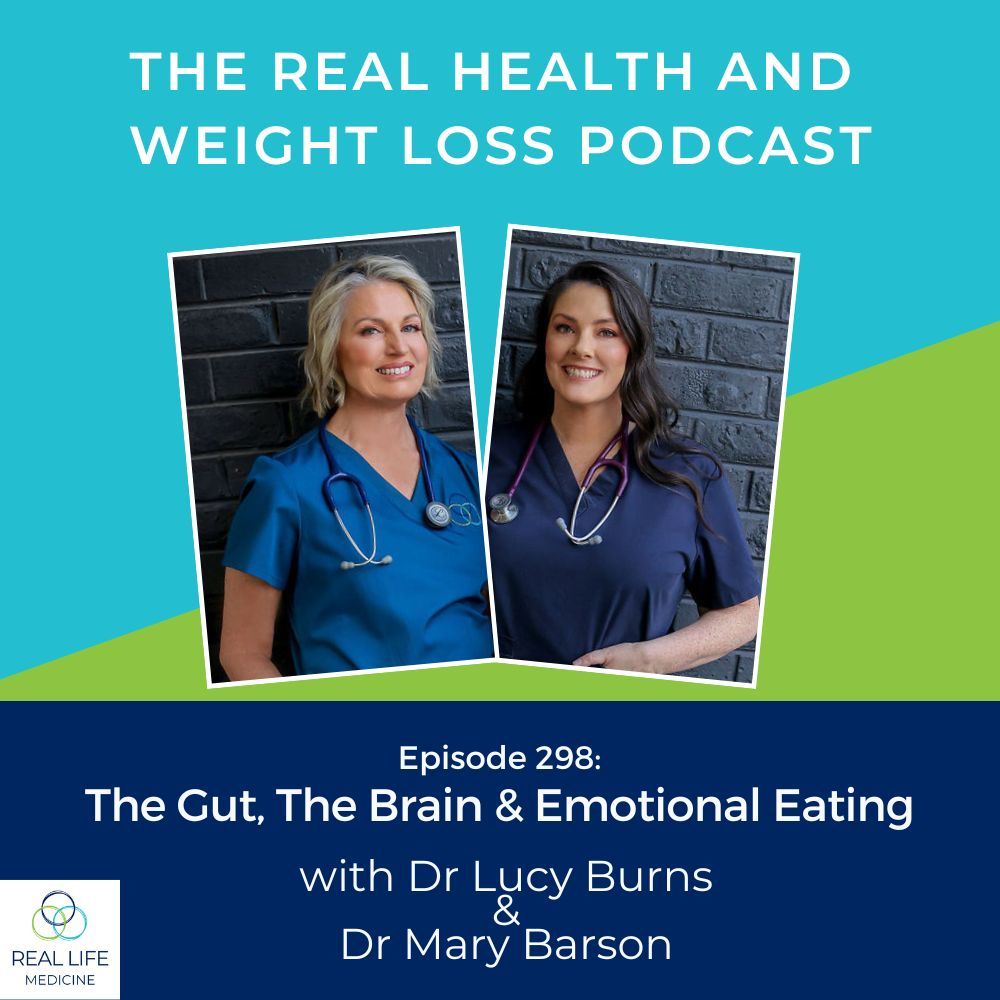


THE GUT, THE BRAIN & EMOTIONAL EATING
One of Australia's Most Popular Podcasts with Hundreds of 5 Star Reviews


Grab your FREE Ebook copy now!
Have you struggled to lose weight and keep it off?
Start your journey to boost metabolism and transform your body into a fat-burning powerhouse.
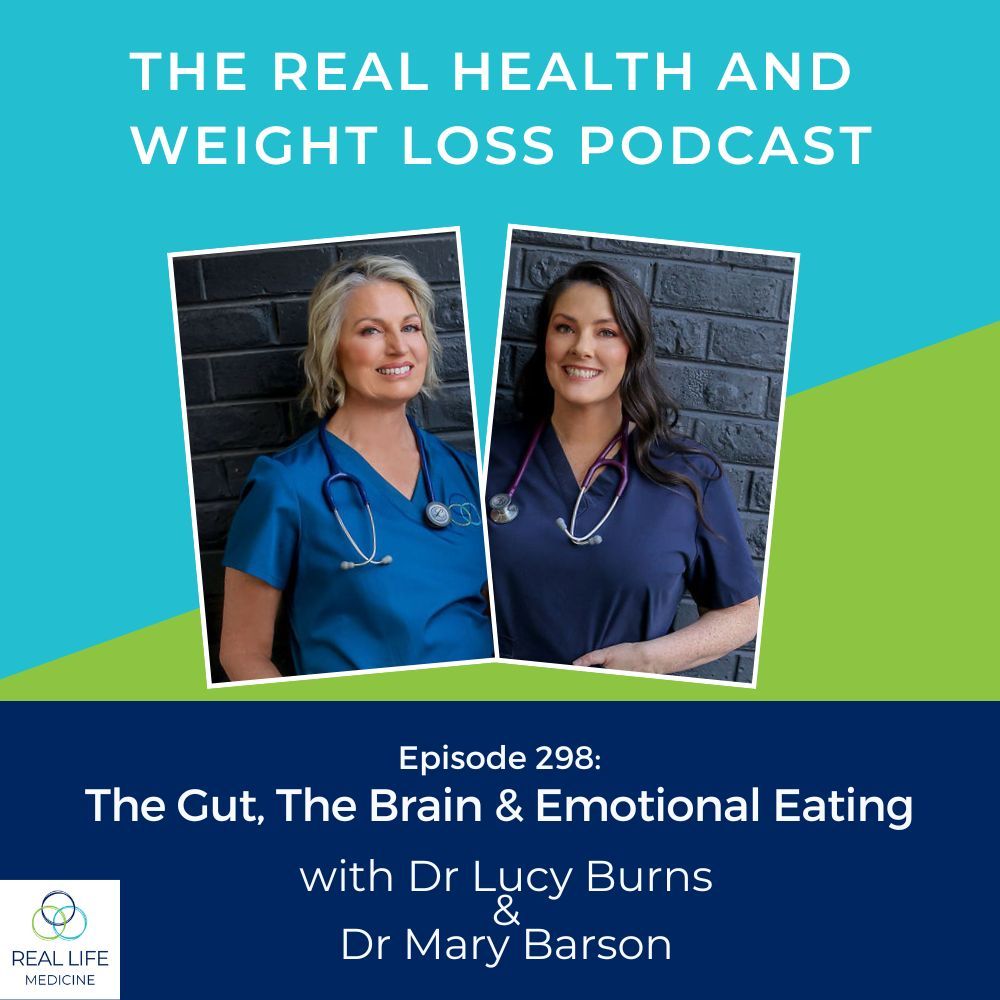
Episode 298:
Show Notes
This episode explores the powerful, bi-directional communication between the gut and the brain — and why understanding it is essential for metabolic health, weight management, mental wellbeing, and reducing food cravings.
The Gut-Brain Connection
The gut and brain are in constant two-way communication via the vagus nerve — an information superhighway linking both systems. Dr. Mary uses a vivid analogy: think of the gut brain and head brain as two busy offices constantly texting, emailing, and messaging each other on Slack — if one office is chaotic, the other feels it immediately. This explains everyday experiences like losing appetite under stress, getting butterflies before a big event, or experiencing digestive upset during anxiety.
The Microbiome's Role
The gut microbiome acts like a community of tiny chemists producing substances that directly signal the brain. Two key bacterial phyla are highlighted:
- Firmicutes — elevated in people with obesity; thrives on sugar and sends "feed me" cravings signals to the brain
- Bacteroidetes — more dominant in leaner individuals; associated with healthier metabolic signaling
Eating ultra-processed and sugary foods feeds Firmicutes, amplifying food noise (persistent cravings and hunger signals). Starving them out by switching to whole, real foods reduces their numbers — and the noise quietens.
Stress, Sleep & the Gut
Chronic stress and poor sleep damage the gut-brain axis, disrupting vagus nerve signalling and worsening gut function. On the flip side, stress management and prioritising sleep strengthen this connection, reducing insulin resistance, improving cognitive function, reducing cravings, and supporting immune health. Dr. Lucy emphasises that while we can't always control external stressors, we can control our reaction to them — and that shift alone has profound downstream effects on the gut, immune system, and overall health.
Key Practical Takeaways
- Reduce ultra-processed and sugary foods to starve Firmicutes and reduce food noise
- Activate the relaxation response — even a few minutes of calm (box breathing, meditation, gentle movement) creates lasting physiological changes
- Regular mindfulness practice has been shown in brain imaging studies to literally grow white matter and change brain structure over just a few months
- Hypnosis is highlighted as a particularly powerful tool — it delivers relaxation plus subconscious reprogramming (e.g., reducing FOMO around junk food), and is endorsed by both doctors from personal experience
- Dr. Lucy shares that years of hypnosis completely eliminated her cravings for ultra-processed foods
Program Mentioned
The doctors reference their 30-Day Hypnosis Program at rlmedicine.com/feel-better as a practical, accessible starting point — described as a "hypnosis snack" with 30 varied sessions from both Dr Lucy and Dr Mary. This episode is part of a gut health series for the month, with more episodes to follow.
Episode 298:
Transcript
Dr Mary Barson (0:04) Hello, my lovely friends. I am Dr Mary Barson.
Dr Lucy Burns (0:09) And I'm Dr Lucy Burns. We are doctors and weight management and metabolic health experts.
Both (0:16) And this is the Real Health and Weight Loss podcast!
Dr Lucy Burns (00:21) Hello lovely friend, Dr Lucy here this week with another gut full of episodes, episode of gut fullness, something like that, some gut-related hoo-ha, something like that, with my gorgeous friend Dr Mary, where we this week are talking about the gut-brain axis and, interestingly, the way in which the brain influences the gut and also the gut influences the brain. So yes, how are you this week?
Dr Mary Barson (00:48) I'm good, I'm good. I've just had a few moments of getting irrationally stressed at my internet, which I know is neither good for my brain nor for my gut because of the effects of stress on the gut, so I'm working through that, trying to let go of those things that we can't control, like the gods of the internet. But yes, I do, I do actually have butterflies in my stomach right now, feeling a bit nervous about whether or not we'll actually be able to record this episode without interruption, and that is the effect of my stress on my gut and my gut and my brain are talking to each other. That is why I have these butterflies in my stomach, or why perhaps we lose our appetite when we're stressed or get cravings when we're stressed. The gut-brain axis has a large part of it.
Dr Lucy Burns (01:37) Or diarrhoea.
Dr Mary Barson (01:39) Yes, absolutely, yes. So, with the butterflies raging in my tummy that the internet won't let us do this, let's crack on and hope that we can set the scene.
Dr Lucy Burns (01:51) Indeed.
Dr Mary Barson (01:52) Our gut-brain axis is this continuous conversation that goes on between our gut and our brain, and it is a very important conversation. It's bi-directional as well. Our gut talks to our brain, our brain talks to our gut, our bacteria talk to our gut-brain, and our brain can talk to our bacteria. It is amazingly complex and so fascinating what happens inside us, and it actually is really, really important. We're not talking about it just for the esoteric interest, although I do find it esoterically interesting. It's because it actually is really important for people who struggle with weight, cravings, emotional eating, brain fog, anxiety, low mood, that this stuff is actually really important. Being able to optimise how well your gut works and how well your gut talks to your brain and vice versa has a really important role to play in our metabolic health and our mental health.
Dr Lucy Burns (02:50) Absolutely. And I think the tricky thing is that Western society is very disconnected between the brain and also all parts of our body. You know, on one level we can accept that you can calm yourself down by taking a few deep breaths, but the idea that your brain can somehow control what's going on in your gut feels like a bridge too far for some people.
Dr Mary Barson (03:17) Yeah, and possibly even a bridge even further — that what’s going in our gut influences our brain, because it does. I love this analogy. You could think of your gut brain and your head brain as two busy officers that are constantly emailing, texting, calling each other, always on, you know, Slack channels, etc. And if one office is feeling really chaotic, then the other one feels it. So we do have these two officers in our head, and we want them to both be harmonious and working together.
Dr Lucy Burns (03:50) Yeah, absolutely. And, you know, again, we see this in households. If you've got one chaotic household member, the whole house knows about it. Emotions are contagious. So yeah, the gut brain and the head brain are like that distinction. Yeah, if one's out of balance or one's chaotic, the other one will be too. We know this, you know, the food-mood connection. I mean, there's a whole department at Deakin University headed up by Professor Felice Jacka on this exact thing, looking at food and how it affects your mood. So, leading on from our recent episode on how ultra-processed food upsets your gut, it's not a big leap to then think about how they change your mood as well.
Dr Mary Barson (04:35) Absolutely. Our little microbiomes are bacteria, and our microbiome is a key player here. Think of those little bacteria as tiny little chemists in our gut that are making substances. And they actually make substances that directly talk to our brain. I just find that incredible. And to other parts of our metabolism. And if we nurture them and if we nourish them well, then this messaging can be helpful and healthful. But if they're not nourished well, then this helpful messaging can really go awry. So yes, the gut-brain axis — it does really matter for our metabolic health and for our weight management. And one way is that our gut plays a role in our cravings and our hunger and satiety signals. It's not the only aspect of cravings, hunger, and satiety, but it is an aspect. Our gut microbes — they send messages, and they make hormones, and they send messages that signal to our brain to help us feel full, to help modulate those “I'm full” signals or the “I'm craving” signals or “I'm still hungry.” And they can contribute to the food noise. And we all know — well, I'd say that many of us know — how annoying and distressing that food noise can be.
Dr Lucy Burns (05:59) Oh, absolutely. And there's a phylum of bacteria called Firmicutes that is associated with obesity. So if you look at the microbiome in people who have obesity, they have a much higher level of Firmicutes, particularly compared to the other side of the coin, which is Bacteroides. So they're the kind of two. Bacteroides is higher in leaner people, and Firmicutes is higher in people with higher body fat levels. And the Firmicutes — I kind of just love saying that word, really. It's a great word. Yeah. But Firmicutes loves… it loves sugar. So it loves sweet stuff. And the more sugar that's there, then the more it grows. And so it's like a little — I just think of it as a little, probably annoying thing that sends messages to the brain going, “Feed me, feed me.” And so the brain goes, all right. And so off we — you know, how can I help you? And off it is, suggesting all sorts of things to feed these Firmicutes.
Dr Mary Barson (06:58) Pushy salesperson saying, “Eat chocolate.”
Dr Lucy Burns (06:59) Yeah, yeah, yeah. Firmicutes going, “Feed me, feed me.” And so when we've had a time where we have been able to reduce the amount of processed food or the amount of sweet food in particular, then the Firmicutes die off. How to get rid of them? You literally starve them out. And so then there's less of them to make noise. So then they're quieter. The quieter they are, the better. Yay.
Dr Mary Barson (07:27) Yes. The less food noise you have. And having experienced both high levels of food noise and low levels of food noise, I can say that the low level of food noise is so much nicer and calmer. Absolutely. So we've got our gut talking to our brain and our brain talking to our gut, especially. One of the most important links between our gut and our gut brain and head brain is the vagal nerve, which is like an information superhighway that connects the two. And there are quite a few things that can sort of disrupt our vagal nerve signaling and make it less effective. And that is stress. So things inside our gut can affect that gut-brain axis. Like if we don't have a nice diverse gut microbiome, if we're eating ultra-processed foods that are then making the bacteria that love ultra-processed foods more numerous. So those bacteria send signals to us to eat more ultra-processed foods, and we can get into this vicious cycle. But if you're able to transition to whole, real foods, then you can kill off those little buggers and you have less of them. But that's not the only thing that's going on. It's like stress — chronic stress and poor sleep also play a really significant role in our gut-brain axis. So chronic stress and poor sleep also damage this axis, the ability for your gut and brain to interact in a healthful way. And on the flip side of that, anything you do to reduce your stress, little moments of calm, anything you can do to aggressively prioritise your sleep, is going to strengthen that signaling as well.
Dr Lucy Burns (09:13) Yes. And I guess just to clarify about reducing your stress, we're talking about reducing your reaction often to external stressors, because sometimes we can't reduce what's going on outside — you know, it's outside our control. But what we can reduce is the way we react to it. And then that has flow-on effects to our immune system, our gut, all sorts of things. It's incredible. It is like, honestly, if everybody could learn effective stress management, their entire health just improves exponentially.
Dr Mary Barson (09:46) Yes, it's robust data to back this up that just even simple nervous system calming tools, things that seem so simple, we might just want to dismiss them as, “God, that can't possibly work. I've got so much crap going on in my life. You're telling me that some box breathing is going to help?” But it actually literally does, because of the changes that it provokes in your central nervous system, which then has flow-on effects to your gut, which has flow-on effects to every organ system in your body, has flow-on effects to your immune system, to every single system of your body, because everything is connected to everything else. And when you can take those just brief little moments to calm your central nervous system, even when life is busy, even when you've got kids who run in and interrupt you when you're doing a podcast — which is what just happened — even when your internet isn't working very well, which is also what just happened, you can do all these things outside of your control. It really does. It's amazing. So physiologically, it's called a relaxation response. And all these beautiful changes happen in our nervous system and in our hormones when we induce that relaxation response. And I think the kind of magical thing about it, even though it's not magic, is that those changes actually persist beyond the time of relaxation. So you can spend a few minutes doing some breathing exercises. Maybe you feel like a bit of a goose when you're doing it. “This can't possibly help.” But you do change your physiology, and then those changes in your physiology persist.
Dr Lucy Burns (11:21) Yes, absolutely. It's like a tightly wound spring. And then all of a sudden, you've just unwound it with those three minutes of whatever it might be. As you said, it might be deep breathing. It might be just some gentle patting. It might be looking at your dog. It might be meditating. It might be doing a hypnosis.
Dr Mary Barson (11:43) Yeah, not fluffy extras. It's this biology, like you're literally changing the messages that are traveling along that gut-brain highway, as well as changing the messages that are traveling throughout your body. Absolutely.
Dr Lucy Burns (11:56) Absolutely. It's really interesting. And again, this week in our metabolic action plan, we've been talking, you know, one of the BAM — so the bare-ass minimum that people are doing this week is to listen to a hypnosis. And even though lots of, you know, long-term participants have had access to these for a long time, they haven't necessarily implemented. And remember that MindMap's all about implementation. So they're implementing. And I spoke to one lady today who just said, “Oh my God, I can't believe I've just been… it's like I've had this gold nugget I've just been sitting on and I haven't used it. And now I'm using it.” And it's like, it's suddenly, you know, this is a one around reducing sugar and starches and cravings. And she just said, “It's like, it's like suddenly I feel like I've got this sort of, in fact she described it as like, you know, I've got this invisibility cloak around me, like the shield, I can just go through, and I feel empowered. And I've got the ability now to make decisions that I want to make, not feel like I'm making a decision that's sort of outside my control.” I know that sounds like a lot, but it is incredible, isn't it? It is powerful stuff.
Dr Mary Barson (13:10) Study after study has proved this. We've got studies looking at brain imaging before and after people start a regular relaxation practice. This particular study I'm thinking of — it was a mindfulness meditation practice — and that people literally grew more white matter in their brain, like their brain structure literally changed with a few months of a regular mindfulness practice. And this was not hours a day. They weren't, like, they didn't uproot their entire lives and go and do some sort of silent meditation retreat. They didn't have to sort of move to Tibet or do anything like that. This was just in their lives, moments of calm, implementing it regularly, and they changed their brain. And when you get those little moments of calm and you can implement them regularly, you can change your brain, you can change your gut-brain axis, you can really make a huge difference to your life, really, your quality of life, including that being less reactive and just being calmer and being able to make choices that are more in line with your values and your goals. It's beautiful. It is. It's a gold nugget. It absolutely is.
Dr Lucy Burns (14:15) Yeah, I know. It is. And it's like, I think again, it's hard for humans. We like really tangible things. So this is why people will buy a recipe book. I can't tell you how many recipe books I've bought over the years. Any of our social media posts, if there's a recipe involved, suddenly they're all, everyone's loving them. And I get it. I get it. It feels easy. It feels tangible. Stress management feels less tangible. Like, really? Is this really? And like, how do I know it's going to work? And it's not like we have a gauge on our chest that we can see, “Oh, stress levels have gone down,” and we get to see it specifically, but you do get to feel it. And I think that's part of the really important thing is recognising that these days we are disconnected from our bodies. Our mind is disconnected. We often are disconnected from how we feel, where we feel our feelings. And it's so important. And when we get back in tune with that, everything changes.
Dr Mary Barson (15:17) Yes, it does. And those changes in your gut are part of that. And they are profound. You know, that stress nervous system regulation — when you get that, that HPA axis, the stress hormonal pathway, and your vagus nerve back into a balance — it improves your gut function. Like, our gut works better. It improves the integrity of our gut. It reduces insulin resistance. It reduces cravings. It improves cognitive function. Every single part of our health is benefited by this. So it's calming your nervous system. It's not like this nice extra; it is gut and metabolic medicine.
Dr Lucy Burns (15:59) Absolutely. And I would like to throw in a little bit of immune medicine in there as well. We know that, you know, and again, you will all know this, you all know this. If you're stressed, you are more likely to get sick. If you're stressed, you're more likely to get a cold sore. The immune system doesn't need a boost. It just needs support. So we don't want an overactive immune system. That's another whole issue, but you can support your immune system by learning and implementing and actually doing relaxation techniques.
Dr Mary Barson (16:32) Yes. For a few minutes a day. So my favorite is probably guided hypnosis. That is my favorite type of relaxation — little doable moments of relaxation throughout the day. What about you, Lucy? What are some of your favorite ways to have that calm?
Dr Lucy Burns (16:47) Yeah. So I either like to go and move my body. If I can go in the pool, if it's appropriate weather and there's a pool available, that's very helpful for me. But I also, I do like hypnosis because I feel like you get to… it's two for the price of one, because you get the relaxation that comes from just actively relaxing each part of your body. And then there's a little subconscious sneaky nugget in there that is always going to be good for me in some way. So, to help me with motivation or to, in particular, I used to get a lot of FOMO with rubbish things like doughnuts and ultra-processed foods. So there was part of me that wanted it. And now I think through doing many years of hypnosis, I couldn't give a toss about that stuff anymore.
Dr Mary Barson (17:37) Yes. I love that.
Dr Lucy Burns (16:39) So yeah, I think hypnosis, that's where you get your bang, which I guess then segues into — we've had a 30-day hypnosis program. We've had this for a long time. It was one of our very first programs that we did. We love it. It's been updated. Maybe the sound quality's improved a bit, but it is what we would call a hypnosis snack. It's a great introduction to hypnosis. There's a variety of styles. There's you, there's me, and there's 30 to choose from. So I think that's pretty good. We seem to get a lot of lovely feedback, which is always nice. It's not super expensive. So I think that — that's what, if anybody here is worried about their stress or thinking, “What should I do? I probably could need to do something, but everything feels a bit hard.” Well, there is nothing easier than lying back, putting your headphones on, and just listening. Honestly, it's easy. And we've even named the page where you can look at the hypnosis if you want to see if it's for you. Instead of going to rlmedicine.com/hypnosis, it's rlmedicine.com/feel-better, because you will feel better.
Dr Mary Barson (18:50) In so, so many ways.
Dr Lucy Burns (00:52) I know. So lovelies, we won't bang on about this too much. If it's for you, go check it out. If it's not for you, walk on by. It's fine. But we'll put the link in the show notes so you can go check it out if you want.
Dr Mary Barson (19:04) Fabulous. Thank you so much, Lucy. I have enjoyed talking about the gut-brain axis as we dive into the gut this month. And we have a few more exciting gut topics coming up. And I hope everybody has an absolutely fabulous day. See you later, everyone.
Dr Lucy Burns (19:19) Bye everyone. Bye for now.
Dr Lucy Burns (19:23) The information shared on the Real Health and Weight Loss Podcast, including show notes and links, provides general information only. It is not a substitute, nor is it intended to provide individualised medical advice, diagnosis or treatment, nor can it be construed as such. Please consult your doctor for any medical concerns.