
SHOULD I DRINK A PROTEIN SHAKE AFTER EXERCISE?
One of Australia's Most Popular Podcasts with Hundreds of 5 Star Reviews


Grab your FREE Ebook copy now!
Have you struggled to lose weight and keep it off?
Start your journey to boost metabolism and transform your body into a fat-burning powerhouse.
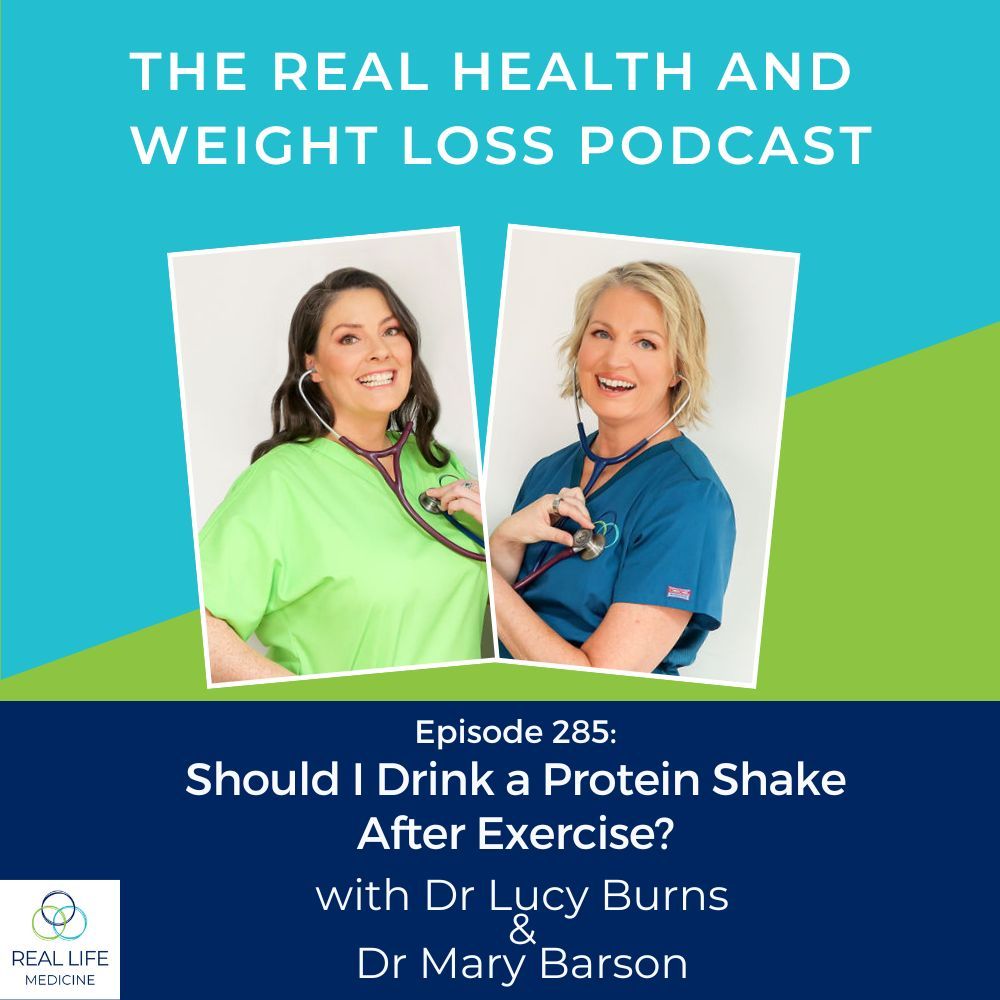
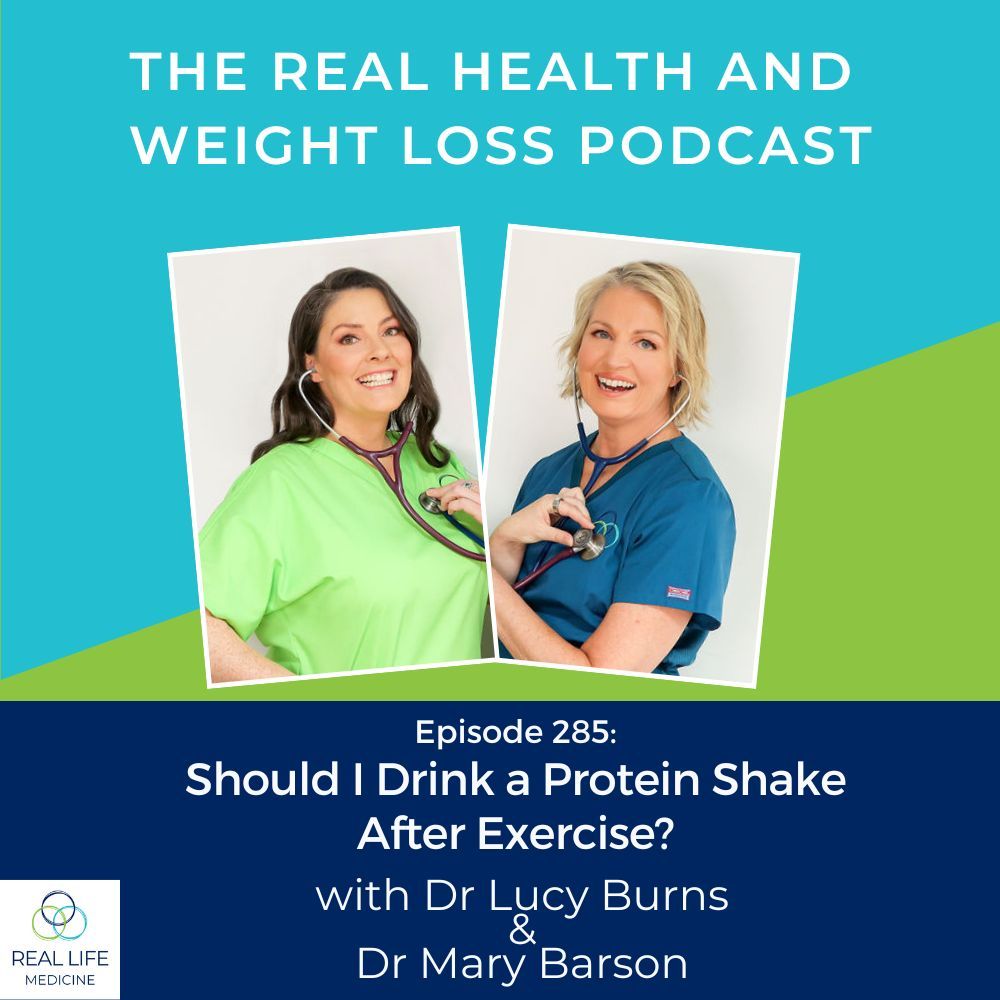
Episode 285:
Show Notes
The episode explains that most post‑workout nutrition advice online is designed for athletic performance, not for everyday women focused on metabolic health and weight loss, and that you do not have to have a protein shake or eat immediately after exercise to be healthy.
Dr Mary and Dr Lucy use the example of training a puppy to show how small, consistent actions create big health changes over time, but acknowledge that confusion and information overload often stop people acting at all. They stress that research done on elite athletes and bodybuilders (who may even sacrifice long‑term health for performance) should not automatically be applied to midlife women whose goals are strength, metabolic health, and avoiding chronic disease in their “glory years.”
They explain that fasted exercise can be safe and beneficial for fat‑burning, insulin sensitivity, growth hormone, and preserving muscle, and that people can also choose to eat around exercise based on how they feel, rather than rigid rules. While there is an “anabolic window” after strength training when protein helps muscle repair, this window lasts for hours, the effect is more about size than meaningful performance for most people, and real food protein (like eggs, cheese, tuna) works as well as processed shakes. The key messages are to focus on fundamentals—regular movement, low‑carb real food with adequate protein, intermittent fasting used appropriately, hydration and electrolytes—and to run personal experiments instead of obeying blanket rules about pre‑ and post‑workout eating.
- Consistency in small daily behaviours (like movement and food choices) is what drives long‑term health change.
- Health and performance are different goals and can even conflict; athlete‑focused strategies may harm long‑term health in everyday people.
- Fasted exercise is generally safe and can enhance fat‑burning and metabolic benefits, provided hydration and electrolytes are adequate.
- A post‑workout protein shake is optional; the anabolic window lasts several hours, and normal high‑protein meals are sufficient for most people.
- Exercise needs and refuelling differ by type and duration (e.g., long bike rides versus short HIIT), so broad “everyone must eat/drink X” statements are unhelpful.
- Emerging “bigorexia” and steroid use among young men show how performance culture can create new forms of disordered eating and health risks.
- Core habits for metabolic health: reduce overall carbohydrates (not zero), prioritise real food with good protein, move regularly, and personalise timing of food around exercise.
Episode 285:
Transcript
Dr Mary Barson (0:04) Hello, my lovely friends. I am Dr Mary Barson.
Dr Lucy Burns (0:09) And I'm Dr Lucy Burns. We are doctors and weight management and metabolic health experts.
Both (0:16) And this is the Real Health and Weight Loss podcast!
Dr Mary Barson (0:21) Hello, lovely friend, and welcome to this episode of The Real Health and Weight Loss Podcast. Dr Mary here on what is a probably disappointingly cool December day here. But I am joined by the beautiful and lovely sunny Dr Lucy. How are you, lovely Dr Lucy?
Dr Lucy Burns (00:41) Oh, I am super, Miss. And when you say sunny, it reminds me of my new puppy who we have named Sunny, in some encouragement to the weather gods to provide a bit more sun down in Melbourne. But it is so interesting looking at her as a puppy, and she's learning and growing. And the thing with her training is that we have to be so consistent. So she's currently in a little bit of a biting phase, which is a normal puppy behaviour. It's just that when her teeth wrap around my hand, not so helpful. And we, you know, I did a little bit of research on how to train a dog. You know, we've had lots of dogs before, not all of them have been particularly well trained. And, you know, current research suggests that, you know, yelling at your dog is not helpful — which, you know, deep down, we probably all know; yelling doesn't actually ever achieve anything. And what you need to do with this particular dog is redirect. So you provide them a safe alternative for their chewing. But the key is to be consistent. If you don't do it consistently, they get confused. They don't know what to do. And humans are exactly the same.
Dr Mary Barson (01:51) Aren't we though? Aren't we? And consistency, although easy to say, not necessarily easy to implement. Not always, no. We all know this, that doing the small, helpful things consistently, it's like that — the drip, drip, drip that can move entire continents. Like, you can powerfully shift your health with small, consistent changes, you know, either for powerfully good or for powerfully bad. But we actually just need to do the helpful, small, consistent changes to get those benefits that we want. This is a beautiful analogy.
Dr Lucy Burns (02:29) Yeah, absolutely. And I think sometimes for people, it can be hard because there's so much information out there and it's confusing and it's conflicting and people, you know, seeing, you know, everywhere — we don't have an information drought, we have an information flood — and trying to work out how do I apply that information to my particular circumstance can paralyse people sometimes with overwhelm. They don't want to do the wrong thing, and so they can sometimes do nothing.
Dr Mary Barson (03:01) Absolutely. I don't think there'd be anybody who would argue that, you know, some regular movement is one of those little consistent things that you can do that will drastically improve your health. But even that is a minefield. There is so much noise out there. And our topic for today is: do we have to have that post-workout protein shake? Because there's a lot of noise out there that tells you that you absolutely must and that you cannot exercise fasted, and that you have to have protein immediately after you eat. Problem is that most of the advice, particularly the advice online, is built around bodybuilders and athletes, and it's not designed for, you know, busy women just trying to improve their metabolic health, trying to lose weight, trying to be healthy — just for the everyday mortals trying to do the right thing for their health. Following the advice that's given to bodybuilders or athletes is not necessarily going to be helpful at all.
Dr Lucy Burns (03:58) No. And I think that is the number one crucial thing — that we need to make sure that we are not taking science that is based in performance and performance-enhancing, and then applying that to everyday people, because there is a huge difference between performance and health. So if the goal is to perform at your peak — which, you know, it sounds good; you'd think, oh, well, that, yeah, I want to do that. But no, because there are people out there who are willing to sacrifice their health to perform so they win. And that is so different to just you and me and everybody out there who's just, you know, going about their everyday life, and they just want to live their glory years free of chronic disease.
Dr Mary Barson (04:44) That's right. And what is good for athletic performance is not necessarily good for health. Like, an extreme example of that is bodybuilding. Bodybuilders at that elite level — bodybuilders — they do lots of things that are unhealthy, that they know are unhealthy. They inject themselves with insulin. They inject themselves with anabolic steroids. They do things that they literally know is going to decrease their lifespan, that's going to increase their chances of getting, you know, cardiac problems later in life. And they choose to do this because it enhances their bodybuilding performance. They're adults; they're allowed to do whatever they want. But this is what they do. But if people try to emulate that, or even just emulate aspects of that, you can see how it's not necessarily going to be helpful or healthy.
Dr Lucy Burns (05:41) Absolutely. And, to be honest, I don't even think it's that extreme anymore within that gym culture with young men. I see a couple of young men in the clinic, and it is part of a whole new sort of form of eating disorders, which we see — you know, eating disorders attributed traditionally to women and girls trying to be thin and small. This is like young men trying to be big and lean and buffed and sculptured and chiseled, and they are doing all sorts of things, emulating these bodybuilders with under-the-counter, cloak-and-dagger access to steroids and all sorts of things. It's mind-boggling.
Dr Mary Barson (06:26) It is. I work with a lot of eating disorder patients at Headspace, and we have dubbed this bigorexia. And it is something that we are having to rapidly get our heads around to help these men because it is, it's an increasing emerging problem.
Dr Lucy Burns (06:41) Absolutely. So summary of that is that health and performance are separate. Not only are they separate, they're sometimes conflicting, competing, so that what people are doing to perform well actually impacts their health. And that's not just, you know, things like bodybuilders. We see this with elite cyclists who end up with osteoporosis when they're older. Ballerinas end up with osteoporosis, you know, related to often eating disorders. Contact sports people, of course, people will be aware of emerging head injuries and the sequelae of that. And all of these performance-enhancing things are stealing the glory years. We're always banging on about that. We want people to enjoy their glory years, that you've worked hard, that when you're entering the last third of your life, that this is where you should be, you know, you're free of responsibility. You should be able to gallivant around. It's pretty hard to do if you've had, you know, three hip fractures and you've now got post-concussion dementia.
Dr Mary Barson (07:45) That's right. That's right. I get extremely weary of, like, broad sweeping, you know, blanket advice. And you'll see people on the internet say this, you know, all women should eat before exercise and should eat again immediately after exercise. I think that these broad reaching statements are potentially harmful because they don't take into account your own goals and your own metabolism. I mean, if you are choosing to engage in some movement and some strength training, what are your goals? Is your goals to be well, to be strong, to avoid chronic disease, to move better, to lose weight, or are your goals to increase your performance at a competitive level? And that's an important question to ask because, you know, whether or not you decide to eat processed protein, you know, shakes immediately post-workout, you need to know the answer to that question. And I think this might be pretty obvious to the listeners here, but if you are really interested in metabolic health and just being healthy, then you definitely don't need to follow that gym bro advice. It's actually perfectly okay to not eat before exercise, to not eat after exercise, and certainly okay to not have processed shakes after exercise. That is perfectly healthy and indeed probably quite a helpful choice. You've just got to tailor it to you.
Dr Lucy Burns (09:19) Obviously, some of this advice comes from Stacey Sims, who's a current and very well renowned exercise scientist, but her role is in, again, performance. And so that's really important to distinguish that she helps athletes perform. We also know that there was a study, an old study now, right back in 2012, around chocolate milk as a post, the perfect post-recovery drink. And I guess, you know, on one level, part of me thinks, oh, well, chocolate milk, at least, you know, it's actually less processed than some of the shakes. But if you're a woman in, you know, let's say you're 55 and you're maybe doing some strength training at the gym to support your metabolic health, and yes, obviously you're wanting to get a bit stronger. That's the whole point of going, but you're not about to enter the local body sculpting competition in your teeny tiny bikini, then, you know, do you need to have chocolate milk or a protein shake post workout?
Dr Mary Barson (10:21) No, no, you don't. And I reckon that we could dive just a little bit into the science. I know we've talked about fasting recently, but just to explain why you don't, I think it can be quite helpful. So, as I've mentioned before, when you're in that, the fasted state, so, you know, you and I know that fasting is just a, it's a short, sharp break from food. We balance periods of intermittent fasting with periods of nourishing our body really well. And when you're in that period of fasting, your insulin is low. So you've got beautiful access to your fat stores, your insulin, you're more insulin sensitive. You've got more growth hormone, which means that your body is prone to grow more muscle and support your muscle and preserve your lean muscle mass. All these beautiful things are happening. And then if you exercise, you can actually kind of amplify some of those benefits. You can easy access to that fat storage because growth hormone is nice and high. Your muscles can repair really quite easily. And you can absolutely exercise safely in a fasted state, grow muscle in a fasted state. Obviously, you need to hydrate yourself, but it's a perfectly safe thing to do. You can also choose to eat if you want to as well. And, I mean, a few different things happen when you're in that, if you choose to exercise when you're not in the fasted state, you don't get that added benefit, that sort of amplified effect of the fasting. But when we move our muscles, we get little micro tears in the muscles. And then that triggers all of these metabolic cascades in our muscles, which mean our muscles are primed to recover and to grow back and to grow back bigger. And our bodies do enter what's called this anabolic window after strength training, after those little micro tears. And if you, your body has some protein in a few hours after that, then a little bit more extra amino acids, the building blocks of protein, do get into those protein, and they can build back a little bit bigger than they would perhaps if you didn't have that protein. But doesn't necessarily mean that they're stronger, it does just mean that they're bigger. And, like, this may have a little nuanced effect if, like I said, you want to be a bodybuilder or, you know, you're entering some, you know, strong man competition, strong woman competition. But in terms of your metabolic health, your weight loss, your overall wellbeing, actually doesn't make that much difference. Both can be beneficial, and you can do either. And it really is kind of up to you and what feels best for you.
Dr Lucy Burns (12:57) Yeah, absolutely. And I think this is the other thing is that, again, broad statements like, you know, after exercise, you should have a protein shake. It depends on what your exercise is as well. Like, if you've done a, I don't know, 80 kilometre bike ride and you're a bit dehydrated, then we know that, obviously, supplementing your, you know, rehydrating with water or electrolytes or sometimes even milk can be helpful. We know that, you know, if your exercise is a 10 minute HIIT session, like, exercises, they're not all created equal. And so to then suggest an equal intervention post exercise is, again, it's not very nuanced. So I like what you're saying, Miss, is that you can also just do what we often recommend, which is your own experiment. See, you know, you can decide if you finish your exercise and you feel absolutely knackered and you feel like you haven't got any energy and you eat something and you feel better. Okay. Well, you've got your answer. Some people finish exercise and don't want to eat. Their brains, their bodies, you know, they've lost their appetites down. They've actually got all their upregulated, all their fat-burning enzymes. So they're burning fat for fuel. They're clear-headed. They feel great. They go good. They just need to make sure that they've had plenty of electrolytes and water, and they're fine. So again, for health, we want, you know, at the end of the day, we want to do things that reduce our insulin resistance or increase insulin sensitivity, the same thing. And we do this by, again, lots of ways, but the way we think that is proven, lots of evidence around it, is to reduce your carbohydrates globally. It doesn't mean none. Okay. They're not no carbs. We're not cutting out a whole food group. We're just reducing them. Because, honestly, the world eats tons of carbohydrate, and that's not always helpful depending on your baseline levels of insulin resistance. And that's the whole point, is that what you do for a person who's insulin resistant and what you do for a person who isn't are completely different.
Dr Mary Barson (15:16) Yes. You could summarise it by saying that there are those absolute fundamentals to good metabolic health that you have to have keyed in, of which, you know, movement is one. And there are benefits to doing your exercise in a fasted state.
And there are benefits to—well, there are also benefits to eating some protein in the few hours after exercise, but it doesn't have to be, you know, immediately 30 minutes. That anabolic window continues for hours. And it doesn't have to be a processed shake. It can be real food, like real food high in protein. So some, you know, healthy fasting is beneficial. Healthy exercise is beneficial. Eating low carb, real food with a good amount of protein is beneficial. Different combinations of these on the same days are also beneficial, but you don't have to get bogged down in, you know, musts and shoulds and nuances. You can decide what works for you. And as long as those basics are down, it's going to be beneficial. Differently beneficial, sure, but still beneficial.
Dr Lucy Burns (16:17) Oh, absolutely. Absolutely. And I think, you know, we've got plenty of time from the gym to go home. You can make yourself a cheese omelette. There'll be 30 grams of protein in that. If you, you know, have enough eggs and enough cheese in it, you can have a tuna salad. Like, there's tons of different ways to get your protein. We don't need to have it, you know, zoomed up in a hyper processed shake. Again, if you want to, and that suits you in your busy life, then, you know, no judgment from us. But what we're just saying is that you don't have to, you don't have to do that. Like, that's not the only way. So I think reminding yourself of your goals and recognising that translating research that is done on athletes for performance does not necessarily equate to health.
Dr Mary Barson (17:06) Yes. Perfect.
Dr Lucy Burns (17:08) Perfect. All right. Lovely. So that's it for them. A little short, sharp, you be your own boss, do your own experiments. As always, the fundamentals of good health, they can't be replaced in a packet. Real food is the king, the king, the queen, the prince, the princess, the Duke, the Duchess of good health.
Dr Mary Barson (17:28) Bye now guys.
Dr Lucy Burns (17:29) Bye now.
Dr Lucy Burns (17:33) The information shared on the Real Health and Weight Loss Podcast, including show notes and links, provides general information only. It is not a substitute, nor is it intended to provide individualised medical advice, diagnosis or treatment, nor can it be construed as such. Please consult your doctor for any medical concerns.