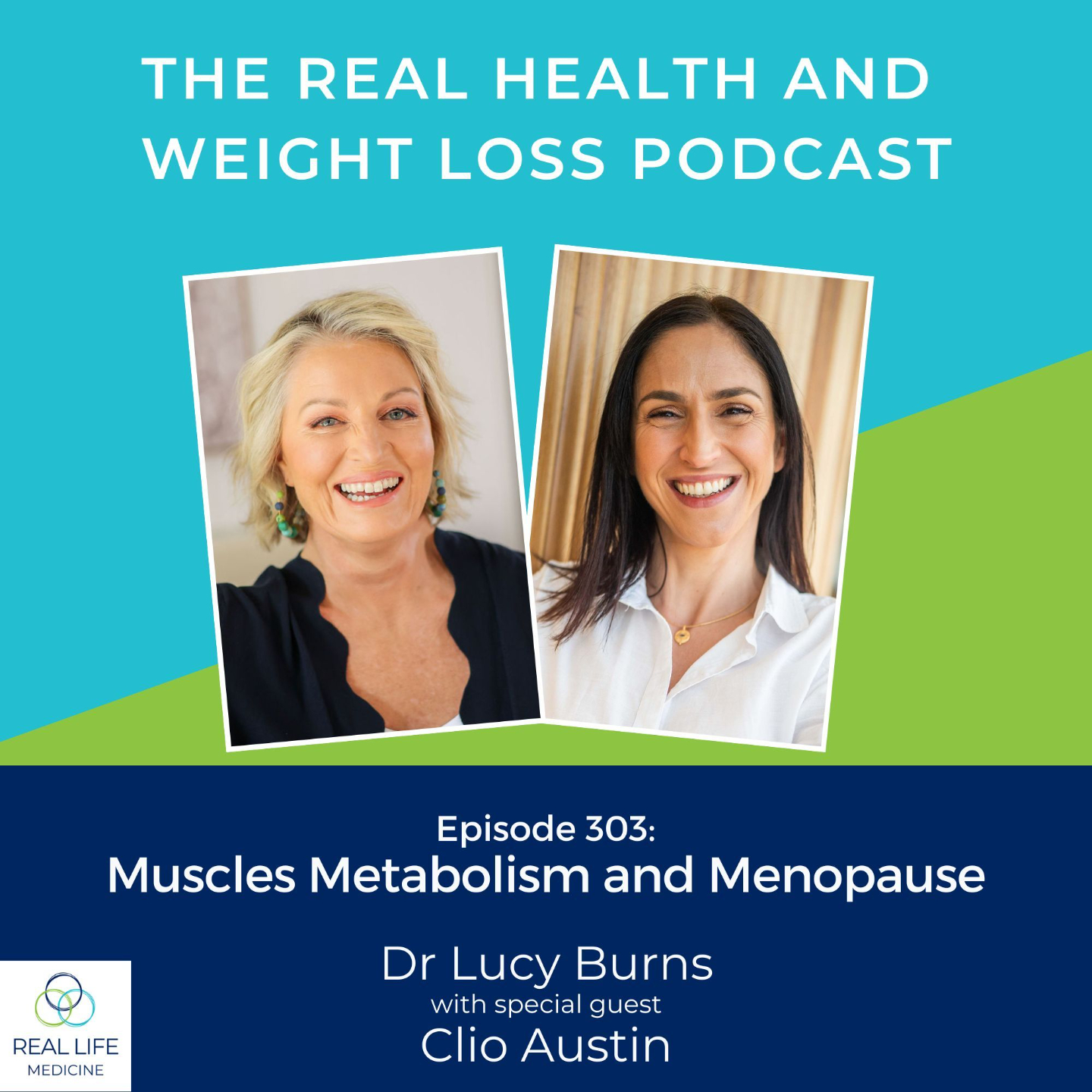

MUSCLES, METABOLISM AND MENOPAUSE
WITH CLIO AUSTIN
One of Australia's Most Popular Podcasts with Hundreds of 5 Star Reviews

Grab your FREE Ebook copy now!
Have you struggled to lose weight and keep it off?
Start your journey to boost metabolism and transform your body into a fat-burning powerhouse.
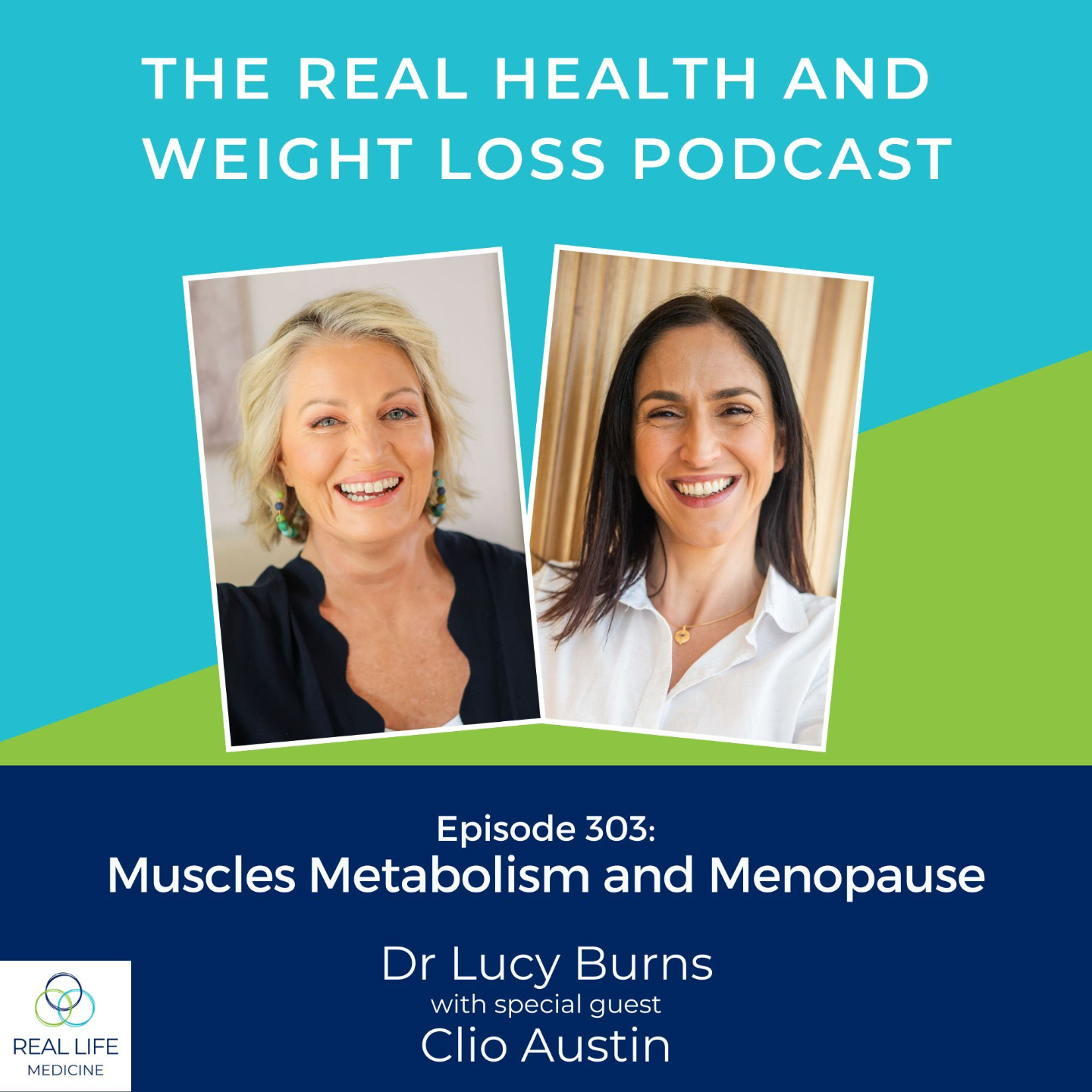
Episode 303:
Show Notes
Dr Lucy Burns hosts exercise physiologist and scientist Clio Austin for a deep dive into bone, muscle, and metabolic health for women navigating perimenopause and menopause. Clio brings over 20 years of clinical experience, including a Masters in Occupational Injury Management, and now runs a women's health clinic in Brisbane alongside a telehealth program.
Why Menopause Is a Critical Health Window
Clio emphasised that the menopause transition is a pivotal and an often overlooked time to invest in health. Many women are unaware of the downstream risks, including:
- Insulin resistance and increased belly fat
- Sarcopenia (muscle loss) and osteopenia/osteoporosis (bone loss)
- Increased cardiovascular disease risk
- Joint inflammation, tendinopathies, and conditions like frozen shoulder and hip bursitis — all linked to declining oestrogen
A key insight shared was that menopause is permanent, even after hot flushes subside, the cardiovascular and bone risks remain.
The Problem with "Exercising Like You Did in Your 20s"
Many women in perimenopause default to either no exercise plan at all, or excessive cardio combined with under-eating — both of which are counterproductive. The science points firmly in the other direction: the menopausal body is in a catabolic state, breaking down muscle and bone, so chronic calorie restriction accelerates this process rather than helping.
Strength Training: The Non-Negotiable
Clio's number-one priority for all her clients is structured strength training, even if it starts with just bodyweight exercises at home for 10–15 minutes a few times a week. Key points:
- Lifting weights stimulates both muscle growth and bone density simultaneously one squat covers both
- Women will not get "big and bulky" — building significant muscle mass is genuinely difficult, especially post-40
- Walking is valuable for incidental movement and steps, but it alone is not a substitute for resistance training
- The goals at this life stage are: build and maintain muscle, build and maintain bone, improve balance and mobility, and get some cardiovascular fitness
The Calorie Deficit Debate
Both Dr Lucy and Clio pushed back on the popular PT/Instagram messaging that "all you need is a calorie deficit". Their position:
- Short-term calorie restriction can reduce body fat but is not sustainable and disrupts hormonal health
- For menopausal women specifically, undereating depletes muscle and bone - the exact opposite of what's needed
- Nutrient-dense, protein-rich food that supports muscle and bone is far more important than hitting a calorie number
- The "calorie deficit" message is essentially low-fat dieting rebranded, which strips out the healthy fats (olive oil, avocados) women actually need
The Musculoskeletal Syndrome of Menopause
A standout moment was Clio referencing Dr Vonda Wright's journal article on the musculoskeletal syndrome of menopause, which clarified the direct link between oestrogen loss and widespread joint inflammation, aches, and pain. This reframed many workplace injuries Clio had seen in midlife women, previously unexplained, as menopause-related.
MHT and Exercise: A Win-Win
Dr Lucy highlighted the synergy between Menopausal Hormone Therapy (MHT) and exercise:
- MHT reduces pain, making it easier for women to actually implement an exercise program
- Exercise itself reduces breast cancer risk, which offsets any slight increase associated with MHT
- Clio always asks clients about their MHT status to tailor exercise programming appropriately
Clio's Approach: Meet You Where You Are
Clio's clinical philosophy is built on personalisation and gradual progression:
- Detailed initial history covering medical background, lifestyle, family situation, and time availability
- Small, achievable building blocks never overwhelm clients with too much at once
- Whole-person care, especially for women who present with complex medical histories alongside their exercise needs
Work With Real Life Medicine
For a step-by-step approach to improving metabolic health in menopause and beyond, check out My Metabolic Action Plan. This comprehensive program gives you
- strategies to improve metabolism
- skills to develop mindset and
- tools to so you will implement!
Connect with Clio
Instagram: @menopause_exercisephys
Website: https://www.clioaustin.com.au/
FREE Simple Daily Habits to Help Reduce Belly Fat During Perimenopause:
“10 simple daily habits to help reduce belly fat in perimenopause”
Episode 303:
Transcript
Dr Mary Barson (00:04) Hello, my lovely friends. I am Dr Mary Barson.
Dr Lucy Burns (00:09) And I'm Dr Lucy Burns.
Both (00:11) We are doctors and weight management and metabolic health experts. And this is the Real Health and Weight Loss podcast!
Dr Lucy Burns (00:21) Good morning gorgeous friend, how are you? This morning Dr Lucy here, I am without my pal Dr Mary, but I have a fabulous guest instead, who I think you will love because she brings a wealth of knowledge to not just women's health but health, life, health span, lifespan. Brilliant. She's so engaging. I can't wait for you to hear her chat. Her name is Clio Austin. She's a brilliant exercise physiologist and we're going to be talking all things bone, muscle and beyond. Welcome Clio, how are you?
Clio Austin (00:57) I'm great, thank you. I'm a bit chuffed. Thanks for the wonderful introduction.
Dr Lucy Burns (01:02) You are welcome. You are welcome. So you are a health professional and work with women around, you know, women in midlife and beyond I'm imagining. And I thought we might start by just perhaps a little bit of background and how you got into that space and how you find it.
Clio Austin (01:20) Yeah. So I am an exercise physiologist and scientist. And what that means is I am a university qualified allied health practitioner basically. I studied a long, long time ago and my introduction to the allied health space was in occupational injury management and I also hold a Masters in occupational injury management. So I've been doing that for a very long time, I'm going to say 20 years plus. Yeah. And I had been working in that space up until recently but also in and out of clinical work, so working with people with chronic disease as well. Whilst I had young children, in and out of sort of full-time employment, I was doing some clinical work as well. And so a couple of years ago I was in my early 40s, so I'm 44 now, but I'll say that I started noticing changes within myself, classic entering into perimenopause that I now recognise, and I wasn't quite feeling like myself. And so I started researching what was going on with me. Because of my aversion to reading journal articles, I quickly discovered through my research that I was going through perimenopause potentially. I had all sorts of classic signs. So I realised also that there wasn't enough support for women around the perimenopause and menopause transition in terms of, I guess, exercise prescription, using exercise as medicine. And I found that very odd because I thought, wow, there's so much evidence to suggest that this is a really critical time of our lives, to be starting to invest in our health if we hadn't already started down that path in our 30s. And the more I spoke to other women, the more I realised that they had actually no idea that they needed to start down an early prevention path to avoid all the flow and effect of the menopause transition, including chronic disease, insulin resistance, osteopenia, osteoporosis, increased risk of heart disease, all these things that become more prevalent as we go through the menopause transition. And also a lot of women were still trying to exercise and eat the same way that they were doing in their 20s and 30s. And it was either no plan at all, no clear direction on how to exercise, so it was just a bit of ad hoc exercise or walking, or they were doing excessive cardio and under eating because they were starting to notice that they were putting on belly fat, increasing in weight, and they weren't sure why, so they started depriving and overexercising. And that's just not what science was telling us, that was the right thing. So that's when I actually decided to take a pretty drastic career change and I dropped out of full-time employment in, I was working in occupational rehabilitation in mining, and I dropped down to part-time employment in occupational rehabilitation to open up my own women's health clinic. And so I operate a couple of days a week out of a clinic here in Brisbane and I also run an online telehealth program to be able to reach women who don't have access and who need it. And so, yeah, that was my change of direction. And so really what I specialise in or what I really enjoy is working with women through the menopause transition. So that's a bit of my backstory.
Dr Lucy Burns (05:35) Oh, fantastic. And good, and I love the way you encapsulated then all of the things that happen during the menopause or the risks that are increased because I think the thing that I also like to, I guess, just remind people of is that menopause is permanent. So when people go, oh, no, I'm all over and done with that, I'm thinking you might be over and done with the hot flushes but all the rest of the stuff, the risk of cardiovascular disease, the increased risk of osteopenia or osteoporosis, that's all still there. That's just chugging along in the background there. And I love the way you framed that menopause can be or the transition can be the time to kind of take stock and like a little wake-up call to start looking after yourself again. And I think it's really interesting because women will often do that in pregnancy or pre-pregnancy. They're all into the pregnancy. They're buying the pregnancy books. They start getting themselves healthy, going to the gym, doing, and then they're pregnant, they're doing pregnant classes and water aerobics and whatever. And then, yeah, we don't do any of that in the menopause time. So, yes, reframing it as an opportunity to go, right, yep, this is a phase in my life and it's time for me to do something. So it's fantastic.
Clio Austin (06:53) Absolutely.
Dr Lucy Burns (06:54) Great. So with your work with women then, like what do you specifically do?
Clio Austin (06:58) Yeah, so I would normally have an initial consultation where I take a really detailed history, much like yourself, you need to know who the woman in front of you is, where they've come from, what their medical history is, maybe what their family situation is like because, honestly, that whilst I'm not going to call family a barrier, but family a barrier to exercise is what I mean, but the personal life situation going on around a woman is super important because it informs the amount of time that they're going to be able to commit to themselves, to exercising, you know, what stresses they have going on in their lives. So I really take a comprehensive history of the woman, lifestyle, risk factors, any medical information they might have collected or been sent along from their doctor. Sometimes we have care plans from the doctors, so chronic disease care plans or other times I have women seek me out independently because they've done their own research and this is what I love about the generation of women who are going through the menopause transition right now is that we're so educated and we're so self-empowered and we go and we learn this information for ourselves and then we seek out the treatment that we need. So I love that about a lot of the women who see me. So we'll do that. We'll come up with a plan that suits the woman sitting in front of me. So we meet you where you're at. What is it that fits into your lifestyle that is realistic and that your body can handle right now? And I'm also super mindful and call it practice and error from previous years of not overloading the program because a lot of people don't have a huge exercise background. A lot of people maybe played sports at school, engaged in a little bit of activity, maybe did a few boxing classes, did CrossFit once upon a time, did a lot of walking, you know. So not everyone comes to me who is already doing some formal type of exercise. A lot of people aren't doing any formal exercise. So meet you where you're at. Start a program that fits into your lifestyle and we start small. What I like to do is educate on, okay, here's where we're at now, here's where we want to be and here are the little building blocks to getting to that point because I'm not going to give you all these things at once. You're just going to throw it out the window and go, this is too hard. There's got to be an easier way and there isn't, unfortunately. Exercise has to be, you have to work. Sometimes you have to work up a sweat, not too much sometimes, but it's work that you actually have to do if you want to make a difference to your body, to your body composition. So we meet the person where they're at. We do little building blocks. My priority is to get people into strength training, even if it's from the comfort of your own home and you're doing body weight exercises, you're doing 10, 15 minutes every couple of days. Right, we've mastered that. Maybe now we can start to build in some more exercise. Let's get out and walk for 10 minutes twice a day and just get a bit of movement. It really depends on where the person is at at that point in time. It's all about, at this time of our lives, it's all about building muscle, maintaining muscle. Building bone, maintaining bone. Balance, mobility. Yes, we want to get some huffy-puffy in to improve our cardiovascular health, but it does not mean we have to be doing hours and hours of cardio exercise on a machine or walking for hours and hours. I'm a big advocate for get your steps. If you love walking, walk all day. Walking is super important. Getting steps in is super important, but that's also an incidental activity as well. We need to have a structured strength training program. And luckily for us, it kills two birds with one stone because strength training will improve muscle and it will improve bone density. So those two things together, well, we can tick that off with this one squat that we're doing, with this one push-up that we're doing or chest press that we're doing, right? So the way that happens is when we lift a load or carry a weight, it puts a stimulus on our muscles, but it also puts a stimulus on our bones. So we want to grow and get stronger. Now, I will say that at this point, some women may be freaking out going, I don't want to lift weights because I'm going to get big and bulky. It is absolutely impossible unless you're working out for a bodybuilding competition and you're eating tonnes and tonnes of calories. You will not get big and bulky. In fact, try as I might, I lift heavy weights and need all the protein and I still find it hard to build muscle at 44. It is very difficult. Now, I'm not saying this to discourage because, yes, you will build muscle, but you also won't get big and bulky. So please, if you're thinking that right now, put that out of your mind. It is virtually impossible for that to happen.
Dr Lucy Burns (13:12) Absolutely. And you know what? I think it's tricky because the fear of being big and bulky is, you know, for people of my generation, so I'm in my 50s, because of, you know, diet culture in the skinny 90s where we all needed to look like we had cancer. And now sadly it's coming back in that little phase. But, you know, you don't need to shrink yourself to be acceptable. And what we really have seen then is that a lot of those very thin girls and thin women now have osteoporosis and osteopenia because they didn't build bone in their teens and 20s. So, you know, out there to all the mums who are my age, if you've got girls that are, you know, in their teens and 20s, get them building muscle, eating yoghurt, you know, scoffing cheese, all of that.
Clio Austin (14:11) Absolutely. I've got a 13-year-old daughter, so I am very acutely aware of what's going on in the culture at the moment, yeah. And I will say that for a very long time in my 20s I was chasing the skinny, yeah, I was in the tail end of that skinny culture for sure. At high school I starved myself, I didn't eat. I fractured when I was in my late teens. When I was 19 I had a stress fracture. That's not normal. I didn't have a traumatic incident. It was under eating, over exercising, poor bone density. I know now that that's probably what it was. Did I ever get a scan? Did anybody ever tell me that that's what I should do? No. But I am putting all the pieces of the puzzle together trying to figure out why at that age I fractured. And I was undernourished and over exercising and that's probably the likely cause. So it happens in younger women.
Dr Lucy Burns (15:14) Yeah, absolutely. And this is the whole thing, isn't it, that we became like scared of food and food became the enemy because it made us fat and, you know, now we've still got, you know, difficult relationships with food and, you know, food is like I just think of it now as nourishment and it's nurturing and it's all of the goodness that our body needs to be able to thrive and do all the things that it needs to do. Clio, I'm really interested in your thoughts around, and I might be putting you on the spot here, personal trainers and some because what I'm seeing a lot and, again, maybe my algorithm is slightly skewed although I suspect not, but I see a lot of PTs that are on Instagram and they're banging on about calorie deficits and the only way to lose body fat is to be in a calorie deficit and they're showing people that you can eat whatever you like as long as you're in a calorie deficit and, you know, that a Snickers has 260 calories, which is the same as this little thimble of olive oil. So, you know, blah, blah, blah. What are your thoughts on all of that?
Clio Austin (16:23) I love that because I used to do natural bodybuilding. So I did in my mid-30s. I was how old was my baby? My son was 10 months old when I did my first bodybuilding competition and so I was right in that culture of the calorie deficit. We did it in a safe, controlled way but certainly for a short period of time calorie deficit can help bring down body fat but it is not a sustainable thing for most people and certainly people in the bodybuilding circuit aren't like that 12 months out of the year, right? It's not a sustainable thing. It's for a short period and it can impact your energy levels and it does impact your hormones. Think of it as relative energy deficiency, you know, with young female athletes, for example, who are under eating, over exercising, their hormones are disrupted, their periods stop. It has a huge impact on your hormonal health for starters. You're not potentially getting the right nutrients. You know, in bodybuilding I say it's controlled because you are watching your protein portions and so on but it has its place and it's usually in that type of competitive sport. I think as a short-term intervention it might be an appropriate thing to do but that would be something that I would suggest somebody seeing a dietician for and getting a really clear structured plan but for women in the menopause transition it's not super helpful because our bodies now are in a catabolic state. What that means is that our body is breaking itself down. It's breaking down muscle. It's breaking down bone. We stop feeding it with the right nutrients and usually if we're in a calorie deficit and we don't have a good education on what sort of nutrients to have, we're going to be depleting our muscle and we're going to be depleting our bone. With muscle, when we start and the reason why we're losing muscle and I'm saying this because I'm explaining it to your listeners, I know you're acutely aware. That's okay. As our oestrogen starts to decline, it is harder for us to build and maintain muscle. We have sarcopenia which is the breakdown of muscle, osteopenia, osteoporosis, breakdown of bone. Now if the more muscle we're losing, I guess we're in a more insulin-resistant state. If we're not feeding our body with the right building blocks to build and maintain muscle, we become less metabolically active. Our body's not churning away at this energy because we've got these beautiful muscles burning away at the energy. What happens when we don't have that lovely muscle is we start to store body fat and particularly around the midline for women in this time of life. So if we're in this constantly underfed state, which is what this calorie restriction essentially is, it's actually working against the menopausal body, not with it. In saying that, I'm not suggesting that we have, you know, 2,000 calories and it can be whatever we want. It still has to be the right kind of food that is supporting the body, that is building muscle, that is building bone, not that is working against us. And inflammatory foods, right, like your junk foods.
Dr Lucy Burns (20:38) Well, the way I look at it is I think that the selling, if you like, of the calorie deficit message is just low-fat rebranded because the easiest way to reduce calories is to reduce the amount of fat in the diet. But we actually need fats. We need healthy fats. We need olive oil. We need avocados. They provide nutrients for all sorts of things, all of our fat-soluble vitamins. They're really important. And so like everything, you can have too much of a good thing, too much fat, too much sugar, you can have too much of anything, too much air. You know, it's all about the Goldilocks. But, yeah, this obsession with calorie deficits and then people suggesting that when weight loss stalls you just need a bigger deficit and it's like, oh. So, yeah, it's really tempting and I think that you nailed it when you said, you know, yes, it's a short-term solution. So, you know, it's tempting and it's short-term but it's not usually a road to long-term sustainable health and, you know, weight loss coming along for the ride.
Clio Austin (21:51) No, absolutely. And I know a lot of my dietician friends who I work in close circles with in the menopause space are all about the nutrient-dense foods. You're eating food that supports your health, that makes you feel good. Not a lot of them are big supporters of super-duper long-term calorie restriction. So, yeah, I really encourage women to think hard before they start down this slippery slope of calorie deficit. Think hard about how sustainable that is, how that's going to fit into the rest of your family life as well.
Dr Lucy Burns (22:38) Yeah. Yeah, and, I mean, it sounds like the women that come and see you too also value your expertise as a university-trained health specialist compared to maybe someone who's done, you know, they may have worked in the fitness industry for a long time but they've originally started with a six-week course and, you know, they're not always.
Clio Austin (22:59) Look, I think it's getting better. I'm constantly surprised by some of the things I see fellow or personal trainers, I will say, who I see in the gym. A lot of them are coaching on pelvic floor health. You know, this is mostly the women, and I think that's fantastic because that's not something that used to be part of the training. So there's a better focus on women's health. But the difference is, is that we specialise in chronic disease management to an extent as well. I mean, that is my background in terms of clinical practice. And so most women, I'm going to say 99% of the women I see come to me with all sorts of problems. You know, your typical shoulder, frozen shoulder, bursitis, hip bursitis, lateral hip pain, knee problems, osteoarthritis, insulin resistance, you name it. There is a long medical history. So that's the beauty of what we do is that we can look at the whole picture and manage the whole person in front of us. You're not just an exercise program to me. We're looking at improving your health in the long term and doing it in a way that's sustainable.
Dr Lucy Burns (24:19) Yeah, absolutely. And, you know, all the ITISs that you mentioned, we know, the minute oestrogen disappears, it has such a powerful effect on our collagen and our muscles as well. And so, yeah, inflammation and it's a potent anti-inflammatory. So certainly that is a peak period for women that never had plantar fasciitis. Suddenly they've got it and it's like, oh, really? What's going on here? And, you know, I think five, six, eight years ago, I used to see lots of women with tendinopathies and I'd be sending them off to the exercise physiologist for, you know, strength training and rebalancing and reactivating, you know, muscles that are no longer firing and doing all that stuff. And it never occurred to me that it was anything to do with menopause. God, so many people I should have been more onto. But anyway.
Clio Austin (25:14) Yeah. Do you know what a breakthrough for me? I don't know if you were there but I went to the So Hot Right Now. Oh, yeah, yes. Yeah, I went to the medical conference there and I got to meet Vonda, Dr Vonda Wright, and a few of the other docs there. But, you know, I'm a big fan of Dr Vonda Wright and it really clicked for me when I read that journal article about the musculoskeletal syndrome of menopause. It clicked for me because I'd been working in occupational rehabilitation, workers' compensation, and a lot of the time seeing women with shoulder injuries, other aches and pains. Sometimes women were diagnosed with fibromyalgia, all sorts of things. And it didn't click for me why this was such a typical injury or condition that a midlife woman might develop until I read this journal article that shows the clear link of loss of estrogen to the inflammation of our joints and aches and pains in the body. And, yeah, it blew my mind and it made such a strong connection for what I was seeing in workplaces as well and things that women were struggling with. So, yeah.
Dr Lucy Burns (26:41) Yeah, absolutely. And I think the, you know, brilliant thing about MHT is that now what it means is that when women have less pain they can actually do the exercise that they may have been thinking about doing but every time everything aches and they feel about 100. And so when we prescribe it, people feel better and therefore can implement the plan that someone like you has created for them.
Clio Austin (27:04) Yeah, yeah. And I always talk to my clients about where are you on your menopause journey? Have you got the, you know, have you got your MHT? If not, why not? Not that it's for me to, you know, sway either way or not but to understand why they've made that decision so that I can support them where they are on their sort of menopause journey in terms of, you know, their capacity to be able to exercise if they're experiencing these symptoms.
Dr Lucy Burns (27:38) Ah, 100%. And I always show women the, there's a British Menopause Society graphic which has got little ladies on it and it's a risk factors, you know, the pros and cons and the breast cancer risk. And the thing that reduces breast cancer risk is exercise. So it reduces it by miles. So it's significant improvement. So if taking MHT and there is a slight increased risk but it's much, you know, it's much smaller than was ever, than we ever, than I got taught, that's for sure. And then it's offset completely by the fact that you can actually exercise. So you go, ah, so it's like a win-win.
Clio Austin (28:24) Yeah, absolutely.
Dr Lucy Burns (28:25) Yeah, definitely. So that sounds fantastic. So, Clio, if people wanted to connect with you, how do they find you?
Clio Austin (28:32) Sure. I am on Instagram. I'm at menopause underscore exercise phys. If you look up Clio with an I, C-L-I-O, Austin, you will find me as well. I am online. I've got a website, Clioaustin.com.au. Great. So that's how people can connect with me. If anyone wants to reach out, you can just send me a DM in Instagram. You can connect with me through my website. Yeah, and I'm passionate about making this service accessible to all women in Australia, including women who live rurally, who don't have this access. And so that's why I run a telehealth program, so that service is available to all women because I don't think any woman should have to go without the ability or the education on how to build muscle, build bone density, and improve their health outcomes, mitigate chronic disease development, and prevent frailty.
Dr Lucy Burns (29:43) Yeah, totally. It's wonderful. And I think the brilliant thing about telehealth, I mean, it's the one good thing that's come out of COVID is that we're much more familiar with Zoom and with telehealth and with is that and it doesn't even have to be rural women. It might be women that just don't want to go to a gym, like they're traumatised from.
Clio Austin (30:01) I see plenty of women who live in my local town here in Brisbane who just don't want to leave the comfort of their own home. And you know what? It's convenient. I see my menopause doctor virtually and I love it.
Dr Lucy Burns (30:17) Absolutely. I reckon I do because, you know, we have our telehealth clinic as well and I reckon about 60% of people are in their car. They're not driving but they're in their car because it's easy. You can just duck out into your car at work. I call it your mobile office. And, yeah, it's so convenient. You don't have to take half a day off work and sit in a waiting room. It's great. So, yeah, no, we are lucky with the new softwares that have come about. Wonderful. All right, my friend. Well, thank you so much for imparting your knowledge. I'm sure you have, you know, inspired some women to, you know, just think about muscle, think about, you know, movement. How can you move your body? How can you start small? And if you need any help with it, well, we've got our friend, Clio, to help us out.
Clio Austin (31:00) Thanks for having me. You're welcome.
Dr Lucy Burns (30:01) All right, lovelies. Bye for now.
Dr Lucy Burns (31:07) The information shared on the Real Health and Weight Loss Podcast, including show notes and links, provides general information only. It is not a substitute, nor is it intended to provide individualised medical advice, diagnosis or treatment, nor can it be construed as such. Please consult your doctor for any medical concerns.