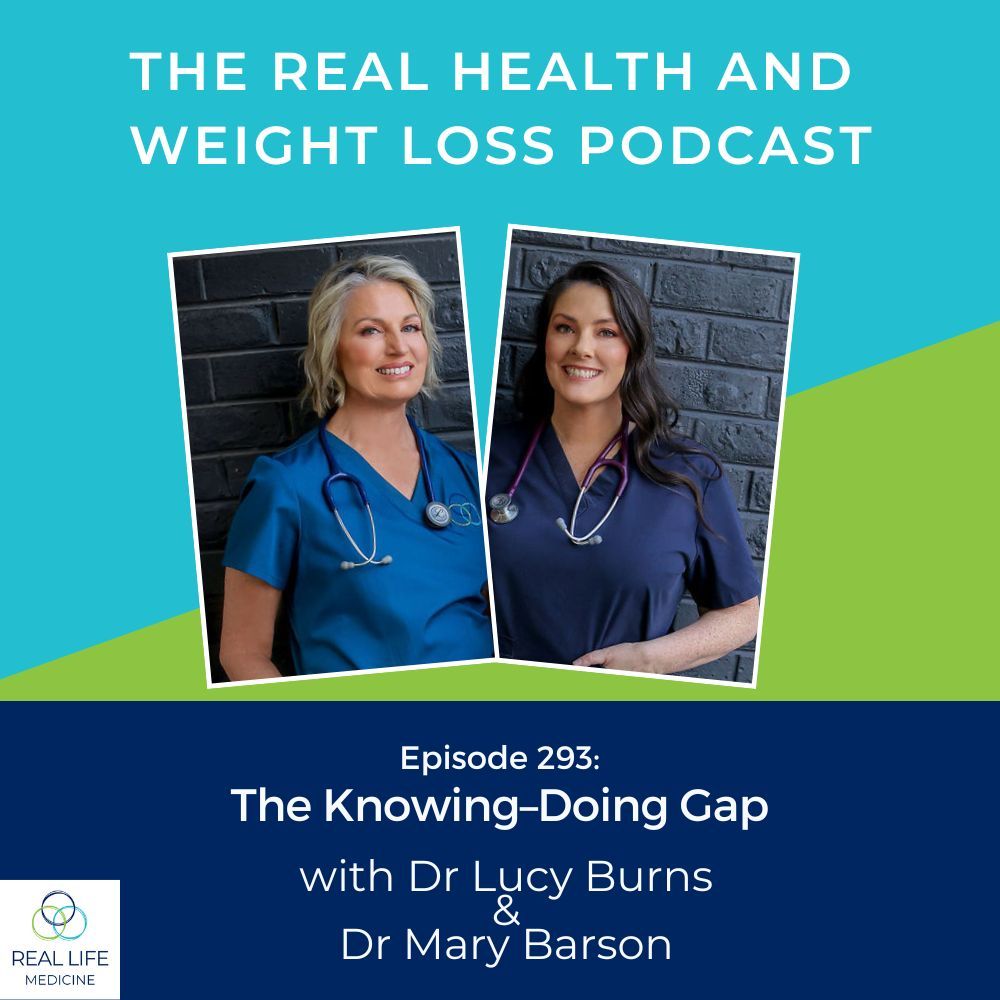

THE KNOWING–DOING GAP
One of Australia's Most Popular Podcasts with Hundreds of 5 Star Reviews

Grab your FREE Ebook copy now!
Have you struggled to lose weight and keep it off?
Start your journey to boost metabolism and transform your body into a fat-burning powerhouse.
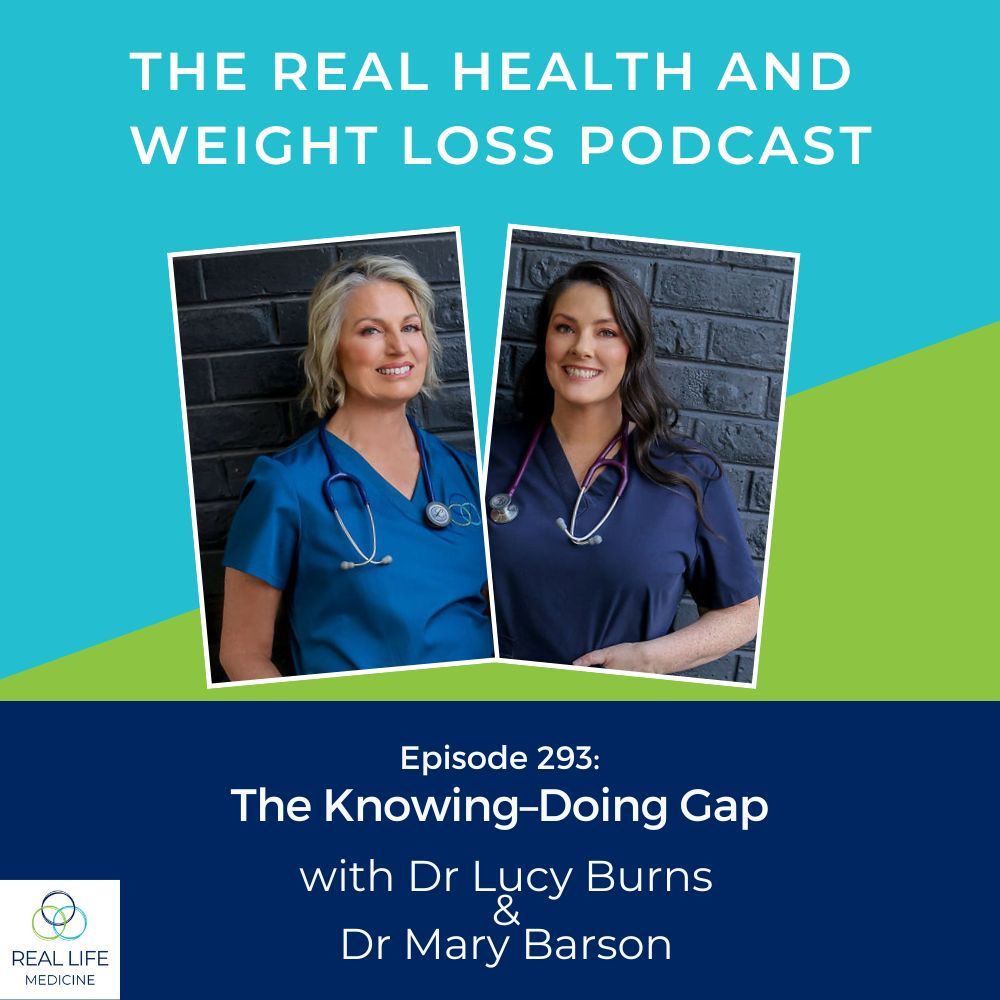
Episode 293:
Show Notes
The Knowing-Doing Gap
This podcast episode addresses one of the most common challenges people face: knowing what they should do for their health but being unable to follow through. Drs. Mary Barson and Lucy Burns explain that this "knowing-doing gap" is not about willpower, weakness, or laziness—it's about lacking the right tools and understanding.
Why the Knowing-Doing Gap Exists
Overwhelm and Survival Mode
When life becomes stressful, the brain naturally retreats to what feels safe, familiar, and predictable. Change registers as a threat, causing people to default to comfortable behaviors even when they're unhelpful. The paradox is that "normal and safe" simply means familiar—not necessarily good for you.
Decision Fatigue
People making numerous daily decisions (particularly working mothers managing kids, parents, work, and domestic life) deplete their cognitive capacity. By evening, there's no mental energy left to make another decision, leading to the path of least resistance. Additionally, having too many options creates the "tyranny of choice," making it harder to decide what to eat or do.
Feeling Overwhelmed by Requirements
The perceived need to change everything at once—eat well, prioritize protein, exercise, get sunshine, supplement correctly, sleep perfectly—feels like a full-time job. People believe they need a complete makeover or there's no point in changing anything, which paralyzes action.
Subconscious Emotional Blocks and Identity
Past identity plays a crucial role in sustainable change. The truest form of change is identity change—shifting from "I can't stick to it" to "I am someone who eats well". On stressful days, people revert to behaviors aligned with their current identity.
What Doesn't Work
"A good kick up the pants" doesn't solve the knowing-doing gap. Self-criticism and harsh motivation may seem tempting but are ineffective for long-term health changes.
Waiting for motivation is passive and unreliable because motivation is an emotion that comes and goes. While motivation can amplify existing actions, you can't depend on it for consistency.
What Actually Works
Small Steps
Small, sustainable changes compound quickly and lead to dramatic results in short periods. The brain often resists small steps as "not big enough," but they're far more effective than attempting massive overhauls. Using the ladder analogy: closely-spaced rungs allow you to climb quickly, while widely-spaced rungs leave you stuck at the bottom.
Curiosity and Barrier Identification
Ask yourself with compassion (not judgment): "What is actually stopping me?". Dr. Lucy shares her example of struggling to get morning sunlight: what seemed simple revealed multiple barriers (mobility challenges, spilling coffee, lacking proper equipment) that required specific solutions. Problem-solving these barriers one by one made the behavior sustainable.
Make the Right Thing Easy
- Make cues for helpful behaviors obvious
- Remove cues for unhelpful behaviors
- Reduce available choices to minimize cognitive load
- Sometimes temporarily remove tempting items entirely to create a circuit breaker
Build Identity Through Consistency
Repeated healthy choices gradually shift your identity from someone who "tries to eat well" to someone who "eats well". This identity change becomes your default, especially on difficult days.
Patience and "All or Something"
Replace "all or nothing" thinking with "all or something". Define the minimum steps you'll take on unmotivated days, then do more when motivation is present. This requires patience to trust that small steps are the solution, despite conditioning to believe in "harder, faster, stronger" approaches.
Key Takeaway
Closing the knowing-doing gap requires skills and support, not willpower. Success comes from understanding your barriers, troubleshooting with compassion, making helpful behaviors easier than unhelpful ones, and building new habits through small, consistent steps that create lasting identity change.
Our My Metabolic Action Plan (MyMAP) is your chance to finally turn knowing into doing — build real health and lasting weight loss. Program starts February 14 — enrol now before the bonuses disappear in 2 days! 👉 www.rlmedicine.com/map
Episode 293:
Transcript
Dr Mary Barson (0:04) Hello, my lovely friends. I am Dr Mary Barson.
Dr Lucy Burns (0:09) And I'm Dr Lucy Burns. We are doctors and weight management and metabolic health experts.
Both (0:16) And this is the Real Health and Weight Loss podcast!
Dr Mary Barson (00:21) Hello lovely friend, Dr Mary here from Real Life Medicine joined by my lovely doctor colleague Dr Lucy.
Dr Lucy Burns (00:30) How are you lovely one? I am really good and if anyone is watching any clips of this you'll see I've got my flick back hair because I've just got out of the pool having done my early morning swim. So you know, just polishing my halo and reminding myself what an awesome job I'm doing.
Dr Mary Barson (00:46) I think that's very, very sensible that celebrating your progress is a key part to being able to continue progressing well, so yay for you Lucy.
Dr Lucy Burns (00:57) Oh thank you, thank you, yes I think you're right. Most people, including us, are not very good at celebrating. It feels sometimes, you know, like oh wow, well you woohoo, you want a reward for, you know, moving your body, and the answer is yes, I do. I do want a reward for moving my body.
Dr Mary Barson (01:15) Yes, as you should, as you most definitely should. So today we're talking about a big topic. I reckon it's something that I get asked possibly more than anything else. I get told, actually I get told this Dr Mary, I know what I should be doing, I just can't seem to do it. As the knowing-doing gap, and I think people often fall into this big chasm of shame because they feel like just because they know what they should be doing means that they're useless and weak-willed and lazy and slothful and just greedy if they're not doing it, and I think this is where people come unstuck probably the most often. So today we're going to talk about the knowing-doing gap.
Dr Lucy Burns (02:03) Absolutely, and I think a lot of people's response to the knowing-doing gap is to tell themselves or to tell me or you, I just need a good kick up the pants, and if you've ever said that to yourself or ever told somebody else, I mean, we're going to explain to you today why that solution seems tempting, but why it doesn't actually work, why that response doesn't help you, and we will tell you what will help.
Dr Mary Barson (02:30) Absolutely we don't need to get out the big whip. What people need is a few more tools and a little bit more understanding. So I don't think we necessarily need to define what the gap is. I think most people would know what it is — it's this frustrating space between, you know, what you feel like you should be doing and what it is that you're actually doing day to day. Yes, absolutely. We should talk about some of the reasons why people get stuck in this gap, this knowing-doing gap. Yeah. I think one of the biggest reasons is overwhelm, especially if our brains get stuck in survival mode because life is stressful, life is hard. There might be extra things going on, extra responsibilities being thrown around. Our brain will just naturally want to retreat back into what feels safe and what feels comfortable. And safe means familiar, it means predictable, it means low effort, and so our brains will be less willing to try new things, less willing to take a risk. You know that trying something new has a little flavor of risk, of failure, and that is one reason. I think sometimes it is simple overwhelm. It's definitely not the only reason, but it is a big reason. And when we're in this state, our brains can really register change as a threat, and threats are scary. And so we retreat back into what's normal and safe.
Dr Lucy Burns (04:07) And the tricky thing is that what is normal and safe doesn't actually mean good for you. That's the paradox of the whole thing. Normal and safe means familiar to you, so what you've done in the past, whether it's good for you or not, is familiar, and that's what your brain will do when it's overwhelmed. Which is why if you've spent many years, like I certainly used to do, sitting on the couch watching telly at 11 o'clock at night saying, "Go to bed, go to bed," but not going to bed — that's where I always go. So weird, but I always go there when I'm overwhelmed, when I'm stressed, and even now it's the default mechanism. And so I have to be really conscious of this behavior, recognising that this is like a barometer. When I'm staying up late watching whatever on telly, or even scrolling on my phone, and I'm not going to bed, that's like a little warning bell to me: "Okay Lucy, what's going on for you? Not 'God Lucy, go to bed, you idiot,'" which Is what I used to say. Now it's, "What's going on for you?"
Dr Mary Barson (05:18)
That's right. Being curious and trying to figure out why. Why are you in this overwhelm? What can be done about it? Even just giving yourself a bit of understanding and a little bit of kindness, even just seeing yourself, it can help you feel better.
Dr Lucy Burns (05:35) Absolutely. And as part of overwhelm, I think, you know, the next reason we see a lot is decision fatigue. So decision fatigue comes up in sort of two ways. One, it can be for people who bear a large cognitive load, and you know, that is often women, particularly moms, who are working, managing kids, parents, workplaces, and domestic life. There's a lot of decisions that get made every day, and by five o'clock, you've just run out of capacity and you're just too tired to make another decision. So you just again default to what is easy or familiar, the path of least resistance. Your resolve is all just, you know, dwindled away.
Dr Mary Barson (06:28) Yep. And deciding not to decide is, of course, a decision. But moving into that default state of whatever it is — takeaway, toast, nuggets, and chips — yeah, it can feel like the easy option, and it can feel like the way that our brain wants to go. Even though, as you may be sitting there eating the nuggets and chips, you're just filled with this frustration: "Why am I doing this? This is not what I want to do." But there are reasons why this is happening, and there are things you can do to help overcome this, but we need to understand what is going on for us, I think that's very, very important.
Dr Lucy Burns (07:07) Absolutely. And the other, I guess, then I was just going to extrapolate, I guess, on these two — those two points of overwhelm and decision fatigue — is the sort of third point, which we've spoken about before, which is when you've actually got too much choice, the tyranny of too many options. So you open the fridge and you can see you've bought all the veggies, you've got all the stuff there, and you just look and you can't quite decide what to eat. It's like going into your wardrobe, you can't decide what to wear, going to the video shop in the olden days, you can't decide what to watch, aka Netflix now — it's too many options. And again, so it's like another decision. Whereas when you limit the choices, it's actually easier. So easy.When you've got fewer options,
Dr Mary Barson (08:01) , you take it off your cognitive load. It is extremely important because our cognitive load is finite. We do not have the capacity to hold things, to remember things, to choose things. So cutting down your available choices is extremely helpful. Yeah, absolutely. I always make the same dinner for my kids on busy days. It's always the same and they don't even seem to notice or care. I make a pre-cooked grilled chicken with cut-up cucumbers, cut-up tomatoes, maybe some cut-up carrot, and that's it. And that's just like, when I can't decide or I can't think what to do, I just do that. And I reckon they eat that three times a week and they don't seem to care, and it just makes my life easier.
Dr Lucy Burns (08:50) Absolutely, absolutely. I mean, it's really interesting. For many of us, you know, we had the same breakfast cereal day in, day out. You just kind of got out of bed, put the kettle on, poured the cereal — there was no decision. You just did it. It's so interesting how we can limit decisions and it doesn't feel like restriction, it's just what you do. Totally. One of the other reasons that we find people struggle with the knowing-doing gap, and it's a little bit like the overwhelm, is that they feel like there's so much to do. You know, they've got to eat well, prioritise protein, eat low carb, get sunshine, do a cold plunge, do a hot spa, have your creatine, don't forget your vitamin D, what about the omega-3s, go to bed on time, get up early, sleep well, don't sleep too much, don't sleep too little — like, it's like, oh my god! It's a full-time job looking after yourself. So people don't always know where to start, and they feel like they need an entire makeover, that whole "I just need to run away to a deserted island and get off the life train so I can focus on myself." That's it.
Dr Mary Barson (10:08) I need to like just be able to drop everything and change everything at once, or there's no point in changing anything. And most of us mere mortals aren't able to completely change the way that we shop, cook, feed our family, move our body, sleep all at once. That's usually not really possible. But we don't need to, to make useful, meaningful change. That isn't necessary. But it's often the story the brain — a story our brain will tell us. And the stories our brain tells us are extremely important. They play a really big role.
Dr Lucy Burns (10:44) They play a really big role. Yes. And they lead us, I guess, to our next reason, which can be subconscious emotional blocks and past identity. And this will be one of the things that online trainers on Instagram will not talk about, because they don't know about it. It's part of it, and they will just tell you what to do without helping you understand why you can't or why that feels hard for you when it seems so easy. And we spend a lot of time helping people unpack emotional blocks and looking at their past identities as well.
Dr Mary Barson (11:31) And I think identity is such a key issue here. The truest form of change, the truest, most sustainable type of change, is that identity change. And it doesn't happen straight away. We need to make it easy for ourselves, set ourselves up for success, and start to get a few sort of wins on the board. You know, the more that we make those healthy eating choices, the more our identity changes into "I am someone who eats well," rather than, "Oh, I just can't stick to it," or "I need my lollies." These are those little stories we tell ourselves. It's actually how we view ourselves — that is our identity. And they're powerful. On our worst, most stressful day, we will generally revert back to what our identity tells us we are. And we can change our identity, but it takes a little bit of time, and we need to give ourselves grace there, but also allow ourselves to be consistent as well.
Dr Lucy Burns (12:26) Absolutely. The one thing that people think they need is more motivation, and I get that. It does seem like, you think, “Right, well, I need motivation to change.” And if you’re anything like me, I just used to wait quite passively for motivation and inspiration to just sort of descend upon me like some, you know, lightning bolt from the Lord above. “Right now, I’m ready to go.” And I used to say to myself, “Oh, I’m just waiting for the switch to flick.” I just had no understanding of what made that switch flick, or what I was actually waiting for. I just was waiting.
Dr Mary Barson (13:09) Motivation is extremely helpful — like, don’t get me wrong — it’s just not particularly helpful for long-term health and wellness. Motivation is great to, you know, get you to sit down and cram for the exam tomorrow. It’s great to make an unfit person run 1,500 meters in the airport to catch the plane as they’re calling their name over the loudspeaker. But it’s not going to make that same person go, you know, for a jog every day. We can’t rely on motivation because it’s an emotion, and emotions don’t last. All emotions come and go. You feel happy for a while, then you don’t. You feel sad for a while, then you don’t. You feel motivated for a while, then you don’t. But the good news is we don’t need to rely on motivation when you can set yourself up right. Motivation can come and go; you can ride it when it’s there and love it and find it very helpful, but you don’t need it when it’s not there.
Dr Lucy Burns (14:01) Absolutely. And I think that’s a great way to look at it. Motivation is like an amplifier for what you’re already doing. So if you’ve got the steps you take on your least motivating days, then you just do them regardless. And then on days where you feel more motivated, you can do bigger things or more things if you want to. And so that then takes away the all-or-nothing trap and turns it into the all-or-something phenomenon.
Dr Mary Barson (14:33) That’s right. All-or-something is definitely what we need. It’s about small steps. And our brains can sometimes hate the concept of small steps. You think about, “I just need to change my health. I’m pre-diabetic. I’m overweight. I hate where I am. Everything’s got to change.” And then someone like you or me comes along and says, “We can help you change. Let’s start small. Let’s start really, really, really small. Let’s just think of the smallest little step, so small your brain can’t argue with it.” Your brain will definitely want to argue with it. It’ll say, “That’s not big enough. That’s not going to do anything. Why? That’s why would I do that? I’m not doing that. Totally, I need to overhaul everything by this afternoon. Come on!” But small steps do work, and they compound really quickly — far more quickly than compound interest in the bank. They compound quickly to quite dramatic change in quite short periods of time if you can embrace them.
Dr Lucy Burns (14:01) And I would say that the number one thing the small steps need is actually patience — from our brain to recognize that this is the solution, this is the way forward, this is the thing that will help. But it’s tricky because we’ve been conditioned to believe that we need to go harder, faster, stronger, and we’ll get there quicker.
Dr Mary Barson (16:03) That image of someone, two ladders reaching up into the clouds, and the lofty heights is your goal: one ladder has lots of little runs, all really close together, and the person can just scurry up those tiny little runs one at a time. And it’s halfway up to the clouds before the other person is like, “No, I need to make big change,” and the rungs of the ladder are really, really far apart, and they’re jumping as hard as they can to try and reach the first one. The other person has got up the ladder before they’ve even made it onto the first rung. Little changes work — absolutely.
Dr Lucy Burns (16:42) Absolutely. The other thing I think people need to get help with is understanding their barriers to change. Sometimes what seems like a simple step — your brain is saying, “Well, this is a little step and I still can’t even do this. I am really useless” — is then going, “Okay, well, if it’s such a… then what is my barrier here? What is the reason?” And you do it, you know, kindly and with some compassion, not yelling at yourself, because that doesn’t work. But you ask yourself, “What is the actual reason here that I’m not doing the thing I want to be doing?” Curiosity, as we’ve spoken about many times, is the key to personal development. Sometimes you need to map this out with a friend, it might be a therapist, might be a counselor, might be in our coaching calls, might be in a journal. Getting out of your head and into a bit of clear space can be really useful. But it’s unpacking this, unlayering, unwrapping all of these things rather than just saying to yourself, “Well, just do it,” because that’s a good slogan — Nike — but it doesn’t always work, especially not in this domain. No, I’ll give you a little example. I did a little reel the other day on Instagram — if any of you are listening to our podcast and don’t follow us on Instagram, just head over to Real Life Medicine because we post there quite often. I was telling a story about the early morning sunshine. So, you know, we’ve spoken many times about getting sunlight into your eyeballs in the morning. It’s seemingly easy — we’re getting out of bed, we’re making a coffee, and the next step is to take that coffee outside. That is pretty easy, and I had trouble doing it. I had to unpack why. So I’ll quickly run through the steps in my mind. First step: “Right, go outside.” Okay, that’s easy. Well, and again, many of you know, now I’ve got muscular dystrophy, and mobility is actually not that easy for me. So the thing I was telling my brain: “It’s easy, go outside, do it.” Well, my other part of my brain was going, “Yeah, well, it’s not that easy. You fell over last year hopping outside, so I don’t really want you to go outside. It’s not very safe.” There’s that word. So then I thought, “Okay, right, use your scooter, Lucy. You’ve got a scooter, go outside with the scooter.” My other part of my brain goes, “Yeah, good idea. Alright, so we’ll do that.” Then I thought, “Okay, I’ll do that.” Well, as I’m trying to get out the door, there’s a step. I’m clunking down the step — my coffee’s going everywhere. I said, “This is rubbish, I don’t want to do this.” So we put a little wedge in for the step to make it into a ramp. Great, this will be perfect, no problem. Still, scoot down even with a ramp — I’m still spilling my coffee. Plump, plump, plump. And then my brain’s going, “Well, you could go outside without the coffee.” And there’s this little chat — I’m sure all of you do this. And then the other part of my brain goes, “Well, why would you want to go outside without a coffee? I mean, honestly, coffee is lovely. You might as well take it with you.” Oh, all right. Then I thought, “Well, I need to put the coffee into the little trolley of my scooter so I’m not holding it. It needs a lid.” So a few keep cups later — the first keep cup fell over and spilled everywhere. The second keep cup I found had a great lid and a good seal, so I was able to put it in, take it outside, pop it onto my table, and sit outside. So all of this troubleshooting has now meant that I can go, “Right, this is my new routine. I get up, make the coffee into the fancy keep cup, scoot outside, and sit.” I’ve got a little table out there. I sit for 10 minutes, getting my morning sunlight and drinking my coffee. It’s amazing, isn’t it, that something that could go from not doing to doing took a number of steps and some actual breaking down? But I tell you what didn’t work: just me telling myself, “Oh, for God’s sake, Lucy, get outside. It’s not that hard. What are you carrying on for? Just do it, really, come on.” That didn’t work.
Dr Mary Barson (21:09) Self-beration really doesn’t. That’s a beautiful example of how you broke it down — there were emotional blocks as well as physical blocks. You recognized them, thought about them, problem-solved them, and came up with a solution. And I think for many of us, our barriers are going to be more subtle than the ones you had to overcome to have your coffee outside in the morning, but the process is the same. It’s still just getting curious and asking yourself, “Why am I having the toast with cream cheese and honey every morning? This is not what I want to do. I’ve got my little breakfast muffins. I’ve got bacon and eggs. I’ve got ingredients for hemp seed porridge.” And yet, I’m still doing this. Just asking yourself “why,” being curious, and then without self-judgment trying to experiment with different solutions — and experimenting is the key. You might not get it right the first time; that doesn’t mean the process is useless. You might have to keep trying..
Dr Lucy Burns (22:16) Absolutely. We talk a lot about making the right thing easy and the helpful thing easy, and the unhelpful thing hard. So, you know, to borrow from James Clear: make the cue for the helpful behavior obvious and remove cues for unhelpful behavior. So even in something like the toast with cream cheese and honey, it may be initially that you need to not have those products available to you. That doesn’t mean you have to never have them in the house again, ever. But sometimes, just to put a circuit breaker in, you remove them at the first instance. Make the unhelpful thing harder and the helpful thing — whatever it is that you want to do — easier. Small steps, troubleshooting, small steps are so much easier than ginormous overhauls. When you get the small steps nailed — when you unpack your barriers, make the cue easier, make the right thing helpful, the unhelpful thing less obvious — that becomes cemented into your routine. You do it without even realizing it. That, technically, is what a habit is: an unconscious or subconscious behavior. It becomes part of your subconscious behavior, which is what we want.
Dr Mary Barson (23:47) And if you do that for a little while, your brain starts to learn, “Ah, I am someone who eats a healthy breakfast. I am someone who eats a healthy breakfast.” Hey, I’m still eating a healthy breakfast. And then all of a sudden, you become a person who eats a healthy breakfast, and that becomes your default. The truest type of change is identity change, and breakfast is just one example. We can get that true identity change in all areas of life where we want to make meaningful changes for ourselves. So the knowing–doing gap — it’s definitely not your fault. It’s not about willpower, motivation, being weak, or being useless. It really is about skills and support, I would say.
Dr Lucy Burns (24:37) You know, identifying the issue, breaking the barriers down again — we use small steps to do the helpful thing. You can break barriers into small steps, identify all the components of the barriers, and just keep chipping away at them until suddenly there are no more barriers and you go, “Okay, this is easy.” Getting really granular and specific rather than just saying, “I need a kick up the pants,” because I can tell you now, that will…Not work.
Dr Mary Barson (25:13) No, definitely not in the long term. With our new revamp program launching now, My Metabolic Action Plan, we help people get really specific on their goals. We really help people close that gap for good. The knowing–doing gap is closed so it can be easy. We focus very heavily on implementation. It’s definitely not just about learning — it’s about doing. If you want to check out more, go to the link in the show notes or visit rlmedicine.com/map for more details.
Dr Lucy Burns (25:56) Indeed, indeed. Turn that knowing into doing. Knowledge is great — you need the right knowledge — but you actually need to implement it. Alright, lovelies, we will talk to you next week. Take good care of your beautiful selves.
Dr Lucy Burns (26:14) The information shared on the Real Health and Weight Loss Podcast, including show notes and links, provides general information only. It is not a substitute, nor is it intended to provide individualised medical advice, diagnosis or treatment, nor can it be construed as such. Please consult your doctor for any medical concerns.