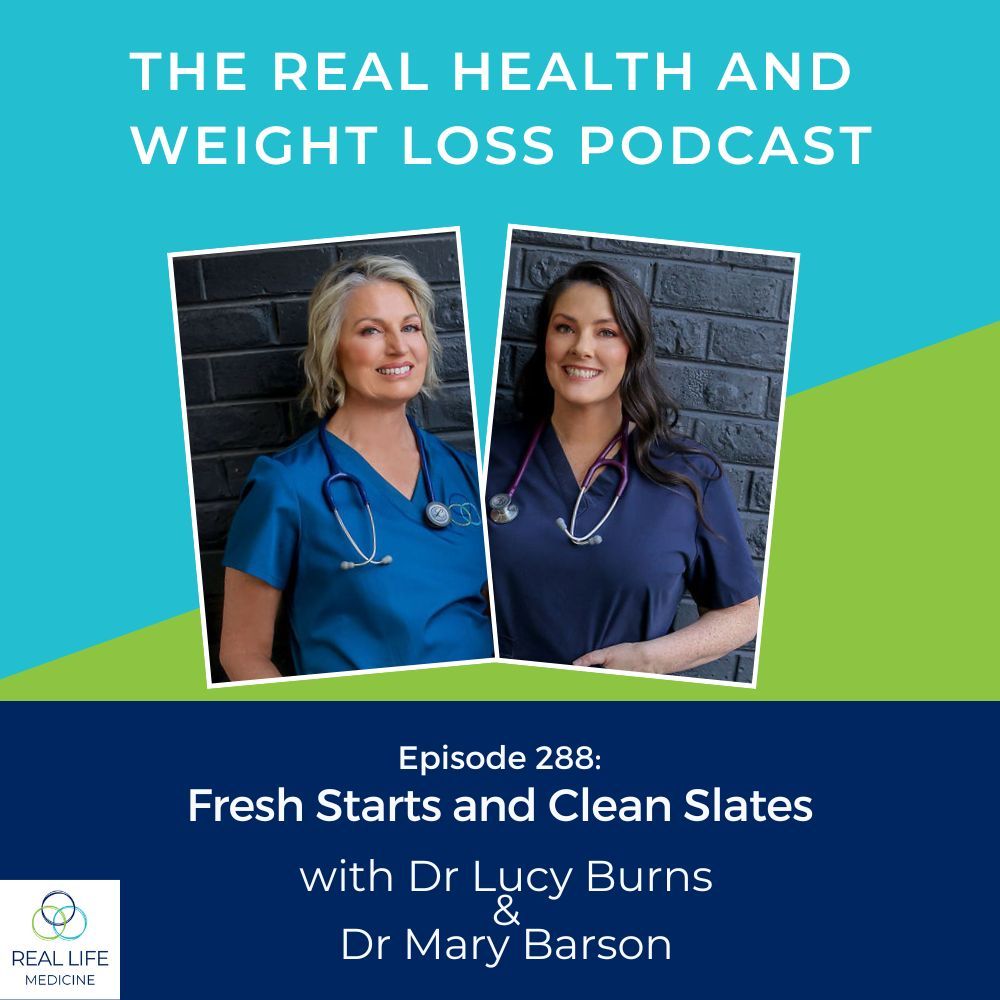

FRESH STARTS AND CLEAN SLATES
One of Australia's Most Popular Podcasts with Hundreds of 5 Star Reviews


Grab your FREE Ebook copy now!
Have you struggled to lose weight and keep it off?
Start your journey to boost metabolism and transform your body into a fat-burning powerhouse.
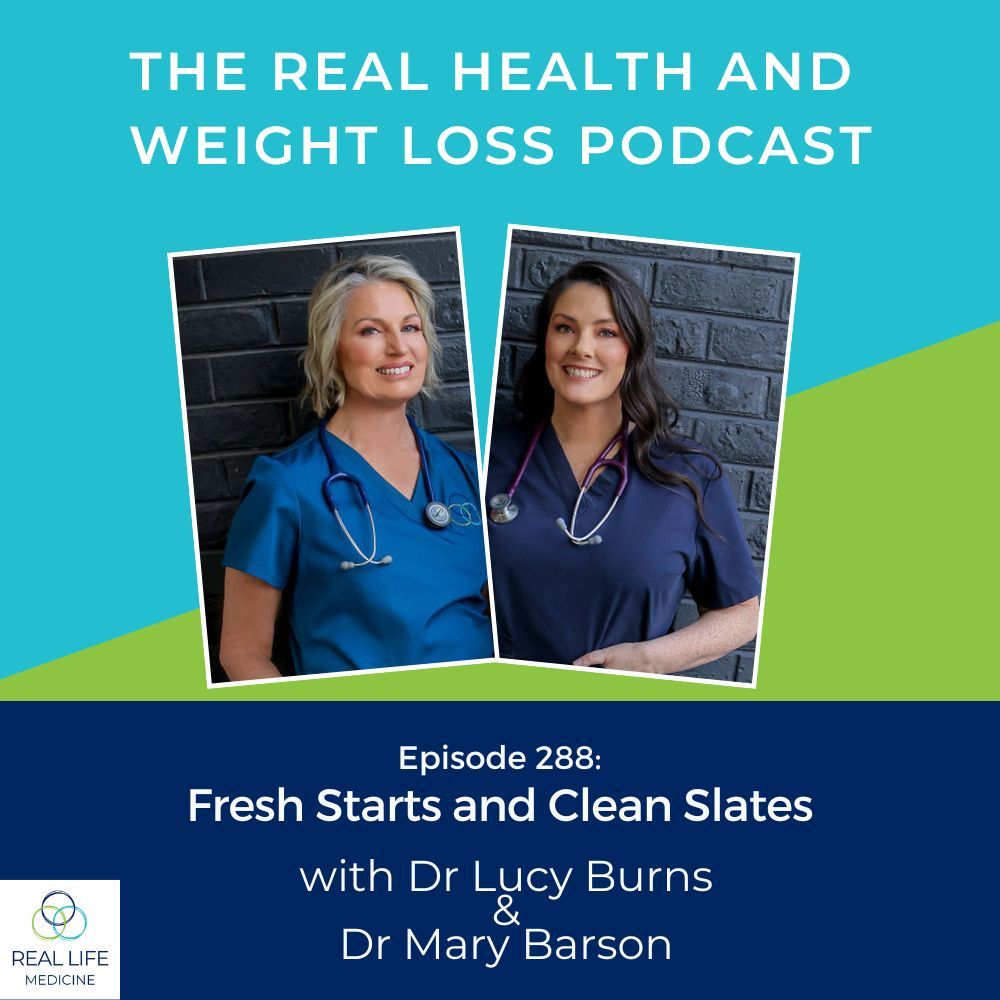
Episode 288:
Show Notes
The episode focuses on using the New Year as a gentle reset to shift from shame-based resolutions toward identity, progress, and self-compassion so that behaviour change actually sticks.
Dr Mary and Dr Lucy explore why most New Year’s resolutions fail and suggest replacing rigid, outcome-focused goals with identity-based habits, focusing on “the gain not the gap,” using micro clean slates, and seeing your health journey as a flexible, all‑terrain vehicle you are always driving and can steer back on track at any moment.
- New Year’s resolutions often fail
- Around 80% of New Year’s resolutions are abandoned by February, largely because they are perfectionistic, rigid, and shame-based.
- Focusing on a “perfect” future version of yourself implies current you is not okay, which fuels all‑or‑nothing thinking and giving up after slips.
- Shift from outcome to identity
- Instead of “I will lose weight” or “I will get stronger,” reframe as “I will become a person who looks after my body and mind.”
- Identity- and behaviour-based goals reduce pressure and make daily actions more sustainable than chasing a single end result.
- The gap vs the gain
- “Gap” = focusing on what you haven’t achieved, how far you are from your ideal, and everything that is missing, which breeds shame and stuckness.
- “Gain” = deliberately noticing how far you’ve already come, what you’ve learned, and the progress you’ve made (e.g., going from no running to completing 5K, 10K, or a half marathon), which is more motivating and empowering.
- Physiological impact of where you focus
- Focusing on the gap activates the fight‑or‑flight response, making the body feel unsafe and making change harder.
- Focusing on the gain calms the nervous system, shifts brain chemistry and hormones toward safety, and builds courage, confidence, and willingness to keep practising new behaviours.
- Self‑reflection with compassion (SLC)
- Use SLC: self‑reflection, learning, compassion, when things don’t go to plan (e.g., injury, not hitting a goal).
- Ask kind, practical questions like “What am I learning here?”, “How can I do it differently?”, “What do I need?” instead of “I’m a failure,” so you can adjust your plan and keep going.
- Clean slate and “micro” clean slates
- The brain loves the idea of a fresh start (New Year, Mondays, “start tomorrow”), but this timing is a psychological construct, not a biological need.
- You can create “micro clean slates” at any moment—next bite, after an email, after a lapse—and simply begin again, using what you’ve already learned rather than “starting from scratch.”
- Celebrating gains without losing momentum
- Some people fear that acknowledging progress will make them relax too much or “take their foot off the pedal.”
- You remain in charge of how you celebrate and reward yourself; you can appreciate your gains without abandoning the behaviours that created them.
- The 4WD health journey analogy
- Health is not a fragile train or wagon you “fall off”; those metaphors are disempowering because they suggest you’re a passive passenger.
- Instead, your journey is like an all‑terrain four‑wheel drive that you control: you can steer, change gears, and get back on track as many times a day as needed, regardless of obstacles or detours.
- Overall New Year approach
- Use January as a time to:
- Reflect on progress over the past year.
- Notice both the gap and the gain, while deliberately practising living in the gain.
- Set intentions or resolutions with kindness and compassion, aligned with the identity of the person you are becoming, rather than from shame or “not good enough” thinking.
Episode 288:
Transcript
Dr Mary Barson (0:04) Hello, my lovely friends. I am Dr Mary Barson.
Dr Lucy Burns (0:09) And I'm Dr Lucy Burns. We are doctors and weight management and metabolic health experts.
Both (0:16) And this is the Real Health and Weight Loss podcast!
Dr Lucy Burns (0:21) Good morning, lovely friend. How are you today? I am with the spectacular Dr Mary as we are welcoming in the new year. Happy 2026.
Dr Mary Barson (00:33) Yes, here we are again, another January. I very, very, very soon am about to head off on a big holiday. I'm going overseas for the first time in many, many, many, many, many, many years. And that'll be exciting. So actually, I probably will be already there by the time this lands. I'm going to Japan for nearly three weeks. So yes, I'll be cold, but having fun, I'm sure.
Dr Lucy Burns (01:00) Yes, of course, it's winter over there. I know. Glad I'm not going.
Dr Mary Barson (01:04) I know. It feels a bit silly leaving beautiful Australian summer. But anyway, that's when our holiday is. So, no, it'll be fun.
Dr Lucy Burns (01:11) Yes, that'll be. And a great experience, you know, trying new things, new culture, new foods.
Dr Mary Barson (01:17) New foods, absolutely. Dragging the kids around. It'll be good fun.
Dr Lucy Burns (01:22) Indeed, indeed. All right, so I thought we might, you know, do what we do every January and just start the year off thinking about, you know, goals, plans, intentions, resolutions, whatever words lands with you. And, you know, with the sobering fact that the majority of goals, plans, intentions, resolutions are not followed through with.
Dr Mary Barson (01:46) That's right, yes. By February, 80% of New Year's resolutions have already been abandoned, which is a sad but interesting statistic to think about.
Dr Lucy Burns (01:58) Indeed, indeed. So I guess in some ways, you know, January, we could reframe it as being a time rather than to, you know, make these absolute resolute resolutions. Yes. Thinking about, you know, what are the reasons that we haven't been able to follow through in the past and how could we reframe this so that we can set ourselves up for success.
Dr Mary Barson (02:22) Absolutely. Rather than just burdening ourselves with extra pressure and impending shame, what can we do to make it easy for ourselves so that we don't make a whole lot of resolutions that will then backfire on us badly. That's not what we want. Resolutions, I think one significant problem with New Year's resolutions is that they focus on the outcomes and, you know, future perfection, future wonderfulness and focus on the fact that current you is not okay but future you will be okay. But it's quite shame-based and it can also be a bit rigid, a bit of all-or-nothing thinking. And shame, rigidity, all-or-nothing thinking are not conducive to positive changes. So instead of making these resolutions, we want to focus more on our behaviour and our identity. So a nice little shift could be rather from, you know, I will lose weight and I will get stronger. It can become I will become a person who looks after my body and my mind.
Dr Lucy Burns (03:32) Yeah, I love that. I love that. And I think it's humans are very good at finding fault with themselves, where they need to improve, you know, and, again, there's industry, a whole industry dedicated to self-improvement and I guess, you know, on some level we are part of that industry. But the implication is that, you know, you're not good enough. And so I think it's also really helpful to introduce that concept of the gap and the gain.
Dr Mary Barson (03:59) Yes, absolutely. And I think in January most people are deeply focused on the gap. So the gap and the gain, a concept that we use in positive psychology, so the gap is where we focus on what we don't have or what we aren't or how far we are from what we think we should be. That's the gap. And you just look at, you know, what you want yourself to be like and where you are now and you just focus on this big chasm of, you know, shame and guilt and to-dos that are between here and there. But the gain is, interestingly, you could be in exactly the same position as you are right now, but if instead you're focusing on the gain, that is recognising how far you've already come. And that is a much more motivating place to plunk your mindset. And if we can focus on the gain, we're actually able to get to where we want to be faster than if we're focusing only on the gap.
Dr Lucy Burns (05:02) Indeed. Indeed. And, you know, an example might be not an example that I would ever do, but let's say you decided you wanted to run a marathon. So you're practising and you're training and you're doing all of these things focusing on running the marathon and, you know, you run the 5K and then, you know, you move up to the 10K and maybe you crack out a half marathon and then maybe you get a little bit injured and you have to, you know, reduce your training and you're planning to do the Melbourne marathon and all of a sudden it's becoming clear that you're not going to be ready and so we spend then this time on how you've, you know, not run the marathon, you've failed.
Dr Mary Barson (05:42) That's it, yes. And you've just created all this shame and pressure on yourself.
Dr Lucy Burns (05:47) And your brain can tell you what a waste of time it's all been and that, you know, you didn't achieve and, you know, why would you bother trying again? You'll probably just get injured again and it will keep you in that space of stuckedness because it's a bit scared to try again.
Dr Mary Barson (06:04) Yeah. And it makes the progress that you've made feel invisible and never enough.
Dr Lucy Burns (06:10) Yes. And progress is another word that we love focusing on in our favourite, another favourite phrase that we have of progress, not perfection.
Dr Mary Barson (06:19) Absolutely, which is absolutely focusing on the gain. And so, Lucy, with that same amazing human that's just done the half marathon but now has an injury, what would be the difference if they were then focusing on the gain?
Dr Lucy Burns (06:32) Yeah, so they could look back and think, wow, you know, six months ago I was sitting on the couch and, you know, I'd never done any running or I'd only run one kilometre or something or I was too scared to run. And now, look at me, I've done a 5K, I've, you know, competed in a 10K or I've done my own 10K run. Now I've done a half marathon and I think that if you looked at the percentage of people in the world that have done a half marathon, you would be in a pretty small category of people. So really focusing on the achievements. And, again, they can be distance. That might be part of your scale of achievement. But you may also look at the other things that you've done in that time which might be something like, wow, I got up at 5 o'clock every morning in winter to go running. That might not be the case but you know what I mean. Or it might be, wow, I'm so proud of myself. Even when it was raining, I went out on a trail run. So that you're acknowledging, I guess, that bit of grit that you've applied to your training and noticing how, you know, how much resolve you had over that time and that came from within you and you can get that whenever you want.
Dr Mary Barson (07:58) Yes, yes. And I'm really fascinated by what happens physiologically as well, by when we just focus our thoughts on two different things. So if we focus our thoughts on what we haven't done, what we've still got to achieve, all the ways in which we are still failing and that we're still falling short, we activate our fight or flight response. We don't feel safe in our bodies. And consistent behaviour change actually takes courage. And in order for us to have the courage that we need to potentially fail, to try something new, we need to feel safe. So when you focus on that gap, you're actually making it much harder for yourself physiologically to change. But when you focus on the gain and all the cool stuff you've already done, all the wonderful ways in which you've already made achievements, the ways in which you are progressing, this helps calm your central nervous system, takes you out of that fight or flight response, changes your brain chemistry, changes your neurotransmitters, changes your body hormonally into a way that when we feel safe, then it's so much easier for us to change and take risks and do the things that we need to. So it's also much healthier for our physiology and also much easier for us to be able to build confidence, skills, and have the courage to change.
Dr Lucy Burns (09:22) Absolutely, absolutely. I love that. I think when you're focusing on the gain as well, it allows you to self-reflect in a way, again, that is safe and encouraging for your brain rather than it is shameful and punitive. And maybe, and again, this isn't running a marathon case, maybe you might reflect on how to prevent injuries. Rather than going, oh, my God, I haven't done the marathon, you think, right, well, why did I get injured? Oh, maybe I need to strengthen my calf muscles. Yeah, and so you go and you make a plan to do that. And we use an acronym a lot called the SLC, and that's self-reflection learning. You do it with compassion. So, you know, and again, this is very much an activity-based example. But, yeah, you could self-reflect, why did I get injured or how come I didn't make my goal, what were the circumstances? And you're doing it kindly. You're not going, oh, my God, I'm such a loser. I never should have tried so hard. I never should have aimed so high. I was never going to achieve it. That's unhelpful. But if we can do it with compassion, then we can learn and we can make a plan to change, and we can do this with anything.
Dr Mary Barson (10:43) Absolutely anything. Any way that you want to change, in any way you want things to be different to how they are right now, you can cultivate this habit of focusing on the game. January is an interesting time because our brains really like the idea of a clean slate, and there's nothing wrong with that. We can leverage this clean slate effect, you know, that our brains love a fresh start. So we love, oh, we'll just start again on Monday. Tomorrow is a new day, and January 1st is just like the cleanest of all clean slates psychologically. But we do this with a bit of intelligence and leverage this game idea with January 1st. That can really help us. But, you know, with those little, those slips and those lapses that come along, where's other ways in which we can leverage that clean slate effect as well?
Dr Lucy Burns (11:36) Absolutely. The thing about the clean slate is it's an artificial kind of thing that we've just invented. Like, at the end of the day, the body has no idea what day of the week it is. The body has no idea what month it is or what year it is. And, in fact, the body doesn't even run. I mean, there's circadian rhythms, so there is a 24-hour thing. But there is no kind of, it's not like a bank where everything resets at the start of the next day. So there isn't really even the need to wait for the next day. That's just a construct. We can change that construct to be whatever is going to be most useful to us.
Dr Mary Barson (12:19) Yeah. And I love this idea of still using the fact that our brain loves the clean slate, but we don't have to wait until some artificial right moment. We don't have to wait until January 1st or Monday. We can introduce this idea of micro clean slates, like just at the next moment, at the next bite. As soon as you've finished this email, you're going to get up, have a drink of water, and you're just going to start again. You can change again at any moment, and you can tell yourself that little mental image, cleaning the slate, wiping it down, starting again at any time during the day. You can leverage this little trick that our brain loves.
Dr Lucy Burns (13:02) Yeah, absolutely. And the thing about starting again is you're not starting from scratch. You're starting with a whole heap of knowledge. Again, you can do a little SLC. You can do them any old time, and you go, all right, what am I learning here? How can I do it differently? What do I actually need? Like, there's so many little questions that you can ask yourself that will help you cultivate long-term change. I think something that has come up for me with people who are worried about celebrating or acknowledging their gain, they're worried that they're going to take their foot off the pedal, if you like, and they're going, oh, I don't want to get too ahead of myself or I don't want to celebrate too early. And, again, these are just little ways our brain likes to try and keep us safe. And, you know, it's worried that if you celebrate too early, somehow you'll stop doing what you're doing. So it's going, well, we're not going to celebrate. Or it's worried that if you, you know, let's say you're on a plan to change your eating and you're wanting to lose some weight and you lose a few kilos and then your brain goes, oh, good, you know, you can reward yourself now with fish and chips or something. Again, you're in charge of all of that. So you get to decide how all of that's going to look for you. It doesn't have to be. You're not a passenger on your wagon. You're not just floating down a river passively, you know, getting ginned from side to side. And we have a fabulous analogy around this whole thing about taking control. So, Miss, I don't know if you'd like to explain it, since it is your wonderful analogy.
Dr Mary Barson (14:48) Yes. So the analogy of the four-wheel drive all-terrain vehicle. This is important because, you know, our thoughts, they're not just thoughts. Our thoughts, they actually shape our actions, our habits. They actually shape our brain, and they shape our whole behaviour; therefore, they shape our whole body. And we can be in charge of our thoughts. And your health journey is within your control. And I love this analogy of the all-terrain four-wheel drive vehicle. You'll hear people say, oh, you know, I've been derailed. You know, I was going fine. I was ticking along. I was doing everything perfectly. Then all of a sudden, I saw all of the leftover chocolate Santas in the tea room. My boss was being really, you know, total dick, and so I just ate all the Santas, and I've been derailed. It's just done now. I absolutely reject this analogy because your health journey isn't a train ride. It's some rigid train ride driven by a train driver that's not even you. And if something pops up on the tracks that you can't control, then you just have to give it all up. That is disempowering and not true. And also the wagon ride. We all use this analogy, oh, I fell off the wagon. This idea that your health journey is this wagon ride, I mean, pulled along by horses that you're not controlling, and then if something pops along, a big ditch in the road, something that you didn't put there, that you can then be thrown from the wagon and never, ever be able to get back on it again because, oh, I just fell off the wagon. Absolutely not. Your health journey is an all-terrain four-wheel drive vehicle that can go anywhere and handle anything. And if people throw rocks on the road, or if there are ditches, and if you get pulled off track, you can, at any moment, just change gears, pull on the steering wheel, and get back on track. And it doesn't matter if you have to do that once, twice, a million times a day, you're always in control. You are driving that all-terrain four-wheel drive vehicle, and you can drive it through January and beyond to make this year whatever you want it to be.
Dr Lucy Burns (16:54) Absolutely. And I love that, the idea that you bring yourself back on track. That is your micro clean slate all the time. You just keep turning that wheel, wiping that slate, and starting again, not from scratch but from where you are, and off you go.
Dr Mary Barson (17:10) That's right. And that is so much easier to do when you are focusing on your progress and not being perfect and letting yourself stay in that gain mindset.
Dr Lucy Burns (17:18) Absolutely, absolutely. All right, lovely friends. So New Year's, this is a good time to reflect, look at your progress, see where you've gone. Yes, you may, of course, you know, we all want to, we all come up with ways to make the next year a bit better, and that's okay as well. Again, it's not, you know, we're certainly not saying don't do resolutions. You can do, you know, you're the boss of you. But what we want to do is do them with kindness, compassion, with part of the gap and recognising the gap and the gain and how our tendency is to be in the gap, and so we actively have to be in the gain. Wonderful. Good. All right, lovelies, we'll see you next week. Bye now.
Dr Mary Barson (18:00) See you later, gorgeous people.
Dr Lucy Burns (18:05) The information shared on the Real Health and Weight Loss Podcast, including show notes and links, provides general information only. It is not a substitute, nor is it intended to provide individualised medical advice, diagnosis or treatment, nor can it be construed as such. Please consult your doctor for any medical concerns.